Agile vs. Waterfall: Is your static product roadmap costing you growth?


Every year, countless companies spend weeks—sometimes months—creating detailed product roadmaps, only to revisit the same challenges a year later. Despite careful planning, these rigid roadmaps often fail to keep up with shifting market conditions, customer needs, and technological advancements.
The issue? Static product roadmaps are built on assumptions that quickly become outdated. They lock teams into fixed plans, leaving little room for iteration or real-time adjustments. Companies that rely on these roadmaps often find themselves investing heavily in the wrong priorities, missing market shifts, or struggling to deliver features that customers actually want.
In contrast, agile product roadmaps emphasize flexibility, continuous learning, and cross-functional collaboration. By shifting to an agile approach, companies can adapt quickly, stay ahead of the competition, and drive sustained growth.
In pursuit of clarity and structure for long-term planning, many companies still rely on traditional, rigid product roadmaps. These roadmaps often take the form of multi-year release schedules, fixed milestones, and feature commitments planned far in advance. While this approach offers a sense of predictability, it can become a major liability in fast-changing markets.
Static roadmaps assume that market conditions, customer needs, and technological landscapes will remain stable—an assumption that rarely, if ever, holds true. When companies lock themselves into rigid plans, they struggle to adapt when faced with unexpected disruptions, new competition, or shifts in customer preferences. The result? Wasted resources, delayed releases, and missed opportunities for innovation.
The financial and strategic impact of static product roadmaps is significant. Studies show that companies with ineffective roadmaps often face delayed launches, misallocated budgets, and declining returns on innovation investments. A lack of adaptability can lead to missed market opportunities, low team morale, and wasted development efforts—all of which add up to substantial losses.
Today, businesses can no longer afford to treat roadmaps as fixed contracts. Instead, they need dynamic, continuously evolving strategies that enable teams to respond to real-world changes. The shift from static to agile product roadmapping isn’t just about efficiency—it’s about survival in competitive markets.
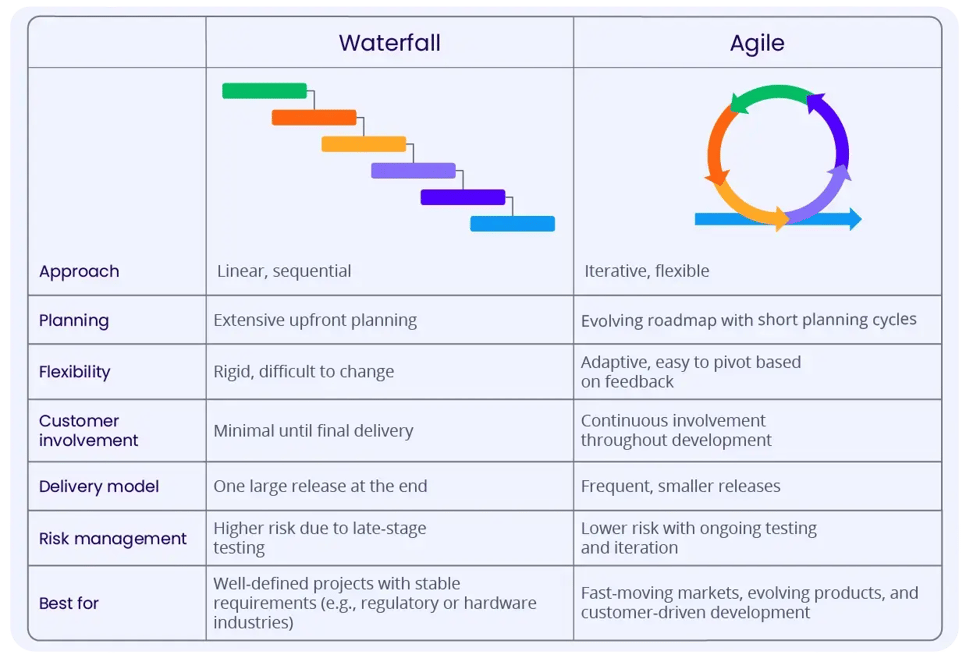
For decades, product development followed a waterfall approach—a structured, linear process where teams meticulously planned each stage before moving forward. Like an architect’s blueprint, waterfall roadmaps rely on fixed timelines, defined deliverables, and rigid milestones. In the past, this approach worked well when requirements were stable, such as in industries with regulatory constraints or hardware development, where precision was critical and changes were costly.
But as industries evolved, so did the speed of change. Customer needs, market conditions, and technological advancements began shifting too quickly for rigid roadmaps to keep up. The downside of waterfall became clear: once a project moved to the next phase, there was little room to pivot. Testing often came too late in the process, leading to expensive reworks, missed opportunities, and products that no longer met customer expectations.
Waterfall relies on predictability and upfront planning, while agile roadmapping embraces uncertainty, iteration, and continuous feedback. In fast-moving markets, where adaptability is often the difference between success and failure, agile product roadmaps offer companies a way to innovate smarter, faster, and with less risk.
Agile roadmaps aren’t just timelines with feature releases; they’re strategic tools designed to help teams navigate uncertainty, respond to market changes, and focus on what truly matters. Traditional product roadmaps often fall into the trap of over-promising and under-delivering—committing to features long before teams can validate their value. Agile roadmapping frameworks solve this by focusing on outcomes over outputs and prioritizing flexibility over fixed plans.
Imagine a product team working on a new AI-powered customer support tool. If they follow a rigid, waterfall-style roadmap, they might commit to rolling out five major features over the next 12 months—only to find that after six months, customers want something entirely different. An agile roadmap, however, would allow them to adjust course based on real feedback. Here’s how different agile frameworks can help:
Think of this as a compass rather than a calendar. Instead of locking teams into rigid deadlines, a now-next-later roadmap categorizes initiatives into three evolving buckets:
For our AI customer support team, this means that instead of committing to “automated sentiment analysis” by Q2, they can place it in the "next" category—giving them flexibility to prioritize more urgent features if customer needs change.
Rather than being feature-driven, this framework organizes work around big-picture themes that drive business goals. Instead of committing to specific features, teams define problems they want to solve or outcomes they want to achieve.
For example, instead of saying: “Build a chatbot escalation feature by September.” A theme-based roadmap would frame it as: “Improve chatbot accuracy to reduce customer frustration.”
This approach ensures that teams remain solution-agnostic and continuously iterate towards the best possible outcome—whether that involves chatbots, live agent handoffs, or something else entirely.
Companies like Google, LinkedIn, and Spotify all use OKRs (objectives and key results) to align their product development efforts with measurable business goals. This framework ensures that roadmaps are directly tied to company success metrics rather than just listing features for the sake of delivery.
For instance, instead of a vague goal like “Improve customer satisfaction,” our AI team could define:
Objective: Reduce customer support response time.
Key results:
Agile roadmaps are powerful tools for navigating uncertainty, adapting to change, and staying competitive. But simply shifting to an agile approach doesn’t guarantee success—without the right balance of flexibility, alignment, and measurable progress, teams risk losing focus, frustrating stakeholders, or falling into chaos.
While agile prioritizes adaptability, successful teams still define a clear product vision and high-level goals. The key is to avoid overcommitting to specific features while maintaining a strong strategic direction.
✅ Do: Focus on themes and outcomes rather than rigid feature lists.
❌ Don’t: Treat an agile roadmap as a constantly shifting backlog with no long-term priorities.
For example, instead of committing to “Launch AI-powered search by Q3”, an agile roadmap might set a broader objective: “Enhance search functionality to reduce time-to-answer by 30%”. This keeps teams aligned on impact while allowing for flexible execution.
One of the biggest challenges in agile roadmapping is managing stakeholder expectations. Executives, investors, and cross-functional teams often want hard deadlines—but agile thrives on adaptability. The solution? Transparent communication and regular roadmap updates.
By reframing discussions around business impact and priorities, rather than exact delivery dates, teams reduce friction while maintaining strategic focus.
Since agile roadmaps aren’t tied to fixed releases, success must be measured differently. Instead of tracking feature completion rates, focus on metrics that reflect customer impact, product adoption, and team efficiency:
Tracking these ensures that agile roadmaps drive real value rather than just shipping features for the sake of it.
Even with the best intentions, agile roadmaps can fail. Common mistakes include:
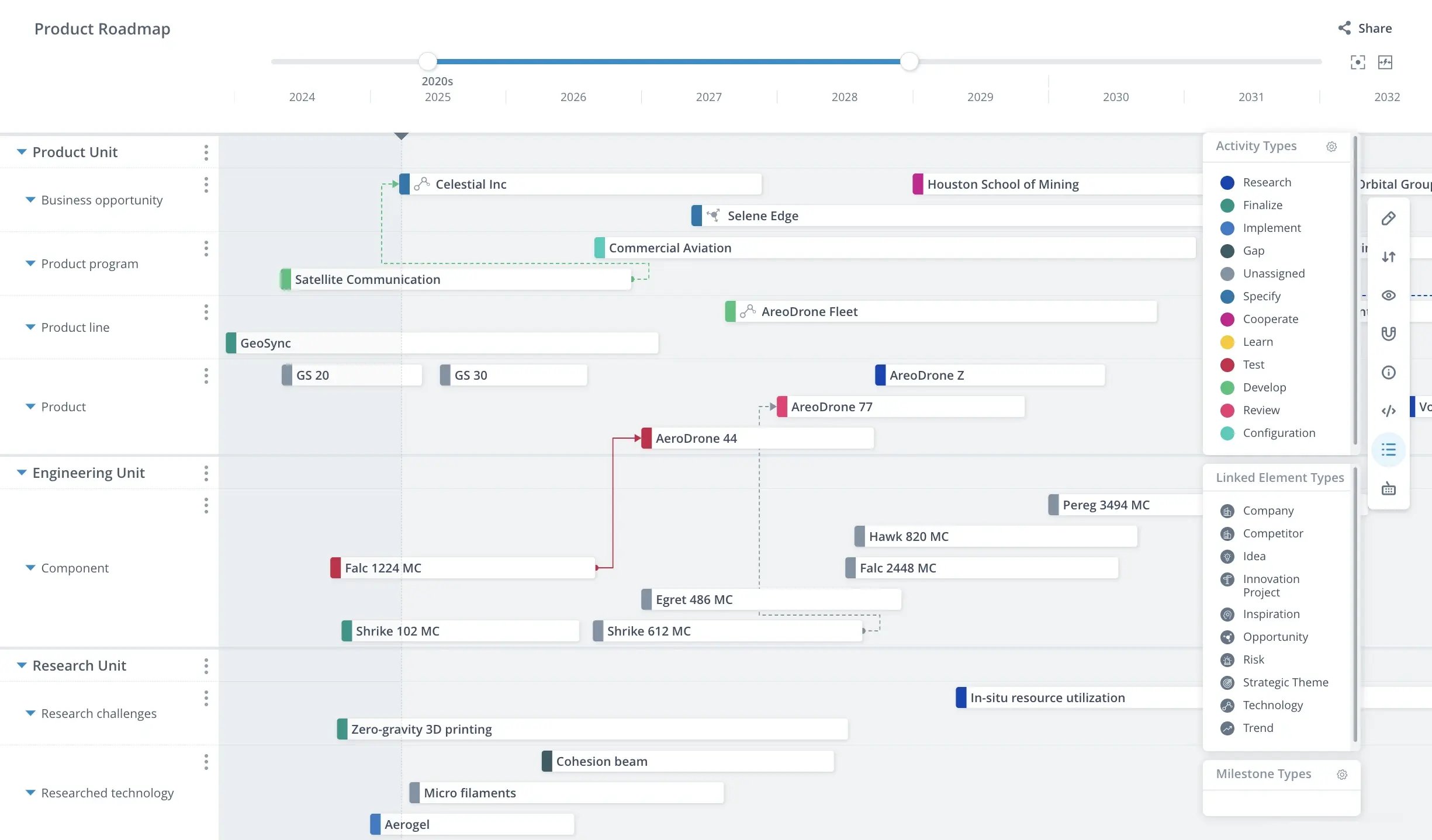
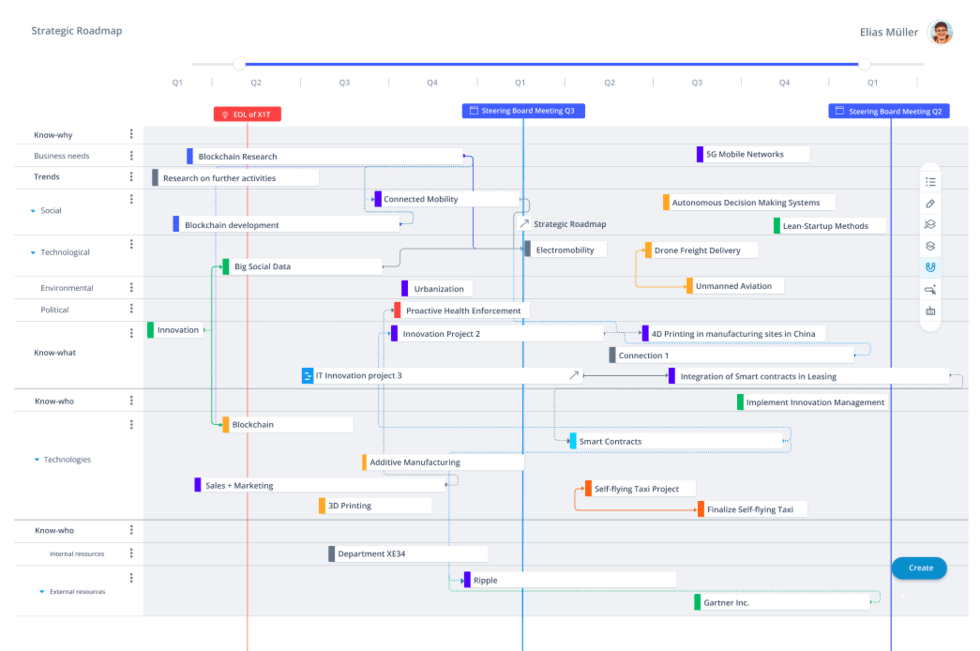
ITONICS Roadmap helps overcome these challenges by providing a structured yet flexible framework for product planning. It enables teams to visually map dependencies, track progress in real-time, and integrate customer insights—ensuring that roadmaps remain both adaptable and strategically aligned. With collaborative features and data-driven decision-making tools, ITONICS supports sustainable growth by keeping agile roadmaps focused, transparent, and outcome-driven.


.webp?width=900&height=450&name=Top-10-project-portfolio-software-tech-and-development-teams-use-for-managing-innovation-projects-fullwidth%20(1).webp)