The ideabox is not dead. Your idea management process might be.


Most organizations running idea boxes are measuring the wrong thing. Participation rates. Entry counts. Campaign reach. None of that captures whether the program succeeds.
The number that matters is implementation rate: the percentage of ideas that become funded projects, new products, or process improvements the business can point to.
For most programs, that number stays low. Not because employees stopped contributing. Because the idea management process behind the suggestion box was designed to collect ideas.
The argument in this piece is that most digital idea box failures share the same root cause: evaluation is structurally separated from budget authority.
Siemens Energy and La Poste closed that gap deliberately, building systems that connect idea management to business decisions already in motion. The five structural choices that made this possible are laid out in the second half of this piece.
| Structural decision | What | Why | How |
| Decision authority | Assign someone with resource authority to every evaluation panel. | Without a decision-maker, evaluation produces rankings, not commitments. This is the most essential step. | Name the decision-maker per track before the challenge opens. They must commit budget or team time, not just flag potential. |
| Criteria before opening | Publish what makes an idea worth pursuing before contributors submit. | Open challenges produce volume, not quality. Criteria align contributor effort to priorities from the start. | Define the business challenge, scoring rubric, and evaluation dimensions. Share publicly at launch. |
| Cross-functional panels | Include product, operations, and business unit leads alongside the innovation function. | Single-team review creates single blind spots. Disruptive ideas get filtered before they reach the right people. | Build panels of 3 to 5 people. Together they identify what a single function would miss. One member must have resource authority. |
| Documented outcomes | Return a decision and reason to every contributor, not just winners. | Silent rejection kills future participation. The feedback loop is what builds a contribution culture. | Template a short note: outcome plus one reason. Return within two weeks of evaluation closing. |
| Company planning alignment | Connect ideabox outputs to the cycles where real resource decisions happen. | A standalone innovation track gets ignored when budgets are set. | Assign a liaison to quarterly planning. Include top-ranked ideas in portfolio and partnership reviews. |
Exhibit 1: The five structural decisions of working idea management programs
Most senior innovation leaders have run dozens of ideation campaigns. The diagnosis when they stall tends to focus on culture: low contribution rates, weak leadership support, and teams that don't believe their ideas matter.
These factors are real. But the structural problem usually comes first.
When idea management is built for employee retention rather than for business impact, the consequences for trust follow. Teams quickly identify that contributing ideas delivers no business value for them. They focus their effort elsewhere. Leaders see low numbers and often attribute them to the idea managers.
Fixing culture without fixing structure produces a more expensive version of the same failed program.
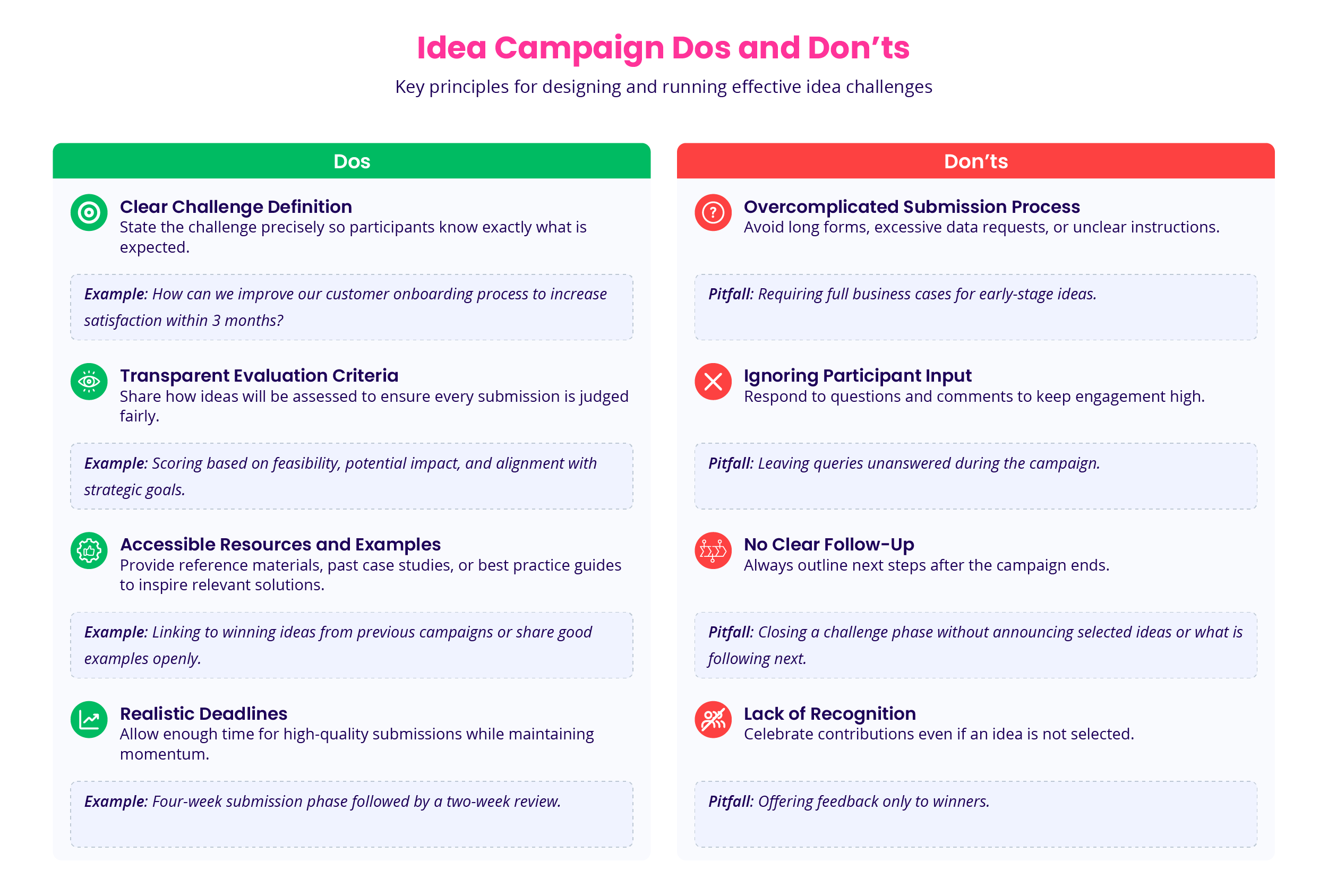
Exhibit 2: Idea campaign dos and don'ts
Most idea box programs fail at three structural points.
No criteria before the campaign opens. Participants contribute ideas without knowing what business challenges the organization is trying to solve. Without guidance on what makes a submission worth pursuing, evaluation teams receive unfocused input. Ideas with genuine high growth potential fall through the cracks.
No cross-functional review panels. A single team evaluating ideas creates a single set of blind spots. The proposals that survive evaluation are the ones least likely to disrupt anything. Product managers, operations leads, and customer-facing employees all need decision authority in the process.
No feedback for contributors. Teams hear nothing after contributing. Nobody explains why certain ideas advanced and other insights did not. The idea box develops a reputation for producing no outcomes. Contributions drop in every subsequent cycle.
These are organizational design failures. Adding more awards or internal competition to encourage employees to participate doesn't fix them. Only a structured approach to evaluation does.
Senior leaders acknowledge why suggestion boxes die: ideas collected without evaluation criteria, no decision timeline, and no visible outcome for users.
What separates a functioning idea program is its governance structure.
Universities have refined this for decades through grant competitions and innovation challenges. At the university level, graduate students and undergraduate students contribute ideas within defined categories. Faculty members lead evaluation panels, score entries using published rubrics, and identify the strongest concepts. Awards recognize top performers. Winners receive development resources.
The process is repeatable, visible, and built into the life of the program rather than a one-time event. The core features are consistent: defined scope, published criteria, and real stakes.
Many university programs assign additional faculty mentors to help graduate students develop ideas before the final evaluation. Corporate programs benefit from the same model, encouraging internal entrepreneurs to compete for funding and development support.
Corporate idea management systems that deliver adapt to this competition structure for business priorities. Eligible ideas are scoped to specific challenges. Evaluation panels include cross-functional stakeholders with real decision authority. Winning ideas receive investment, not just acknowledgment.
/Still%20images/Ideation%20Mockups%202025/ideation-gamify-and-reward-2025.webp?width=2160&height=1350&name=ideation-gamify-and-reward-2025.webp)
Exhibit 3: Leaderboard to reward participation inside ITONICS
Organizations that treat their idea box like a digital suggestion box, collecting ideas without defined evaluation, capture suggestion box results.
The submission brief is one of the most underused forcing functions in idea management.
When organizations define what a complete idea looks like before a challenge opens, two things happen simultaneously.
Idea quality improves at the source. Contributors who must think through customer impact, customer requirements, and success criteria before entering a challenge produce better ideas. The brief is the first filter and does most of the evaluation work.
Teams that publish evaluation criteria before a challenge opens report fewer entries and a higher ratio of ideas that advance to implementation. That is not a participation problem. That is the idea box functioning correctly.
/Still%20images/System%20Mockups%202025/ideation-build-engaging-campaign-pages.webp?width=2160&height=1350&name=ideation-build-engaging-campaign-pages.webp)
Exhibit 4: Build custom webpages for any idea campaign
Most idea box programs treat evaluation as a quality filter. Someone reviews incoming ideas and flags the ones worth developing.
That is the wrong assignment.
The product manager's role in a functioning idea box is decision authority. The person evaluating an idea should be able to commit:
a funded project,
a structured pilot,
or a documented no with a specific reason why this idea does not align with where the business is focusing.
They should also be able to explore adjacent concepts that surface during evaluation.
An advisor creates a bottleneck for ideas to pass through. A decision-maker creates a commitment that ideas can build on.
Most idea box programs add product managers to an evaluation panel as advisors and wonder why good ideas do not advance to implementation.
Three programs demonstrate how structured idea management produces outcomes at scale. Each connects idea management to decisions leaders are already making.
Siemens Energy built Innovation Orbit on ITONICS to connect idea intake directly to trend monitoring and portfolio data.
This changes what evaluation means for cross-functional teams. Instead of asking "is this a good idea," evaluators ask "does this idea address something we are already tracking?" The second question is answerable by people with real authority. The first produces debate.
As Axel Bitsch, Senior Digitalization Program Management Expert at Siemens Energy, described it:
"The platform allows the business to "leverage our internal expert communities to their full potential and foster transparency, company-wide collaboration, and co-creation."
The platform's features give evaluation teams the context they need: trend data, portfolio alignment, and a clear picture of which ideas are essential to the company's growth and profitability.
La Poste is France's national postal service. Aligning idea management across multiple subsidiaries with different service lines is a genuine structural challenge. Innovation insights rarely travel between business units without a visible incentive to share them.
Their intrapreneurship program gives employees a defined window to develop ideas for improving existing services or creating new offerings. Internal entrepreneurs receive coaching, access to partnership support, and faculty-style evaluation panels, mirroring how university programs support graduate students: defined timelines, mentorship, and awards for the most compelling ideas.
Their InnoGame competition engaged more than 4,000 employees in under a year. Teams that had never contributed to innovation programs before submitted ideas that crossed departmental lines. Behavioral science confirms it: real stakes produce more thoroughly developed ideas.
Eligible ideas were scoped to specific service and operational challenges. Awards went to the entries with the strongest business case, clearest customer benefit, and most viable project plan.
A functioning idea box consists of five structural decisions that most organizations have not made explicitly.
ITONICS provides the infrastructure that makes these five decisions operational.
The platform connects idea intake, trend monitoring, and portfolio management in one system. These tools make structured evaluation possible at scale. Evaluation panels assess ideas against business priorities and market intelligence. The best ideas get tracked from intake to project completion, new products, or company-wide process improvement.
/Still%20images/Kanban%20Board%20Mockups%202025/ideation-organize-idea-flows-2025.webp?width=2160&height=1350&name=ideation-organize-idea-flows-2025.webp)
Exhibit 5: An idea with high priority moves into a new phase on a Kanban board
Siemens Energy, La Poste, and KPMG use ITONICS to deliver structured idea management at enterprise scale across subsidiaries, global challenges, and member firm networks.
If your idea competitions collect ideas without delivering business value, the platform is rarely the diagnosis. The organizational design running on it is.