Intel is an American technology company founded in 1968 by Gordon Moore and Robert Noyce and headquartered in Santa Clara, California. It designs and manufactures semiconductors, including the processors that power PCs, servers, and data centers, and is one of the world’s best-known chipmakers.
Case StudyIntel
Driving innovation with corporate foresight at Intel
Experts from across the business work directly with strategy leaders, so foresight influences real decisions.
Avoiding the usual traps
The corporate foresight program at Intel was built with keen awareness of how foresight usually fails. Trend reports are saved as background reading. Small teams of futurists see forces of change but have no influence on those who hold budgets. And programs that claim a single view of the future lose credibility when reality diverges.
John Miranda, who led the program, sees lost trust as the fastest way to end a foresight function. Intel’s answer was to treat foresight as a system of relationships rather than a system of reports.
A federated contributor network
Intel does not centralize foresight in one team. The program draws on a community of contributors from across the business: engineers, strategists, market analysts, and sustainability leads. Miranda identified employees who show curiosity and thought leadership, mapped their expertise, and built a go-to network for each subject area.
The network is effective because it runs on reciprocity. Contributors get visibility for their thinking, access to executives, and recognition inside the company. Intel’s culture helps too. Early leaders Gordon Moore and Andy Grove modeled the cultural posture the program relied on. Both flew economy. Both drove subcompacts on campus. That modesty translated into a culture where intellectual contributions from any level get taken seriously.
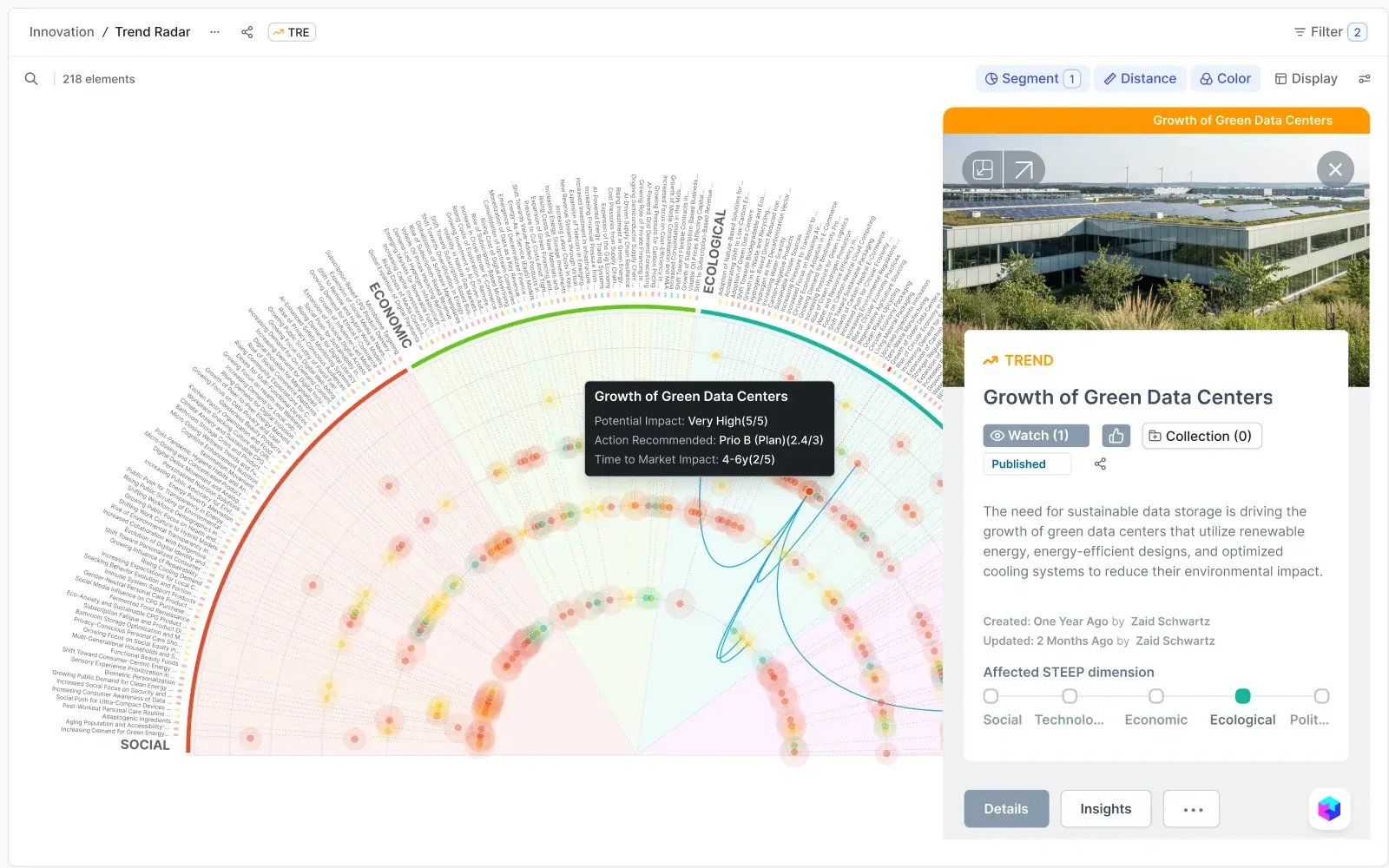
Example of an ITONICS trend radar
Signals that trigger decisions
Members meet a few times each quarter to interpret findings, debate implications, and construct arguments for why a signal matters. Intel uses ITONICS for structured signal evaluation, to pressure-test hypotheses before they reach senior management.
Miranda explicitly partnered with groups like the Corporate Strategic Office, so that resource reallocation can follow insight.
“Coming up with insights without the accompanying change is not enough.”
Four drivers of change
The program surfaces drivers with several plausible outcomes, rather than predictions. The first is sustainability: computing consumes vast amounts of energy, so Intel is rethinking how its products fit a circular economy, from longer product life to end-of-life flows. The second is decentralized computing, which is pushing resources back toward workstations and points to a different chip and platform mix than a cloud-only world.
The third is GenAI, which Intel treats as more than a GPU-centric problem, looking instead at agentic, system-level workloads. The fourth is geopolitics and populism, and the pressure they put on information trust across the tech ecosystem.
About Intel
More best practice stories from our clients
How Tec de Monterrey maps the future of learning across Latin America
Inside Mexico’s powerhouse of innovation, a small foresight team is turning expert signals and interviews from 15 countries into shared scenarios for lifelong learning education through to 2040.

How GOLDBECK built a transparent innovation pipeline
GOLDBECK uses ITONICS to connect startup scouting, use cases, and teams in one transparent innovation pipeline.


How LTM turns foresight into strategic growth
LTM uses ITONICS to centralize foresight, build dynamic trend radars, and turn technology intelligence into business growth.

