ISO 56001 innovation management - guide & trainings


If you ask any executive, they’ll probably agree that innovation is important. Yet, research shows that many feel that their organizations fall short of achieving reliable outcomes in terms of innovation. What stops them from improving performance? Part of the problem is that companies lack a systematic approach to innovation. They treat it like a wild garden, expecting groundbreaking innovations to sprout after occasional watering.
Such a spontaneous and disorganized approach might appeal to some, but it’s not a reliable way to get results or learn from failures. The good news is that several guidelines and certification programs exist. Most recently, the International Organization for Standardization, as one example, brought global experts together to agree on the best ways to establish and improve an innovation management system. They’ve published this as ISO 56001.
Let’s look at the essentials of ISO 56001, what sets it apart, and how organizations can leverage it to professionalize their innovation efforts.
ISO 56001 builds on the principles outlined in earlier standards, such as ISO 56000 for innovation vocabulary and ISO 56002, which provides guidance for creating an Innovation Management System. Published in September 2024, ISO 56001 takes these principles further by outlining specific requirements for establishing, implementing, and maintaining an IMS that aligns with strategic business goals.
The aim of ISO 56001 is to make innovation more predictable, sustainable, and manageable—qualities not typically associated with the sometimes chaotic nature of traditional innovation practices. This shift to a formalized structure offers businesses a chance to professionalize innovation, making it an integral part of everyday operations rather than an unstructured activity.
ISO 56001 breaks down the elements of an innovation management system in clauses 4-10 of the document: organization, leadership, planning, support, operation, performance evaluation, and improvement.
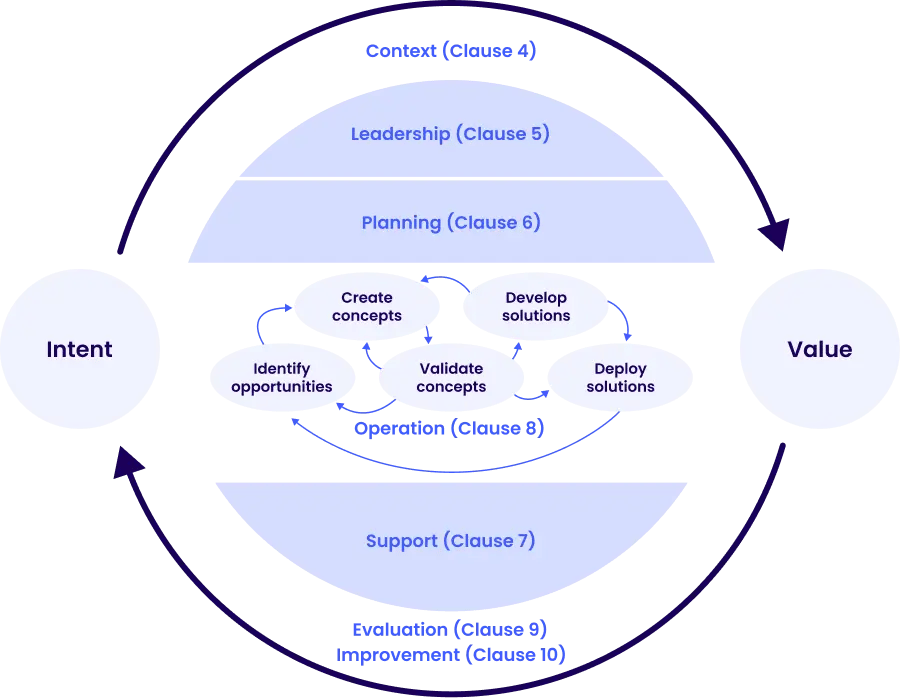
Each of these clauses contains prescriptive statements, listing what the organization needs to do to innovate consistently. ISO 56001 states that organizations can realize value through these iterative innovation processes that identify opportunities, create and validate concepts, and deliver solutions to the market.
Organizations often struggle with an inconsistent approach to innovation that lacks structure. This reduces their ability to drive execution from strategy. According to the International Organization for Standardization, implementing an innovation system aligned with ISO 56001 can address these challenges with the following benefits:
For executives, the appeal of ISO 56001 lies in its potential to deliver these benefits through a consistent approach. ISO 56001 promises to bridge the common gaps in innovation practice by turning innovation into a structured process comparable to other business functions, such as quality control or environmental management. Its comprehensive framework prepares organizations for future technological shifts and market demands, enabling a robust approach to innovation.
ISO 56001 does not exist in isolation. It is part of the broader ISO 56000 series, a family of standards developed to provide a 360-degree view of innovation management. Each standard in the series covers a specific aspect of the innovation process:
Before implementing ISO 56001, it’s worthwhile understanding the terminology in ISO 56000 and using that to establish a shared vocabulary for innovation principles in your organization. Together, the standards of the ISO 56000 series equip organizations with a toolkit to build, sustain, and refine their innovation capabilities over time. A structured approach enables businesses to remain competitive and future-focused.
The ISO 56001 standard defines an innovation management system that functions across three levels: strategic, tactical, and operational. These levels are interrelated, each playing a distinct role in managing innovation.
By coordinating innovation efforts across these levels, organizations can use ISO 56001 to create a structure to scale innovation in alignment with their strategic vision.
To achieve ISO 56001 certification, organizations must embark on a structured journey to align their innovation practices with the ISO standards. This starts with familiarization; the organization needs to thoroughly understand the requirements, framework, and terminology laid out in ISO 56001 and the broader ISO 56000 series. This initial step often involves training key personnel on the principles and how they align with the company’s strategic goals. The organization can conduct a gap analysis to assess its current innovation processes against ISO 56001 standards, identifying areas for improvement to meet the certification criteria.
Following the gap analysis, the organization develops an Innovation Management System (IMS) tailored to the standard’s framework. The IMS should include a firm commitment from leadership to support innovation efforts. Key components like setting measurable innovation objectives, allocating resources such as budget and skilled personnel, managing innovation-related risks, and establishing continuous improvement processes will be essential to the system’s success. This system is then implemented across the organization, with relevant employees trained on the new processes and structures and all procedures meticulously documented to support ISO audits.
Once the IMS is in place, the organization undertakes an internal audit to evaluate compliance with ISO 56001 standards, identifying and addressing any gaps or non-conformities. A management review follows, allowing leadership to assess the IMS’s effectiveness and make adjustments, demonstrating continued support and alignment with organizational goals.
When the IMS is fully implemented, an accredited certification body is selected to conduct the certification audit. It won’t be the ISO itself, since it does not certify organizations. The audit verifies that the organization’s IMS meets ISO 56001’s requirements and assesses its effectiveness. If the system is compliant, the organization receives ISO 56001 certification. If any areas fall short, corrective actions will be needed before certification can be granted.
Achieving certification, however, is only the beginning. To maintain it, the organization must commit to continually improving its IMS, ensuring it remains aligned with ISO 56001 standards and continues to deliver on innovation objectives. Periodic surveillance audits by the certification body will monitor the IMS’s ongoing effectiveness, with full recertification required every three years. Through this certification journey, an organization validates its commitment to structured, sustainable innovation.
If you or your team want a quick refresher on the essentials of innovation management, you may be interested in our series of online courses on the ITONICS Academy. We cover topics such as strategic foresight, portfolio management, and business model innovation. It’s based on ITONICS’ years of experience working with leading companies and the common obstacles they encounter in establishing a systematic approach to innovation.
The ITONICS Academy offers free courses on these subjects:
Our courses include downloadable templates, links to relevant guides, and a certificate of completion that you can save to LinkedIn. If you’re a leader aiming to instill the right approach to innovation in your organization, we recommend sharing the Academy with your team and motivating them to upskill with ITONICS certification.
ISO 56001's structured guidance will help organizations standardize how they innovate, making it an integral part of their growth strategy and future vision. ITONICS applauds the global experts who collaborated on this important standardization. We expect it to be a valuable resource for organizations that want to enhance their innovation maturity.
In line with the principles of ISO 56001, the ITONICS Innovation OS software provides a centralized platform to elevate innovation from a sporadic activity to a structured, strategic business function. With ITONICS, organizations can streamline their innovation management across departments, integrating processes such as ideation, trend and technology scouting, and portfolio management. By leveraging AI, Leveraging AI, ITONICS software automates the monitoring of global trends, emerging technologies, and market changes. It also helps your teams generate better ideas by augmenting human creativity. If you’d like to see how ITONICS can benefit your business, book a demo with our experts.