How AI trend scouting is transforming innovation intelligence


Gartner expects over 40% of agentic AI projects to be canceled by the end of 2027, citing unclear business value and inadequate risk controls as the primary causes. AI trend scouting sits inside that risk directly. It is one of the fastest-growing agentic AI use cases, and one of the least governed.
Trend scouting has always rested on seven distinct skills. Three of them just became someone else's job.
The organizations pulling ahead reorganized their teams around the four skills still left to a human: verification and triangulation, speed-depth judgment, stakeholder translation, and collaborative decision-making. The ones that didn't are producing more signals and fewer funded decisions.
This article breaks down which three of the seven innovation intelligence skills AI trend scouting already automates, why the remaining four now decide whether a program survives its next budget review, and how three organizations, Toyota, LTIMindtree, and Dolby, already run those four skills at scale.
Corporate innovation intelligence rests on a defined skill set for converting signals into decisions. ITONICS' guide to the seven innovation intelligence skills lays out the discipline in full: signal detection, verification and triangulation, pattern recognition, speed-depth judgment, stakeholder translation, continuous monitoring, and collaborative evaluation.
Practiced well, innovation intelligence gives an organization the ability to spot a shift early enough to act on it, and enough confidence to commit real budget to a response. Rohrbeck and Kum's seven-year study of nearly 90 multinational firms found that companies with mature foresight practices posted 33% higher profitability and 200% higher market capitalization growth than the average, gains that translate directly into competitive advantage, while firms with weak practices took a performance discount of up to 108%. That confidence comes from all seven skills working together as one discipline.
That discipline has a real history, and a specific vulnerability now that agentic AI has entered the picture. The sections below trace where the practice came from and which of the seven skills no longer require a human hand.
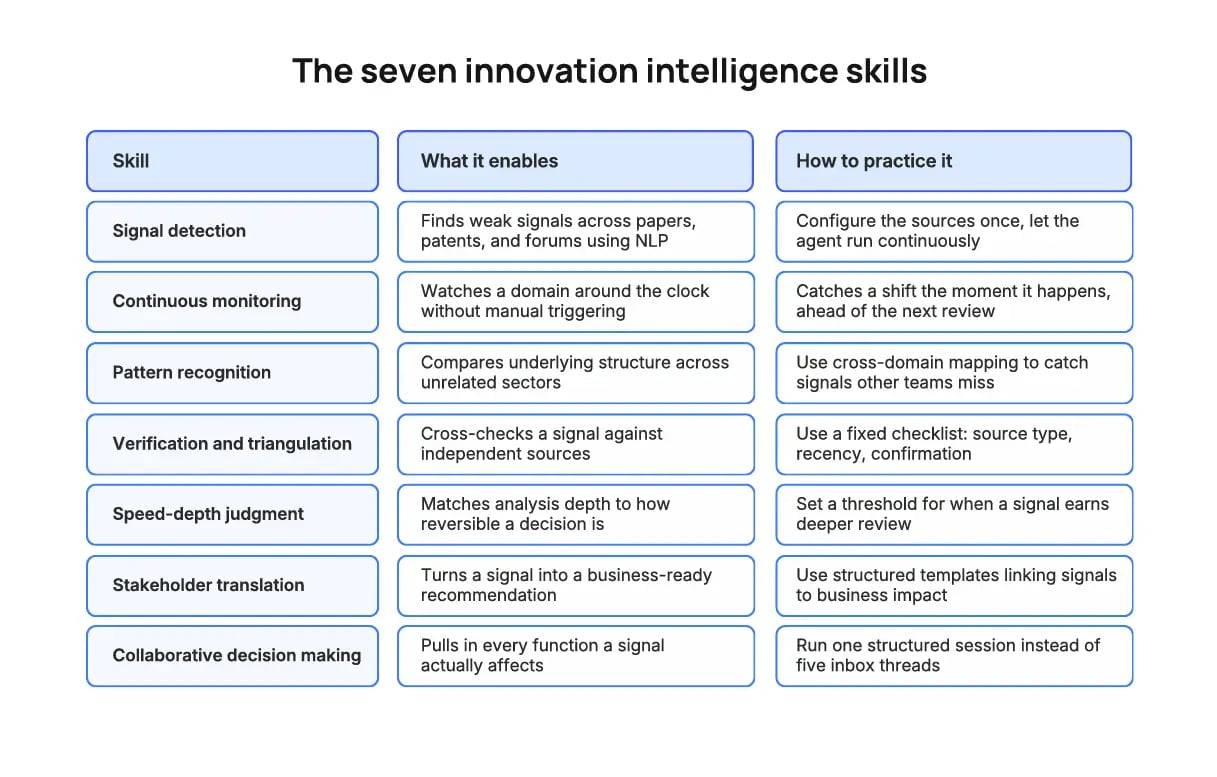
Exhibit 1: All seven skills, what each enables, and how to practice it, from automated detection to human-owned decisions.
Signals rarely arrive clean or self-explanatory, and they take many forms. A weak signal has to be found, watched over time, and set against a pattern before anyone can vouch for it. It then has to survive a judgment call, get translated for a decision-maker, and pass through people who don't automatically agree on what it means.
Innovation intelligence is the name for doing all of that reliably, on a fixed cadence, rather than by accident. A repeatable method for noticing, verifying, translating, and deciding produces a steady stream of funded decisions, quarter after quarter, regardless of which analyst is on the desk that week. Reliability built from all seven skills together is what creates competitive advantage.
The seven skills fall into two natural groups:
Mechanical: detect, monitor, and recognize patterns at scale.
Human judgment: decide what a signal means, how much to trust it, and what to do about it.
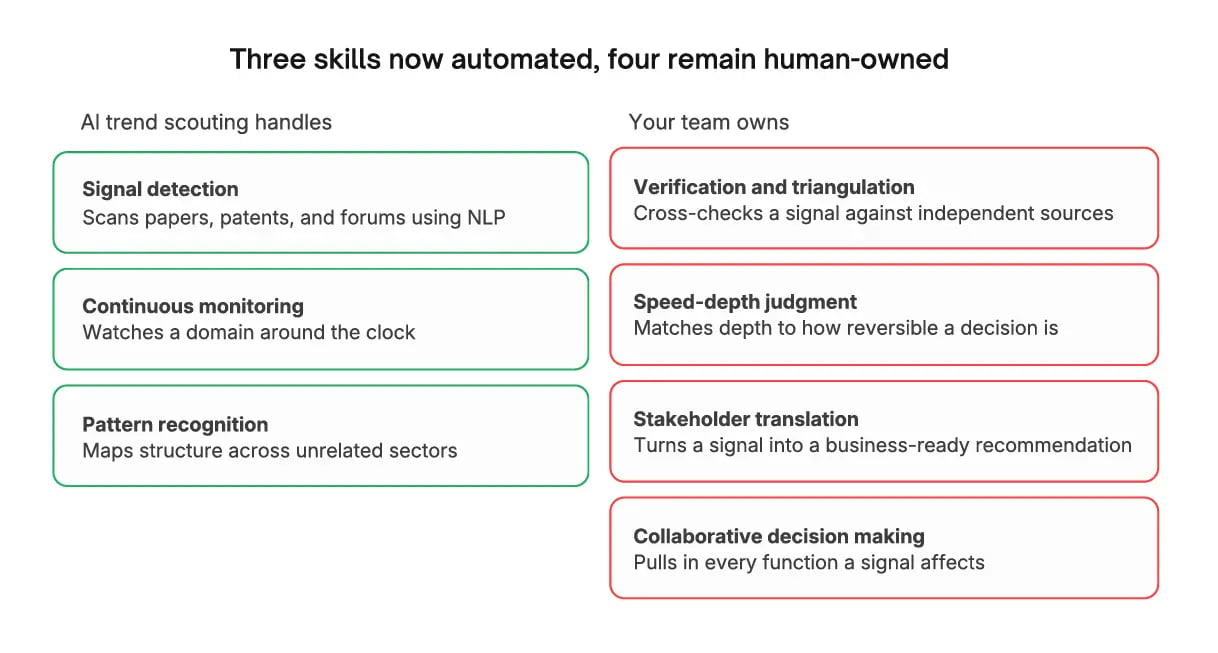
Exhibit 2: AI trend scouting now handles signal detection, monitoring, and pattern recognition. Verification, judgment, translation, and decisions stay with your team.
The practice spans more than five decades. Francis Aguilar's 1967 book, Scanning the Business Environment, first formalized environmental scanning: systematically watching the world outside the company for signs of change.
Igor Ansoff extended that idea in 1975 with his concept of weak signals, early and ambiguous indicators of change that don't yet look like a trend to most observers. What one person dismisses as so called noise, another person can identify as a weak signal worth acting on, simply because they're reading the same information through a different frame. Ansoff's work sits alongside futures studies as a field, the discipline of mapping possible futures from present-day signals rather than waiting for certainty.
AI trend scouting is the direct descendant of that discipline, built to catch the same slow-moving, cross-industry signal, just at a different scale. Where environmental scanning meant an analyst reading trade journals and industry reports by hand, AI trend scouting is the proactive process of identifying emerging technologies, shifting customer preferences, economic shifts, and early-stage societal change before they surface as public trends everyone else can see too.
In practice, that means natural language processing scanning unstructured text across millions of documents at once, across multiple sources simultaneously. One analyst reading one publication at a time cannot compete with that, no matter how skilled they are at environmental scanning the old way.
That scale removes three of the seven skills from a human's daily task list, the same skills driving the broader shift toward foresight automation across the industry. Each one now runs across big data volumes faster and wider than a team ever could alone.
For a foresight team running AI trend scouting, the value is direct. Hours that used to go into manual scanning and cross-referencing now go into deciding what the results mean, and a team that used to track one sector can credibly track ten.
None of that, though, answers the harder question. Once a signal surfaces at that speed and scale, someone still has to decide what it means and what happens next.
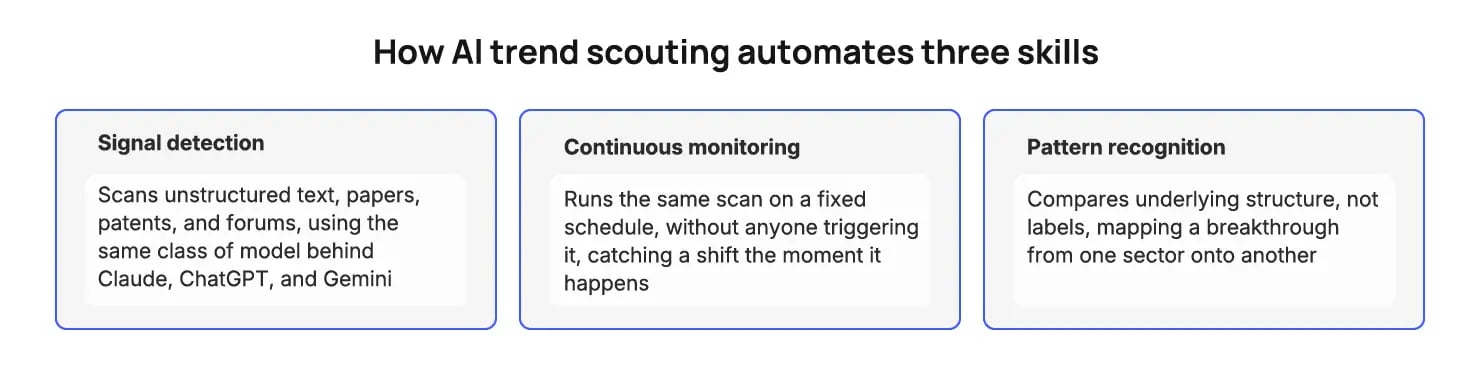
Exhibit 3: Three mechanical skills now run continuously on their own, freeing analysts to focus on judgment.
Automating detection raises the stakes on decision-making inside an AI trend scouting program. Every signal that used to take a week to surface now takes minutes, and someone still has to decide what to do with it, under clear governance over who makes that call. Competitive advantage in this environment comes from the decision itself.
Gartner's own framing of that 40% cancellation figure is specific about the cause. The projects getting canceled are mostly early experiments driven by hype, where organizations misjudge the real cost and complexity of running an agent at scale, which stalls the project before it reaches production.
An AI trend scouting program built only on the three automated skills runs into exactly that wall. Detection and monitoring alone don't answer who verifies a signal, who decides its urgency, or who translates it into a recommendation the business will actually act on. Volume of signals detected was never the scarce resource; structured human judgment always was.
Human-in-the-loop design, built on real human interaction rather than a rubber-stamp review, is what closes the gap between detection and decision. Keeping a trained person in the loop measurably improves the accuracy and reliability of AI-driven scouting, since a human reviewer catches biased or misleading outputs an agent would otherwise pass through unchecked. That review also creates an audit trail, which matters the moment a scouting recommendation becomes a funding decision someone has to defend to a steering committee.
Human oversight is a genuine design requirement, addressing the ethical quality of a decision on its own merits, and it's now a legal one in large parts of the world. Article 14 of the EU AI Act mandates human oversight for high-risk AI systems, with enforcement beginning in August 2026. Regulation is catching up to what good practice already required.
A January 2026 survey of over 500 data professionals, run through Drexel University's Center for Applied AI & Business Analytics, found that 41% of organizations already use agentic AI in daily operations. Only 27% said their governance was mature enough to manage it responsibly (The Conversation).
The researcher's finding is about sequencing. Oversight added after deployment turns people into a safety valve, catching problems only once something visible breaks. Oversight designed before deployment turns those same people into accountable decision-makers from day one, and it's what encourages responsible use rather than reluctant compliance.
Singapore's Infocomm Media Development Authority reached a similar conclusion in its Model AI Governance Framework for Agentic AI, which requires organizations to bound risk and assign accountability at the planning stage, before any agent goes live (IMDA). Government policy is increasingly explicit about this, shaping how organizations design AI deployment going forward.

Automating three skills concentrates the entire job facing a foresight team into the remaining four. Each one now needs a specific method rather than general effort spread thin across all seven. These four skills separate an AI trend scouting program that produces real competitive advantage from one that just produces more signals to ignore, and each deserves its own approach rather than a single shared checklist.
Surfacing a signal and confirming one are two different jobs. Verification means cross-checking a weak signal against multiple independent sources before treating it as real, since comparing source types produces stronger confirmation than relying on a single feed:
Hiring trends are one of the most underused weak signals available for spotting a shift before competitors do. A sudden run of job postings in a specific technical area often signals a company's real priorities well before any public announcement.
Structured frameworks help this skill scale across a team instead of depending on one analyst's instinct. A fixed checklist, covering source type, recency, and independent confirmation, keeps triangulation consistent regardless of where the signal came from. Similarly, a second reviewer should always be free to challenge the first analyst's read on a signal before it moves forward.
Not every signal deserves the same depth of analysis. A reversible decision, testing a small pilot, watching a competitor for one more quarter, can move fast on thin evidence. An irreversible one, a major capital commitment or a market entry into a new region, needs deeper verification even if that means moving slower.
An algorithm cannot make this call alone, because it depends on factors like the organization's size, risk appetite, and tolerance for uncertainty. Setting the threshold for when a signal triggers deeper review, especially when a decision is hard to reverse, rather than an automatic pass, is the key skill, and it looks different for every company.
A verified weak signal is still just data until someone translates it into language a decision-maker can act on. That translation, connecting a signal to a specific business strategy, risk, or opportunity cost, is what turns detection into competitive advantage.
This skill also determines whether an innovation team gets taken seriously by the rest of the business. A well-translated recommendation reads like a business case with a clear ask. A raw signal dump reads like noise, however accurate the detection behind it.
The final skill keeps a signal that matters from dying quietly inside one department. Collaborative decision making pulls in the functions actually affected, R&D, strategy, product, and commercial, so a market shift gets evaluated from more than one perspective, and the insights each function brings shape how the organization responds.
This is also where speed compounds. A signal evaluated by four functions in one structured session beats the same signal circulating slowly through four inboxes over two weeks, even when the judgments end up identical. Speed here comes from shared structure, built once and reused for the next signal.
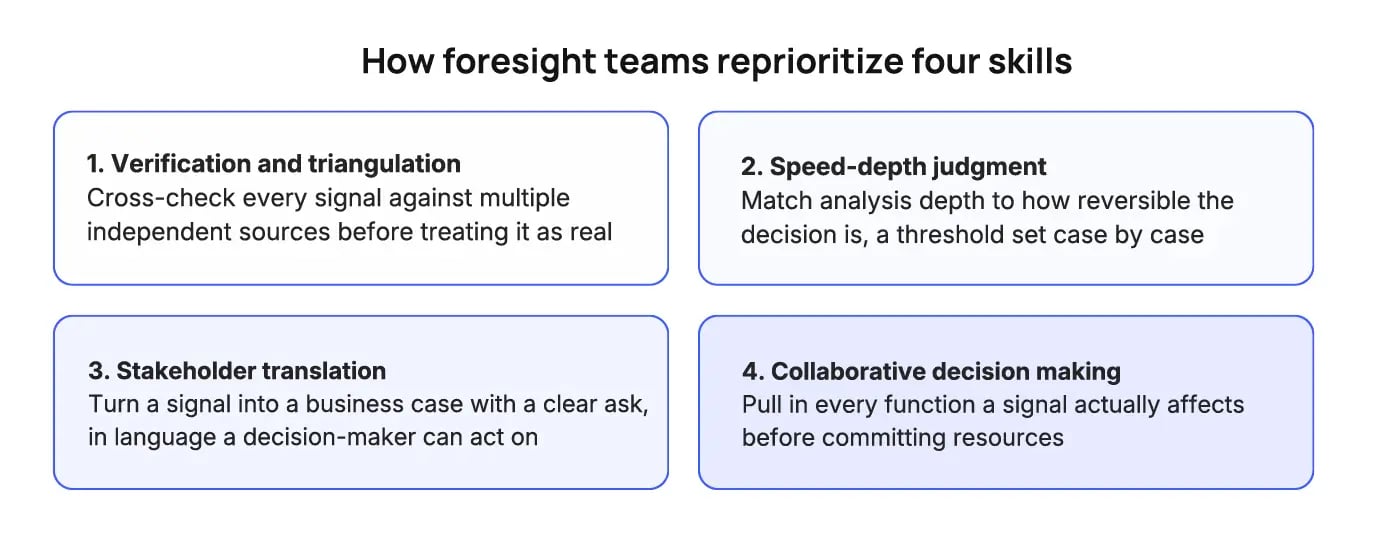
Exhibit 4: Four human skills now decide whether a signal becomes a funded decision, judgment no algorithm can replace.
Three organizations already lead the way in running the four skills at real scale, each anchored in a different one. Together they show what mature innovation intelligence, and real competitive advantage, looks like once AI trend scouting handles detection underneath it, turning weak signals into funded decisions rather than an archive nobody reads.
Toyota Motor Europe uses a shared platform to gather and assess weak signals, trends, technologies, companies, competitors, and internal project proposals in one place. More than 500 members across Europe use the system, which supports virtual pitch events where new R&D and production engineering proposals get evaluated by experts before becoming funded initiatives. Verification at that scale runs on a shared system of record everyone can see and contribute to.
LTIMindtree connects 13,000 technical and business engineers through a platform that shifted trend and technology tracking from an internal capability into a client-facing one. The organization now uses tracked trends to spark strategic conversations with clients directly, informing their decisions and unlocking new business opportunities. That is stakeholder translation working at genuine enterprise scale.
Dolby's Futures Council brings together stakeholders from different parts and levels of the company with an explicit mission to anchor foresight across the whole organization. The platform is used to input, rate, and discuss foresight data collaboratively across that group. That is precisely the structure collaborative decision-making needs to function past a single department.
The right AI trend scouting software should support all seven skills behind innovation intelligence, including the three AI already automates. Six criteria matter most when evaluating a platform against the standard that actually produces competitive advantage.
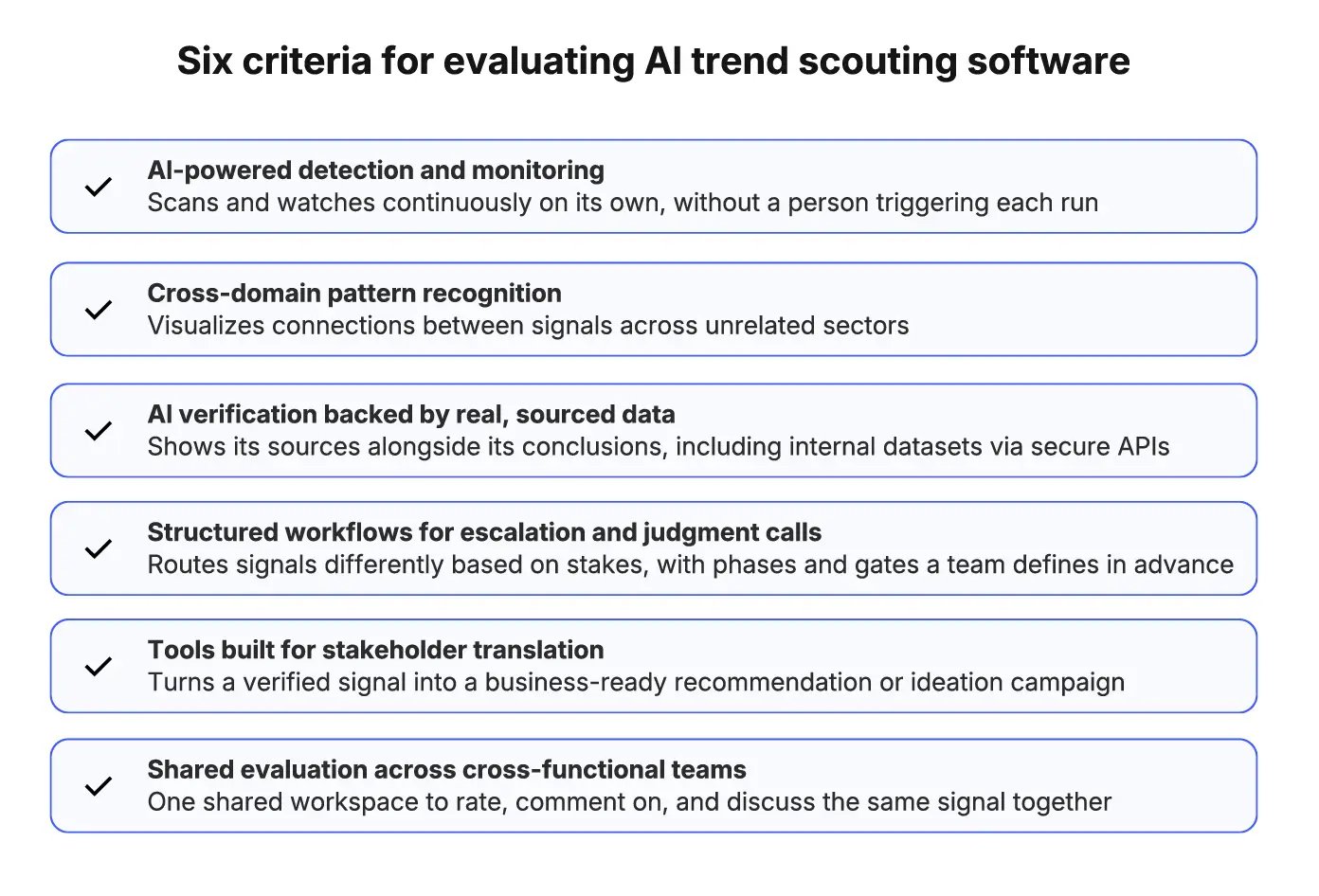
Exhibit 5: A platform that satisfies all six criteria supports every skill behind innovation intelligence, automated and human alike.
The tool should scan and watch continuously on its own, without a person triggering each run. That covers the same ground signal detection and continuous monitoring otherwise require by hand.
Look for a platform that compares the underlying structure of a signal across unrelated sectors, through visualizations that show connections and relations between signals to identify patterns. A simple keyword or label match within one domain won't catch it.
Any AI trend scouting tool should show its sources alongside its conclusions. Verification depends on an AI layer that pulls from a real, curated set of weak signals, patents, startups, research, and news, rather than a general-purpose model guessing at relevance. It should also read internal datasets safely through APIs, so proprietary data feeds the same verification process without leaving the organization.
Software should let a team define, in advance, which signals move forward automatically and which stop for a human decision. Configurable AI trend scouting workflows with phases and gates route different signals differently based on stakes, rather than treating every entry the same.
A platform should turn a verified signal into a business-ready recommendation directly, through dashboards that consolidate analysis into one view, or into an ideation campaign that mobilizes the wider organization around it. That saves a scout from rebuilding the same slide from scratch every time a signal reaches a decision-maker.
Collaborative decision-making needs a shared workspace where multiple functions can rate, comment on, and discuss the same signal without exporting it into separate reports. A tool that keeps evaluation siloed by department undermines collaborative decision-making by design.
/Still%20images/AI%20Mockups%202025/foresight-discover-new-insights-2025.webp?width=1440&height=900&name=foresight-discover-new-insights-2025.webp)
Exhibit 6: Prism, ITONICS' AI layer, scans the web and a curated data lake, surfacing relevant and evaluated signals with a single click.
The seven skills can be practiced with tools a team already has. Doing all seven well, at scale, and as one connected system is where most teams run out of road.
Prism, ITONICS' AI layer, handles detection, monitoring, and pattern recognition, scanning the web and a curated data lake of signals so a team starts from verified candidates rather than raw noise. Radar turns that signal landscape into one shared, visual view instead of a spreadsheet, so verification happens against a common picture everyone can see.
MCP integration connects external AI agents, including the same class of large language model mentioned earlier, directly to that data. A signal Prism surfaces can flow straight into an agent-driven workflow rather than sitting in an export queue.
Configurable workflows with phases and gates give speed-depth judgment a real home instead of an inbox. The Insights Tab then turns a verified signal into a synthesized answer instead of a raw feed, three to six cited bullets addressing configurable questions like what's changing and what it means for a specific team, so stakeholder translation happens as part of the workflow rather than requiring a scout to build the case by hand.
Shared elements, ratings, and comments give cross-functional teams one place to debate that answer together for collaborative decision-making.
Consulting support is available for teams that prefer not to build this themselves, though none of it is gated behind a services engagement. Teams that treat all seven skills as one connected discipline are the ones whose AI trend scouting programs survive a budget review and adapt fastest as signal volume grows, turning innovation intelligence into competitive advantage instead of an archive of unread weak signals.