First-mover advantage: Winning the time-to-market race


Decades of research on market entry timing show that first-mover companies fail 47 percent of the time and capture just 10 percent average market share. Early followers achieve 28 percent market share with failure rates closer to 8 percent. Speed to market matters, but launch velocity alone predicts disappointment more often than competitive advantage.
The real edge belongs to organizations that build learning velocity. They validate assumptions faster through early testing, shut down weak bets earlier, and adapt their product development strategy toward market fit while competitors remain locked into execution. Speed without learning compresses the development cycle but magnifies risk.
This article explains where time to market is won: well before development teams write code or freeze specifications. It outlines six capabilities that accelerate time to market sustainably and provides a diagnostic framework to assess when first mover advantage makes sense versus when fast follower positions outperform. It closes by showing how project management infrastructure turns episodic speed into repeatable organizational capability.
The business world celebrates first-mover companies. Tesla dominates electric vehicles. Amazon conquered online retail. Google owns search. These success stories fuel the belief that racing to market quickly delivers an unbeatable competitive advantage.
The data tells a different story. Research by marketing professors Peter Golder and Gerald Tellis analyzed hundreds of brands across multiple product categories and found that first-mover companies have a 47 percent failure rate compared to just 8 percent for early followers. Even when first mover companies survive, they capture roughly 10 percent average market share, while early market leaders who entered second achieve 28 percent and gain market share over time.
The pattern repeats across industries. MySpace pioneered social networking but lost to Facebook. Friendster came before both and disappeared entirely. Netscape introduced the web browser, but ceded the market to Microsoft and then Google Chrome. Being first creates visibility, but sustaining mover advantage requires something else entirely.
Three mechanisms theoretically protect first-mover companies. Technology leadership emerges through learning curve effects that reduce costs faster than followers can match, creating an absolute cost advantage. Resource control lets pioneers secure the best locations, suppliers, and talent before competitors arrive, enabling the first company to control resources that later entrants cannot access. Buyer switching costs create friction when customers must invest time or money to change providers.
When these advantages align, first mover advantage enables decades of dominance. Coca-Cola and Kleenex became synonymous with their product categories, building brand recognition and brand reputation that followers struggle to overcome. This brand recognition creates customer loyalty that compounds over time. The logic seems airtight. Get there first, lock in customers, control scarce resources, and maintain the lead while direct competitors play catch-up.
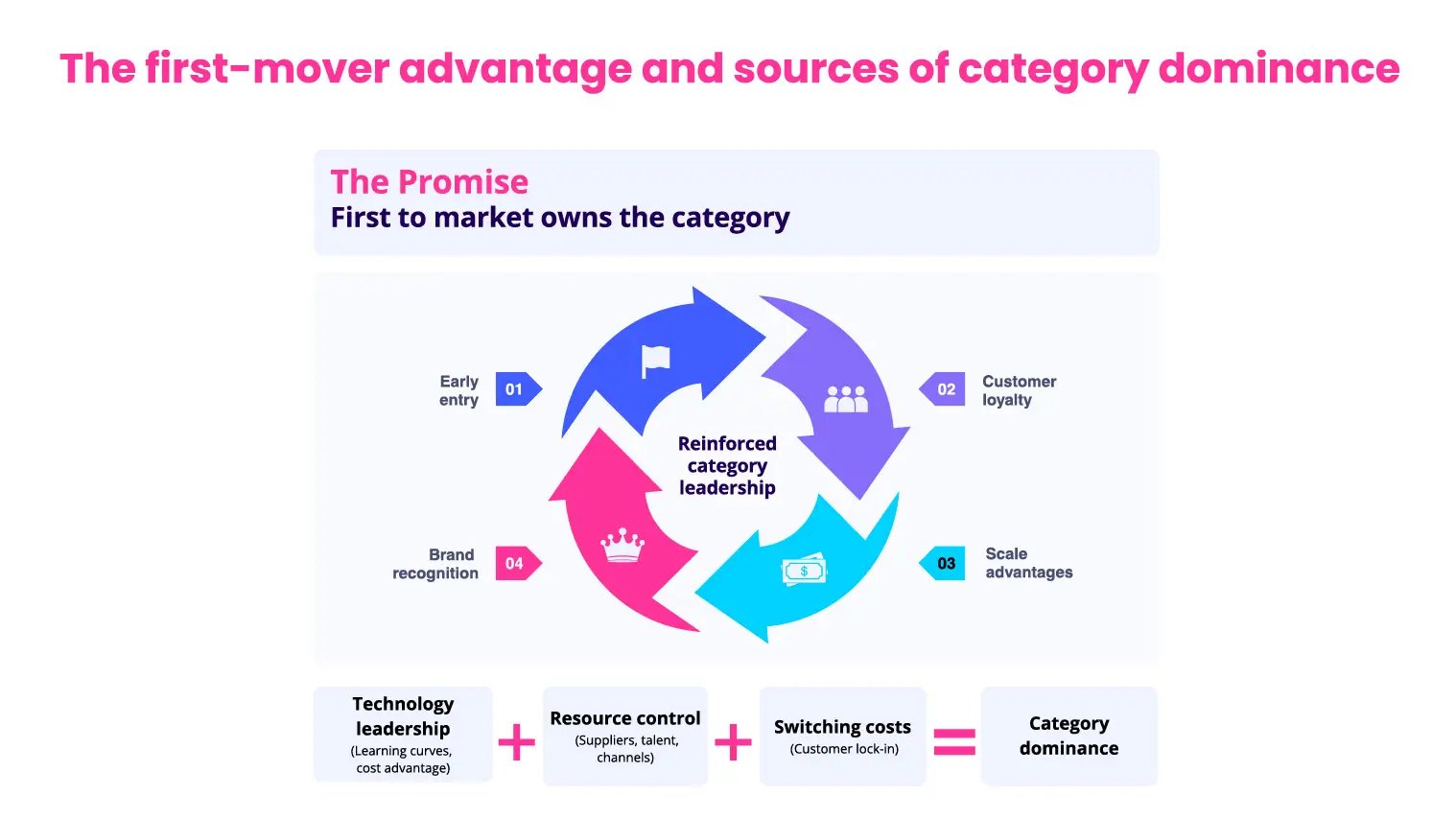
Exhibit 1: Diagram showing how early entry combines technology leadership, resource control, and customer switching costs to reinforce brand recognition, scale advantages, and category leadership.
The promise rarely materializes because timing accounts for 42 percent of the difference between winners and losers in new ventures. Markets need time to mature. Customers need education. Technology needs to stabilize. First mover companies often arrive before any of these conditions exist, missing business opportunities that emerge only when markets mature. Other factors like market readiness and competitive dynamics also determine outcomes, with considerable variation across industries and product categories.
They face uncertainty without reference points. Should the product include feature A or feature B? What price will the market accept? Which distribution channels are market important? Every decision becomes an expensive experiment. Meanwhile, followers watch, learn, and enter when answers become clear through market research and industry benchmarks. They skip the costly mistakes and focus resources on execution rather than exploration, improving both financial performance and market measures from day one.
First mover companies bear the full cost of market education while followers benefit from informed buyers without equivalent spending. This creates an asymmetric burden. Pioneers invest in explaining why the category matters, how the product works, and what problems it solves. Followers inherit an educated market and differentiate on features, price, or quality instead, often leveraging brand reputation built through existing products in adjacent categories.
Buyer switching costs that should protect first mover companies also trap them. Early design choices harden into constraints when customer expectations form around initial implementations. Improving the product requires asking customers to relearn workflows, retrain staff, or abandon investments. The same friction that deters switching also prevents iteration. Second movers avoid this trap by observing which design choices create value and which generate friction, learning from the potential challenges first movers faced without experiencing them directly.
Resource commitments compound the problem. First mover companies allocate scarce resources to unproven bets, then lack capital to pivot when market feedback arrives. They also face supply chain disruptions without established vendor relationships or backup suppliers. Fast followers enter with clarity about what works through superior market research, directing investment toward refinement rather than discovery. The mover advantage shifts from those who move first to those who learn fastest.
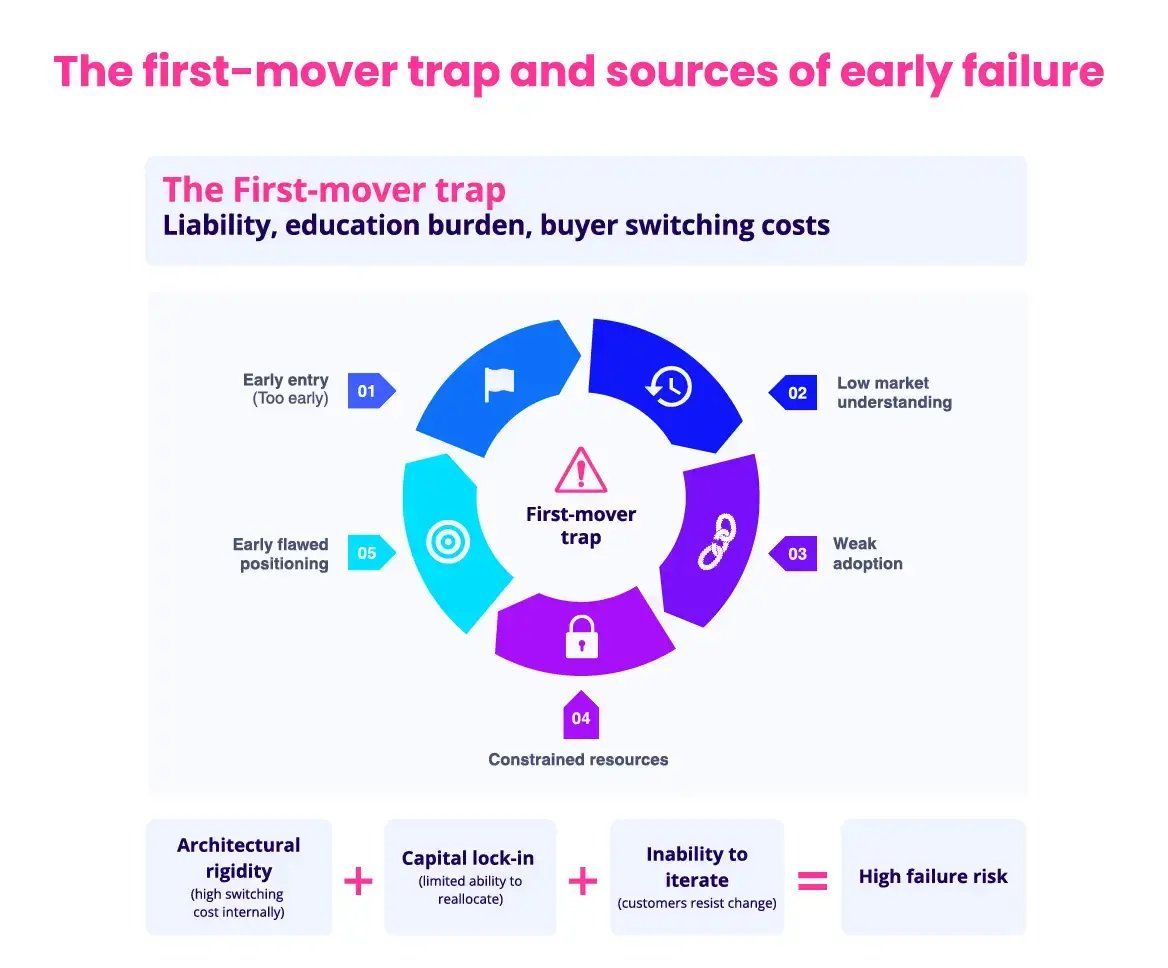
Exhibit 2: Diagram showing how early entry can create rigidity, capital lock-in, and resistance to change, leading to weak adoption, constrained resources, and elevated failure risk.
Fast launchers ship products quickly. Fast learners validate assumptions quickly. The difference determines who survives market contact.
Traditional product development treats speed as execution velocity. Teams compress schedules, add developers, and work weekends to hit launch dates. This approach triggers long, slow learning cycles where decisions made early in the product development process get validated only at launch, forcing costly rework when assumptions prove wrong. The time between decision and validation stretches across months. Every wrong bet compounds. First mover companies that prioritize launch velocity over learning velocity face the highest risk of market failure.
Learning velocity flips this equation. Instead of optimizing for code volume or feature count, organizations optimize for validated insights per product development cycle. Applying validated learning to the product development process delivers faster development, actionable metrics aligned to user needs, reduced costs, and more agile organizations. Speed matters, but only when paired with evidence.
Fast launchers measure output through story points completed, features shipped, or lines of code written. These velocity metrics hide invisible quality erosion and fail to show whether shipped features create customer value. High velocity means nothing when cycle time grows or product quality drops.
Fast learners measure different metrics entirely. They track hypothesis validation rate, time from question to answer, and decisions reversed before they become expensive. Feedback loop velocity combines the quantity, quality, and actionability of customer feedback divided by effort, creating a leading indicator for product success. Teams that validate ten assumptions in a development cycle outperform teams that ship ten features without learning which ones matter.
The distinction shows up in resource allocation. Fast launchers pour resources into execution. Fast learners invest upstream in decision clarity through effective resource management. Research on upstream versus downstream decision-making shows upstream decisions require three days lead time compared to one day for downstream choices. What may initially appear as a delay in progress, that extra time generates clarity that prevents rework later.
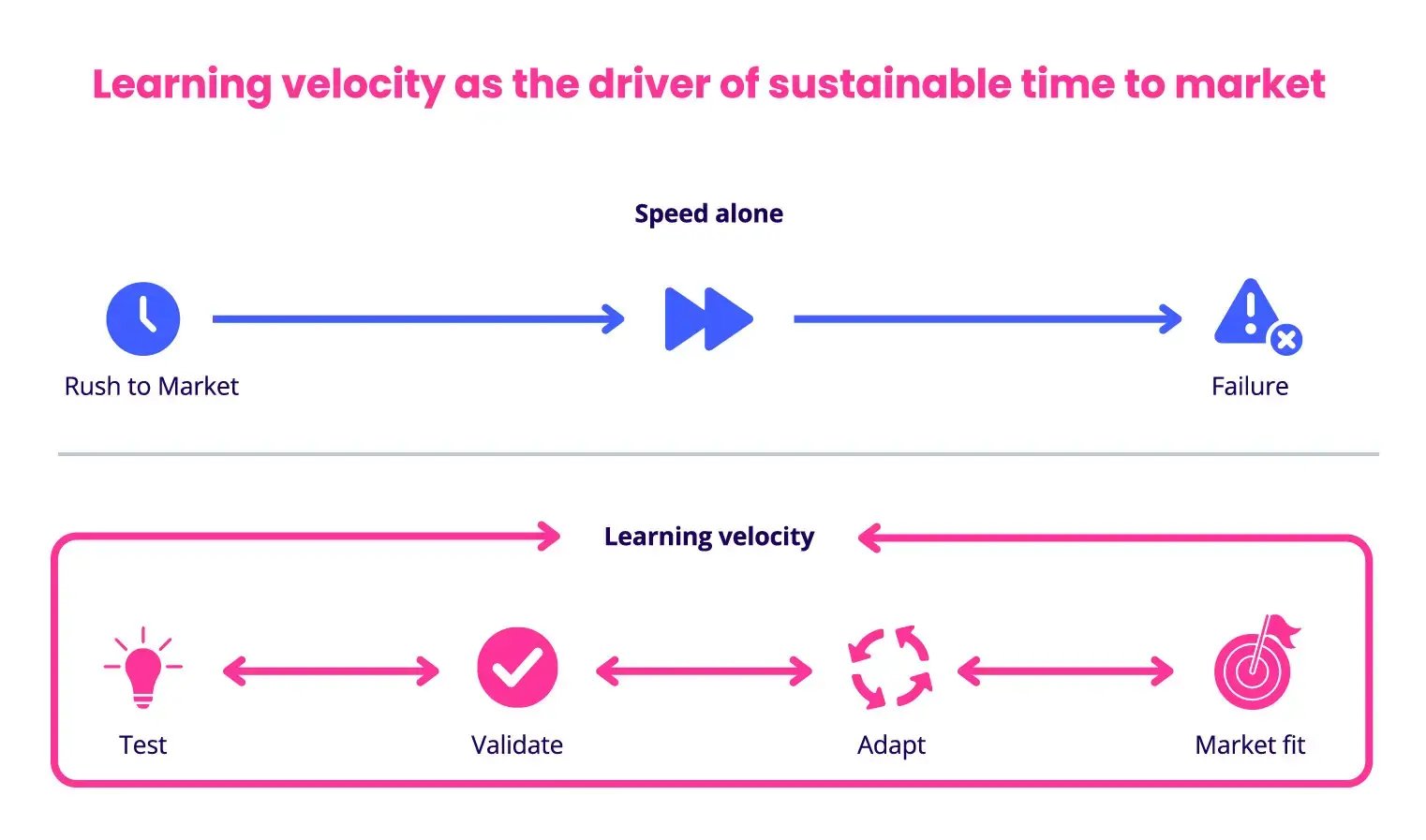
Exhibit 3: Illustration comparing linear rush-to-market execution with an iterative learning loop, showing how early testing, validation, and adaptation reduce risk and improve market fit.
Four drivers separate organizations that learn fast from those that launch fast. Together, they create the infrastructure for sustainable time to market advantage without sacrificing product quality or customer satisfaction, and while advancing business goals.
Organizations must identify which decisions trigger long learning cycles in the product development lifecycle, then pull learning forward to validate those choices earlier and push commitments as late as possible. Decisions made at the last responsible moment rarely need revision. Early decisions made without data guarantee rework.
High velocity without quality creates cycle time growth and forces teams to spend effort on rework rather than progress. Resource velocity means directing investment toward validated opportunities through effective resource management and resource allocation principles, and killing weak bets before they consume scarce resources. Funding speed enables team speed.
Validated learning describes conclusions generated by testing ideas against potential customers to validate effect, with each test representing a single iteration in a larger learning process. Progress happens through evidence accumulation, not task completion. Teams should measure how many assumptions they validate per development cycle using a minimum viable product approach, not how many features they build.
Products must evolve with market demands through frequent iterations rather than one-shot execution. Features and capacity cannot be fixed if products are to grow with market needs, making validated learning critical for understanding and anticipating those needs. Architecture decisions should enable change across the entire product lifecycle, not lock teams into early choices that become expensive to reverse.
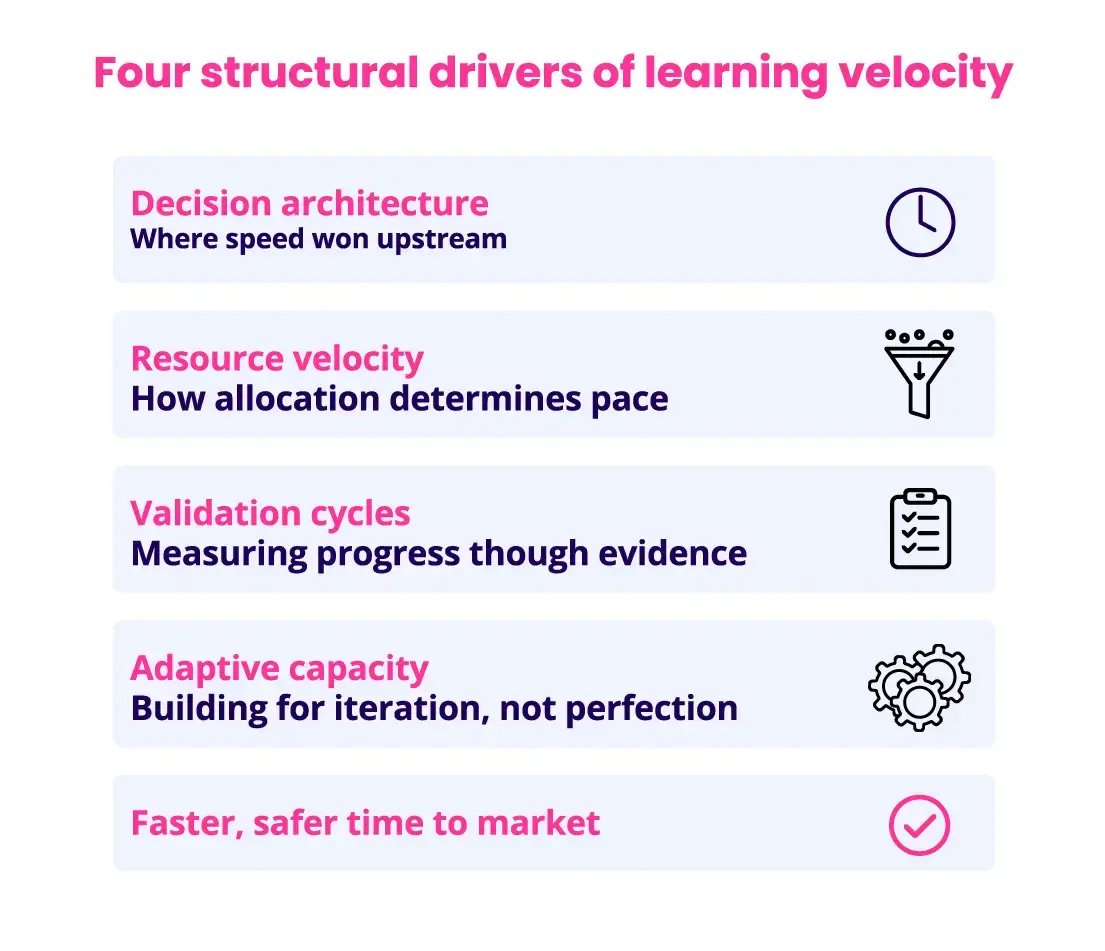
Exhibit 4: Framework showing how decision architecture, resource allocation, validation cycles, and adaptive capacity combine to accelerate learning and deliver faster, safer time to market.
Building learning velocity requires infrastructure. The organizations that consistently reduce time to market without sacrificing product quality invest in six specific capabilities. These capabilities accelerate TTM sustainably and enable faster TTM across the entire product portfolio. They transform episodic speed into sustained competitive advantage.
Agile methodologies provide lightweight frameworks for cross-functional teams to rapidly build prototypes in short sprints by focusing on the highest priority user stories. But agile methodologies alone do not guarantee validation speed. Each iteration involves cross-functional teams working in all functions, including planning, analysis, design, prototyping, testing, and validation.
The infrastructure matters more than methodology. Development teams need testing environments that enable rapid experimentation and customer feedback channels that deliver insights within hours. Medical device companies conduct iterative formative usability tests that can deliver findings in one or two days, followed by quick redesign and additional testing days. Rather than treating verification as a final step, manufacturers integrate iterative testing throughout the development process, with early-stage prototypes undergoing preliminary verification to catch design flaws.
Organizations should measure validation throughput, not just development velocity. How many assumptions can cross-functional teams test per development cycle? How quickly do test results reach decision makers? Measuring TTM requires tracking these validation metrics, not just project milestones. These metrics predict time to market more accurately than task completion or milestone tracking. Project management software that tracks validation cycles alongside traditional milestones provides the visibility needed to optimize learning velocity and streamline workflows across the development process.
Decision architecture determines whether teams spend weeks debating choices or minutes executing against clear criteria. The bottleneck in most product development processes sits not in execution speed but in decision latency. How long does it take to get approval for a pivot? How many layers review resource requests? How quickly can teams reverse course when data contradicts assumptions? When the business decides which core features to prioritize based on clear criteria rather than consensus, velocity increases dramatically. Clear decision systems also enable teams to streamline workflows by eliminating unnecessary approval loops and aligning the product roadmap with validated learning.
Iteration-ready systems push decisions to the last responsible moment through effective project management practices. They separate reversible choices from consequential ones. Reversible decisions move fast with lightweight approval. Consequential decisions get more scrutiny but clear decision rights prevent endless debate.
Only 16 percent of product teams use sales and support feedback to inform their product development strategy. Decision systems should route market signals to the people who can act on them. When customer feedback takes weeks to reach product teams, competitors capture opportunities while you deliberate. Project management software that integrates customer feedback loops directly into decision workflows accelerates response time to market signals.
Over 30,000 new products launch annually, yet 95 percent fail, with timing failures explaining many disappointing outcomes. Market sensing answers the question that determines a successful product launch: Is the market ready now, or should we wait? A few examples illustrate this challenge. Companies launching innovative products too early face market education costs, while those who wait too long cede ground to competitors. The first company to validate the product concept and launch wins only when market timing aligns with product readiness. Launching with a first version that meets minimum market requirements often works better than waiting for perfection, reducing the overall TTM period.
Organizations should establish always-on early warning systems that aggregate real-time data, automatically spot and explain changes in interest, and contextualize these changes within the innovation ecosystem. Manual tracking no longer suffices when market conditions shift weekly.
Timing decisions require coordinating internal readiness with external opportunity. Companies with a defined launch process saw 10 percent higher success rates with go-to-market launches. Market sensing infrastructure should answer three questions continuously: What customer problems are intensifying? Which competitive moves create openings? What regulatory or technology shifts unlock new possibilities? First mover advantage enables market capture only when timing aligns with readiness, ensuring first customer shipment occurs when the market is prepared to adopt an innovative idea.

According to Deloitte research, 83 percent of digitally maturing companies reported using cross-functional teams, but most organizations fail to capture insights that span projects. Learning stays trapped in project silos. The same mistakes repeat. Successful patterns go undocumented. Cross-functional teams working on different initiatives rarely benefit from each other's discoveries.
Knowledge management focuses on knowledge creation, acquisition, refinement, storage, transfer, sharing, and utilization, supporting organizational processes involving innovation, individual learning, collective learning, and collaborative decision-making. Systems that capture validated learning across the product development lifecycle create compounding advantages for every development team and inform product strategy across the portfolio.
Practical implementation requires lightweight documentation that survives beyond project completion. What assumptions proved wrong? Which technical choices created downstream constraints? What customer insights surprised the team? These lessons should flow automatically into future project planning rather than requiring archaeological research through old Slack channels. Project management software with built-in knowledge repositories enables teams to access historical insights without disrupting workflow, ensuring every development team benefits from collective learning. This systematic knowledge capture helps accelerate TTM for future initiatives by eliminating repeated mistakes.
Traditional resource allocation locks teams into annual budgets and quarterly reviews. Minimum viable product development emphasizes minimal resources, including time, budget, and manpower, with the goal to validate the product idea with the least investment possible. Dynamic funding extends this principle across the full product portfolio through agile resource allocation practices and agile practices that enable rapid reallocation.
Fast-kill discipline matters as much as fast funding. Organizations waste more time perfecting weak bets than they save by accelerating strong ones. The ability to shut down initiatives when validation fails frees scarce resources for opportunities with stronger signals.
Effective resource velocity requires clear kill criteria established upfront. What evidence would prove this bet wrong? How many validation cycles before we decide? Without predefined thresholds, teams defend failing initiatives through increasingly creative interpretations of ambiguous data. Project management platforms that track validation metrics against predefined thresholds automate go/no-go decisions based on evidence rather than politics, enabling superior resource allocation across the portfolio.
Quality gates are checkpoints in the development lifecycle designed to ensure that each phase of the process meets certain predefined standards before moving on to the next. Speed without quality creates rework that destroys velocity.
Quality gates minimize project risk through phase-by-phase checklists, reducing development cycle time by achieving higher success rates and increasing focus on a well-designed product. The discipline to pause and verify creates sustainable speed while protecting product quality. Teams that skip validation accumulate design debt that eventually forces complete redesigns or product recalls. Measuring TTM accurately requires accounting for both initial launch speed and the rework that results from skipped validation.
Establishing quality gates allows teams to identify issues in early stages of each development cycle, enabling timely resolution while avoiding additional costs. Quality gates should feel like acceleration, not impediment. When criteria are clear and verification processes are efficient, gates add days to cycles while preventing months of rework. Gates also streamline workflows by establishing clear criteria for advancement, eliminating ambiguity about what constitutes "done."
The key is right-sizing gates for project risk. Safety-critical products need comprehensive verification at each stage. Low-risk design iterations need lightweight checks. Organizations that apply uniform gate requirements regardless of context create bureaucracy that slows everything without improving outcomes proportionally. Modern project management software enables teams to configure gates that match risk profiles while maintaining visibility across the portfolio.
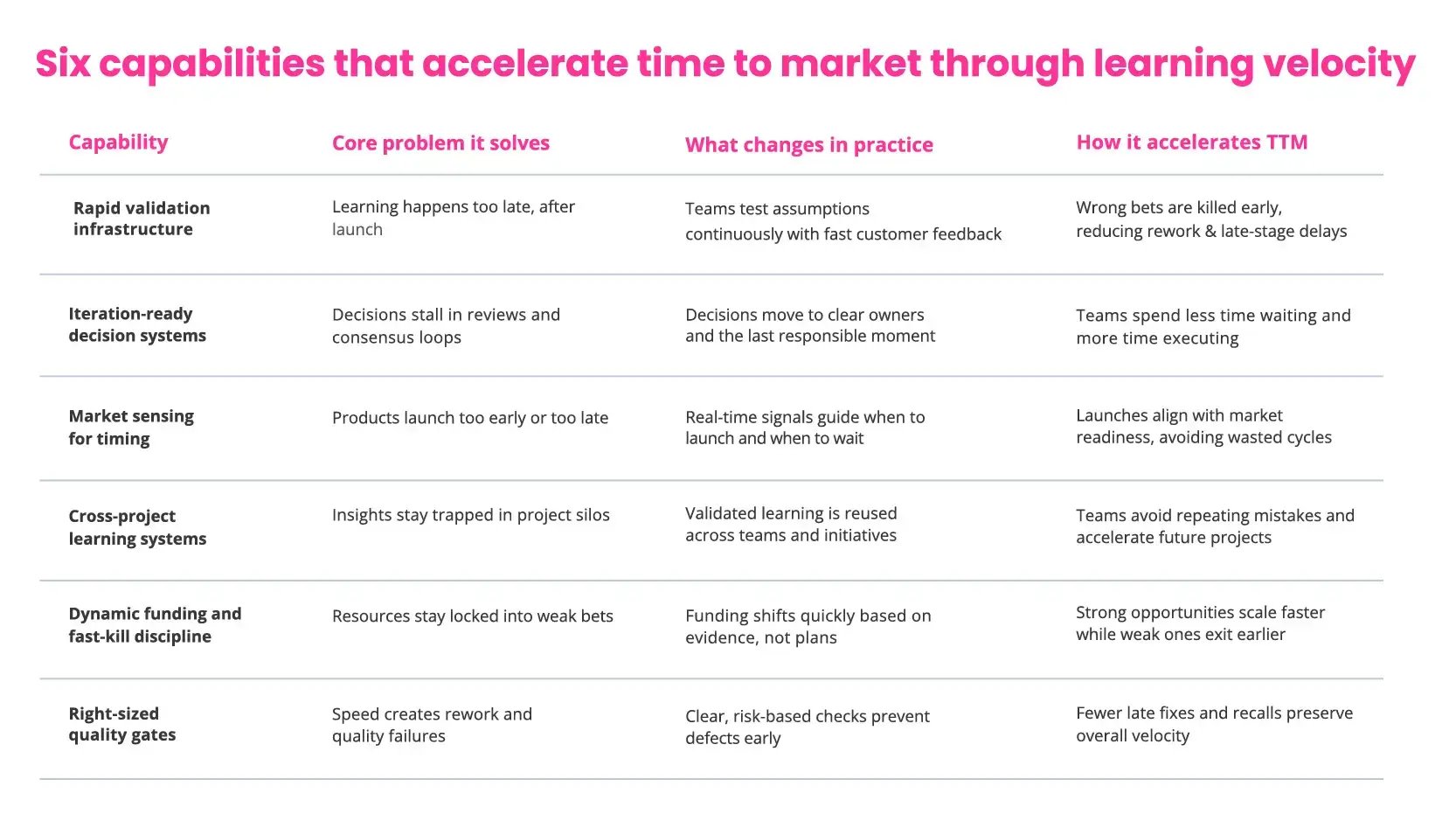
Exhibit 5: Table linking six organizational capabilities to the problems they solve, the practice changes they require, and how each reduces rework, delays, and market timing risk.
Most organizations overestimate their capability to execute fast-to-market strategies. They confuse enthusiasm for infrastructure, aspirations for actual readiness. The gap between ambition and execution explains why first-mover attempts often fail while followers with superior capabilities win. First mover companies with weak capabilities face higher risks than fast followers with mature systems.
Before choosing a timing strategy, assess whether your organization possesses the capabilities to execute it. A maturity model provides a set of criteria for ensuring products are planned, built, and delivered in a way that meets your organization's standards, helping you understand existing levels of maturity and identify areas for improvement.
Maturity models evaluate manufacturing companies along dimensions including Process, Monitoring and Control, Technology, and Organization, with outputs presented in both five-level maturity scales and radar charts. Apply this framework to your product development velocity.
Start with diagnostic questions that force honest assessment. Can cross-functional teams validate assumptions in days rather than weeks? Do decision systems route market signals to people who can act on them immediately? Does resource allocation shift fluidly toward validated opportunities? Can you kill failing projects without political interference? Can you move from concept to customer shipment in less than a year?
The purpose of a maturity model is to assess where you're performing related tasks really well and where you have room for improvement, framing conversations internally about the improvements you want to make. Score each of the six capabilities on a simple scale. Low maturity means ad hoc practices with no systematic approach. High maturity means optimized, data-driven processes that continuously improve through software development practices and continuous integration.
Strategic timing decisions require a comprehensive analysis of market readiness, competitive landscape, and organizational capabilities to determine optimal entry strategies. Your capability maturity determines which timing strategies make sense for your organization.
Organizations with high learning velocity can pursue first-mover positions because they validate quickly and pivot when assumptions fail. First mover companies with mature capabilities can absorb the risks of market education and early design choices. Those with lower maturity should default to fast follower positions until they build the infrastructure to learn faster than competitors.
The critical factor is learning speed, not launch speed. The art of entering a market is making sure that you jump onto the technology adoption cycle at the right point, as entering too early means investing heavily before the market is ready to monetize.
Choose first mover positions when three conditions align. Your organization demonstrates high capability maturity across all six areas. The market shows signs of imminent acceleration, meaning customer problems are intensifying and alternative solutions remain inadequate. Your business goals include establishing technology leadership, building brand recognition ahead of direct competitors, or controlling scarce resources that create sustainable barriers. The first company to enter a market can control resources and establish standards, but only when organizational capabilities support rapid learning and adaptation.
Contemporary research from Harvard Business School indicates that first-mover companies achieve sustainable competitive advantage in only 37 percent of new market categories, while fast followers demonstrate superior long-term profitability in 42 percent of markets studied based on multiple market measures, including customer satisfaction and financial performance. Fast follower positions make more sense when capability gaps exist, when market timing remains uncertain, or when market education costs would consume resources better spent on product refinement.
Fast followers need to be very focused on which specific innovations add significant value to specific market segments, rather than trying to bring every possible innovation to market with no particular one being of standout quality. The selection requires speed. Extended evaluation processes mean competitors release next-generation innovations before you launch your first version. The mover advantage belongs to those who combine speed with strategic focus.
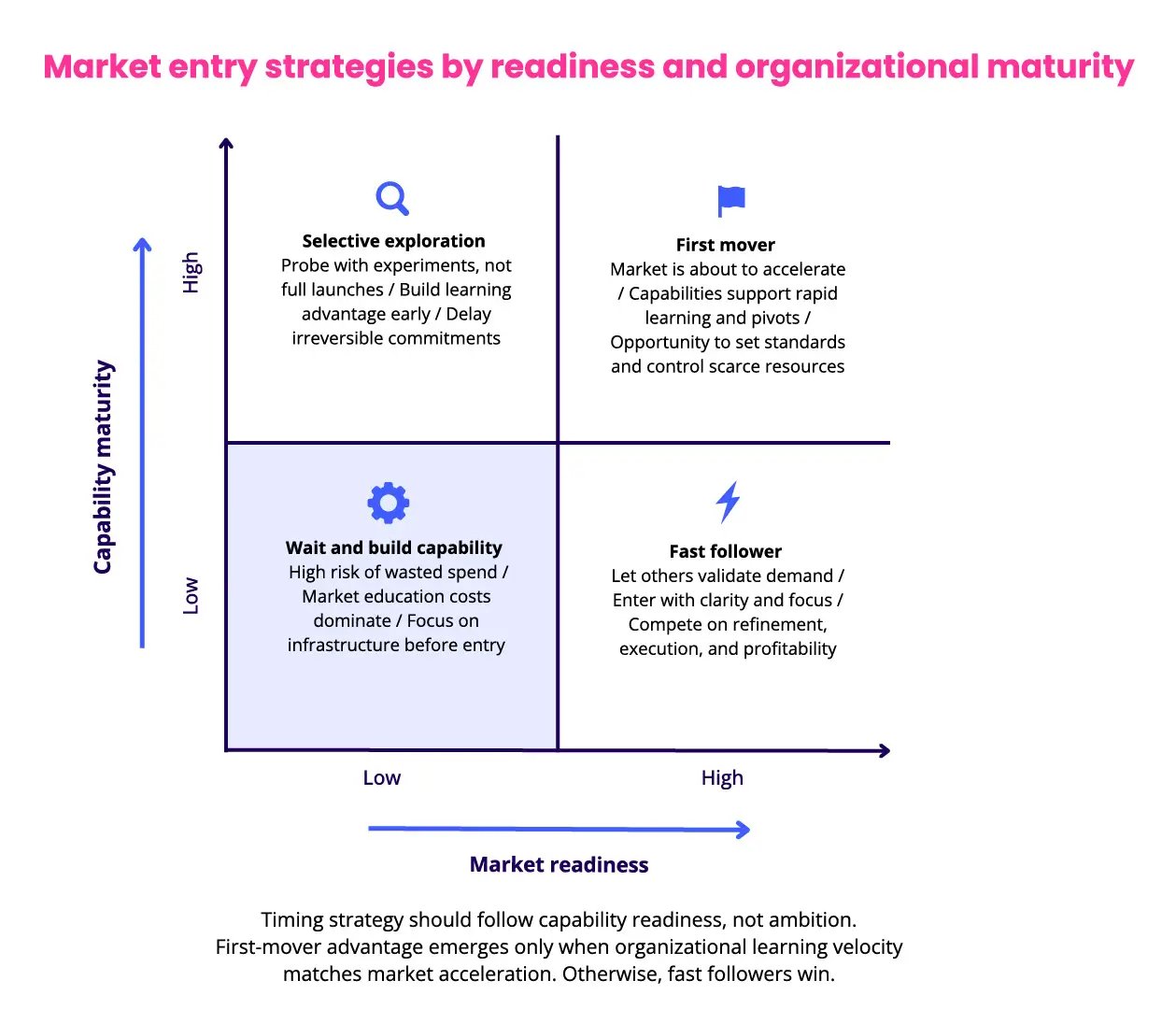
Exhibit 6: Matrix showing when to explore, wait, follow fast, or lead as a first mover based on market readiness and organizational capability maturity.
Speed becomes sustainable only when infrastructure supports it. Organizations that compress time to market once through heroic effort rarely repeat the achievement. Those who build infrastructure turn episodic velocity into organizational capability.
The shift requires moving from project thinking to portfolio thinking. Portfolio management is a dynamic decision process whereby a business's list of active new product projects is constantly updated and revised, with new projects evaluated and selected while existing projects may be accelerated, killed, or de-prioritized. According to McKinsey research, 40 percent of senior executives are actively reducing their portfolios, while 44 percent plan to reallocate R&D budgets toward new product development.
Single projects create temporary speed gains. Portfolio management creates sustained velocity. The capability to continuously evaluate, prioritize, and reallocate resources across multiple initiatives transforms innovation from episodic effort into systematic advantage.
Practical implementation starts with visibility. Can you see your entire portfolio status in real time? Do you track which projects consume resources without generating validated learning? Can you identify which initiatives deserve acceleration and which require termination? Can marketing teams and development teams access the same data when launching products? Organizations like Toyota Motor Europe manage 200+ projects worth over €20M through unified portfolio platforms that provide cross-location visibility and enable rapid resource reallocation.
The discipline to kill weak bets matters as much as the discipline to fund strong ones. Lean enterprises focus on building capability to continuously move initiatives through the model from explore to retire, with initiatives that do not achieve desired outcomes being killed and their investment transferred to other initiatives. This requires infrastructure that makes portfolio decisions transparent, evidence-based, and rapid.
When implemented correctly, agile methodologies and agile innovation teams result in higher team productivity and morale, faster time to market, better quality, and lower risk than traditional approaches can achieve. However, launching agile teams without platform support creates bottlenecks when fast-moving teams hit slow-moving bureaucracies.
Scaling agile methodologies is a cultural transformation where the business's people, practices, and tools are committed to improving collaboration and the organization's ability to execute against strategy. Platforms operationalize the six capabilities by embedding validation infrastructure, decision systems, market sensing, learning systems, dynamic funding, and quality gates into workflows that teams access daily.
The competitive advantage flows to organizations that connect foresight activities with portfolio execution in a unified system. Project management software platforms that integrate trend scouting, ideation, and portfolio management enable development teams to see market signals alongside project status, letting AI flag weak signals and emerging opportunities that should influence resource allocation. This transforms methodology into muscle memory and turns capability into repeatable mover advantage that first mover companies and fast followers can both leverage.
Time to market advantage belongs to organizations that build learning velocity, not just launch velocity. The six capabilities outlined here create the infrastructure for sustainable speed and enable organizations to capture market share through superior execution. Start with an honest capability assessment. Where do gaps exist? Which capabilities would deliver the highest return if strengthened? How does your product strategy align with your capability maturity?
Most organizations already possess fragments of these capabilities scattered across tools, teams, and processes. The transformation comes from integration through effective project management. When validation infrastructure connects to decision systems, when market sensing informs resource allocation, when learning systems feed portfolio management, velocity compounds. First mover advantage enables sustained leadership only when supported by this integrated infrastructure. Whether you are the first company in a category or a fast follower, these capabilities determine your ability to achieve faster TTM consistently.
The organizations winning the time-to-market race treat innovation infrastructure as seriously as manufacturing infrastructure. They invest in project management software platforms that connect foresight, ideation, and go-to-market execution. They embed agile methodologies into systems that scale. They turn episodic speed into organizational capability. They build brand recognition through consistent, successful product launches rather than one-time wins. That infrastructure determines who captures market share and who plays catch-up. First mover companies and fast followers alike benefit from these capabilities, but only those with mature infrastructure accelerate TTM and achieve successful product launches consistently.

.webp?width=900&height=450&name=Top-10-project-portfolio-software-tech-and-development-teams-use-for-managing-innovation-projects-fullwidth%20(1).webp)