How to run a successful hackathon: From idea generation to real-world prototyping


Most innovation hackathon ideas never reach production. A study of hackathon projects on Devpost, by researchers at the University of Tartu and Carnegie Mellon, found that about 65 percent show no continued technical work in the days after the event ends. Only 3.55 percent still show any activity five months later.
The bottleneck sits in what happens after judging ends. Hackathons compress a normally slow process into a short, high-energy window, and that compression produces a strong prototype. Without a connected pipeline waiting on the other side, the prototype has nowhere to go.
This article sets out the five-step framework that connects a hackathon pitch to a funded portfolio decision. It covers what to look for in innovation management software built for follow-through, and closes by showing how Toyota, Cisco, and KSB use ITONICS to turn hackathon energy into portfolio value.
An innovation hackathon is a time-limited event, typically 24 to 72 hours, where diverse teams solve a defined problem and pitch a working prototype to a judging panel.
The same study found that team composition predicts which projects survive. Teams with more diverse skills were 71 percent less likely to be discontinued long-term, and teams whose skills closely matched the project's technical requirements were 53 percent less likely to be discontinued.
The pattern repeats across companies of every size, from smaller teams running one internal event to larger organizations running hackathons across business units worldwide. Innovation leaders run the event, teams demo their work, judges pick a winner, and then nothing moves. The energy in the room fades before it reaches the portfolio.
Gartner's Hype Cycle for Innovation Practices names the reason directly, as ITONICS covers in its innovation methods guide. Hackathons rank among decades-old techniques still used only intermittently, often driven by one enthusiastic manager rather than embedded into the innovation management process. A hackathon that lives outside that process stays a one-off event, cut off from the organization's other innovation activities, no matter how much creativity it produces on the day.
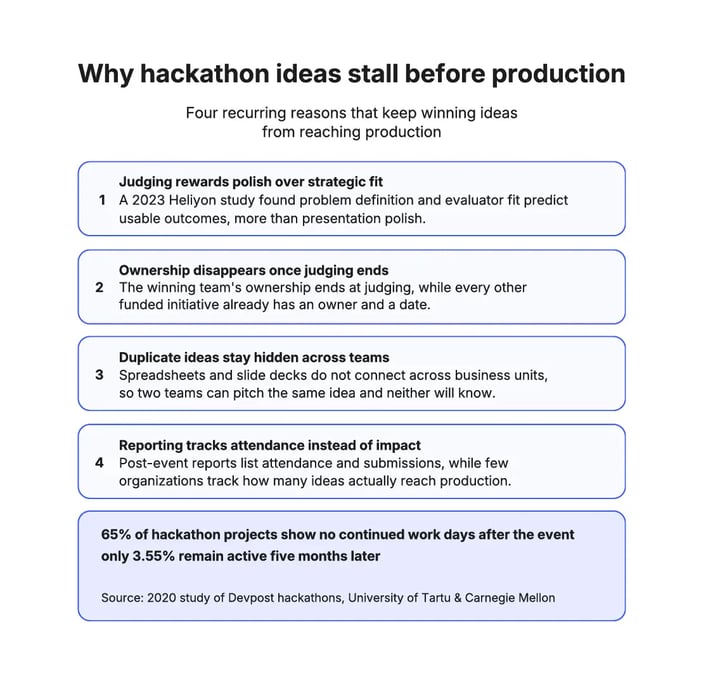
Exhibit 1: Four reasons hackathon ideas stall, with source data from a 2020 Devpost study.
Hackathon judges typically score on presentation quality: polish, pitch, and stage performance. A 2023 study in Heliyon on hackathon success factors found that clear problem definition and qualified evaluators separate hackathons that produce usable outcomes from ones that produce entertainment. That list rewards problem definition and evaluator fit instead.
The Tartu and Carnegie Mellon study adds a sharper point: winning a prize predicted short-term continuation activity, but had no measurable effect on whether a project was still active five months out. Long-term survival tracked team composition, independent of who won the prize.
Teams that optimize for the judging round often build something that looks impressive for five minutes but solves no real problem for the business. The winning demo and the fundable project are sometimes two different things.
A hackathon has a clear owner during the event: whoever is running it. The moment judging ends, that ownership disappears.
No one on the winning team is assigned to carry the idea toward implementation, and no key stakeholders in the business are on the hook to fund it. Often, this means a winning idea gets a trophy and applause but no calendar invite for what happens next.
This gap sits squarely in portfolio management. Every other initiative already in the pipeline has an owner and a decision date, and stakeholders across the business know who to ask. Without that structure, a hackathon idea carries the risk of dying quietly with no one accountable.
Large organizations run hackathons in multiple business units, often in the same quarter, often solving adjacent problems. Existing tools like spreadsheets, slide decks, and one-off submission forms do not talk to each other.
Without a shared system, no one can spot the overlap early enough to put both teams on the same page. A team in one location and a team in another can pitch nearly the same idea to two different judging panels, and neither will know.
That duplication wastes resources twice: once building the same prototype twice, and again evaluating it twice. It also means internal stakeholders fund the same problem twice without realizing it. The larger the organization, the more often this happens unnoticed.
The report that goes to leadership after a hackathon typically lists how many people attended, how many teams competed, how many ideas were submitted. None of those numbers say whether any idea reached a customer. Innovation leaders who want continued budget for hackathon programs, year over year, need a different number: how many ideas from this event are actually live.
Engagement still matters in its own right. Programs that engage employees through recognition and gamification features often see stronger participation. Hackathons also give participants hands-on experience with new tools and open networking opportunities with mentors and peers.
Structured feedback and consistent support after the event strengthen that engagement further. Tracking whether the ideas themselves went anywhere is a separate question, and the one leadership actually funds against. Good innovation efforts still need a funded outcome to matter.
A hackathon idea is just another initiative competing for budget and attention. It is one more candidate for the same pipeline, evaluated against the same criteria as ideas sourced from customer feedback, technology scouting, market trends, or internal strategy work. Once it clears that bar, the portfolio decides whether to fund it, stop it, or scale it.
Organizations run hackathons to solve complex problems quickly. The format works because it compresses a normally slow process into a short window. That compression is a feature during the event and a liability afterward if nothing is built to receive what comes out of it.
This is the core of what strategic portfolio intelligence does: connect signals and ideas, wherever they come from, to a specific fund, stop, or scale decision on a specific initiative. Our complete guide to strategic portfolio intelligence covers the full model behind that decision layer.
A hackathon that skips this step produces demos. A hackathon that feeds it produces implemented ideas.
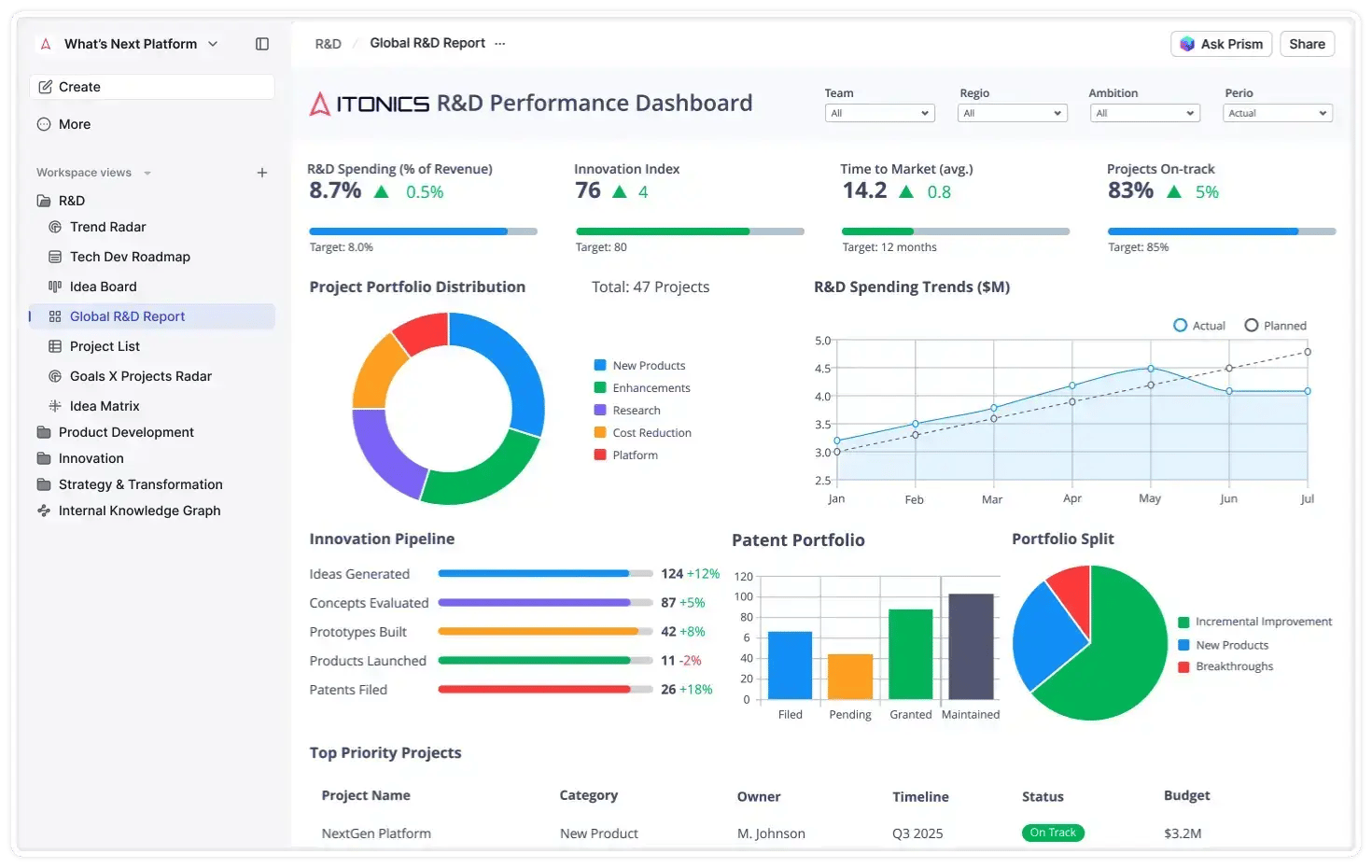
Exhibit 2: The ITONICS dashboard and timeline view where hackathon ideas sit alongside every other portfolio initiative.
Closing the gap between the pitch and production takes five changes to how the event connects to what happens next. The goal is to implement ideas at the same pace the event generates them.
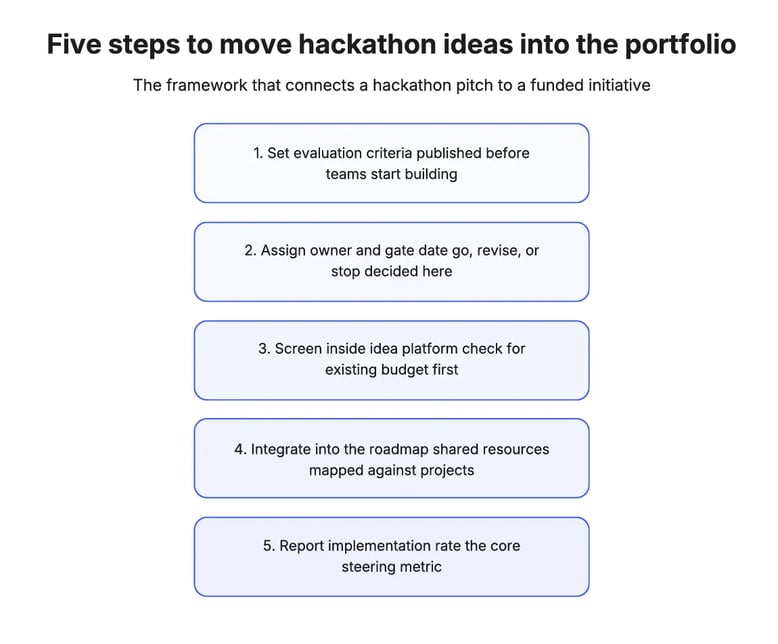
Exhibit 3: The five-step framework that turns a hackathon pitch into a funded portfolio initiative.
Publish the scoring rubric before teams start building, well ahead of judging day. Weight strategic fit and feasibility alongside presentation quality. Teams build toward whatever gets scored, so score the thing that matters for implementation, beyond the demo.
Name a business owner for every idea that advances, on the spot, at judging. Set a gate date, typically 30 to 60 days out, where that owner reports a go, revise, or stop decision.
This is the same discipline good project management software already applies to every other initiative. An idea with no owner and no date defaults to stop by inaction.
Before funding a new pitch, check it against what already exists inside your idea management platform to identify any overlap. If a similar initiative already has a budget and a team, route the hackathon idea into that existing effort instead of starting a parallel one. This routine is part of the same idea management process that governs every other idea already in the system.
Once an idea clears the gate, place it directly on the portfolio roadmap, the same one every other funded initiative already lives on. Map it against the same resources and milestones as those other projects, in Roadmap or Kanban Boards, so leadership sees one pipeline instead of two.
Track what percentage of hackathon ideas from each event reach production within twelve months. Report that number to the steering committee as the headline metric. A lower participation number paired with a higher implementation rate reflects a better program.
A hackathon program lives or dies on what happens between events, and that depends on the innovation management platform underneath it. The right innovation management software enables organizations to centralize idea collection and treat innovation as a repeatable process built around specific needs, rather than basic functionalities alone. Eight capabilities separate technology solutions and services that sustain follow-through from ones that just host a submission form.
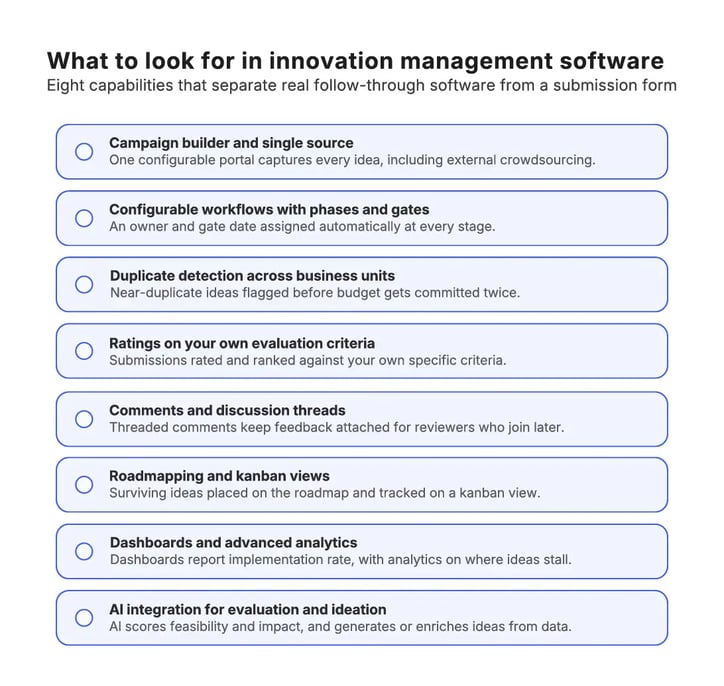
Exhibit 4: A checklist outlining the capabilities to look for in innovation management software built for hackathon follow-through.
ITONICS runs all eight of those capabilities as a single system on one platform, mapped directly to the five-step framework. Idea campaigns capture the submission, Workflow assigns the owner and the gate, and an approval at that gate converts the idea straight into a project.
Prism screens for duplicates and rates every submission against your own criteria, and Network Graph catches overlap Prism might miss by tracing shared tags across the portfolio. Comments keep the discussion attached to the idea the whole way through.
Kanban Boards and Roadmap place the surviving idea as an activity tied to milestones, and Dashboards report the one number that matters: implementation rate.
The ITONICS MCP, now in beta, lets assistants like Claude do this same review and triage work directly from a chat interface, without anyone leaving the conversation to open the platform.
Three ITONICS customers already run their idea pipelines exactly this way, from the first submission to the reported implementation rate.
/Still%20images/AI%20Mockups%202025/capabilities-collaboration-one-single-source-of-truth.webp?width=1440&height=900&name=capabilities-collaboration-one-single-source-of-truth.webp)
Exhibit 5: Prism identifies identical and related projects on request, flagging duplicates before budget gets committed twice.
Toyota Motor Europe needed one system to manage pitch events for R&D and production-engineering proposals across scattered teams, rather than evaluating tools department by department. It tested 40 innovation software systems before choosing ITONICS as its top-level innovation platform. Virtual pitch events now let proposals get submitted, evaluated by experts, and turned into real development initiatives, with more than 500 Toyota members across Europe using the system and over 200 R&D projects managed on it.
Cisco needed an innovation challenge that could reach the whole company without fading into a one-time competition. Cisco's Innovate Everywhere Challenge, powered by ITONICS, runs as one continuous pipeline rather than a single annual event. It now engages more than 50,000 employees across the company, and Cisco's Director of Innovation Strategy credits the platform with making the challenge a key part of company strategy and building a company-wide startup culture that supports long-term competitive advantage.
KSB's biggest challenge was connection and knowledge-sharing between employees spread across 16 locations, with no integrated process for handling ideas. It used ITONICS to build a digital backbone connecting all of them into one system. Idea processing time fell by more than 60 percent, covering the same submission-to-implementation window this framework targets, and more than 7,043 users are now active on the platform with over 1,100 ideas submitted since launch.
A hackathon generates energy for one weekend. A connected pipeline keeps that energy working for the next twelve months. The five-step framework, backed by the right innovation management software, turns a strong pitch into a funded initiative instead of a forgotten prototype.
Toyota, Cisco, and KSB all run their idea pipelines this way, and all three report the same outcome: more ideas reaching implementation, tracked on the same timeline as the rest of the portfolio. The next hackathon your organization runs can produce the same competitive advantage, provided the pipeline it feeds into already connects criteria, ownership, roadmap placement, and reporting into one system. That is what driving innovation at scale actually looks like: less improvisation, more infrastructure.