Trend search in the AI era: The tools, and how to use them


MIT's Project NANDA tracked more than 300 enterprise AI initiatives through 2025. It found that 95% delivered zero measurable return. A 5% minority generated real, documented business impact.
What separates them is application design, not model quality. Teams that treated generative AI as a research assistant got research-assistant results: plausible summaries, no verification, no connection to a decision.
Trend search sits squarely on that divide. Ask an AI tool to summarize where an industry is heading, and it will answer confidently. It will also miss last week's regulatory change, the customer behavior shift buried in a support ticket queue, and the competitor announcement from three days ago. None of it is in its training data yet.
For innovation managers, R&D leaders, and strategy or transformation teams at mid-sized and large enterprises, that failure is operational, not theoretical. Weak trend analysis leads to weak prioritization, slower response, and low-impact AI programs.
This article covers how trend search has evolved and where conventional AI-driven analysis breaks down. It explains what agentic AI and MCP actually add, how to score and escalate signals, and which practices make continuous trend search durable over time.
Trend search used to mean a periodic competitive intelligence report, built from paid industry reports and an analyst's judgment call. That model held because the pace of change matched it. A regulatory shift or a competitor's move took months to surface, not days.
That pace has changed. Patent filings, regulatory changes, and product announcements now publish continuously. Customer sentiment shows up in support tickets and social channels long before a formal market report, the same way sales trends and shifting competitive landscapes surface before a quarterly review. Structured trend radars replaced ad hoc spreadsheets as AI capabilities matured.
AI promised to compress the reading and summarizing work, and for a narrow set of tasks it does. But as the MIT figures above show, most teams applying it to trend search saw no measurable return. Summarizing sources faster doesn't fix a process never built to verify, score, or act on what it finds. Faster-moving trends and an AI layer that only helps inside a disciplined process: that's the landscape trend search now operates in.
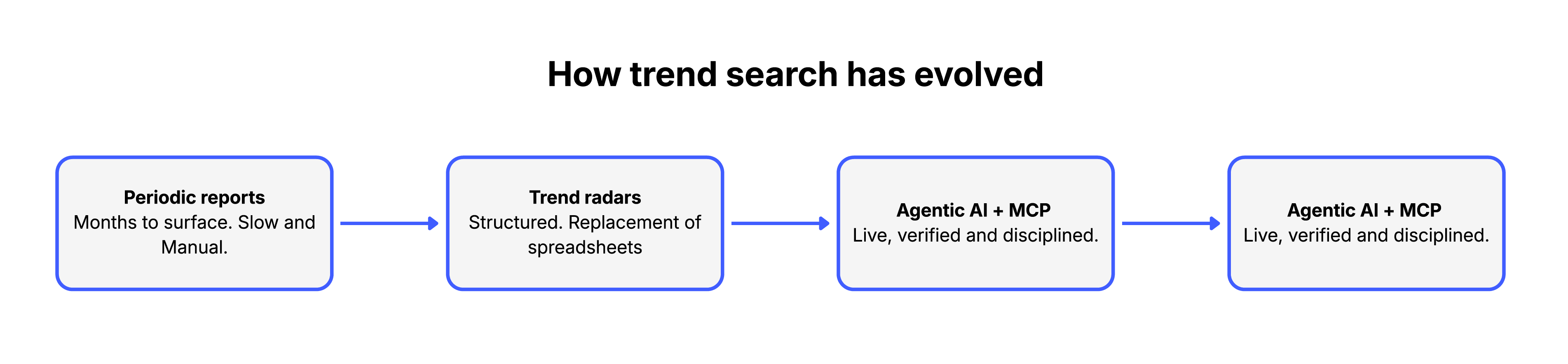
Exhibit 1: Trend search moved from periodic reports to structured trend radars to agentic AI and MCP, running as a live, disciplined process.
Most trend search practices fail in one of three predictable ways. Each pattern feels productive. Each one produces very little that a leadership team can use for strategic planning or day-to-day business decisions.
Teams collect first and filter later, if at all. Analysts subscribe to industry reports, monitor social media engagement, and track competitor moves. Everything routes into a shared folder or dashboard. Volume becomes the proxy for coverage.
The proof is in what happens next: nothing. A signal library with thousands of unscored entries places the entire analytical burden back on the analyst who has to read it. Collecting data without a scoring layer does not reduce workload. It just moves the noise problem downstream, where it's harder to solve because there's more of it.
Consider an R&D team monitoring emerging technology trends across three product lines. Without a filter, the team receives the same volume of alerts about a minor packaging trend and a genuine supply chain management issue. Both compete for the same five minutes of attention. Collection without triage is not trend analysis: it's an inbox.
Customer behavior data is one of the richest sources available to any business. It's also one of the most underused for trend search. Support tickets, product usage logs, churn data, and social channels all contain early signals of shifting sentiment or need. Most of it never reaches a strategic planning conversation, and identifying which tickets matter takes real analyst hours few teams have to spare.
The reason is structural. These sources are large, unstructured, and scattered across systems that don't talk to each other. A single support ticket mentioning a competitor's new feature is a data point. Ten thousand of them, if nobody's watching for the pattern, is invisible.
A rise in support tickets referencing a specific integration failure can flag an emerging shift in customer sentiment. Tracked against historical data and historical patterns, it can help determine whether a churn report or a dip in revenue growth is about to show the same thing. These signals need the same statistical treatment as external market data. Left unscored, they stay buried regardless of how much data sits in the system.
The third pattern is the most avoidable, and the most common. Businesses ask a general-purpose AI assistant to identify trends and treat the output as current. It isn't, for two reasons.
First, AI assistants can't independently verify a claim against a primary source, or assess whether the evidence is sufficient. Ask one to confirm a statistic and it restates what looks statistically plausible. That's not the same as what the actual regulatory filing, patent record, or customer complaint says. Nothing checks the claim against the source unless something else in the system is built to do that.
Second, every generative AI model carries a training cutoff. Anything material that happened after that date, a regulatory change, a move in interest rates, a competitor's launch, doesn't exist in its knowledge. It has no way to flag that blind spot on its own. It answers as if its training data were still current, because as far as it's concerned, it is.
The practical effect is false confidence. An analyst who doesn't independently verify a fluent-sounding answer inherits an error they can't see. A few years ago the bottleneck was volume: too many sources, not enough analyst hours. Today it's trust: is this signal current, verified, and is someone accountable for it, whatever the industry.
Closing that trust problem means changing the architecture. The AI system queries external systems and tools directly, instead of relying on what it memorized during training. Effective trend analysis needs three things generative AI alone doesn't provide: live access to current sources, a statistical method for separating signal from noise, and a governance layer that decides when a finding, in context, reaches a person. That combination is what agentic AI adds, letting a team determine which signals deserve attention before an analyst opens the queue.
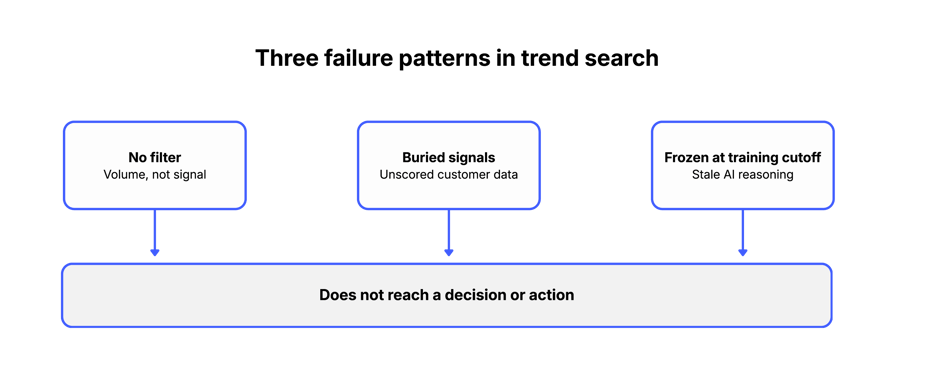
Exhibit 2: Three failure patterns, unfiltered collection, buried customer signals, and stale AI reasoning, all end with no decision made.
Delivering on that combination takes two things: an agentic system that can act on what it finds, and MCP, the connection that gets it there. Agentic systems need both pieces to function at all, and agentic AI is only as good as the data it can reach.
A static AI assistant cannot solve problems it can't see or verify. Agentic systems can act on what they find instead of just answering a question. The same pattern shows up well beyond trend search: agentic AI already spans finance, healthcare, logistics, and education, enabling more personalized services in several of those sectors.
Agentic AI is a real technological evolution beyond generative AI, not a rebrand of the same tool. A generative model produces content when prompted, nothing more. Agentic AI systems pursue a goal and take a sequence of actions toward it. They adjust based on what happens along the way, and perform tasks autonomously without a new prompt for every step.
Three features define an agentic system: autonomy, goal-orientation, and adaptability. It works toward a defined outcome instead of answering a single question. It maintains contextual memory across a session, so a recurring task gets handled better over time. It learns from experience, checking sources at 3 a.m. as reliably as at 9 a.m.
For trend search, without AI agents doing this work, someone still has to run the query, weigh what it returns, and decide whether to act on it. Agentic AI systems close that final step. AI agents use external tools, APIs, and databases directly, and apply scoring logic on their own. Then they take specific actions inside a defined boundary: drafting an alert, updating a shared radar view, or requesting a human decision.
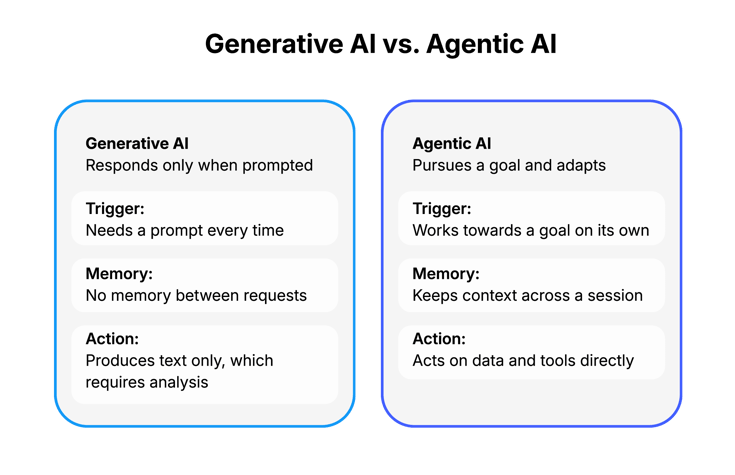
Exhibit 3: Generative AI responds only when prompted, while agentic AI pursues a goal, takes action, and adapts as it works.
Model Context Protocol, or MCP, is the open standard that lets AI agents plug into live data sources instead of only working from what they were trained on. Before MCP, connecting an AI system to ten sources meant building ten custom integrations. MCP replaces that with a single, shared connection, the way USB-C replaced a different cable for every device.
For a trend search practice, that means one agent can read a patent database, a regulatory tracker, and an internal support ticket system as three live feeds instead of three separate integration projects. That's exactly the live access a training cutoff can't provide.
That same connection should point inward too. The most useful context for a new external signal is often a business's own innovation data: its active project portfolio, existing idea pipeline, and past initiatives. A regulatory shift overlapping a technology already in development needs a different response than one appearing cold. Without that context, an agent can flag a signal as new when a team scoped it eighteen months ago.
Reaching that far comes with a tradeoff. An agent wired into external and internal sources alike inherits whatever access those sources have, and MCP's ecosystem has already had real, documented security incidents. The practical implication is to manage risk the way any sensitive system gets managed: access centrally controlled, audited, and revocable, not granted once and forgotten.
ITONICS now offers exactly that kind of connector, across various LLMs including Claude, ChatGPT, and Gemini. A team can connect its own workspace directly, pull existing data into a conversation, and build on it in natural language instead of code. A reporting dashboard on feedback volume and customer trends, or a page built from data already sitting in the workspace, is the kind of work that used to require hard-coding skills. Simpler automations run the same way, like scanning a Slack channel for new links and logging them into the workspace, without a custom integration project.
ITONICS' own connector runs inside that same discipline rather than around it. A team authenticates with its own credentials, so access to internal data still follows whatever permissions and roles are already set up in the workspace, and that access can be reviewed or revoked the same way any other integration can. Implementing agentic AI requires disciplined API management as much as it requires good models, and that discipline, not a blanket promise of safety, is what actually protects internal data.
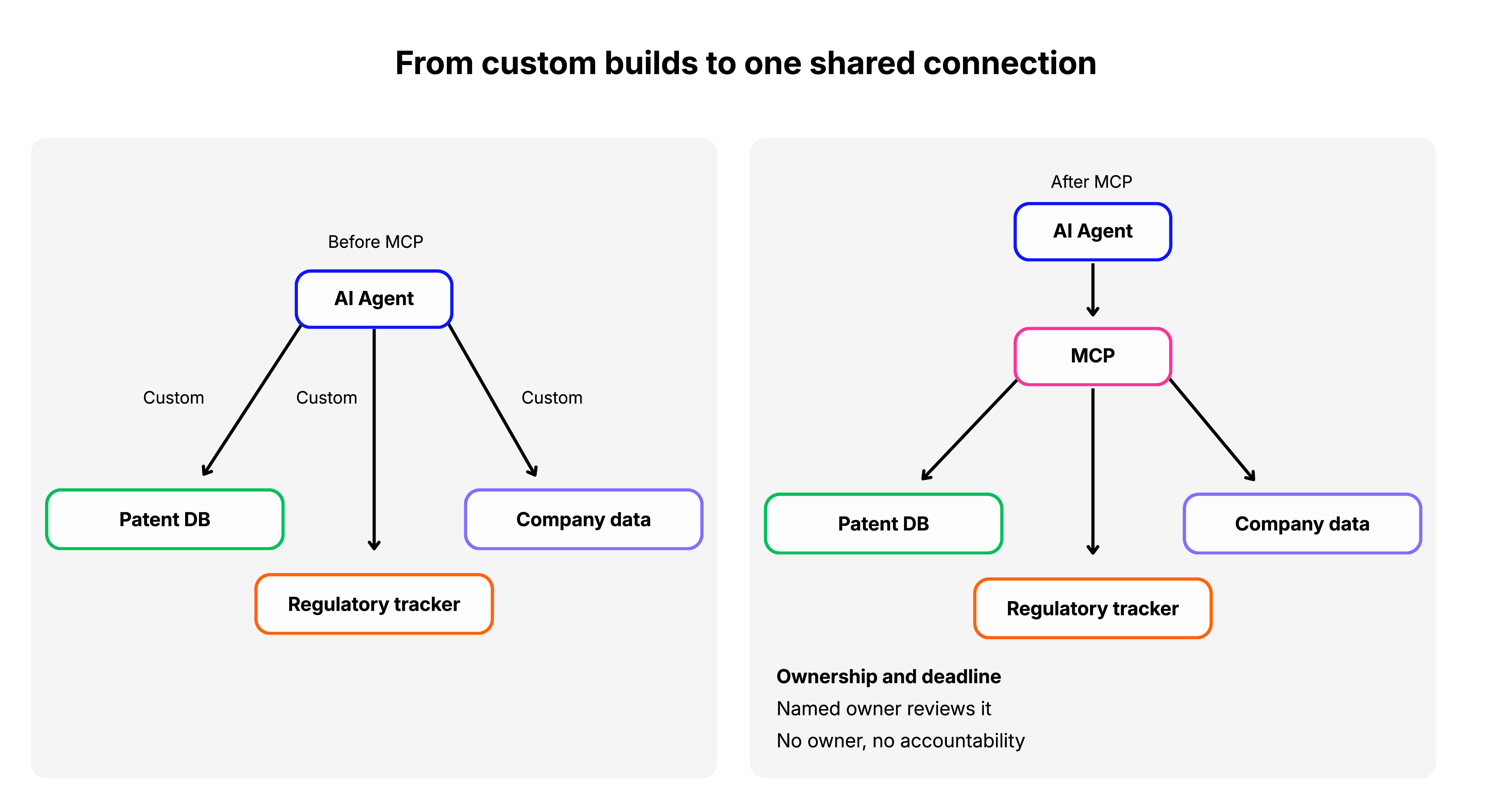
Exhibit 4: Before MCP, an agent needs a custom build per source. After MCP, one shared connection reaches every source
Knowing what agentic AI and MCP do is one thing. Putting them to work on an actual trend search practice comes down to the same three things raised earlier. MCP supplies the first, live access to current sources. The other two, a statistical method for separating signal from noise and a governance layer that decides when a finding reaches a person, are what the next two sections build.
An agentic system connected through MCP doesn't wait for someone to open a dashboard. It pulls each source on schedule and scores it with the statistical method below. Then it checks the result against the escalation rule, and only surfaces what clears both. A person still makes the final call on anything escalated; everything before that call is what AI agents now do on their own.
Applied consistently, this turns trend search from a periodic report into a live decision-making system. Not a quarterly document, but a continuously re-scored view of the observed trends and how confident the organization should be in each one.
The goal is simple: identify which signals matter to the market or industry a team operates in, then convert them into a comparable number so they can be ranked instead of judged one at a time. Four methods do most of the work, and none require a data science background to run.
Frequency count. Track how many independent sources mention the same signal within a fixed window, a week, for example. A signal repeated across five unrelated sources carries more weight than one mentioned once.
A weighted scoring matrix. Score each signal across a small range of dimensions. Impact, probability, and velocity are a reasonable set, scored on a simple 1 to 5 scale. Sum the scores into one comparable number. This is the tool that lets a scout rank a new material against regulatory shifts and a competitor's patent filing on the same list.
Rate of change. Compare a signal's frequency this period against the prior, using historical data as the baseline. Five mentions this month against three last month is a mild increase; thirty is a different kind of event, the sort analysts should flag immediately. Time-series analysis examines data points at regular intervals. Regression analysis uncovers relationships between dependent and independent variables, testing whether external factors, like a regulatory shift or a move in interest rates, explain the spike.
A basic outlier check. Identify any signal that spikes well above its own recent average, rather than one climbing steadily. A steady climb is normal market movement. A sharp spike against a stable baseline is worth a second look, and AI agents can flag it automatically once the threshold is set.
Pick one of these methods and apply it consistently. Resist building a more elaborate model before the simple version is trusted and in use.
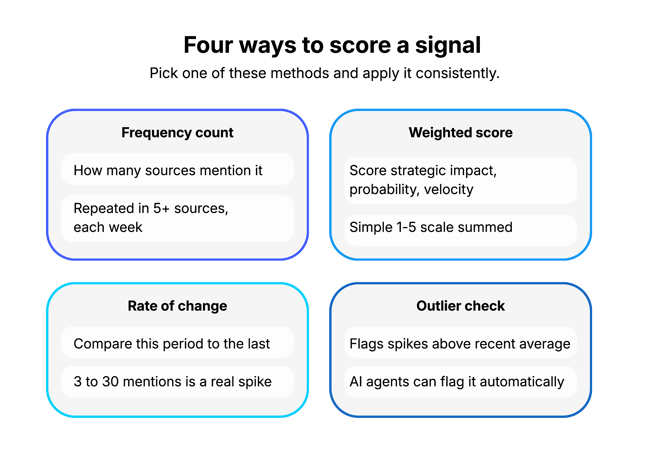
Exhibit 5: Four scoring methods, frequency count, weighted score, rate of change, and outlier check, each with a concrete example.
A scored signal still needs a decision rule attached, or the scoring exercise just produces the same downstream inbox problem as an unfiltered signal library. That rule decides, in advance, what score and what pattern of confirmation moves a finding from the queue to a person, replacing judgment calls with a fixed test so the decision doesn't depend on whoever happens to be reading that day. It also helps identify which challenges deserve escalation. This is the governance layer, built from four mechanisms below.
A numeric threshold. Set a cutoff on the scoring matrix above, a total score of 12 out of 15, for example. A score crossing that cutoff triggers review; nothing lower does. This keeps the decision consistent from one week to the next and gives the team a way to review performance over time.
A source-convergence rule. Require independent confirmation from a minimum number of source types before a signal escalates. A scouting report and a patent filing count as two source types; a single source repeating itself doesn't. This is what separates a genuine early signal, the kind that supports decision making and revenue growth, from an echo chamber.
A three-way outcome. Every escalated signal gets one of three labels: adopt, monitor, or discard. A signal that clears the score but fails independent confirmation gets discarded, not left open indefinitely, which frees resources for signals that actually matter.
Ownership and a timeframe. Name who reviews an escalated signal, and by when. Without a named owner and a deadline, an escalated signal is functionally the same as an unscored one.
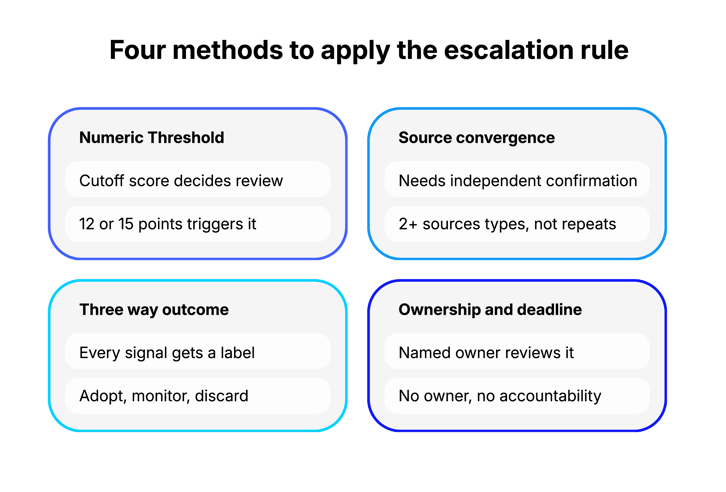
Exhibit 6: An escalation rule combines a numeric threshold, source convergence, a three-way label, and named ownership.
Gartner found only 15% of IT application leaders were considering, piloting, or deploying fully autonomous agents. That's well below the 75% experimenting with agents in some form. Confidence in bounded, well-scoped agentic systems is building. Confidence in full autonomy isn't, and agentic AI shouldn't run unsupervised for trend search, where a missed regulatory shift has a real cost.
That caution is earned. A 2025 field study of clinical AI agent deployments found that 80% of total implementation effort went into data engineering, stakeholder alignment, governance, and workflow integration, not development of the model itself. Prompt design and model tuning made up the rest. Trend search agents follow the same pattern, where the model is the easy part and the real advantages come from the discipline built around it.
Agentic AI also raises accountability questions a static report never had to answer. If a system escalates the wrong signal, who's responsible: the team that set the scoring rule, or the system that applied it? Organizations are exploring policies for accountability and auditing as AI systems gain autonomy, and trend search is a reasonable place to start. Teams that analyze this early get the benefits of agentic AI without the stability risks of skipping it.
None of this works without discipline behind it, especially for the trends that move fastest. Some practices compound in value the longer they run. Others erode trust in the system and should be killed the moment they're identified, which is why the practices below focus on the systems around the technology.
Recalibrate thresholds against real outcomes. A cutoff or scoring weight set on day one won't stay right forever. Review a sample of escalated and discarded signals each quarter, and adjust the numbers based on what actually happened.
Assign ownership of each source to one person. Shared responsibility becomes no responsibility, even once an agent runs the queries. The owner keeps its connection and context current, and is the first call when results start to drift.
Set a fixed review cadence and define desired outcomes and KPIs before you scale autonomy. Ad hoc review lets trend search quietly revert to the one-time report it replaced. A fixed cadence, defended on the calendar, keeps the practice alive. Define success and set KPIs before scaling autonomy to agentic systems.
Treating trend search as a one-time report. A report captures a moment. Markets, competitors, and customer sentiment keep moving after it ships, and a document from last quarter can't catch what changed this week.
Scoring signals without a rejection threshold. Escalation without rejection means every signal accumulates instead of clearing the queue. Six months in, the backlog is unmanageable, and the scoring system has lost the one job it had, separating what matters from what doesn't.
Letting AI agents query stale, cached data. AI agents that query a cache refreshed once a month provide false assurance of currency. If the architecture can't guarantee a live source, it shouldn't run scoring or escalation unsupervised.

Verified signals, scored data, a defined escalation rule, and agentic AI systems connected to live sources rather than static reports are the practices that matter. They separate the small minority of businesses getting real value from agentic AI from the majority that are not, whatever the market or industry.
ITONICS brings these pieces into a single environment rather than leaving teams to assemble them from a dashboard here and a spreadsheet there. Signals get scored and filtered continuously, then routed to a named owner the moment they clear threshold.
Prism, ITONICS' AI layer, builds that same discipline into a governed workflow of specialized agents, purpose-built for trend synthesis, intelligence triage, and portfolio work. Each agent handles one job, and every output carries its reasoning and sources, the same escalation discipline this article has argued for throughout. Teams that want it built rather than assembled by hand can lean on ITONICS' consulting team, already on standby.
This agentic architecture has already been proven in production, running a live intelligence triage workflow inside a Fortune 500 insurance group and a 360°-PESTEL trend synthesis pipeline in the defense sector.
Beyond the agents ITONICS builds directly, any MCP-compatible tool can also connect to pull trend and portfolio data out or push findings back in. MCP only became a Linux Foundation standard in late 2025, and building both directions of that connection this early keeps ITONICS current with where the standard is heading, not behind it.
Whether it runs on a spreadsheet or an agentic AI platform, discipline decides which side of the MIT numbers a team lands on, not the technology. The organizations already running trend search this way won't need to pitch their AI investment by year-end. They'll already know what it found.