Technology IP protection: When patents beat trade secrets (and vice versa)


Patenting is seen as the gold standard for protecting a company's intellectual property. In reality, approximately 97% of patents fail to cover the expenses incurred during filing.
The effect of patents for companies is foremost commercial: attracting investments, trading, licensing, and suing copycats. It is more like a business case than an effective protection strategy. Other IP strategies - like trade secrets, complexity, tacit knowledge, and lead time - are often more effective at protecting technology.
The real question is whether resale value or technology protection is the right priority. This article explores the criteria that favor patenting, trade secrets, and informal protection strategies, so you can align each technology in your portfolio with the right approach.
Technologies are the materialization of a firm's unique know-how. They enable the creation of products and determine what companies need to succeed in the market.
If these technologies are proprietary and unique, there is a strong chance of generating a sustainable competitive advantage. Effective protection of a company's intellectual property is essential to securing its market position and revenue stream.
IP protection strategies fall into two categories. Formalized strategies include patents and trade secrets. Informal strategies include high complexity, tacit knowledge, strong branding, and a lead time advantage. Both categories serve not only as protection mechanisms but also as paths to commercialize technology.
None of them is a silver bullet. The effectiveness of each strategy depends on specific factors - and on your company's overall IP and business strategy.
Patents give companies a legal monopoly over a technology for a defined period. In return, they disclose the invention to the public. This trade-off - exclusivity for transparency - shapes when patents make sense and when they don't. The following sections cover why firms patent, how the process works, and what conditions must be true for patent protection to deliver real value.
Firms pursue patent protection primarily to safeguard new, non-obvious, and useful inventions that diffuse across different applications. If a patent application fulfills the necessary requirements, the patent holder receives exclusive rights to make use of a patented invention for a limited area and time. This means stopping other parties from making, using, or selling it without authorization.
This legal protection serves as a deterrent against competitors and provides a foundation for attracting investments and negotiating licensing agreements. If someone commits patent infringement by violating this exclusive right, they can be reported and fined. Patents grant a monopoly of usage and, as a consequence, commercially attractive revenue paths.
The patent system provides a structured legal and procedural framework for protecting inventions, fostering innovation, and enabling companies to strategically manage their patent portfolios. Developing a patent strategy is a critical component of any company's overall business strategy.
The patenting process involves several stages governed by patent law and the requirements of the relevant patent and trademark office.
To file a patent, the inventor or a patent attorney drafts a patent application describing the invention in detail - its features, functions, and potential applications. The application must address prior art to demonstrate novelty and non-obviousness, and meet the specific requirements of the patent office where it will be filed.
Patent filing can be initiated through a provisional patent application, which provides an early filing date and is cost-effective. It allows a 12-month period to further develop the invention before submitting a non-provisional application. Public disclosures or other forms of disclosure - presentations, sales, publications - before filing can jeopardize patent eligibility and may result in the invention entering the public domain.
It can take 30 to 64 months until a patent is granted and can cost approximately €50,000 in fees alone, not including costs for legal representation and advisory services.
After filing, the patent application undergoes examination by a patent examiner at the patent and trademark office. The examiner determines whether the invention meets the criteria for patentability: novelty, non-obviousness, and utility.
The examination phase - known as prosecution - involves reviewing and responding to office actions. These are official communications detailing objections or requirements. The inventor or their patent attorney must respond within a specified time frame, usually six months, by addressing the examiner's concerns and amending the application.
If the examiner determines that the invention meets all patentability requirements, the application will be allowed, and an issued patent will be granted. The grant date marks the official start of the patent's enforceability. Patent holders must then pay maintenance fees at regular intervals to maintain the patent in force.
If the examiner maintains objections that cannot be overcome, the application may be rejected. In this case, the details of the invention will still be disclosed and may enter the public domain, but patent rights are not granted, and the applicant does not receive exclusive rights to restrict usage.
In many countries, patents have a limited term of 20 years from the filing date, after which they expire, and the invention enters the public domain.
The first critical factor is having the financial and legal resources not only to file a patent but also to find and sue potential infringers. Successful enforcement can result in monetary compensation or monetary damages, providing financial redress and deterring future patent infringement. Without the means to identify infringements and pursue them, patents hold little practical value.
The second factor is the expected diffusion of the technology and its ability to set technological standards. If a technology is likely to become critical across many applications, patent protection prevents competitors from bringing similar technologies to market. This is why many suppliers in the automotive industry — Bosch, Continental, Denso - consistently lead patent rankings.
But two additional factors matter:
If a technology is easy to replicate once its mechanics are understood, a patent creates a time advantage that complexity alone cannot provide.
And in R&D-heavy firms, patents function as currency. Engineers' reputations and investor evaluations are partly built on the number of patents applied for and held.
Patents are not the only option - and for many technologies, they are not even the best one. Trade secrets, complexity, tacit knowledge, and speed to market can provide stronger protection at lower cost and without the risk of public disclosure.
The sections below explain when these strategies apply and what conditions make them more effective than filing a patent.
Every patent registration requires the disclosure of unique knowledge. There is always a risk that the right to exclude is not granted, expenses are never covered, or infringers are not identified and sued. That is why companies also choose IP strategies that do not disclose unique knowledge.
Trade secrets grant the right to prevent others from using or disclosing secrets without authorization. They are formal agreements - like non-disclosure agreements - that commit holders to confidentiality without requiring formal registration or public disclosure.
Beyond formal contracts, informal arrangements complicate the understanding of a technology's mechanics. Complexity, tacit knowledge, and being first to market are often more effective protection strategies than patents. Complexity and tacit knowledge hinge on restricted accessibility of required knowledge. While patents reveal this knowledge, these informal strategies force potential imitators to acquire it independently - at high cost and time.
Being fast-to-market also helps create recognition of a certain brand with a specific technology. This first-mover advantage complicates building the same position for competitors, even with better technology.
The first factor is cost. If a firm lacks the legal and financial resources to patent and enforce patent rights, or if licensing is unlikely, keeping the technology secret is more effective. If usage is unlikely to diffuse across many applications, it is probably not attractive enough for copycats to invest in researching and rebuilding it.
The second factor is the uniqueness of the technology and its expected diffusion rate. If a large majority of adopters will benefit immediately and the technology is easy to understand, the advantage gained from speed and strong branding can outweigh the monopoly position from patenting. OpenAI and ChatGPT illustrate this: the company has kept core IP secret while moving fast to market, creating a brand association that competitors struggle to displace.
The third factor is complexity coupled with sunk costs. If the technology requires considerable investment to build, keeping it secret forces competitors to spend years catching up. Any disclosure of relevant knowledge crowds out the time advantage.
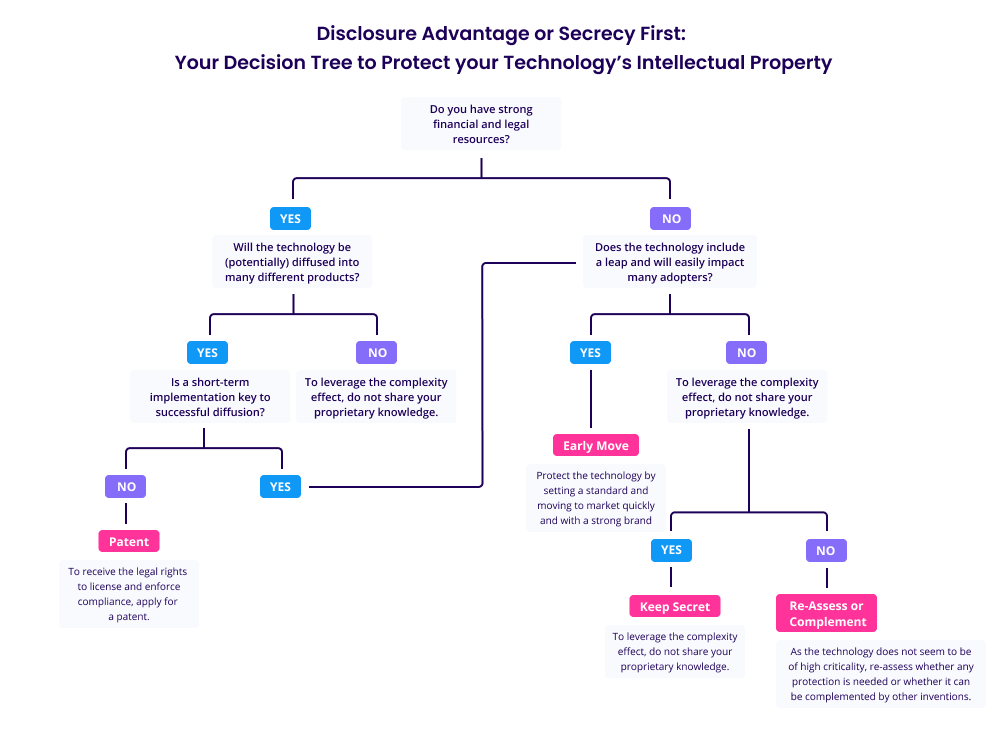
Based on the analysis of patenting, trade secrets, and informal IP protection strategies, a decision tree helps Chief Technology Officers, Patent Managers, and Innovation Managers identify the right strategy.
Trade secrets are a common business practice and apply independently of the go-to-market strategy. They are formal internal agreements binding employees and co-innovating partners to confidentiality. But when it comes to marketing a technology, each decision must account for legal position, financial situation, reputation effects, brand strength, technology characteristics, and revenue strategy.
The key questions to work through:
No single answer applies to every technology. Most portfolios require a mix of strategies applied asset by asset.
Patent holders must actively monitor for infringement by other parties and take action against potential infringers to protect their intellectual property.
If someone commits patent infringement by using a patented invention without authorization, the patent holder can seek patent protection through legal action. Successful enforcement can result in monetary damages for losses suffered and injunctions preventing continued unauthorized use.
The challenge is identification. Infringers are not always obvious. Monitoring competitor products, filings, and market behavior is an ongoing process - not a one-time check. This requires dedicated resources or specialized management software to track relevant activity.
To secure the long-term amortization of any technology investment, every technology needs the right IP protection strategy - applied consistently and tracked over time.
Within ITONICS, organizations gain a clear overview of their full IP portfolio. Every patent, trademark, trade secret, and technology asset gets its own profile page. Protection strategies are assigned, rated, and visualized on an interactive radar. The radar shows what strategies are applied across the portfolio and where gaps exist.
Nearly 97% of patents are not further leveraged after filing. With a complete overview of all patents filed, organizations can identify unused patents, evaluate their revenue potential, and activate them through licensing or sale. The platform also monitors competitor filings automatically, alerting teams when relevant patents are published in key technology areas.
ITONICS also supports the rating process central to the decision tree above. Teams rate each technology against diffusion potential, complexity, and urgency - the three criteria that determine the right protection strategy. This removes guesswork from one of the most consequential decisions in an IP and business strategy.
For additional information on how ITONICS supports IP portfolio management, explore our case studies.
A patent grants exclusive rights for up to 20 years but requires full public disclosure. A trade secret provides unlimited protection as long as it stays confidential, but grants no legal exclusivity if a competitor independently develops the same technology.
The right choice depends on diffusion potential, complexity, and available legal resources.
It typically takes 30 to 64 months from filing to grant, depending on the patent office and the complexity of the technology. Prosecution - the back-and-forth with patent examiners via office actions - is the primary source of delay.
A provisional patent application secures an early filing date without triggering the full examination process. It gives inventors 12 months to develop the invention further before submitting a non-provisional application. It is cost-effective and reduces the risk of losing the filing date to a competitor.
When it lacks the legal and financial resources to enforce patent rights. When the technology is unlikely to diffuse widely. When the complexity of the technology or high sunk costs make informal protection more effective.
When speed to market and brand recognition outweigh the value of a monopoly position.