Choosing AI tools for strategic portfolio management has gotten harder as every vendor has added a chat interface in 2024 and 2025. Most of what is now sold as "AI for SPM" is a project portfolio management tool with a copilot bolted on.
This guide compares the 7 leading AI tools for strategic portfolio management on the same seven criteria. It is built for strategy teams choosing between platforms, not for IT teams running implementations.
Three numbers worth knowing before reading:
-
PMI research shows companies using strategic portfolio management software achieve 38% higher project success rates and finish initiatives 28% faster.
-
Gartner reports 45% of initiatives fail due to poor capacity management. Companies forfeit roughly 11.4% of investment value through misaligned execution.
The tools that move those numbers are the ones worth shortlisting. The decision for each vendor comes down to two questions: does the AI surface signals you would not have caught otherwise, and does it operate on your actual organizational data?
Why AI tools for strategic portfolio management matter now
The work has gotten harder in three measurable ways.
#1: The volume of strategic initiatives keeps rising
A typical enterprise runs 50 to 200 active initiatives in parallel, and most lack an integrated system to govern them.
#2: Market conditions shift faster than annual planning cycles
A strategic plan written in January is often outdated by Q3. AI is the only realistic way to keep portfolio decisions in sync with market shifts.
#3: The evidence base finally exists
PMI research shows companies using strategic portfolio management software achieve 38% higher project success rates and finish initiatives 28% faster. Gartner reports 45% of initiatives fail due to poor capacity management. Companies forfeit roughly 11.4% of investment value through misaligned execution.
Business leaders no longer ask whether AI belongs in strategic portfolio management. They ask which AI capability changes which decision, and whether it delivers measurable business value.
How to evaluate AI tools for strategic portfolio management
Use seven criteria (Exhibit 1). Score each tool the same way. A 7 means "good but fixable." A 10 means "exactly how it should work."
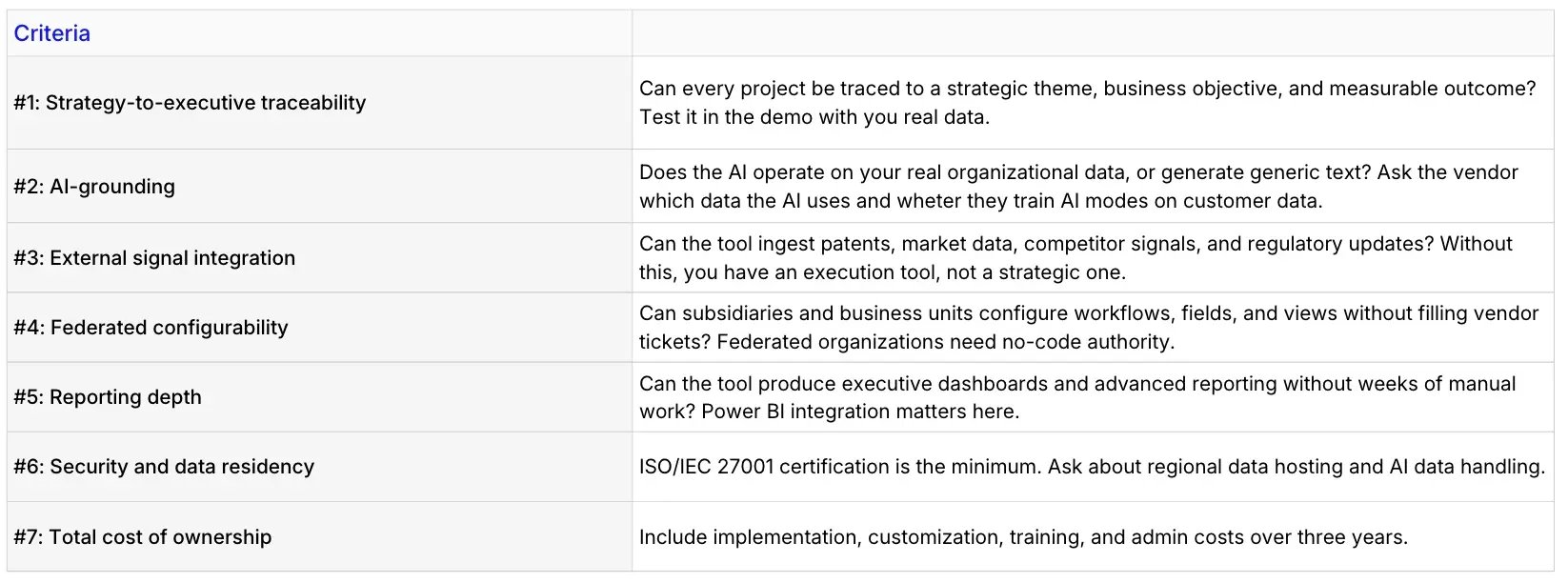
Exhibit 1: The 7 evaluation criteria for AI tools for strategic portfolio management
Use identical scoring for every tool. Then, weigh the criteria by what matters most in your context.
The 7 best AI tools for strategic portfolio management
#1: ITONICS
ITONICS treats strategic portfolio management as one layer of a connected innovation operating system that also covers foresight, ideation, and execution. Prism is the context-aware AI layer that runs across all of them.
Key AI features
Prism tracks over 50 million real-world signals across patents, publications, competitor moves, and market shifts. It checks every initiative against strategy in real time and flags misalignment. It surfaces the 15 to 20% of innovation projects stalling and detects duplicate efforts wasting parallel resources.
The platform exports board-ready PowerPoint reports directly from live portfolio data.
Best fit
Innovation-led companies, R&D-intensive industries, and federated enterprises, where strategic portfolio decisions depend on external signal flow.
Strong choice for organizations balancing core, adjacent, and transformational bets.
Limitations
Less depth on heavy execution tracking than ServiceNow or Planview. If your portfolio is mostly delivery management on locked-in initiatives, those tools fit better.
#2: ServiceNow SPM with the ServiceNow AI platform
ServiceNow Strategic Portfolio Management runs on the ServiceNow AI platform. It is the strongest fit for organizations already standardized on ServiceNow for IT and operations.
Key AI features
Now Assist for SPM adds AI features purpose-built for portfolio work. AI status reports predict schedule health from variance data.
The system calculates resource availability for role-based assignments. The Strategic Planning Workspace provides AI-guided recommendations on goal health and identifies at-risk targets with confidence scores. MyNow gives portfolio managers a personalized workspace with AI-guided recommendations.
Best fit
Large enterprises with deep ServiceNow investments, execution-heavy portfolios, and IT-led SPM ownership.
Limitations
Outside-in capability is weak. Market intelligence, trend signals, and competitor moves come from outside ServiceNow and must be imported manually. The platform is also priced as a serious enterprise commitment.
#3: Planview with Plaview Anvi
Planview is one of the broadest end-to-end platforms for strategic portfolio management and digital product delivery. Planview Anvi is the AI layer.
Key AI features
Anvi uses a multi-agent architecture (patent pending) with separate agents for querying data, document interpretation, and predictive analysis. It taps Planview's Connected Work Graph to surface cross-portfolio dependencies and resource constraints. Sentiment analysis crawls comments across the platform for plan health signals. The Flow Fabric integrates 60+ external delivery tools, which gives Anvi broader delivery data than most competitors.
Best fit
Large enterprises running mixed agile methodologies and waterfall delivery, with heavy reliance on Jira, Azure DevOps, and other delivery tools.
Limitations
Like ServiceNow, Anvi is grounded in internal operating data. External market intelligence relies on imported signals, not native scanning.
#4: Anaplan
Anaplan is a connected planning platform with strong scenario analysis, financial modeling, and financial forecasting. It is less a project portfolio management tool and more a planning OS.
Key AI features
Anaplan's AI surfaces actionable insights, supports scenario planning, and connects strategic, financial, and operational plans. For SPM, it excels at portfolio simulations where financial scenarios drive decisions, including NPI, end-of-life, and cannibalization impact modeling. It segments SKUs by geography, margin, channel, and lifecycle to guide prioritization.
Best fit
Finance-led portfolio management, scenario-heavy strategic planning, and product portfolio decisions tied to supply/demand modeling.
Limitations
Not built for project execution tracking or innovation pipelines. Pair it with a separate execution tool. Implementation is model-heavy and requires modeling expertise.
#5: Atlassian Align (formerly Jira Align) with Focus
Atlassian's Strategy Collection combines Align (the renamed Jira Align) for enterprise portfolio execution and Focus for strategic priorities. Together, they cover the strategy-to-execution path for organizations standardized on Jira.
Key AI features
Align provides cross-portfolio visibility into dependencies, scope, and roadmaps. New roadmap experiences released in 2026 visualize work at every hierarchy level. Focus connects strategic priorities to structured goals, work, teams, and funding. The newer Atlassian AI agents orchestrate, plan, and track projects within the Jira ecosystem.
Best fit
Organizations standardized on Jira and Confluence with agile-led delivery and a need to connect strategic themes to team-level work.
Limitations
AI features lag the dedicated SPM platforms. Outside-in market signal integration is limited. Stronger for delivery alignment than for strategic portfolio decisions about which initiatives belong in the portfolio at all.
#6: Planisware
Planisware is a long-established portfolio management vendor with 30 years of experience and 800,000+ users worldwide. It targets enterprise portfolios with multi-year roadmaps and regulated delivery.
Key AI features
Planisware's AI supports strategic forecasting, scenario planning, and rigorous governance to maintain alignment and compliance at scale. It ties strategic objectives to portfolios, value streams, programs, and products. The platform offers advanced analytics, scenario planning, prioritization, and value-based funding logic for portfolio managers.
Best fit
Large enterprises in regulated industries (pharma, defense, aerospace) where governance depth and audit-grade reporting matter more than AI velocity.
Limitations
Implementation is heavier than newer tools. Structured onboarding takes time to realize value. The user experience is more dated than ServiceNow or Planview.
#7: Celoxis
Celoxis is a newer entrant in AI-driven SPM with growing momentum in the mid-market. It combines a flexible Work OS with LEX, an AI assistant for analytics, risk identification, and reporting.
Key AI features
LEX uses predictive analytics on historical and real-time data to forecast trends, risks, and likely outcomes. It supports schedule, budget, and resource plan adjustments based on early signals. The tool integrates with Jira, Azure DevOps, Slack, and QuickBooks for connected data. Custom dashboards adapt by team, PMO, and executive audience.
Best fit
Mid-market organizations and PMOs needing flexible workflows without enterprise overhead. Good fit when SPM ambition outpaces budget.
Limitations
Less depth on strategic decision-making and outside-in signals than the leaders. Better for project portfolio management with AI assistance than for true strategic portfolio decisions.
How to maximize ROI from your SPM tools
Real ROI from AI tools for strategic portfolio management comes from three places, in order of impact. Most buyers focus on the wrong one first.
Faster stop decisions
Most enterprises carry 15 to 20% stalled projects, per ITONICS portfolio data. Killing those frees capacity for high-impact work and gives leaders comprehensive visibility into where money is being lost. A single quarter of disciplined stop decisions can return more business value than a full year of process improvement.
The bottleneck is rarely identification. AI tools across the seven listed above can flag stalled projects. The bottleneck is the governance cadence that turns flags into stop decisions.
Fewer duplicate efforts
Federated organizations consistently fund the same problem twice across different business units. AI tools that detect duplicates can save 5 to 10% of total portfolio spend. Most vendors do not measure this.
Ask them to demonstrate duplicate detection on real data during the demo.
Better resource allocation
AI capacity planning reduces the "everyone is busy, and nothing finishes" cost by 10 to 15%, drawing on Forrester Total Economic Impact findings on structured portfolio management.
The realistic ROI timeline: year one breaks even after data hygiene. Year two delivers 2 to 3x ROI. Year three approaches the PMI 38% project success benchmark and 28% faster delivery rate.
To maximize ROI, do three things.
-
Start with one portfolio, not the full enterprise.
-
Measure the baseline with clear key performance indicators before deploying AI.
-
Tie AI insights to specific decisions in your governance cadence and program management cycle.
Tools do not deliver ROI or competitive advantage. Decisions made on AI insights do.
How to choose the right AI tool for your strategic portfolio management
The seven tools above are not interchangeable. Each wins on a different dominant pain. The mistake most buyers make is shortlisting based on brand recognition instead of fit.
Match your dominant pain to a tool
If delivery predictability is your bottleneck. ServiceNow SPM or Planview are the strongest fits. Both use inside-out AI on rich execution data to flag risks early. Both integrate deeply with the delivery tools enterprise teams already use.
If choosing the right bets as markets shift is your bottleneck. ITONICS Prism is the strongest fit. It is the only one of the seven that natively scans over 50 million market signals and pushes them into portfolio decisions.
If financial scenario modeling drives your portfolio, Anaplan leads. If you are standardized on Jira, Atlassian Align with Focus fits the existing stack. If you operate in a regulated industry where audit trails matter more than AI velocity, Planisware delivers governance depth. If you are mid-market and need flexibility without enterprise commitment, Celoxis is the lighter option.
What to do in the next 30 days
Three concrete steps.
-
Score your current tooling against the seven criteria above. The gap shows you what to shortlist.
-
Identify the dominant decision type in your portfolio: execution, financial, or strategic.
-
Book demos with two or three tools using your own data, not the vendor's slideware.
For organizations where outside-in market signals drive strategic portfolio decisions, ITONICS is worth a first-round demo (Exhibit 2).
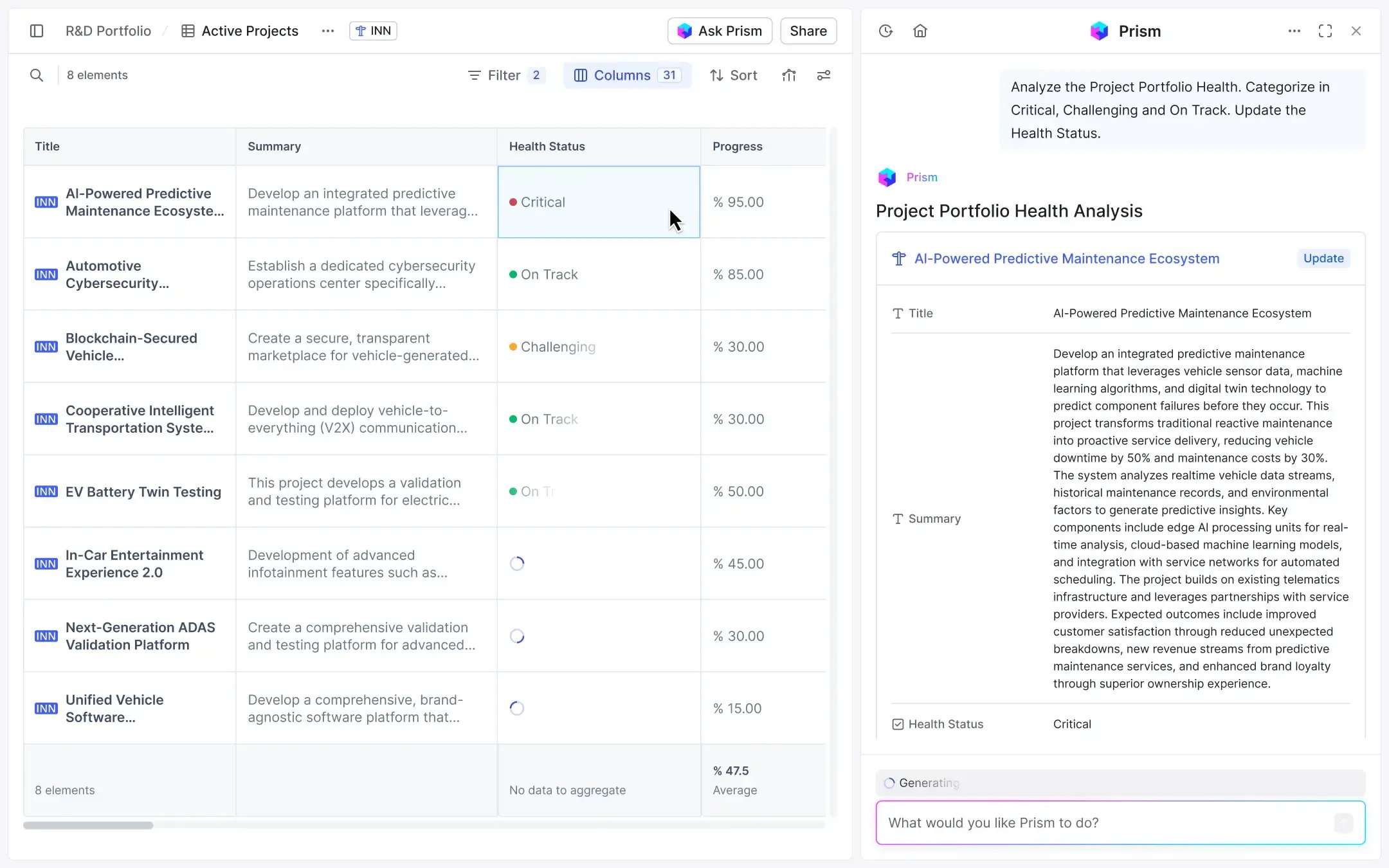
Exhibit 2: Prism checks every initiative against your strategy in real time, surfaces misalignment, and gives you decision support
Prism is purpose-built for that use case, links portfolio items to strategic themes and business capabilities in one data model, and ships with the security baseline (ISO/IEC 27001:2022) most enterprise buyers require.
Start with one portfolio. Prove the value. Then expand.
FAQs on AI tools for strategic portfolio management
What is the difference between SPM tools and project portfolio management tools?
Project portfolio management tools manage how projects run: schedules, resources, milestones, and dependencies.
Strategic portfolio management tools decide which projects should exist in the first place, based on business strategy, business priorities, and market conditions.
Most modern platforms cover both, but their center of gravity differs. ServiceNow and Planview lean PPM-first. ITONICS leans SPM-first.
How long does it take to implement AI tools for strategic portfolio management?
Plan 3 to 6 months for initial deployment on one portfolio. Year one is data hygiene and adoption. Year two is when AI insights start changing portfolio decisions.
Skipping the data hygiene phase is the single most common implementation failure. Budget 30 to 40% of year-one effort on cleaning project codes, capability definitions, and allocation data.
Can your existing PMO tool become an AI tool for strategic portfolio management?
Partially. Most legacy PMO tools added a chat interface in 2024 and 2025. That qualifies as "AI in product," but rarely changes strategic decisions.
The deeper question: does the AI operate on a real strategy model linking initiatives to strategic objectives, business capabilities, and measurable outcomes? If not, the AI is a summary tool. Ask vendors to demo strategic decisions, not chat features.
Should we choose one SPM tool or integrate multiple?
One tool wins if your portfolios share data structure and governance. Multiple tools win if different parts of the organization have genuinely different needs, for example innovation portfolios versus IT delivery portfolios.
The pattern that fails: choosing two SPM tools because of internal politics. That doubles cost and halves visibility. Pick the dominant use case first.
How does ITONICS compare to ServiceNow for our company?
It depends on what your portfolio is for. ServiceNow is stronger if your portfolio is execution-heavy and your bottleneck is delivery predictability.
ITONICS is stronger if portfolio decisions need to respond to market signals and your bottleneck is choosing the right bets. Many enterprises run both: ServiceNow for IT delivery portfolio management, ITONICS for innovation and strategic portfolio decisions.
What is the minimum data quality needed before AI SPM tools add value?
Three datasets must be clean.
-
Every project must link to a strategic theme and business objective.
-
Capacity allocations must be accurate at the role level.
-
Financial actuals must connect to portfolio items.
Without those three, AI predictions are unreliable. Most enterprises need one quarter to get this right.