Skip to content
Featured image: Top 8 Strategic Portfolio Management Software for Strategic Trade-Offs
Strategy

Top 8 Strategic Portfolio Management Software for Strategic Trade-Offs

Most executives couldn't answer three basic questions about their strategic portfolio: Which initiatives compete for the same resources? What happens if priorities shift next quarter? Which projects deliver strategic benefits versus consuming budget?

Companies using portfolio management software achieve 38% higher project success rates and complete initiatives 28% faster than those relying on spreadsheets, according to PMI research.

Yet most enterprises managing 50-200 active initiatives simultaneously lack integrated systems for strategic portfolio management. The result: critical initiatives compete for limited resources, shifting priorities trigger reactive firefighting, and leadership wastes weeks consolidating conflicting data across disconnected tools.

This article examines which platforms excel at rapid rebalancing, which require deep ERP integration, and how to match platform capabilities to your enterprise decision-making speed and system complexity. The goal: Choose software that enables faster, better-informed portfolio decisions.
How strategic portfolio management software solves the alignment problem

Strategic portfolio management software connects strategic priorities to resource allocation in real time. Unlike project management tools that track individual initiatives, SPM platforms optimize entire portfolios across competing strategic priorities, budgets, timelines, and capacity constraints.

Modern SPM platforms operate continuously. Instead of preparing slide decks for the annual off-site meeting, they integrate environmental scanning, strategy definition, and resource allocation in unified workflows. They use AI-powered analytics to model scenarios, predict bottlenecks, and optimize portfolio splits.

Companies with mature portfolio management capabilities report 38% higher project success rates, according to PMI research.

Strategic misalignment causes half of initiatives to fail

45% of initiatives fail due to poor capacity management and resource allocation (Gartner). Companies forfeit 11.4% of investment value through misaligned execution. Companies waste 20% of project time on administrative overhead due to a fragmented IT landscape.

Only 58% of enterprises maintain consistent alignment between strategic priorities and execution.

At 5 initiatives and 2 teams, priorities stay clear. At 50 initiatives across 10 business units, coordination breaks down.

Finance tracks budgets in one system, while engineering manages roadmaps in another. Leadership consolidates updates manually, leading to fragmented data and delayed insights. Teams optimize locally, developing systemic bottlenecks they can't see.

When priorities shift due to market shifts or changing investment objectives, rebalancing requires weeks of analysis while financial resources and other resources required remain locked to original roadmaps, hindering progress toward long-term goals.

What separates SPM platforms from project management tools

Portfolio management software delivers four measurable advantages:

    • Faster completion: 28% faster initiative delivery through real-time visibility into portfolio health and available resources.

    • Lower overhead: 20% reduction in administrative tasks through automated capacity management and resource allocation.

    • Higher success rates: 38% better project results by continuously connecting initiatives to strategic objectives.

    • Rapid rebalancing: Connect to industry signals in real-time and execute reallocation decisions in days instead of quarters.

Core SPM capabilities:

    • Real-time dashboards to optimize portfolios across competing priorities

    • Integrated project status reports and resource allocation

    • Connected market intelligence for strategy adjustments

    • Cross-platform data integration, eliminating manual consolidation

Strategic portfolio management software that delivers these capabilities enables faster decisions and better resource allocation at scale.
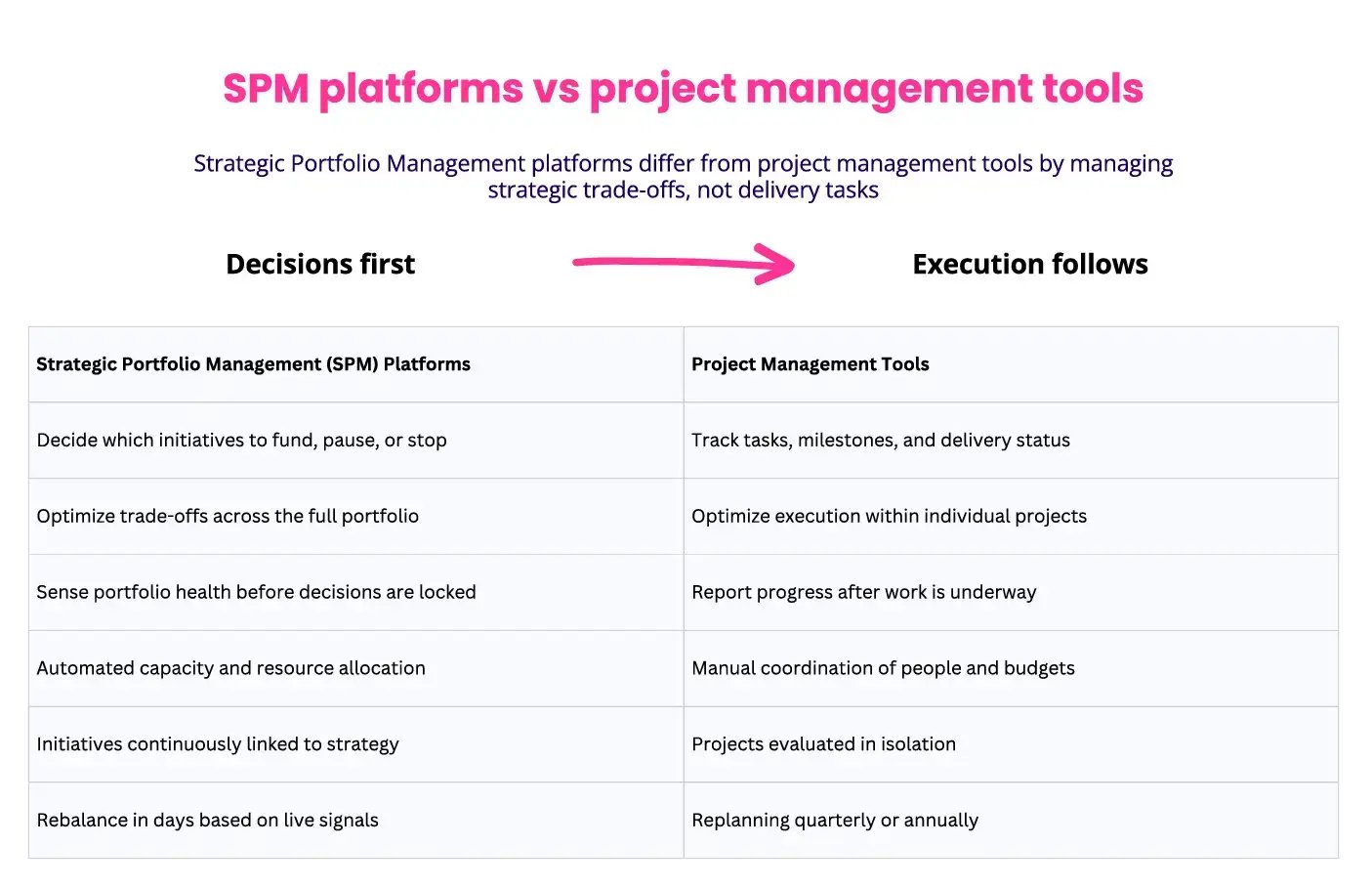
Strategic portfolio management vs. project management tools

Exhibit 1: Strategic portfolio management vs project tools, illustrating the shift from execution tracking to decision-level portfolio governance.

4 Core capabilities of the best strategic portfolio management software 

Strategic portfolio decisions require answering four questions: Which initiatives get resources? How do budget constraints affect execution? What happens when priorities shift? Is the portfolio on track?

Software that answers these questions in real time enables better resource allocation. Software that requires manual analysis to answer them adds overhead. Four capabilities separate the two.

1. Portfolio planning and continuous improvement

Portfolio planning is making decisions about the composition and diversification of the investment plan to maximize strategic value.

The problem: Finance approves budgets while teams face impossible delivery schedules. Resources get allocated to projects that can't execute. Meanwhile, industry conditions change, asking to update the strategy.

What strong platforms do:

    • Provide unified visibility into project plans across departments

    • Automatically flag strategy changes before they impact delivery

    • Enable reallocation based on actual capacity, not theoretical headcount

    • Offer real-time capacity management and workload balancing

2. Budget and resource integration

SPM platforms should connect resource allocation directly to financial planning systems, enabling leaders to model spending scenarios against strategic goals.

The problem: Manual reconciliation between disconnected tools leads to weeks of delay. Investment plans exceed available capital, or priorities shift while budgets remain locked.

What strong platforms do:

    • Synchronize budget data through direct ERP integration

    • Provide customizable dashboards showing spend against plan

    • Enable what-if scenario planning without manual data transfers

    • Surface funding conflicts automatically

3. Risk management and integration of market condition shifts

Enables rapid analysis when priorities shift, including scenario modeling, dependency analysis, and impact assessment across strategic, financial, and operational dimensions.

The problem: Traditional spreadsheets provide static snapshots. When regulatory changes, market volatility, or competitive pressures demand immediate adjustment, rebalancing takes weeks, hindering timely decisions and resource allocation.

What strong platforms do:

    • Enable multiple scenario comparisons within days, not weeks

    • Map dependencies to reveal downstream impacts on portfolios and asset classes

    • Support rapid priority changes without extensive analysis, helping business leaders respond to market shifts

    • Generate decision-ready analytics automatically, improving risk management and strategic planning

4. Real-time rebalancing and execution tracking

Tracks portfolio health and initiative progress in real time, eliminating manual status consolidation.

The problem: Leadership makes decisions based on outdated data consolidated manually from fragmented systems.

What strong platforms do:

    • Aggregate data automatically across project management sheets

    • Provide real-time dashboards showing portfolio health

    • Track progress against strategic planning continuously

    • Enable course corrections based on current data, not last quarter's report
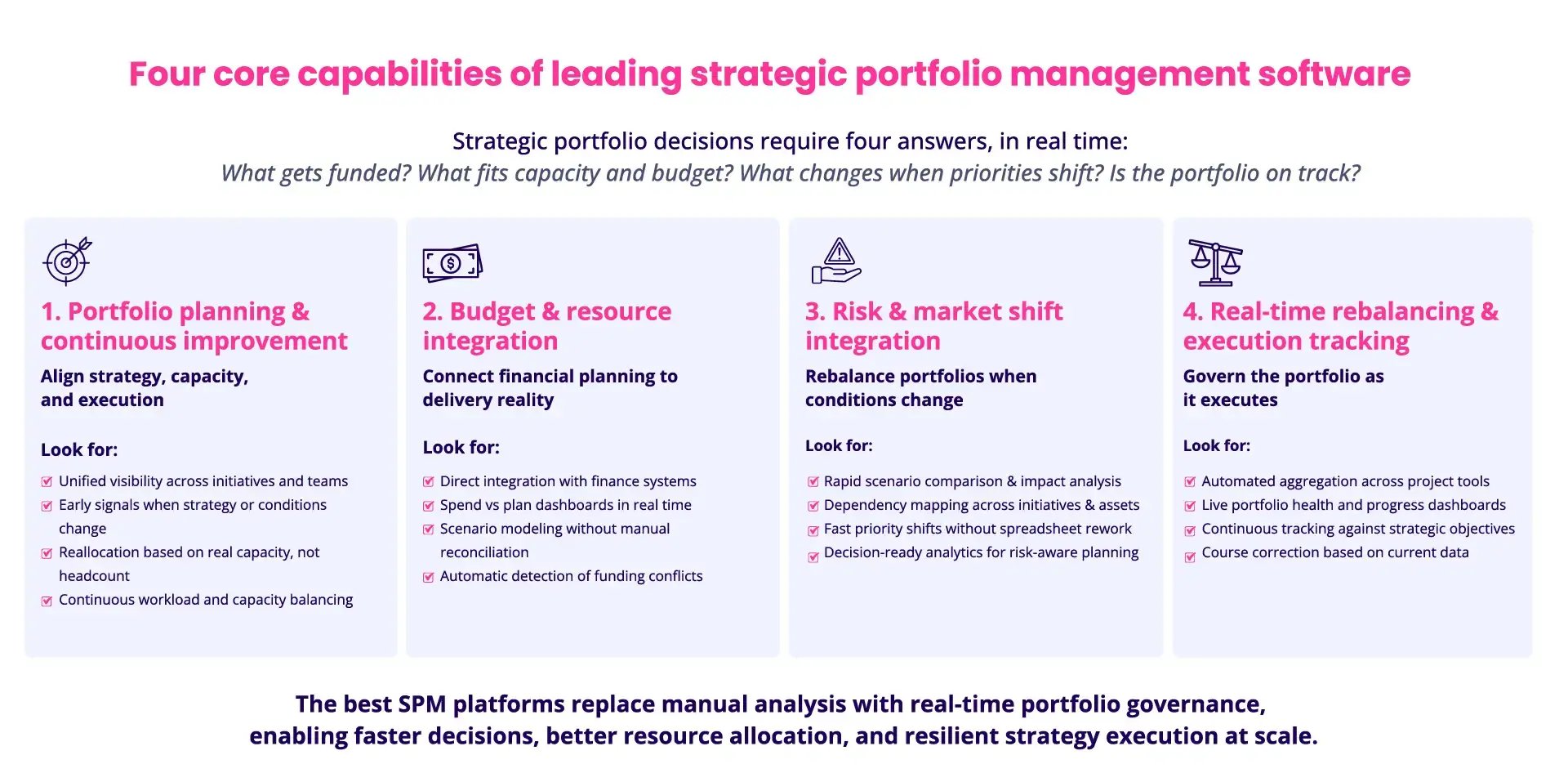
Four core capabilities of leading strategic portfolio management software

Exhibit 2: Four capabilities that distinguish leading SPM platforms, enabling real-time planning, resource alignment, risk modeling, and execution control.

The 8 best SPM tools

Strategic portfolio management software enables executives to connect strategic priorities to resource allocation, optimize portfolios across competing initiatives, and accelerate decision-making when market conditions shift. The following eight platforms deliver distinct advantages for different organizational contexts, from rapid implementation to enterprise-scale complexity.

1. ITONICS: Strategy-driven portfolio optimization

Bottom line: The only platform unifying foresight intelligence, ideation management, and portfolio execution in a single innovation operating system, built for investors seeking market-driven insights.

Best for: Organizations where success depends on connecting external market signals to internal investment decisions, identifying emerging opportunities before competitors recognize them.

ITONICS - Key Differentiators

  • ITONICS Prism AI provides context-aware intelligence across signals, trends, and projects, automating pattern recognition that would require dedicated analyst teams

  • Interactive visualization creates technology radars, innovation roadmaps, portfolio Kanban boards, and matrices that make complex dependencies immediately comprehensible

  • Customization engine adapts workflows, views, and terminology to match organizational processes without code-level modifications

  • Foresight integration connects technology scouting, competitive intelligence, and regulatory monitoring directly to investment prioritization

ITONICS - Implementation Profile

  • Deployment time: 8-16 weeks

  • Technical complexity: Moderate

  • Best fit: Innovation teams in mid-market to enterprise organizations


ITONICS - Strengths

  • Addresses the complete innovation lifecycle from opportunity identification through execution, eliminating gaps between trend analysis and project management

  • Context-aware AI understands relationships between market trends, strategic goals, and initiatives rather than treating them as isolated data points

  • Superior visualization capabilities for executive communication

  • Completely tailorable to organizational terminology and strategic frameworks without forcing vendor-imposed methodologies

  • Named Gartner Category Leader for Idea Management Software in 2025

  • Comprehensive implementation consulting and ongoing training programs

ITONICS - Limitations

  • Breadth of capabilities creates a learning curve for organizations new to integrated innovation platforms

  • Maximum value requires connecting external intelligence gathering with internal investment decisions, a process evolution for organizations operating these functions separately

2. Planview: Investment strategies and resource allocation

Bottom line: Enterprise-grade SPM software connecting roadmaps to program execution across massive investment portfolios, with AI-driven insights that forecast outcomes and optimize resource allocation under changing market conditions.

Best for: Large organizations managing thousands of concurrent initiatives across multiple business units and geographies.

Planview - Key Differentiators

  • Planview Anvi AI analyzes complete enterprise data to deliver expert guidance on resource optimization and risk mitigation

  • Scenario modeling compares investment alternatives across strategic, financial, and resource dimensions simultaneously

  • Enterprise integration connects ERP, CRM, and project systems for unified data flow

  • Dynamic roadmaps link investments to capabilities and strategic objectives with automatic updates


Planview - Implementation Profile

  • Deployment time: 16-24+ weeks

  • Technical complexity: High

  • Best fit: Large enterprises with established portfolio budgets


Planview - Strengths

  • Gartner Strategic Portfolio Management leader for four consecutive years

  • AI-powered optimization identifies opportunities and risks leadership can't see in manual reviews

  • Proven scalability for organizations managing thousands of initiatives

  • Supports multiple methodologies (waterfall, agile methodologies, hybrid) within unified framework


Planview - Limitations

  • Enterprise-grade capabilities require complex implementation with dedicated technical staff and extended timelines

  • Higher cost structure primarily targets large companies

  • Focuses on execution rather than front-end innovation, requires separate systems for trend scouting and ideation

3. Planisware: Resource allocation for complex portfolios

Bottom line: AI-powered SPM software using advanced algorithms to balance assets, timing, and constraints across entire portfolios automatically.

Best for: Organizations with thousands of interconnected projects requiring sophisticated portfolio optimization beyond manual planning approaches.

Planisware - Key Differentiators

  • Particle Swarm Optimization algorithm balances initiatives holistically across assets, timing, dependencies, and strategic constraints

  • Predictive analytics uses historical and live data to forecast costs, timelines, and outcomes

  • Strategic bucket allocation aligns projects to corporate goals across multiple dimensions

  • Real-time budget tracking integrates directly with ERP systems


Planisware - Implementation Profile

  • Deployment time: 20-28+ weeks

  • Technical complexity: Very high

  • Best fit: Global enterprises with high portfolio management maturity

Planisware - Strengths

  • Advanced AI optimization beyond manual planning approaches

  • Continuous synchronization between investment decisions and budget constraints through direct ERP integration

  • Proven at enterprise scale with companies including Ford, Philips, and Pfizer

  • Supports complex interdependencies across programs

Planisware - Limitations

  • Requires significant maturity, less suitable for organizations beginning their journey

  • Implementation complexity demands dedicated expert staff for configuration and administration

  • Steep learning curve can extend time-to-value

  • Focuses on execution without front-end innovation capabilities

4. ServiceNow SPM: Portfolio management meets financial goals

Bottom line: Unified AI platform providing dynamic reallocation based on real-time financial and operational data, eliminating reconciliation delays.

Best for: Organizations with existing ServiceNow infrastructure needing portfolio optimization.

ServiceNow SPM - Key Differentiators

  • Single data model across financial and operational domains

  • Continuous forecasting enables what-if analysis without manual recalculation

  • Dynamic reallocation responds automatically to budget changes, flagging affected initiatives

  • Automated workflow routing streamlines approvals and governance


ServiceNow SPM - Implementation Profile

  • Deployment time: 12-20 weeks (shorter with existing ServiceNow platform)

  • Technical complexity: Moderate to high

  • Best fit: Enterprises with ServiceNow infrastructure


ServiceNow SPM - Strengths

  • Eliminates manual data synchronization overhead across finance and operations

  • Real-time visibility into financial constraints enables faster response to budget changes

  • Leverages established enterprise adoption with proven integration patterns

  • Portfolio optimization rather than periodic planning cycles

ServiceNow SPM - Limitations

  • Deepest value requires broader ServiceNow platform adoption beyond standalone portfolio management

  • Organizations without existing ServiceNow infrastructure face larger implementation footprint

  • Primarily optimized for IT management rather than R&D or innovation initiatives

  • Lacks front-end innovation capabilities

5. Triskell: Real-time resource availability & scenario planning

Bottom line: Highly configurable platform for mid-to-large enterprises requiring flexibility as processes mature.

Best for: Organizations needing strong scenario planning without enterprise-scale complexity or cost.

Triskell - Key Differentiators

  • Configurable dashboards and workflows adapt to organizational evolution without platform replacement

  • Scenario modeling compares resource allocation alternatives with real-time impact analysis

  • Resource-to-budget linking displays capacity constraints against financial plans

  • Cascading objectives connect enterprise strategy to team-level execution


Triskell - Implementation Profile

  • Deployment time: 10-16 weeks

  • Technical complexity: Moderate

  • Best fit: Mid-market to large enterprises


Triskell - Strengths

  • Flexibility allows process and governance modifications as maturity increases

  • Strong scenario planning capabilities support confident decision-making under uncertainty

  • Mid-market pricing makes enterprise-grade features accessible to smaller organizations

  • Adapts to changing requirements without extensive reconfiguration

Triskell - Limitations

  • Configurability requires ongoing administration investment

  • Less brand recognition than larger competitors

  • Lacks integrated foresight and ideation capabilities

6. Accolade: Investment plans for R&D with risk tolerance

Bottom line: Stage-gate governance platform designed for R&D-intensive organizations with regulatory compliance requirements and defined risk tolerance parameters.

Best for: Pharmaceutical, aerospace, and medical device industries managing product development initiatives.

Epicflow - Key Differentiators

  •  AI-powered scenario simulation models alternative resource configurations and downstream impacts automatically

  • Critical path analysis identifies dependencies affecting delivery timelines

  • Resource load balancing prevents team overcommitment while maximizing utilization

  • Portfolio rationalization algorithms recommend which initiatives to prioritize, defer, or terminate


Epicflow - Implementation profile

  • Deployment time: 8-12 weeks

  • Technical complexity: Low to moderate

  • Best fit: Mid-market organizations


Epicflow - Strengths

  • Rapid adjustment when priorities or market conditions shift unexpectedly

  • Focuses on resource optimization, the common constraint limiting throughput

  • Delivers measurable outcomes without requiring comprehensive organizational change

  • Provides actionable recommendations rather than passive reporting


Epicflow - Limitations

  • Narrower feature set compared to full-spectrum enterprise platforms

  • Less established market presence relative to larger competitors

  • Limited integration with front-end innovation processes

  • Smaller user community


7. Epicflow: Resource availability & rapid market response

Bottom line: AI-driven scenario simulation and value-optimized engines enabling rapid rebalancing based on real-time resource availability when market conditions shift.

Best for: Organizations needing agility without comprehensive change management programs.

Accolade - Key Differentiators

  • Stage-gate workflow management with configurable phase reviews, approval criteria, and governance checkpoints

  • Regulatory compliance tracking maintains documentation and audit trails

  • Balancing tools optimize investments across innovation horizons and risk tolerance profiles

  • PLM and engineering integration connects investment decisions to detailed product development data


Accolade - Implementation profile

  • Deployment time: 14-20 weeks

  • Technical complexity: Moderate to high

  • Best fit: R&D-intensive regulated industries


Accolade - Strengths

  • Specializes in product innovation and R&D portfolio management rather than generic project tracking

  • Strong governance capabilities meeting regulatory compliance requirements

  • Proven track record in pharmaceutical and technology-intensive manufacturing sectors

  • Supports structured feedback loops for continuous assessment

Accolade - Limitations

  • Stage-gate focus may require adaptation for organizations preferring agile development approaches

  • Smaller market presence compared to broader enterprise platforms

  • Lacks market intelligence or trend scouting capabilities

8. OnePlan: Capacity planning for enterprise scale

Bottom line: AI-enabled portfolio management with broad integration across diverse technology ecosystems.

Best for: Organizations with heterogeneous project management environments that resist standardization.

OnePlan - Key Differentiators

  • Multi-tool integration consolidates data from Microsoft, Atlassian, and Smartsheet ecosystems

  • Real-time insights aggregate capacity data across disparate platforms

  • Innovation intake workflows connect ideation systems to execution

  • AI-powered capacity forecasting predicts resource availability and identifies conflicts

OnePlan - Implementation profile

  • Deployment time: 10-16 weeks

  • Technical complexity: Moderate (complexity increases with integrations)

  • Best fit: Organizations with established, diverse project management toolsets


OnePlan - Strengths

  • Provides visibility without forcing enterprise-wide tool standardization

  • Reduces manual data consolidation for organizations with heterogeneous toolsets

  • Supports multiple project methodologies within unified framework

  • Delivers value quickly by leveraging existing tool investments


OnePlan - Limitations

  • Value proposition depends heavily on integration requirements

  • Complexity increases with number of integrated systems

  • Integration-focused architecture may create data synchronization challenges

  • Lacks native foresight or trend analysis capabilities


Strategic Project Portfolio ITONICS

Exhibit 3: Real-time dashboards in the ITONICS platform used for portfolio analysis 

How to choose the right SPM software

Match platform capabilities to your enterprise decision-making speed, resource constraints, and current systems to ensure investing in the optimal portfolio management software.

For example, firms often waste money when investing in sophisticated platforms before establishing basic portfolio discipline or selecting simple tools when business units demand advanced solutions.

By carefully evaluating your current financial situation, implementation resources, and time horizon, you can choose a single solution that aligns with your investment plan and benefits the business across asset classes.

Evaluate pain points in your current process

Assess four dimensions of your current state:

Portfolio visibility: Can leadership see all active initiatives, their status, and resource consumption without manual consolidation? If not, prioritize platforms with centralized dashboards and real-time reporting before pursuing advanced optimization features.

Decision-making speed: How often did leadership rebalance portfolios last year? Annual cycles suggest readiness for structured time horizon planning. Monthly or continuous rebalancing requires rapid what-if modeling and dynamic resource allocation that delivers answers in days, not weeks.

System fragmentation: Count systems managing portfolio data: financial planning, project tracking, resource scheduling, others. Five or more disconnected systems require SPM software with strong native integration. Fewer systems allow focus on analytics over integration.

Implementation capacity: Calculate total three-year cost including licensing, implementation, administration, and training. Determine whether your business can support 6-month implementations or needs 8-12 week deployments. Match platform complexity to available technical staff and change tolerance.

Rank your requirements

Identify your constraint: What limits throughput: budget, specialized expertise, leadership bandwidth, or time to implementation? If capital is unlimited but skills are scarce, prioritize sophisticated capacity planning. If budget constrains you, prioritize financial integration and scenario planning.

Understand reallocation triggers: Review the last three significant portfolio changes. Were they quarterly planning cycles, mid-year budget cuts, strategic pivots, or competitive threats? This pattern reveals required modeling speed.

Define your focus: Do portfolio decisions primarily serve strategic positioning or operational execution? Strategic focus requires platforms connecting market intelligence to initiative priorities. Operational focus emphasizes resource scheduling and delivery optimization.

Compare pricing, features, and implementation complexity

Test platforms against actual work, not vendor demos.

Recreate recent decisions: Document 2-3 actual portfolio decisions from the past year: a major portfolio diversification, new initiative prioritization, or money constraint response. Ask vendors to demonstrate how their portfolio management software would have.

Platforms that struggle with your real scenarios and risks won't serve you well.

Test integration: Verify how platforms connect to your ERP, project management, and risk tolerance tools. Ask vendors to demonstrate actual data flows. Understand whether integrations are native, require middleware, or involve manual uploads. Factor security and integration complexity into total cost.

Validate capabilities: Request references from the vendor's clients with similar size, tasks, and decision-making culture. Ask about time horizons for implementation, time-to-benefit, administrative overhead, and whether promised capabilities delivered expected outcomes.

Using portfolio management software that seamlessly integrates with your existing systems ensures optimized resource allocation, supports strategic management, and improves decision making in real time.

Selecting the right software helps business leaders align investment strategies with financial goals, manage environmental changes, and achieve long term goals effectively.

Connect strategy and execution. Today, with ITONICS.

As the only SPM tool linking market intelligence with roadmap decisions,  ITONICS connects strategy-making to pipeline delivery on a unified platform. Unlike spreadsheets and heavy tools, ITONICS integrates market and tech intelligence, strategic planning, and portfolio management to optimize business decisions across competing priorities and support organizational goals.

Connect strategy to execution: Strategic ambitions often fail when they don't translate into clear tasks, responsibilities, and ownership. ITONICS makes this connection explicit and tracks progress against investment objectives and strategic goals in real time. Top management gains decision-ready visibility into which initiatives advance strategy and which consume resources without delivering value, helping reduce risk and improve decision making.

Optimize portfolios against environmental shifts: Effective portfolio management requires understanding external context, including stock market trends and regulatory changes. ITONICS integrates competitive intelligence, technology trends, and regulatory updates directly into strategic portfolio decisions. Users receive alerts on competitive threats or emerging opportunities, allowing to chnage investment plans and re-assess priorities.

Eliminate cross-functional coordination overhead: Dispersed teams working from different data sources often make poor portfolio decisions. ITONICS provides unified visibility across business units, functions, and geographies, consolidating data into customizable dashboards. Leadership can make informed decisions about investing in new ideas and portfolio health, aligning investment strategies with financial goals instead of relying on outdated spreadsheets consolidated manually.


FAQs on R&D management software

What is strategic portfolio management software, and why do enterprises need it?

Strategic portfolio management software connects strategic priorities to resource allocation in real time for innovation initiatives, R&D programs, and product development portfolios. Unlike project management tools that track individual initiatives, SPM platforms optimize entire portfolios across competing priorities, budgets, and capacity constraints.

Enterprises managing 50-200 active innovation initiatives face critical coordination problems when finance tracks budgets separately from engineering roadmaps. Companies using portfolio management software achieve 38% higher project success rates and complete initiatives 28% faster than those relying on spreadsheets, according to PMI research.

Integrated systems eliminate manual consolidation overhead and enable faster decisions about which projects to fund, accelerate, or terminate.

How does strategic portfolio management software differ from traditional project management tools?

Strategic portfolio management software optimizes resource allocation across entire innovation portfolios rather than tracking individual project tasks. Traditional project management tools excel at execution tracking but lack capabilities to model trade-offs between competing R&D programs or enable rapid rebalancing when priorities shift.

The distinction matters because 45% of initiatives fail due to poor capacity management, according to Gartner research. Companies forfeit 11.4% of investment value through misaligned execution.

SPM platforms provide real-time dashboards connecting innovation initiatives to strategic objectives, integrated budget allocation across business units, and scenario modeling that answers critical portfolio questions in days instead of weeks.

How do SPM platforms improve cross-functional R&D collaboration?

Organizations with mature project portfolio management capabilities report measurable performance improvements across three dimensions. First, 28% faster initiative delivery through real-time visibility into available resources. Second, 20% reduction in administrative overhead by automating capacity management. Third, 38% higher project success rates by continuously aligning innovation initiatives with strategic objectives.

Companies waste 20% of project time on administrative tasks due to fragmented systems. When priorities shift, rebalancing product development portfolios can require weeks of analysis while resources remain locked to outdated roadmaps.

SPM platforms compress this cycle to days, enabling faster response to competitive threats and emerging opportunities.

Which industries benefit most from strategic portfolio management platforms?

While project portfolio management platforms deliver value across industries, three sectors show particularly strong returns. R&D-intensive organizations in pharmaceutical, aerospace, and medical device manufacturing require stage-gate governance and regulatory compliance tracking across multi-year product development cycles. Technology enterprises benefit from platforms connecting market intelligence directly to product prioritization decisions. Manufacturing firms with complex new product introduction processes gain an advantage through scenario modeling.

The common thread is complexity, not industry. Organizations managing 50+ concurrent innovation initiatives across multiple business units face coordination challenges that spreadsheets cannot solve. When leadership makes portfolio decisions based on manually consolidated data, fragmentation costs exceed platform investment.

How should executives evaluate strategic portfolio management software vendors?

Effective vendor evaluation requires testing platforms against actual project portfolio decisions rather than scripted demonstrations. Document 2-3 portfolio decisions from the past year, such as major product development rebalancing or R&D initiative prioritization under budget constraints, and ask vendors to demonstrate solutions using your real data.

Match platform capabilities to three organizational dimensions. First, decision-making speed: annual planning cycles require different capabilities than continuous rebalancing. Second, system integration: five or more disconnected systems require robust native integration. Third, implementation capacity: calculate the total three-year costs, including licensing and training.

Organizations waste money selecting sophisticated platforms before establishing basic portfolio discipline or choosing simple tools when demanding advanced capabilities.