6 borrowed process improvement tactics to ship products faster


Every product development team eventually hits the same wall: a promising idea takes too long to reach a customer, and nobody quite agrees on why. Some point to unclear specs, others to too many approvals. Most point to inefficient processes running through the pipeline at once.
Process improvement methodologies exist to answer this question, but adopting one wholesale rarely works. McKinsey's own Transformation Practice puts the failure rate of large-scale transformations at roughly 70%. A peer-reviewed study of Six Sigma programs across 573 respondents in Germany, the UK, and Sweden found a similar pattern: around 60% of corporate process improvement initiatives fail, mainly from incomplete implementation rather than a flawed idea.
Most teams do not need the whole framework. They need one process improvement tactic, borrowed from inside it, that moves speed to market without the training program or multi-year rollout attached to it.
This guide profiles 6 process improvement tactics, one borrowed from each of 6 established process improvement methodologies. It compares them side by side and makes the case for keeping all six on hand rather than committing to just one.
Product development sits on a genuine trade-off between speed and quality. Move faster and quality risk rises; protect quality and speed drops. This is the trade-off every process improvement effort in this guide is built to manage.
Internal analysis of more than 2,000 sales conversations found workflow and governance concerns raised in 65% of calls, and portfolio prioritization concerns in 68%. Both numbers point to the same issue: teams cannot tell whether a change to their product development process actually improved effectiveness, or simply moved work around.
Effectiveness means the process reliably produces the intended outcome, beyond simply moving faster. A tactic that cuts cycle time while raising defect rates trades one cost for another. The methodologies covered next were each chosen for a documented track record of holding both sides of that trade-off in a product development context.
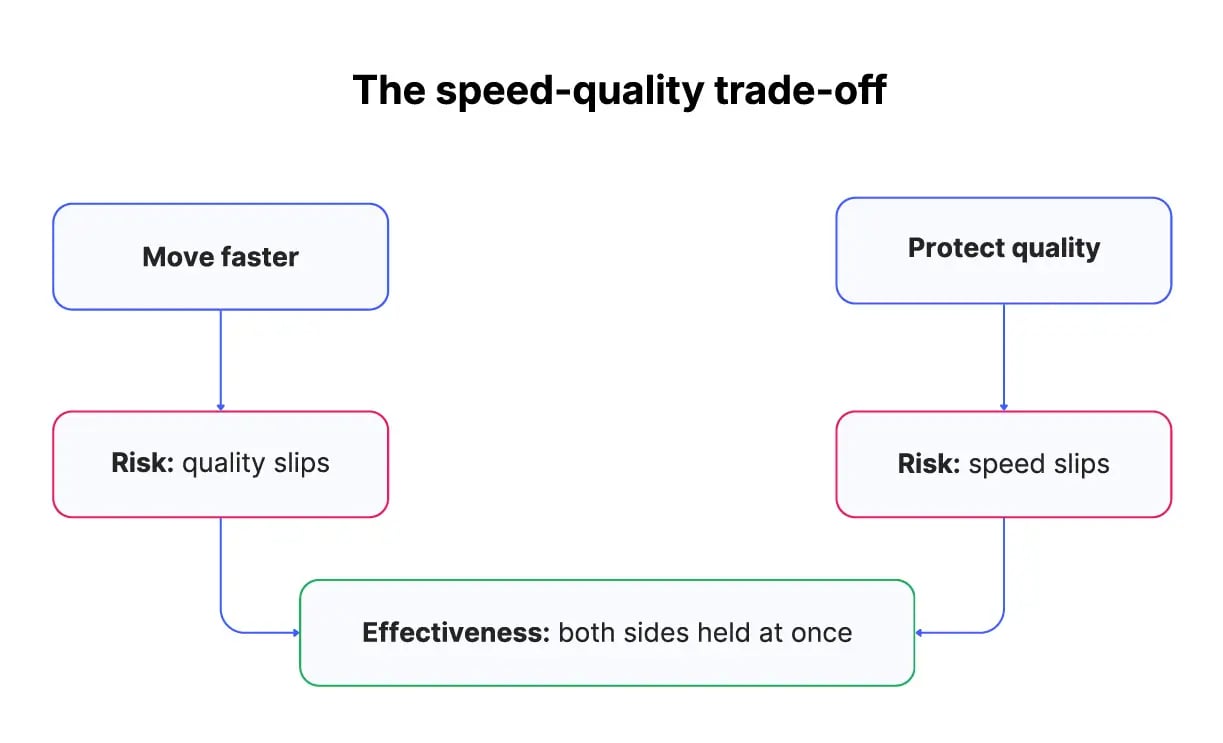
Exhibit 1: The speed and quality trade-off every process improvement tactic in this guide is built to hold at once.
Product development slows down in three recurring ways: uncertain work that keeps evolving, repeatable work stable enough to standardize, and work needing small, constant refinement rather than one fix. Multiple methodologies exist to answer each of these three problem types. This guide clusters six of them accordingly, so the context each one was built for stays clear before any tactic gets applied.
Product development work is often uncertain. Specs shift, priorities move, and the bottleneck holding things up this quarter may not be the same one next quarter. Two methodologies were built to handle exactly that kind of movement.
Agile process improvement adapts short, iterative cycles to that uncertainty. A team ships a small, testable slice every two to four weeks instead of specifying an entire feature upfront, then adjusts based on what it learns. A plan locked in at the start is usually wrong by the time it ships.
The theory of constraints, developed by Eliyahu Goldratt, handles the same uncertainty from the other side. It assumes the bottleneck itself will move, so the method finds that limiting link, exploits it, and adjusts every other step to match its pace.
The diagnosis then repeats once the constraint shifts again. Unlike Lean or Six Sigma, which assume a stable process worth measuring precisely, this method expects to be re-run, whether the constraint turns out to be technical capacity or a decision queue.
Some parts of product development follow a fixed, repeatable pattern. A compliance check runs the same way every time, and a manufacturing handoff follows an identical sequence release after release.
Lean manufacturing traces to the Toyota Production System and targets waste across a repeatable flow. It removes steps that do not serve the customer once a process runs the same way often enough to see clearly.
The Six Sigma process, developed at Motorola in 1986, takes a more statistical approach. It uses data to reduce defects across high-volume work, targeting no more than 3.4 defects per million opportunities.
Both depend on a process repeating often enough to measure variation reliably, a condition product development rarely meets in its early, exploratory stages. Manufacturing handoffs and compliance testing are the kind of repeatable sub-process where they still work well; a design cycle that changes shape every time is a different problem entirely.
Some processes stabilize enough to run reliably, but they never reach a finished state. A recurring status meeting or a design review keeps running long after the original problems are fixed, and small points of friction keep resurfacing.
Kaizen is a continuous improvement model, part of the broader Lean family, built around small changes that frontline teams surface themselves, rather than a redesign handed down from above.
Value stream mapping takes a more visual approach. It diagrams how materials and information move through a process, making delays visible on a single diagram whenever a once-smooth workflow starts to feel slow again, the same kind of drift covered in our guide to continuous improvement.
Both fit product development once a sub-process has matured enough to refine repeatedly. The target is a process that already works, just not as smoothly as it could.
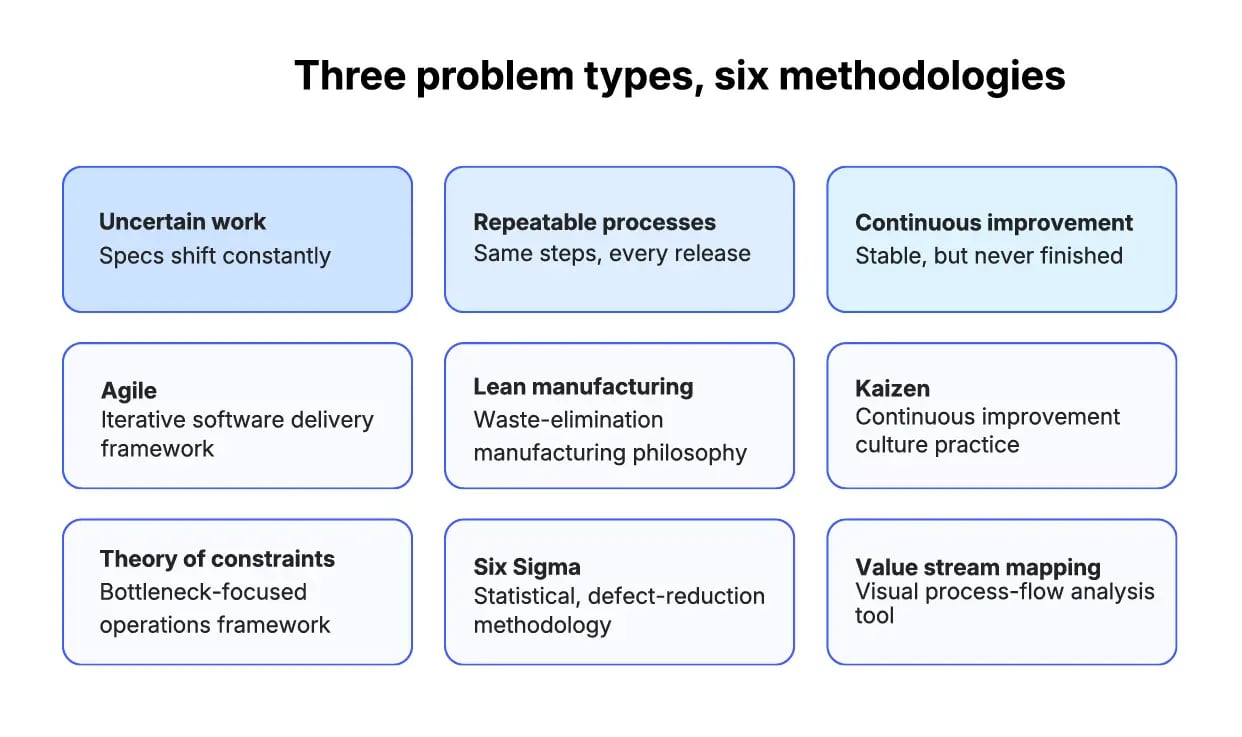
Exhibit 2: The three problem types product development runs into, and the two methodologies built to answer each one.
Product development usually contains all three situations at once, which is exactly why one methodology rarely covers the whole problem. Each methodology took its home industry years to embed properly, and the failure rates cited above show how rarely a fast-tracked adoption pays off. Adopting one wholesale, an org-wide effort to improve business processes, is a multi-year commitment few product development teams can justify for a single speed problem.
A separate study tracking 200 Six Sigma adopting firms found a real, measurable impact on financial performance, driven mostly by reductions in indirect costs rather than a sweeping cultural transformation. The narrow, mechanical part tends to work; the surrounding program, training, governance, and belts, is what fails to land.
A single tactic, borrowed deliberately, captures that mechanical benefit without the surrounding program. A team can standardize intake criteria on a request form without a Six Sigma Yellow Belt or Black Belt behind it, turning one process improvement idea into a working habit rather than a certification exercise.
For a team whose priority is speed to market, this is the approach we advocate. Borrow the narrow mechanism, skip the surrounding program, and measure the result before committing to anything larger.
This also spreads the risk of a wrong bet. Piloting one tactic for a few weeks costs little even if it turns out to be the wrong fit; committing to a full methodology before testing costs considerably more.
Since each tactic is this cheap to try, keep all six on hand and reach for whichever matches the issue in front of the team, rather than adopting one permanently. A tactic used once stays in rotation, since the same delay tends to resurface as conditions change.
The six tactics below are exactly that kind of low-risk pilot, each one specific enough to measure in a few weeks rather than a quarter. Each follows the same structure: why it stands out, when to prioritize it, its key strengths, and where it tends to break down.
Placed side by side, the problem type each tactic answers, along with setup cost and time to results, becomes easy to compare at a glance.
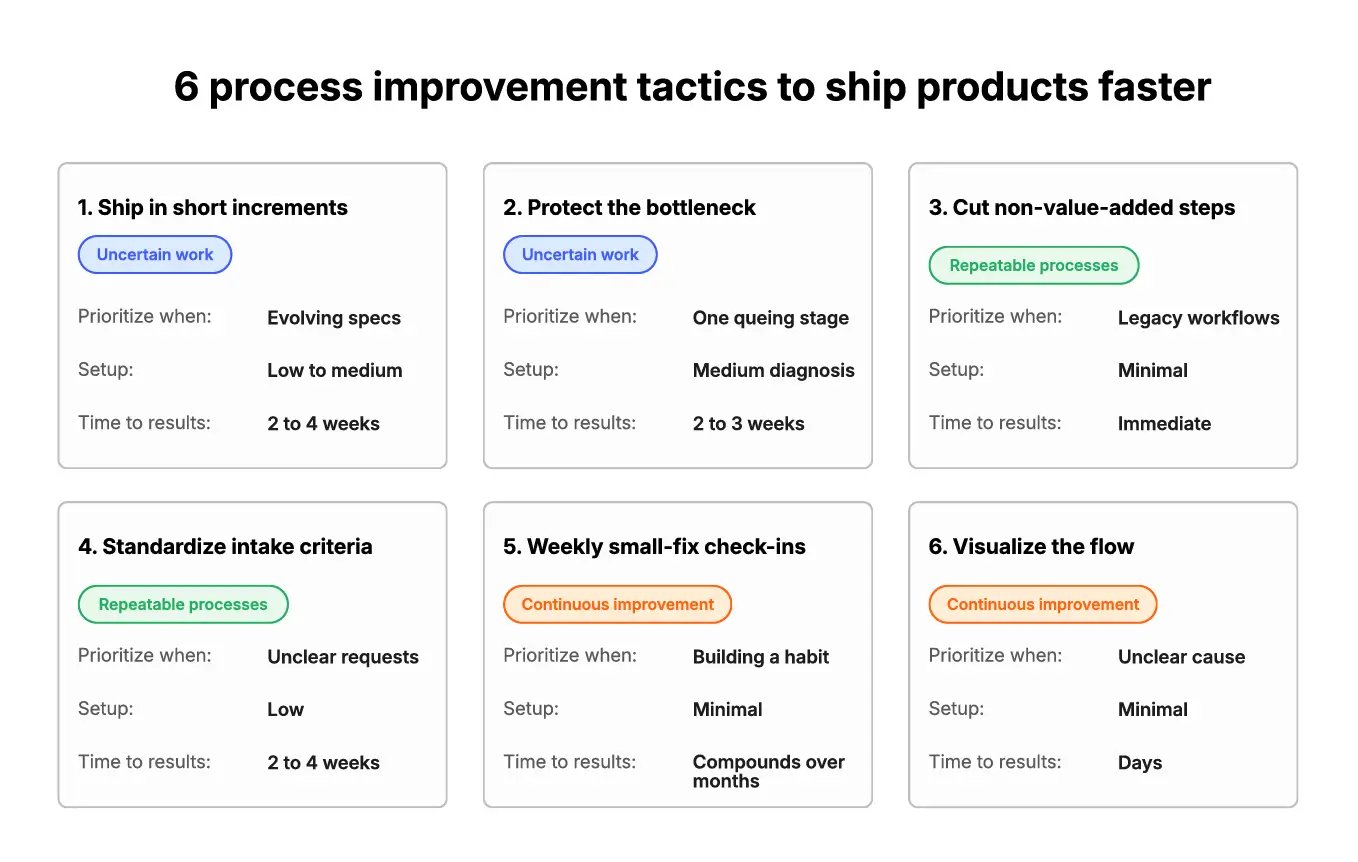
Exhibit 3: All six tactics compared side by side, grouped by the problem type each one answers.
Methodology's key elements: Agile relies on short, fixed-length cycles and a concrete deliverable at the end of each one, a prototype, a demo, or a working slice a customer can react to. Together they let a team respond quickly as market changes make yesterday's plan outdated.
The borrowed tactic: Commit to shipping a testable increment, a prototype, a demo, or a validated hypothesis, every two to four weeks rather than waiting for one long development run. This works as well for new processes as it does for new products.
Methodology's key elements: The theory of constraints treats a process as a chain that can only move as fast as its weakest link, concentrating effort on that one limiting step rather than spreading it evenly. The same idea underpins critical chain project management.
The borrowed tactic: Identify the single step where work waits longest, then protect its time above everything else. Give that step a fixed schedule, route only clean, ready work to it, and resist speeding up every other step first.
Methodology's key elements: Lean manufacturing rests on defining value from the customer's perspective, mapping the value stream to see where that value gets delayed or lost, and tools like 5S for keeping waste visible at the workspace level. This tactic borrows the distinction underneath all three, steps that create value versus steps that exist only for internal convenience or habit.
The borrowed tactic: List every step in a workflow and mark each one as value-adding or not, from the customer's perspective. Remove or shorten anything in the second category, an approval that exists out of habit, for example.
Methodology's key elements: Lean Six Sigma combines Lean's focus on eliminating waste with Six Sigma's DMAIC process, define, measure, analyze, improve, control, which traces defects back to their source rather than treating each downstream error as its own isolated problem. These are common process improvement techniques for reducing variation and defects.
The borrowed tactic: Apply the define and control stages of DMAIC to intake. Define clear, written criteria for what a request must include, then reject anything falling short immediately rather than letting the receiving team discover gaps partway through.
Methodology's key elements: Kaizen relies on small, incremental changes and the people who surface them, the frontline team doing the work, rather than a central redesign handed down from outside. A mistake surfaced during a check-in counts as a learning opportunity, treated as useful data rather than something to hide.
The borrowed tactic: Hold a brief, weekly check-in where the team names one thing that slowed them down and fixes it before the next check-in, without a full retrospective format. Each fix loosely follows the four-step plan do check act cycle, popularized by W. Edwards Deming and used across industries well beyond manufacturing, just compressed into a single week instead of a formal quality program.
Methodology's key elements: Value stream mapping produces a single diagram of how materials and information move through the current process, with wait time and active work time marked at every step.
The borrowed tactic: Draw a current-state map of one recurring workflow, marking how long work waits between steps as well as how long it takes once someone actually picks it up. Target whichever step shows the highest ratio of wait time to work time first.
Picking a tactic is the easy part. Proving it worked is what turns a pilot into real process improvement. That is the same speed-versus-quality trade-off this guide opened with.
Cycle time, the time from request to shipped output, is the clearest signal. Baseline it for two weeks before applying a tactic, then measure again for two to three weeks after, using a comparable mix of work each time, the same baseline-and-remeasure logic behind cutting time to market in complex product development.
A genuine improvement holds cycle time down without raising defects or rework downstream. A relocated problem looks identical at first: cycle time drops at the stage that changed.
Within two to three weeks, though, a different stage, usually the one just downstream, begins to slow. Tracking only the changed stage misses this; tracking the full request-to-ship time catches it.
Rework and defect rate matter alongside cycle time, especially for Lean Six Sigma. For Kaizen and value stream mapping, where the fix is a habit rather than a mechanical change, track how long a fix holds before the same complaint resurfaces. A fix re-litigated every month is being reapplied on a loop, rather than compounding into something durable.
Measuring cycle time, rework rate, and fix durability across six different tactics usually means six different spreadsheets, one per team, with no easy way to compare results. ITONICS replaces that patchwork with a single platform built to run all six tactics at once, the same portfolio-wide visibility that keeps larger innovation programs from breaking down the same way.
DB Schenker used ITONICS as its operating system for innovation-related initiatives and increased speed-to-market by 25%, proof that this works at the scale of a whole organization, beyond a single team's pilot. That kind of visibility across workflows supports long-term success by improving business processes at scale.
This is the same argument this guide opened with. A promising idea that takes too long to reach a customer rarely has one cause, and no single methodology fixes it alone. Six tactics, borrowed deliberately and kept on hand rather than adopted wholesale, hold both sides of that trade-off: speed and quality together.
Borrowing the right tactic moves one team faster. Seeing that result hold across every team and product line is what turns a single quarter's win into a competitive advantage.