R&D management is being reinvented. Here are the 5 trends driving it.

Most R&D organizations are running a model built for a slower world: Annual budgets, sequential testing, and static governance committees that meet quarterly to approve decisions that should take days.
The result: resources locked into underperforming projects, promising ideas starved of funding, and a growing gap between what R&D delivers and what the business needs - often because R&D efforts are not sufficiently aligned with the company's goals to optimize resource allocation and support long-term growth.
The pressure is compounding. Economic uncertainty is shortening return timelines. AI is rewriting what research productivity looks like. Faster competitors are proving that iteration speed, not budget size, determines who stays competitive.
To understand where R&D management is heading, ITONICS engaged in more than 1,000 conversations with R&D leaders and teams worldwide. The findings reveal five clear trends reshaping how leading organizations govern, fund, and accelerate R&D. These are not predictions. They are patterns already in motion - across different industries and different sectors.
The five trends map across governance, people and technology, investment strategy, experimentation, and portfolio management. Each represents a departure from how R&D management has traditionally worked. Each demands attention from decision makers now, and implementing these trends effectively requires a structured approach.
Most R&D organizations still run on bureaucratic structures with multiple layers of approval. Committees are often comprised of stakeholders whose expertise is only tangentially relevant to the decision at hand.
The result: inefficient loops, redundant oversight, and delays in funding, project go/no-go decisions, and resource allocation.
This rigidity does not just slow things down. It creates a systematic disadvantage. When a competitor pivots in weeks and your governance cycle runs quarterly, the structural gap compounds. Companies that fail to fix this lose their competitive edge before they realize it is gone.
Effective R&D management requires a clear understanding of
Leading organizations are replacing static governance models with agile steering committees: small, expert-driven teams that form and dissolve as needed.
They meet weekly or bi-weekly for rapid approvals.
They eliminate redundant approvals by merging scientific, technical, and business reviews into single, focused discussion points.
This approach draws from VC investment committees and crisis-response task forces, where decision-making is fast, and oversight is proportional to actual risk.
There was no single R&D professional ITONICS spoke with who was not frustrated by too many manual workflows:
Knowledge is scattered.
Decision-making is siloed.
Researchers spend hours searching for data that should surface in minutes.
Administrative tasks consume time that should go to research and development.
AI agents are changing this equation. But the shift that matters most for R&D management is not automation alone: It is the combination of AI processing power with human domain expertise that creates new research capability and supports broader business strategy.
AI agents in R&D management act as knowledge copilots, scanning millions of papers, patents, and internal reports to surface relevant insights in seconds.
They enable real-time decision-making by providing dynamic recommendations for portfolio management adjustments.
They enhance creativity by suggesting novel experiment designs that researchers may not have considered.
They automate routine tasks - documentation, literature reviews, experiment tracking - to free up management teams for higher-value work.
The business objectives here are clear: reduce cost savings lost to manual inefficiency, improve data quality across R&D workflows, and accelerate the path from research results to innovative products.
The adoption barrier is not technical. It is trust. Data silos and inconsistent datasets hinder integration. Successful adoption requires a human-centered strategy that defines AI's role clearly before scaling.
Although agile concepts have been discussed for years, most R&D organizations still rely on waterfall models and rigid annual budgeting. These cycles fail to account for evolving market conditions and new insights during development:
Underperforming projects consume resources for years because termination decisions arrive too late.
More promising projects struggle to secure funding because the annual calendar determines resource allocation, not performance.
The portfolio management process needs to change. Leading organizations are applying venture capital principles to R&D investment. This is not just a financial model change. It is a fundamental shift in how portfolio managers think about risk management, strategic value, and the right mix of projects across the whole portfolio.
The new portfolio management process has three components.
Milestone-based funding allocates resources only after projects meet key technical or market validation goals. This replaces fixed annual budgets with dynamic investment strategies tied to demonstrated progress.
Real-time portfolio reviews enable agile, evidence-based decision-making rather than waiting for the annual planning cycle. Portfolio managers assess portfolio performance continuously, not quarterly.
Rolling funding cycles allow dynamic resource allocation based on project potential and external market shifts. This gives the management team the flexibility to respond to new opportunities and emerging industry trends without waiting for a new budget year.
This approach demands a change in decision culture. It means applying strict evaluation criteria consistently, stopping projects that miss milestones, and backing those with validated impact. Unlike index funds or passive investment approaches that track a benchmark index, venture-style R&D management requires active judgment at every stage. It shares more with actively managed funds than with fixed allocation models.
Traditional R&D testing is sequential: One hypothesis and one experiment.
Analyze results.
Decide on the next step.
This ensures scientific rigor. But it slows discovery and increases opportunity costs when validation cycles run long. Resources are committed to dead-end projects before alternative paths can be explored. Basic research and applied research both suffer from the same bottleneck.
Quantum-like experimentation runs multiple controlled experiments in parallel, testing variations in materials, formulations, or product designs simultaneously. AI and digital twins model outcomes and predict top-performing solutions before physical testing begins. Teams increase success rates while reducing the risk of failure.
The strategic alignment benefit is significant. When research results arrive faster, portfolio scenarios can be updated in real time. Decision makers can adjust resource allocation before significant capital is committed to a single path. This keeps the whole portfolio responsive to new market information and shifts in strategic objectives.
Implementing parallel experimentation requires the right infrastructure. Fragmented data ecosystems prevent real-time insights from reaching decision makers. Data quality issues undermine AI-generated recommendations. Without structured validation frameworks, parallel experiments generate data overload rather than faster decisions.
Economic uncertainty is pressuring R&D functions to deliver stable, predictable returns. There is less tolerance for long-term moonshots with unclear commercialization potential. Every investment must be justified, results-driven, and aligned with financial goals and business goals. The emphasis is shifting toward market-driven projects with clear near-term impact.
This is not simply a budget constraint problem. It is a structural shift in portfolio management strategy: Companies are prioritizing market-driven projects over speculative research. Closer collaboration between R&D and commercial teams is essential to ensure development aligns with business objectives and broader strategic goals.
Effective portfolio management in this environment means building a clear understanding of the strategic value each project delivers, assessing risk tolerance across the whole portfolio, and making explicit trade-offs between exploration and exploitation. Portfolio scenarios become a critical tool: they allow management teams to test different resource allocation decisions before committing, mapping how changes in project priorities affect the company's goals under different market conditions.
Asset allocation across the R&D portfolio should reflect the organization's actual risk tolerance and market position, not just historical budget patterns. A general starting point used by leading R&D functions is 70% of budget toward near-term, market-validated projects, 20% toward emerging opportunities, and 10% toward basic research and exploratory applied research. The right mix should be reviewed quarterly against industry trends, not fixed annually.
The risk of overcorrection is real. Organizations that cut all exploratory investment in favor of short-term returns erode the pipeline that sustains future growth. The goal of effective portfolio management is not to eliminate risk but to manage it deliberately - matching investment options to strategic objectives and adjusting the portfolio as market conditions shift.
Each trend challenges the same underlying assumption: that R&D management works best when it is controlled, centralized, and sequential. The evidence from 1,000+ conversations says otherwise.
The organizations outperforming their peers in R&D management share four characteristics.
They make decisions faster through smaller, expert-driven governance structures.
They deploy AI to augment research productivity.
They fund projects like investors - applying active judgment rather than fixed allocation.
And they match portfolio composition to market conditions dynamically, not on an annual cycle.
None of these requires wholesale transformation. Each can begin with a 60-day pilot in one unit. Implementing all five over 12 to 18 months creates a compounding competitive edge that is difficult for slower-moving organizations to close.
Implementing these five trends requires infrastructure that connects technology intelligence, portfolio management, and project execution in one environment. Most organizations currently manage these across fragmented tools, spreadsheets, and manual reporting cycles - creating data quality gaps and slowing down the decision-making that effective R&D management requires.
ITONICS provides the operating system for modern R&D management (Exhibit 1). Organizations use it to monitor emerging technologies and industry trends in real time through dynamic radars, run structured evaluation pipelines from idea intake to milestone-based investment decisions, track portfolio performance across active projects with live dashboards, and coordinate R&D roadmaps across different sectors and business areas without fragmented tools.
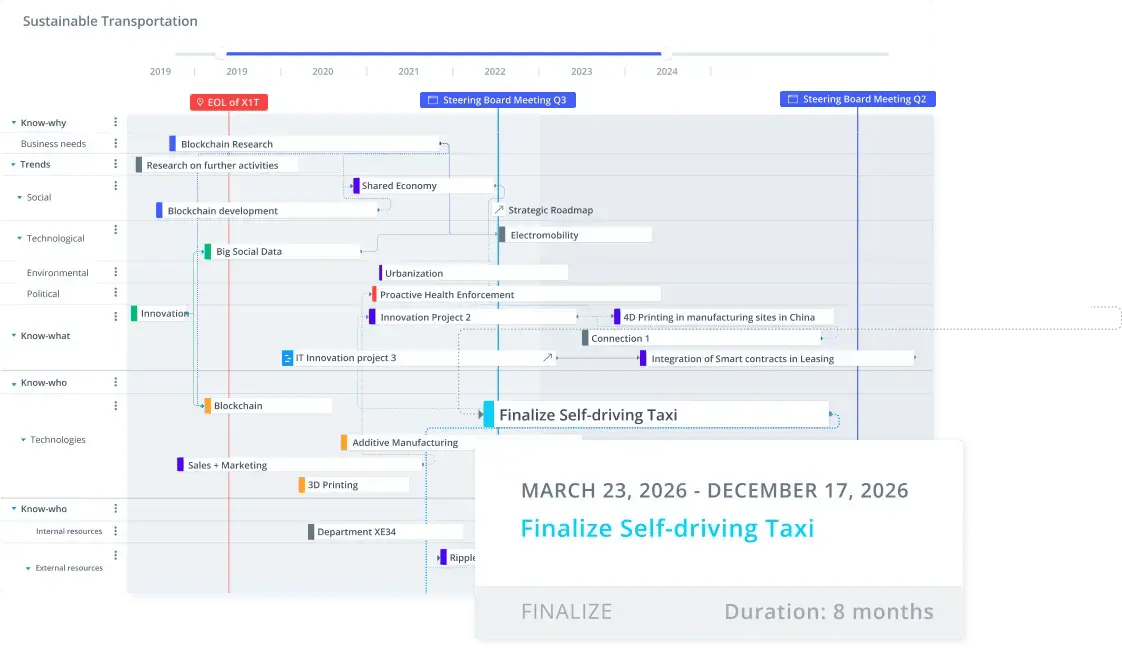
Exhibit 1: Interactive roadmaps to share new product development process plans
Four benefits make the difference in practice:
The result: R&D management teams move from scattered, manual coordination to structured workflows aligned to strategic objectives and built for speed.