R&D portfolio management: When to fund, stop, and scale projects


Most R&D portfolios have a funding gate. Few have a stop gate, and fewer still have a scale gate.
Projects clear the first stage-gate review, absorb budget for two or three years, and skip any second vote on whether the investment still earns its place. Stage-gate governance is built on milestone reviews that assess project feasibility at each gate, not just at intake.
McKinsey documented one food company running more than 560 active projects before it created a dedicated role solely to kill stalled ones. The portfolio dropped to just over 200 within three years.
R&D portfolio management runs on three decisions: fund, stop, and scale. Most companies build a process for the first one. The other two decisions are where R&D budget gets stranded.
Technology scouting surfaces candidates for funding research and development projects. Project management runs a single initiative once it is funded.
R&D portfolio management is broader than either activity. It centers on three decisions:
Fund. Commit budget to a new initiative entering the pipeline.
Stop. Close an initiative and reallocate its budget.
Scale. Increase resourcing for an initiative that is clearing its milestones.
Each decision keeps the portfolio aligned with business strategy and strategic objectives as those shift.
Most CTOs handle funding well. Few have a process for stopping or scaling.
R&D and technology leaders approve funding readily. Stopping or scaling an initiative asks for a different kind of judgment, and most CTOs and VPs of R&D have no formal process for it. That gap is where this framework starts.
This article lays out a working framework for all three decisions, the software capabilities that make those decisions repeatable at scale, and two client examples that show it in practice. A clear portfolio strategy determines how aggressively each check gets applied. Basic research earns its own place in the mix as a bounded allocation, exempt from near-term return scoring.
A stalled initiative clears every budget review on autopilot. It keeps drawing funding, immune to the criteria that would end or scale it.
PMI's 2017 Pulse of the Profession research put a number on this at the portfolio level: organizations wasted an average of $97 million for every $1 billion invested in projects that failed to deliver their promised benefits, based on 2016 survey data. That figure spans project portfolio management broadly, not R&D budgets specifically. R&D budgets that skip a stop decision run on the same mechanism.
Every dollar a stranded initiative holds is a dollar unavailable for the scale decision on a stronger initiative. A portfolio carrying three stranded initiatives already holds enough budget to scale a strong one.
The funding sits there until a stop review releases it. Risk mitigation depends on a diversified pipeline; three stranded initiatives concentrated in one thesis put more of the portfolio in jeopardy than the same three spread across different theses would.
The same effect runs in reverse for a scale decision left unmade. An initiative clearing its milestones but capped at its original budget grows slower than the market it is chasing.
That gap in growth is opportunity cost, invisible on any line-item loss report. A scale decision delayed by even one quarter measurably lowers the initiative's net present value and the strategic value it was funded to deliver.
A stop or scale decision needs an owner separate from the team requesting the funding: a portfolio manager or a steering committee. IESE Business School research from Professor Luis Huete found that leaders and organizations with a track record of success have a harder time killing their own projects. The same logic runs in reverse.
A steering committee that scales an initiative on a sponsor's enthusiasm skips the same milestone check a stop decision requires. Risk tolerance varies by initiative, but the governance split stays fixed: project managers own delivery risk day to day, and the steering committee owns portfolio-level risk management against corporate strategy.
Ownership splits cleanly between two levels, matched to what each group can see.
R&D leads decide:
Which proposals enter the pipeline
Which proposals get resourced first
How a project's scope adjusts between gates
The steering committee decides:
Which stalled initiatives get killed at the next gate
Which initiatives get scaled with additional budget
How capital moves from a killed initiative to a new or scaled one
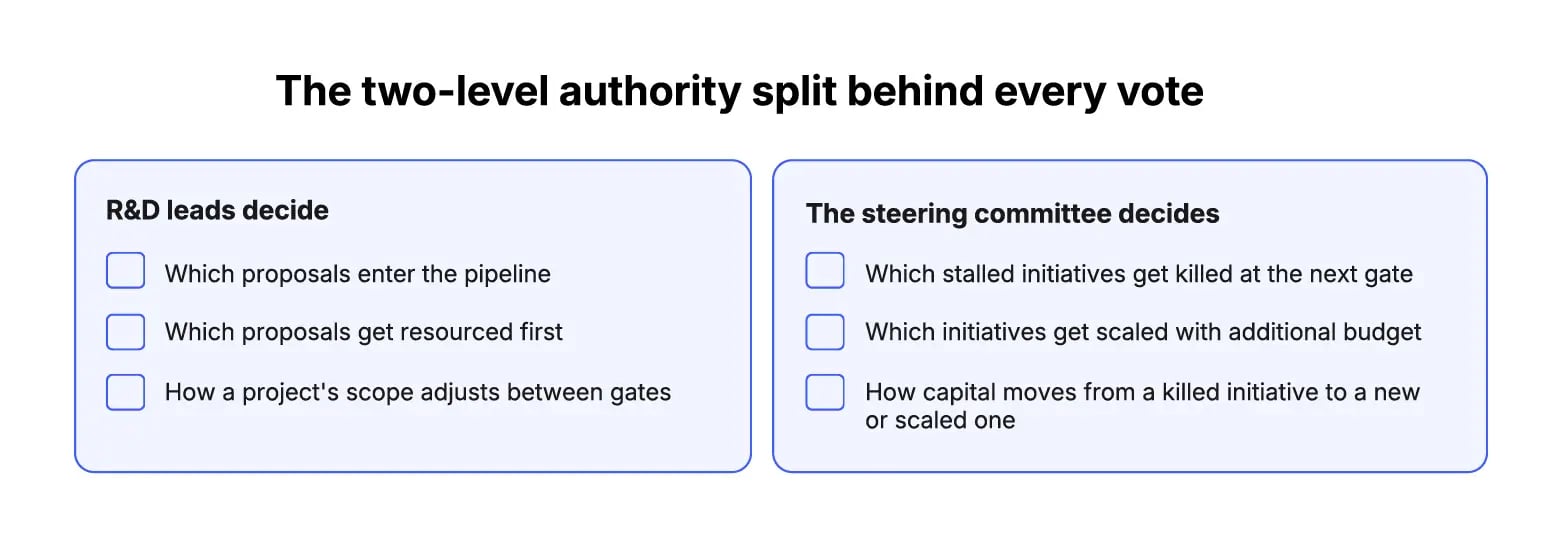
Exhibit 1: R&D leads shape the pipeline. The steering committee owns every fund, stop, and scale vote.
This split matters once two or more kill signals appear on the same initiative. An R&D lead can flag it. Only the steering committee can close it.
Quarterly reviews catch most stalled initiatives before the cost compounds much further. Monthly reviews work better for portfolios with short technology cycles, where a competitor move or a validated risk can date an initiative within weeks.
Faster cadences also catch resource constraints sooner, compounding the cost savings from an early stop. Both cadences need to cover already-funded initiatives as well as new proposals.
The framework turns separate authority into eight concrete checks. Each decision runs on its own criteria, with a specific trigger rather than a general principle to interpret case by case.
These checks turn portfolio management processes into a repeatable, informed decision-making system instead of a fresh judgment call at every review. The checks below follow the order a steering committee works through them: from a new proposal down to an initiative that fails every scale signal too.
Four signals recur across stalled R&D initiatives:
↓ Budget burn outpacing milestone progress
↓ Market assumptions invalidated since the last gate
↓ A lower priority score than newly funded competing work
↓ Two consecutive review cycles with technical risk unchanged
The same four checkpoints apply in reverse:
↑ Milestones cleared ahead of schedule
↑ Market assumptions confirmed by new data
↑ A higher priority score than initiatives currently funded
↑ Two consecutive review cycles with measurable improvement in technical risk
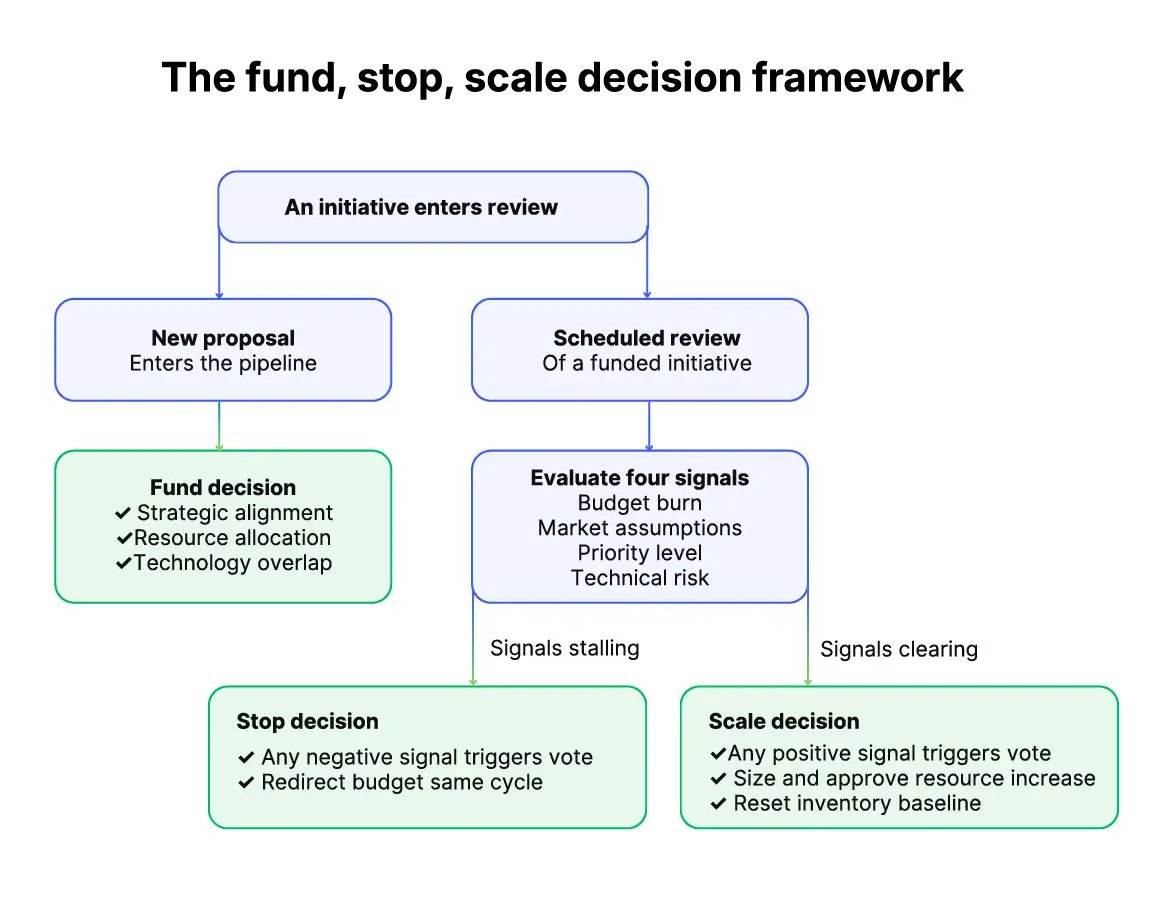
Exhibit 2: One entry point branches to fund, stop, or scale. The steering committee's four signals decide which path an initiative takes.
Competing proposals get scored against each other in a separate step that happens before any of these checks apply. That project prioritization step draws on different prioritization tools depending on the input data available: weighted scoring, Three Horizons, the Eisenhower Matrix, and Technology Readiness Levels each fit different decision types, covered in technology portfolio prioritization.
A fund, stop, scale framework runs on data that changes weekly: budget burn, competitive signals, technology maturity. Portfolio visibility keeps that data in front of the steering committee continuously between reviews. Structured processes built around that visibility reduce both cycle time and resource waste, since a signal that would otherwise wait for the next scheduled meeting gets caught the week it appears.
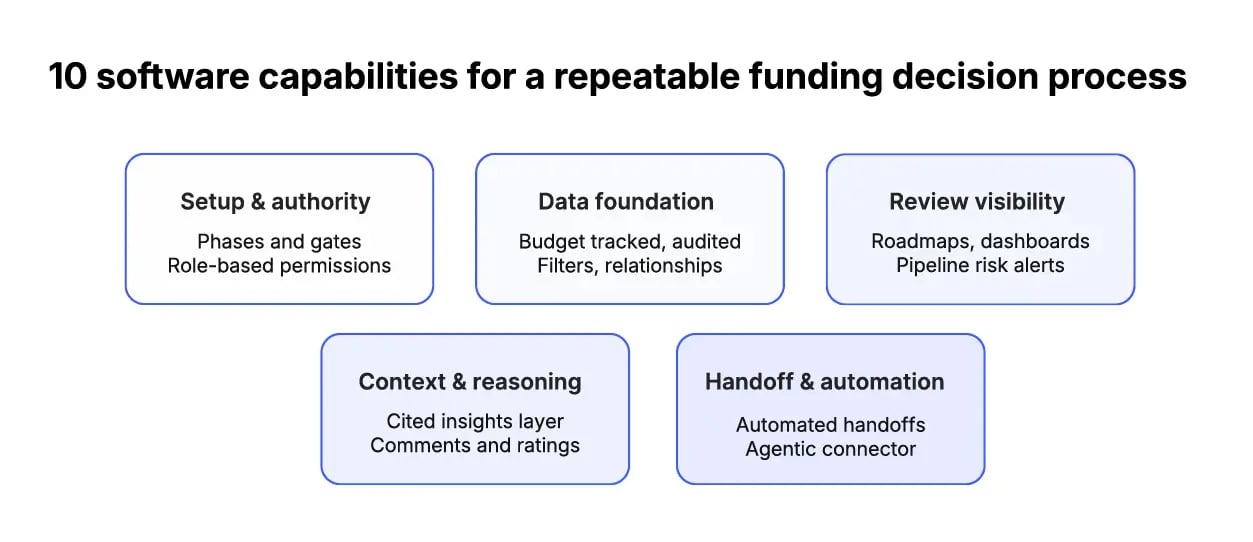
Exhibit 3: Ten capabilities turn a static tracker into a live, continuously updated fund, stop, scale review.
Ten capabilities separate a working system from a static tracker:
A system missing several of these still requires the steering committee to reconstruct the picture manually before every vote.
The fund, stop, scale framework holds up against two client cases already running it.
Toyota Motor Europe runs virtual pitch events where R&D and production engineering teams submit new project proposals. Internal experts evaluate each submission on the same platform, and approved proposals convert directly into funded initiatives.
Toyota tested 40 innovation software systems before choosing ITONICS as its top-level innovation platform. More than 500 members across Europe now use it to manage over 200 R&D projects and score strategic value on the same platform, with further rollout planned across the organization.
DRÄXLMAIER Group centralized its idea management and pre-development workflows onto a single platform. Manual project reporting dropped by 70 percent, saving the Innovation Management department hundreds of hours a year. The team redirects that time straight into evaluating initiatives instead of compiling status updates.
That reporting time is exactly what a stop or scale review consumes when data arrives late. Removing the drag increases how often R&D portfolio management can actually make the call, since fund, stop, and scale decisions depend on the same reporting cycle.
ITONICS is strategic portfolio intelligence built for these three decisions. It holds technology signals, pipeline status, and financial data in one system, so the fund, stop, and scale calls run on the same evidence base at every review.
Toyota and DRÄXLMAIER already run this cycle on live data. Fund, stop, scale runs as a recurring practice, checked against current numbers at every steering committee review.
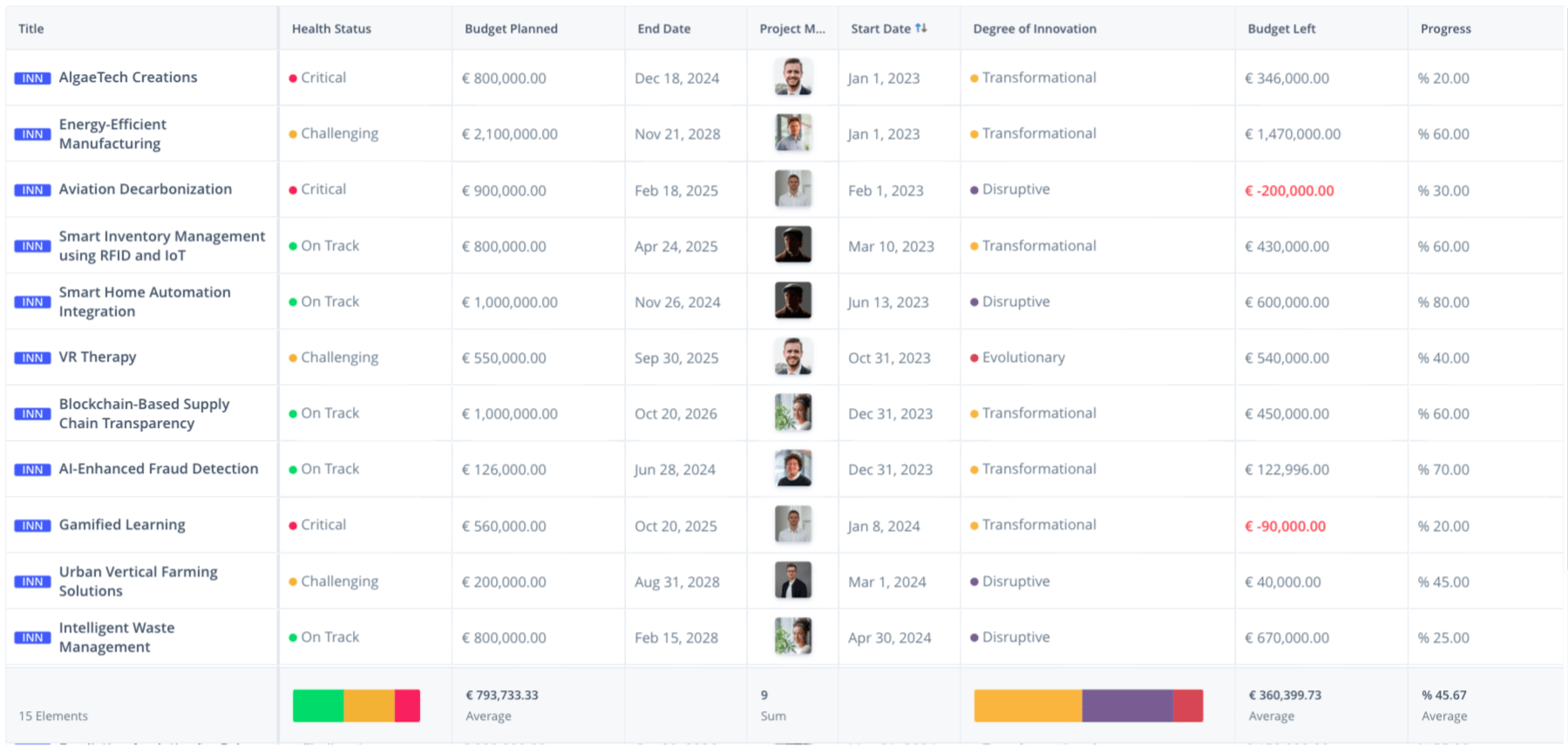
Exhibit 4: Budget sits on the initiative record itself, aggregated automatically, so a stop or scale vote starts from the same figures every time.