AI agents in innovation: A framework any company can apply

Most innovation activities in large organizations follow the same pattern. A challenge is identified. An idea campaign is launched. Employees submit suggestions. A small team reviews them. Most ideas stall. Only a handful move forward.
The bottleneck is capacity. Innovation managers and their teams are expected to scan emerging technologies, run crowdsourcing campaigns, evaluate hundreds of submissions, and maintain a structured pipeline - often with smaller teams than the task demands.
AI agents are changing this equation. Not by replacing human judgment, but by handling the parts of the innovation process that consume the most time and produce the least differentiated value. When AI manages data gathering, idea generation, and initial evaluation, human teams can focus on what actually matters: applicability, feasibility, and industry relevance.
This article presents a four-step framework for integrating AI agents into corporate innovation activities. Each step is grounded in the approach developed jointly by Siemens and ITONICS in a real idea campaign - one that produced a surprising result.
Before applying any framework, innovation managers need a clear understanding of what AI agents can and cannot do.
AI agents are software systems that can execute multi-step plans autonomously. They access data sources, generate outputs, evaluate results, and iterate - without requiring a human to direct each action. Unlike traditional automation that follows fixed rules, AI agents respond to context and adjust their approach based on what they find.
In innovation, AI agents operate across several roles.
These are not theoretical capabilities. Companies are deploying AI agents today to automate processes that previously required dedicated analysts, consultants, or large innovation teams. The benefit is the ability to run innovation activities at a scale that smaller teams could not sustain manually.
The following framework is drawn from the RISE process developed and applied by ITONICS in collaboration with Siemens. It covers four stages: Research, Ideation, Selection, and Enhancement (Exhibit 1).
This framework is specifically designed to optimize the innovation workflow by integrating AI agents at each stage, streamlining tasks, and improving operational efficiency.
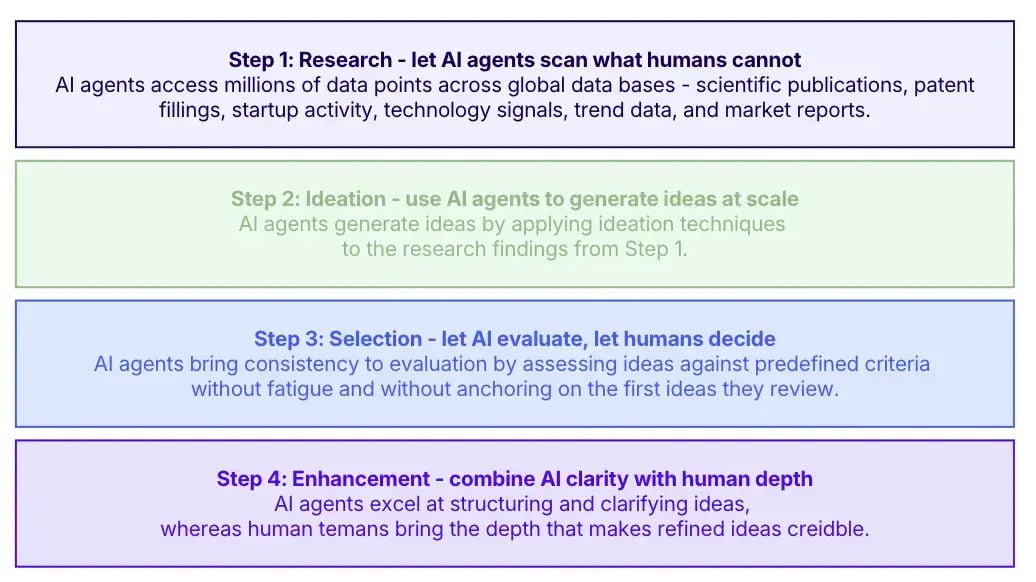
Exhibit 1: The RISE framework for AI agents in innovation
Each stage has a clear purpose, a defined role for AI, and a defined role for humans.
Most innovation activities start too narrowly. Teams scan sources they already know. They read the same industry reports, follow the same conferences, and benchmark against the same competitors. The result is incremental thinking disguised as innovation.
AI agents solve this by accessing millions of data points across global databases - scientific publications, patent filings, startup activity, technology signals, trend data, and market reports - simultaneously and continuously.
The output of this stage is not a final recommendation. It is a rich, structured body of knowledge that informs what ideas are worth generating. AI agents do not decide what matters. They ensure that the knowledge base feeding the innovation process is complete rather than accidentally limited.
The conventional assumption is that ideation requires human creativity. AI challenges this. Not by being more creative than humans, but by being faster, more consistent, and unconstrained by the organizational filters that shape (and limit) human idea generation.
AI agents generate ideas by applying ideation techniques to the research findings from Step 1. They can produce dozens of distinct concepts across different use case clusters in the time it takes a human team to facilitate one workshop. But:
They do not get anchored on familiar solutions.
They do not filter ideas based on internal politics or budget assumptions.
This does not mean human ideation is redundant. Human teams bring industry relevance, stakeholder awareness, and contextual judgment that AI cannot replicate. The right approach is parallel ideation: run AI-generated ideas alongside human-generated ideas, then compare and combine.
The goal is not to decide which is better. It is to create a larger, more diverse pool of ideas than either humans or AI could produce alone. Crowdsourcing campaigns that include AI-generated ideas alongside employee submissions produce richer pipelines than campaigns that rely on human submissions alone.
Evaluating large volumes of ideas is one of the most resource-intensive parts of the innovation process. It is also one of the most inconsistent. Human evaluators bring bias, fatigue, and varying interpretations of criteria. Ideas evaluated on a Monday morning get different treatment than ideas reviewed on a Friday afternoon.
AI agents bring consistency to evaluation. They can assess ideas against predefined criteria scalability, market fit, technological maturity, customer value, competitive differentiation — without fatigue and without anchoring on the first ideas they review. This makes the evaluation process more reliable and frees human experts to focus on the judgment calls that require genuine domain knowledge.
The human role in this stage is not to rubber-stamp AI recommendations. It is to assess the dimensions AI cannot evaluate well: organizational fit, stakeholder readiness, cultural alignment, and the kind of industry-specific nuance that comes from years of domain experience. AI makes the evaluation faster and more structured. Humans make it contextually accurate.
The final stage before ideas enter the development pipeline is refinement. Raw ideas - whether generated by humans or AI - need sharpening. The problem statement needs to be precise. The customer value needs to be specific. The implementation path needs to be credible.
AI agents excel at structuring and clarifying ideas.
They can rewrite vague concepts into clear, well-formed business cases.
They can identify gaps in the logic of an idea and suggest how to address them.
They can check ideas against regulatory requirements, existing patents, or competitive landscape data to flag risks before investment decisions are made.
Human teams bring the depth that makes refined ideas credible. They know which customers will actually pay for a solution, which internal capabilities make implementation feasible, and which organizational constraints will shape execution. The combination of AI's structural clarity and human contextual depth produces ideas that are both well-formed and grounded in reality.
Applying this four-step framework does not require building a new innovation function from scratch. It requires three changes to how existing innovation activities are run.
#1: Integrate AI into the research phase before any campaign launches.
Stop relying solely on what your team already knows. Use AI to systematically scan the technology and market landscape every time you define a new innovation challenge. This takes hours, not weeks, and produces a knowledge base that makes every subsequent step more effective.
#2: Run AI ideation in parallel with human ideation. Do not choose between them.
The Siemens experiment shows that AI and human teams generate ideas in different solution spaces. You need both to build a pipeline that is genuinely diverse. Parallel ideation with blind evaluation removes the bias that typically disadvantages AI-generated ideas in organizational settings.
#3: Use AI to structure and evaluate at scale, but keep humans in the final decision loop.
AI makes evaluation faster and more consistent. Human experts make it contextually accurate. Neither alone produces the right outcome. The organizations that get this balance right will run more campaigns, evaluate more ideas, and identify more opportunities than those still relying on manual processes end-to-end.
The Industrial Metaverse market is expected to reach $100 billion by 2030, according to MIT Technology Review Insights. Siemens is not waiting to find out which use cases will matter. They are generating, evaluating, and selecting them now - with AI agents doing the heavy lifting across every stage of the process.
Your organization can apply the same framework. The tools exist. The process is proven. The question is whether you start now or catch up later.
ITONICS provides the platform infrastructure that makes this four-step framework operational at scale. The Innovation AI runs the RISE process natively - scanning data sources, generating ideas, evaluating submissions, and refining outputs within a single environment (Exhibit 2).
Within the platform, a marketplace of agents collaborates to perform tasks, negotiate, and drive innovation, showcasing the power of agentic AI in orchestrating complex workflows.
/Still%20images/Collaboration%20Mockups%202025/capabilities-collaboration-one-single-source-of-truth.webp)
Exhibit 2: Optimize the portfolio and shift your budget to initiatives that actually move the needle
Idea management platforms like ITONICS are essential tools for organizations to gather, evaluate, and implement ideas from various sources, helping to drive innovation and prevent stagnation. The power of ITONICS lies in enabling global collaboration and harnessing collective intelligence for organizational growth.
Innovation managers use ITONICS to run crowdsourcing campaigns that combine human and AI-generated ideas, evaluate submissions against custom criteria with AI-assisted scoring, track idea pipelines from submission to implementation, and connect technology scouting to active innovation campaigns so research findings feed directly into ideation.
/Still%20images/Element%20Mockups%202025/ideation-add-unbiased-evidence-2025.webp?width=2160&height=1350&name=ideation-add-unbiased-evidence-2025.webp)
Exhibit 3: Validate ideas with market data and customer insights
The Siemens experiment ran on the Siemens Innovation Ecosystem platform, built on ITONICS. It connected 130,000 colleagues, 10,000 startups, 20,000 suppliers, and 230 universities in one innovation community - with AI agents supporting every stage of the process.