Skip to content
Featured image: 18 Company AI Cases Transforming Product Development in Consumer Goods
Product Development

18 Company AI Cases Transforming Product Development in Consumer Goods

Consumer goods companies face shrinking launch windows and rising complexity. Market trends shift faster than traditional development processes can absorb. Manual processes cannot keep up with the volume of customer data, usage patterns, and consumer trends required for confident decisions.

The consumer goods industry has reached an inflection point: Market projections show the global AI in consumer goods market growing from $3.1 billion in 2023 to $37.3 billion by 2032, but the real story is in what leading companies are already achieving.

Mondelēz accelerated recipe development by 4 to 5x using machine learning, launching over 70 new product SKUs, including the Gluten-Free Golden Oreo. Unilever increased ice cream sales by 30% in key markets using weather-based AI demand forecasting. Nestlé compressed product ideation from six months to six weeks with generative AI.

These are true production systems delivering measurable business outcomes. This article examines how AI is fundamentally changing product development in consumer goods - with evidence from companies that have moved beyond experimentation to scaled implementation.

Why AI in consumer goods is now a board-level priority

AI in consumer goods directly shapes growth, margin resilience, and competitive advantage across product development. Boards are paying strong attention because artificial intelligence now influences which product ideas move forward and which die early.

The pressure: Market volatility meets compressed innovation cycles

McKinsey research across 140 digital and AI use cases in consumer packaged goods quantified potential value between $810 million and $1.6 billion for a $10 billion food and beverage company. Thus, boards are paying attention because these numbers represent 7 to 13 percentage point improvements in EBITDA margins.

What changed is the feasibility. AI can now connect consumer insights, demand forecasting, and portfolio decisions in integrated systems. That connection turns uncertainty into data-driven decisions that leadership can defend.

The challenge is environmental. Smaller, agile brands captured about 40% of the overall growth in US consumer products in the first half of 2024. They're winning by adapting faster to consumer shifts and making data-driven decisions at every turn. For large consumer goods companies, the competitive pressure is clear: move faster or lose ground.

Where competitive advantage is created: Speed to learn, not to launch

Currently, 85% of product launches fail within two years, according to Clarkston Consulting. The issue is learning velocity: Organizations that consistently convert market signals into successful launches outperform those chasing isolated wins.

Case: P&G's AI Factory

P&G developed a proprietary machine learning platform now leveraged across 80% of its global business, making their data scientists 10x faster and more efficient. A Harvard Business School study with 776 P&G employees showed teams using generative AI completed product development tasks 12% faster than those without AI.

Overall, the study tested four scenarios: individuals without AI, teams without AI, individuals with AI, and teams with AI. The fastest combination? Teams augmented with AI. P&G's Chief R&D Officer Victor Aguilar noted that "whether employees are brainstorming solo or collaborating with others, AI provides a powerful boost, unlocking new ideas and accelerating our speed to innovation".

But speed without insight amplifies risk. That's why the strongest implementations focus on improving decision quality before scale decisions are made.

From better tools to better judgement: What development AI actually delivers

Most conversations about developing AI focus on tools and especially that framing misses the point. But instead of productivity, the real shift is judgment quality across the product development process. Thus, AI in product development matters because it changes how teams evaluate options, assess risk, and commit resources.

Development AI becomes valuable when it improves decisions earlier in the product development lifecycle, and that is where most value is created or destroyed. Thus, generative AI, consumer insights, and demand forecasting reshape judgment rather than automate tasks.

Using GenAI to explore more concepts without more headcount

Capacity constraints limit innovation more than creativity because product teams have finite time and attention. GenAI changes this constraint by expanding exploration capacity without expanding teams.

Generative AI enables instant generation of product variations, feature combinations, and positioning hypotheses. These outputs are structured starting points that accelerate discovery, and teams can therefore evaluate more options in less time.

Adidas: AI-powered shoe design

Adidas trained a stable diffusion algorithm on 150,000 shoe images at different angles. Employees then generated running shoes with specific criteria, such as partner collaborations or mashups of two shoe types. Designers choose from generated ideas or use them as inspiration for new shoes.

When Adidas China lacked product background and model images customized for the native market, it used Amazon EC2 and Amazon SageMaker to craft photorealistic models, cutting time to market and costs.

Walmart: Design lead time reduction

Walmart developed "Trend-to-Product," a generative AI tool that has reduced apparel design lead times from 24-26 weeks to just 6-8 weeks. This 70% reduction in cycle time enables Walmart to respond to fashion trends while they're still relevant.

Leading organizations embed generative AI into early workshops and portfolio reviews. Product managers use it to stress-test assumptions. Designers explore alternatives faster. Analytics teams focus on validation instead of generation.

Coca-Cola: AI-generated product launch

In September 2023, Coca-Cola used AI to produce Coca-Cola Y3000, an AI-powered beverage created by Coca-Cola Creations. The platform is designed to introduce limited-edition products inspired by various trends and collaborations identified through AI analysis.

Mondelēz: 4-5x faster recipe development

Mondelēz uses an AI tool developed with Fourkind (now Thoughtworks) that analyzes flavor, cost, environmental impact, and nutrition to streamline snack creation. The machine learning tool accelerates recipe development dramatically, enabling R&D teams to move ideas to pilot trials far faster than traditional methods.

The tool has contributed to creating over 70 new product SKUs, such as the Gluten-Free Golden Oreo. Despite economic pressures, this accelerated pace helped Mondelēz achieve 5.4% growth in organic sales. Importantly, final taste validation remains a human task as AI augments creativity without replacing it.

Nestlé: From 6 months to 6 weeks in product ideation

Nestlé developed a generative AI tool that presents product concepts in just over a minute, taking inputs from more than 20 Nestlé USA brands and analyzing real-time market trends. The tool suggests creative product concepts that teams can explore and test.

Nestlé trained about 100 team members in its innovation community on how to use the tool, and in early efforts saw product ideation accelerate from six months to six weeks. An initial test within the Premium Waters business showed promising results, with concepts now being explored for market launch.

The implementation leads to overall better work: Product development cycles shorten, but learning deepens. Faster time-to-market becomes a byproduct of better decisions instead of a rushed execution.

How consumer insights become continuous, not episodic

Traditional consumer insights are episodic: research studies run quarterly, and feedback only arrives after launches. By the time insights surface, decisions are already fixed, and it arrives too late to influence early-stage decisions. But the development of AI breaks that cycle.

AI systems integrate customer feedback, user behavior, and usage patterns into continuous feedback loops. Instead of static reports, teams access live signals that evolve as markets shift. This changes how insights are used inside the development process.

Colgate-Palmolive: AR-powered consumer engagement

Colgate-Palmolive partnered with Perfect Corp., leveraging AI-powered augmented reality solutions that allow online shoppers to use a QR code and smartphone filter to see what their smiles would look like after two weeks of using a Colgate whitening product. This provides a personalized, engaging experience while empowering informed purchasing decisions.

Sephora: AI foundation matching

Sephora embedded AI into retail customer experiences by incorporating AI-powered foundation matching in-store. The technology helps customers find the right product match on their first try, reducing returns and increasing satisfaction.

Dove: AI-powered scalp therapist

In March 2024, Dove launched its virtual AI-powered Scalp + Hair Therapist in the US, an interactive diagnostic tool accessed via Dove's website. Users answer questions about scalp health and hair concerns, then the tool - developed using generative AI and drawing on expertise from Dove's dermatologists - generates a personalized scalp and hair profile with product recommendations.

Every piece of advice is based on peer-reviewed content meticulously evaluated by Unilever's R&D, Legal and Regulatory teams. This builds consumer trust while gathering valuable insights about consumer needs.

Nestlé: AI-powered consumer research

Nestlé brands from Coffeemate to Stouffer's deploy Outset's AI-moderated research to test, validate and refine new product concepts at unprecedented speed and scale. Brand teams provide concepts and consumer target criteria, then AI handles screening participants, conducting interviews, and analyzing results.

Michael Widenmeyer from Nestlé shared: "We were very impressed with how much depth people shared with the AI moderator – it was more than twice as much as our next best method, and we got both quantitative and qualitative concept validation done in record time".

P&G: Real-time usage data from smart products

P&G leveraged AI to analyze real-time usage data from smart products like the Oral-B iO toothbrush. The data revealed actual behavior versus reported behavior and the algorithms then showed the average brushing time was only 47 seconds, compared to the two minutes users reported.

P&G's smart products are equipped with sensors that collect real-time usage data, which is used to create new products or customize product lines to customer preferences. This closes the gap between what consumers say and what they actually do.

Unilever: DelphiAI platform

Unilever worked with PA Consulting to develop DelphiAI, an AI-powered engine that puts data and AI at the heart of product innovation. The platform ingests product reviews, social sentiment, and regional taste preferences to help tailor SKUs to market demand.

DelphiAI launched with laundry products in India and beauty products in the US, and quickly spread throughout Unilever teams. Kumar Subramanyan, Director of Digital R&D at Unilever, explained: "Instead of refreshing products every year, it's now possible to do it continuously, in real-time, adapting as the solutions evolve".

The system analyzes consumer feedback across channels and generates product claims that effectively communicate benefits. Teams can ask Delphi new questions monthly or daily to identify product features aligned with emerging needs.

This shift elevates analytics teams: AI-driven tools free analysts from manual reporting, enabling focus on interpretation and strategic guidance. Insights become actionable, supporting better market fit and fewer late-stage corrections. 

Why demand forecasting now shapes products before launch

Demand forecasting used to sit downstream as products were designed first, and forecasts followed later. That separation no longer works as volatile supply chains and fast-moving consumer trends demand earlier signal integration.

AI-powered demand forecasting moves upstream into product development. With advanced analytics models, demand scenarios can be simulated based on pricing, feature sets, and regional variation. These forecasts inform design choices before scale decisions are even made.

Unilever: Brand DNAi framework

Unilever developed Brand DNAi, a Brand Safe AI training repository that ensures AI models source information only from approved brand voices, values, strategies and visual identities. This framework enables speed without compromising brand integrity.

  • Closeup's launch of White Now whitening toothpaste used an AI-powered SuperShoots production model to produce over 100 assets across ten distinct modular set-ups in just three days. Assets were tailored to specific touchpoints - from social to point-of-sale - primed to make an impact on every channel and market.

  • The Beauty AI Studio at Unilever produces assets up to 30% faster than before and more than doubled key performance metrics like Video Completion Rate and Click-Through Rate.

P&G: Project Genie for customer service

P&G developed Project Genie, which uses AI to provide information to over 800 Customer Service Representatives. The tool quickly gathers knowledge from articles and composes consumer-friendly messages, reducing question processing time and improving the consumer experience.

Unilever: Weather-based demand forecasting

Unilever connected weather data to ice cream demand forecasting, resulting in a 30% increase in sales in key markets. The system uses AI to analyze weather patterns and predict demand for temperature-sensitive categories.

Temperature-sensitive categories like beverages and ice cream show the highest AI implementation success rates at 85%. The approach works because the connection is intuitive (weather affects ice cream consumption), making it easier to validate and scale.

Danone: 90 % increase in forecasting transformation

Danone implemented AI for demand forecasting and promotional planning, increasing forecast accuracy to over 90% while improving service levels and cutting product waste significantly. The improvements translated directly to cost savings and higher customer satisfaction: both measurable bottom-line results.

AI-powered demand forecasting moves upstream into product development. Advanced analytics models simulate demand scenarios based on pricing, feature sets, and regional variation. These forecasts inform design choices before scale decisions are made.

For decision makers, forecasting becomes a governance tool supporting data-driven decisions on where to invest, what to prioritize, and when to exit.

Why software architecture determines AI impact

Many AI initiatives fail for reasons that have nothing to do with models or talent. They fail because the underlying software architecture cannot support learning at scale. In consumer goods product development, architecture determines whether AI accelerates decisions or fragments them.

The hidden costs of fragmented AI investments

A 2024 McKinsey survey showed 71% of CPG leaders adopted AI in at least one business function, up from 42% in 2023. However, adoption doesn't equal impact. Most consumer goods companies haven't truly scaled AI capabilities beyond isolated use cases.

The true fragmentation problem can be found in many companies as they accumulate AI tools around specific tasks: one for consumer insights, another for demand forecasting, and a third for generative AI experiments. Each works in isolation, but none shares context. The result is fragmentation that creates predictable failure modes:

  • Insights don't travel across the product development lifecycle

  • Analytics teams spend time reconciling outputs instead of interpreting them

  • Product teams receive conflicting signals

  • Decision makers lose trust in AI-driven insights

The lesson: point solutions create local optimization. Integration creates system-wide impact.

Integration creates a system-wide competitive advantage

An AI-powered innovation system orchestrates information, decisions, and learning across the development process. That orchestration is where impact is created.

At minimum, such a system connects consumer insights, market trends, demand forecasting, and product development workflows. AI systems need access to relevant information across stages, not snapshots. This enables retrieval augmented generation and contextual reasoning instead of generic outputs.

Kraft Heinz: Universal data hub

Kraft Heinz partnered with Snowflake to develop a universal data hub within their business, then partnered with several analytics platforms to create an on-demand, ChatGPT-like platform that helps inform employees making strategic decisions.

Their goal is to gather real-time insights and information across their supply chain that can be accessed at any time. Kraft Heinz partnered with Alteryx to automate workflows and FourKites to add real-time visibility to their supply chain.

Nestlé: Comprehensive AI infrastructure

Nestlé implemented a full suite of AI-powered data-management tools to embed analytics across their business, working with Microsoft Azure to layer key organizational data capabilities over their SAP HANA system. Utilizing Azure Machine Learning and Microsoft PowerBI allowed Nestlé to develop key monitoring dashboards.

Nestlé's collaboration with Deloitte generated an estimated cumulative business value of over $200 million in its first four years through a combination of cost savings and new revenue opportunities. The program allowed decommissioning of 17 legacy siloed systems and made the process of ingesting new data sets 50% faster.

Over 2,000 additional personnel across the business now utilize the centralized data lake. Mature MLOps and DevSecOps processes significantly reduce time-to-production for new AI use cases.

P&G: Digital manufacturing transformation

P&G sealed a multiyear partnership with Microsoft to transform its digital manufacturing platform, leveraging industrial IoT, digital twin, data, and AI to bring products to consumers faster. The transformation enables real-time product quality checks directly on production lines, equipment resiliency while avoiding waste, and optimization of energy and water use.

P&G CIO Vittorio Cretella explained: "We leverage AI across all dimensions of our business to predict outcomes and increasingly to prescribe actions through automation". Applications span product innovation (where modeling cuts formula development from months to weeks), consumer communication (delivering brand messages at the right time and channel), and retail operations (ensuring products are available where consumers shop).

Strong architecture supports feedback loops: outcomes feed back into models, usage patterns refine assumptions, product variations inform future decisions, and learning compounds across innovation cycles.

From a practical standpoint, architecture determines scalability. AI platforms that centralize data, logic, and workflows allow teams to build once and reuse often. This reduces duplication and aligns AI investments with business outcomes.

Building AI into your product development process: The ITONICS approach

The evidence is clear: AI delivers measurable impact when properly implemented. Leading consumer goods companies report 20% reductions in time-to-market, 4-5x faster recipe development, and demand forecasting accuracy reaching 90%+.

But these results share a common pattern: they come from integrated AI systems instead of isolated point solutions.

ITONICS embeds AI into product development decisions through Prism AI, our purpose-built engine for strategic decision-making. Unlike generic AI tools, Prism operates on your company's specific context as it understands your portfolio structure, strategic priorities, and data landscape.

What this means in practice. Prism continuously connects internal and external signals - like consumer insights, market trends, portfolio progress, and execution risk - into focused, actionable intelligence (Exhibit 1). Multiple specialized AI agents work under a unified context, delivering grounded outputs through retrieval augmented generation rather than disconnected responses.
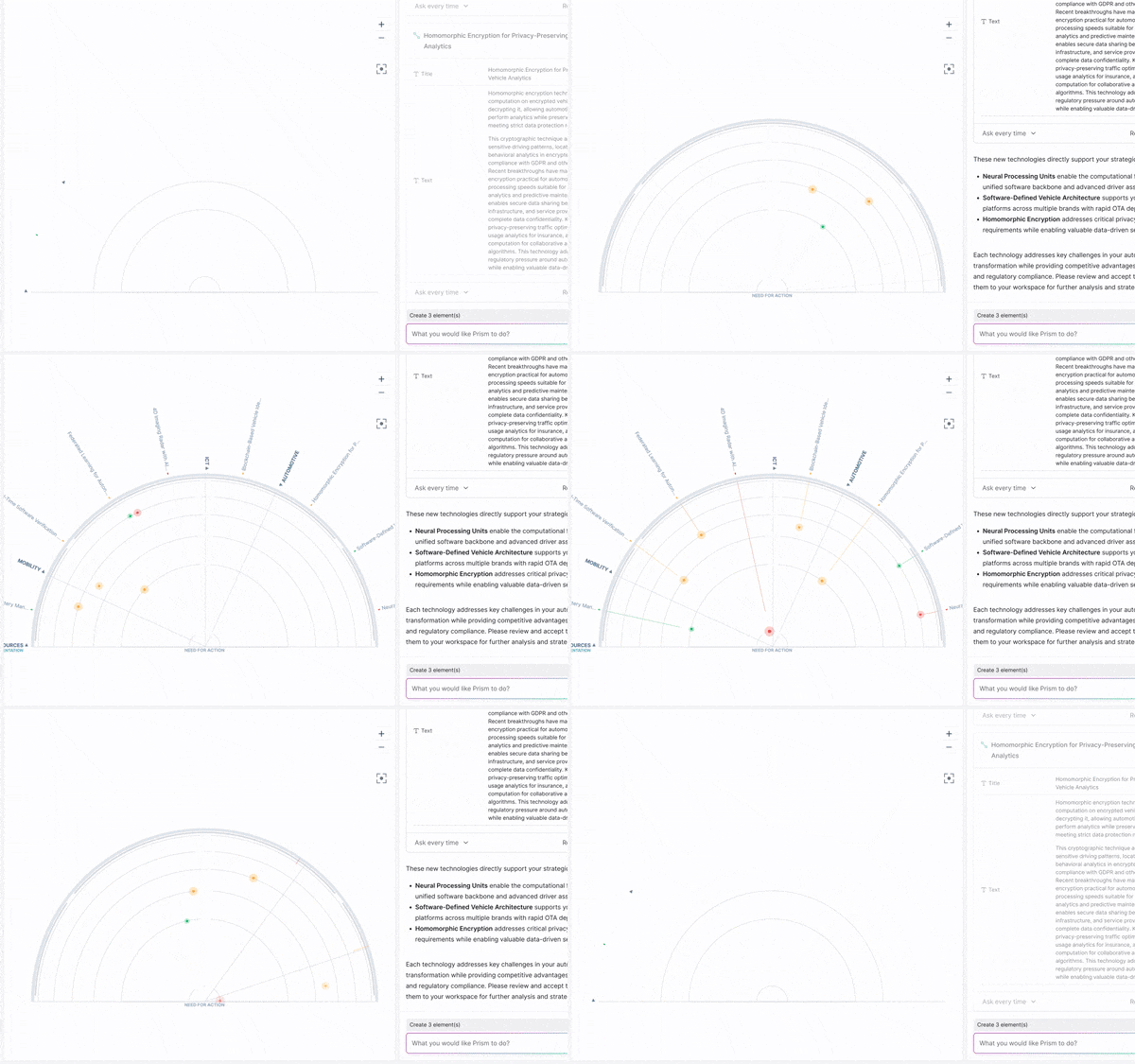
Consumer Goods Trend Radar

Exhibit 1: Spot opportunities ahead of competition with Prism's auto-generated industry insight radars

The result for consumer goods teams:

  • Fewer manual processes through automated signal detection across consumer feedback and market data

  • Earlier misalignment detection before resources are committed

  • Stronger insight-to-action links delivered directly in workflow context

Enterprise-ready governance. Data remains in your environment, proprietary information stays protected, and human oversight remains explicit. This makes AI adoption scalable and trustworthy for leaders responsible for long-term competitive advantage.

The companies profiled in this article succeeded by treating AI as a core capability integrated across their development process. ITONICS provides that integration layer, enabling teams to move from isolated AI pilots to systematic competitive advantage.

FAQs on AI transforming the product development process in consumer goods

Why has AI in consumer goods become a board-level priority now?

AI now directly influences growth, margin resilience, and competitive advantage in consumer goods. What changed is feasibility: AI systems can connect consumer insights, demand forecasting, and portfolio decisions end to end. This allows leaders to defend investment decisions with data rather than intuition. In volatile markets with compressed innovation cycles, boards see AI as a lever for faster learning, better capital allocation, and sustained competitiveness.

Where does AI create real competitive advantage in product development?

The advantage is not faster launches, but faster learning. Most product failures stem from poor early decisions, not slow execution. AI improves judgment quality early in the lifecycle by helping teams explore more concepts, assess risk sooner, and kill weak ideas before scale. Organizations that convert signals into insight faster consistently outperform those relying on episodic research and late-stage validation.

How does AI change consumer insights and demand forecasting in practice?

AI turns insights from episodic reports into continuous feedback loops. Live consumer signals, usage data, and behavioral patterns flow directly into development decisions. Demand forecasting also moves upstream, shaping product design before launch. Teams can simulate demand scenarios by price, feature set, and region, improving investment decisions and reducing late-stage corrections.

Why do many AI initiatives fail to scale in consumer goods organizations?

Most failures are architectural, not technical. Companies deploy isolated AI tools for insights, forecasting, or experimentation, but these systems lack shared context. This fragmentation creates conflicting signals and erodes trust. Scaled impact requires integrated architecture that connects data, decisions, and learning across the full product development process, enabling reuse, feedback loops, and consistent governance.