Business Model Innovation Guide: Strategies, Tools, and Examples


Your business model defines how you earn profit. When you change it, you change how you make money. Business models are, at heart, the logic of how value is created, proposed, and appropriated.
The business model perspective provides a compiled answer to who the target audience is and how a company's value proposition addresses their needs. It details how the company creates and delivers value to customers, and how it generates greater profit by earning more revenue than the costs incurred.
Any change to one of these dimensions can be considered as a business model innovation; however, the most disruptive business model innovations have resulted from changes in multiple dimensions. Business model innovation can mean that something is new to a company, an industry, or the world.

In its simplest form, a business model can be broken down into three components: value creation, value delivery and proposition, and a revenue capture system. Each component plays a unique role in ensuring the business not only survives but thrives in competitive environments.
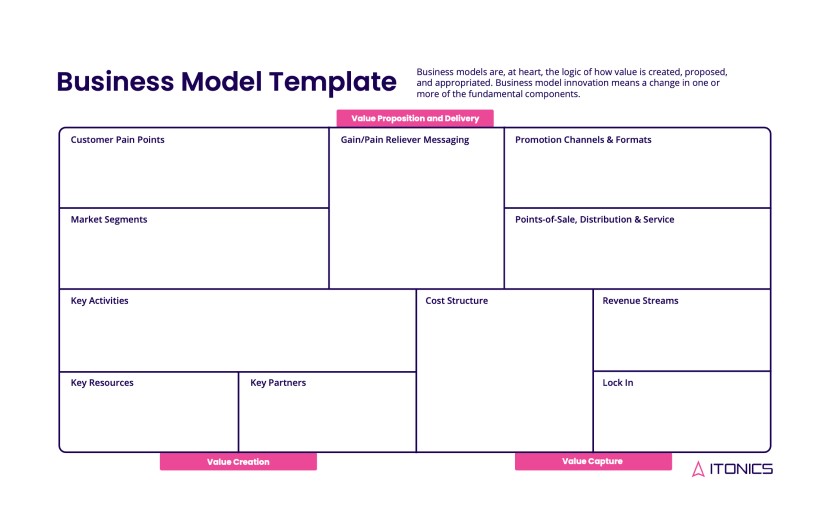
Along these dimensions, there are business model archetypes that explain he unique characteristics of each business model type on a high level. The Business Model Navigator is a great resource and features 55 different business model patterns that help to find new options and understand business models, including the examples we presented above.
Bosch’s perspective on business model innovation
Maybe not so easy, but several definitions exist. We use a lot of Osterwalders ‘Nine Blocks Canvas’. But in terms of the definition, I would go with the St. Gallen model with four quadrants or four aspects. You can describe a business model with those four different segments, be it with the customer in the center, and then there's a magic triangle around it. And the corners of the triangle are the ‘what’. So, what do you offer to the customer? How do you create value? Where does the profit come from? And then the definition is, if you change or innovate in at least two of those four aspects, such as customers or value generation and so on, then we talk of business model innovation.
Manuel Krauß, Bosch Innovation Consulting
Business model innovation has significantly increased its importance as an innovation type in the Digital Age. By leveraging digital capabilities, firms can now run businesses while easily adjusting to customers’ needs, without even owning the key resources, without direct customer interactions:
Yet, also outside the digital arena, firms have introduced newer ways to create, deliver or capture value:
These examples illustrate that innovating your business model can take a variety of forms. In essence, a business model outlines how an organization aims to make money from its services and products efficiently, detailing its operations for creating and capturing value. It represents the leadership of the organization’s assumptions about customer desires, the delivery of those desires, and how the company can fulfill them profitably.
A new business model design leads to profit when the company's operations and resources enhance its efficiency compared to competitors (thereby reducing overall costs) or increase its effectiveness in boosting revenues, whether through higher prices or larger sales volumes.
Finding a good business model can seem like an art. But it does not have to be. When assessing whether a business model is good or not, there are several criteria for systematic evaluation:
Using these evaluation factors is particularly helpful when innovating and designing new business models. They help evaluate the characteristics of existing business models and identify innovation opportunities. From a quantitative perspective, business model evaluation is fairly easy: The profit margin indicates how good a business model is.
How does PayPal approach radical business model innovation?
Horizon 3 is definitely three years and beyond. And that is a hard feat. You don't really know where that's going. But what it allows you at Horizon 3 is that you can stage this entire environment. You can make assumptions that might ring true in the future or not. And with that, you then set milestones against your critical assumptions and then you see if you hit them or not. Yet we hear too much that a project needs to be finished because too much money was invested already. And this is exactly what we shouldn't be doing.
Maria Mileder, PayPal
The profit margin informs you about the revenue-to-cost relationship. The more profit relative to costs that can be earned, the better the business model. Yet, this factor can only be evaluated precisely after implementing and testing the business model. From the quantitative perspective, several industry business models seem to be very good and attractive, as shown in this figure.
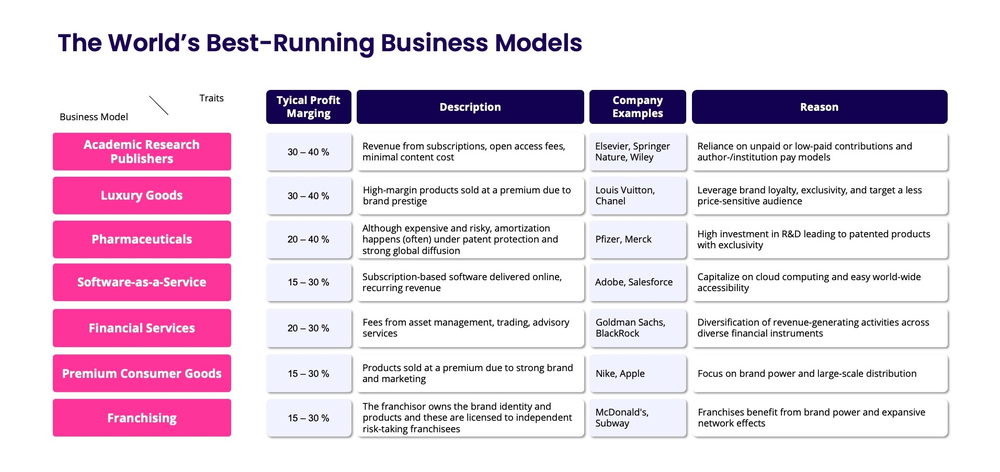
In contrast to the good business models shown above, not all business models perform well. This opens the question of when and how to innovate a business model. A typical situation to engage in business model innovation is when your company has an ambition to grow or improve its market position.
However, external factors can also force companies to rethink their business model and innovate it. Market changes, new technological opportunities, competitive pressure, regulatory changes, and macroeconomic downturns are common reasons to change your business model.
Business model innovation means changes to one or multiple elements of an existing business model. It can also involve creating an entirely new business model.
The central components are value creation, value delivery and proposition, and revenue capture. Business model innovation can thus be understood as a change in who is the target audience and how a company's value proposition addresses its needs.
It can also mean a change in the operational logic, such as changing from manufacturing to partnering for operational efficiency. Or, it could be a switch in how revenue is collected, from selling to renting or licensing.
To approach innovating your business model systematically, this article provides 10 ways to visualize business models as well as business model archetypes. Here are also six strategies to manipulate a business model: Integrating, Substituting, Augmenting, Elevating, Excluding, and Porting.
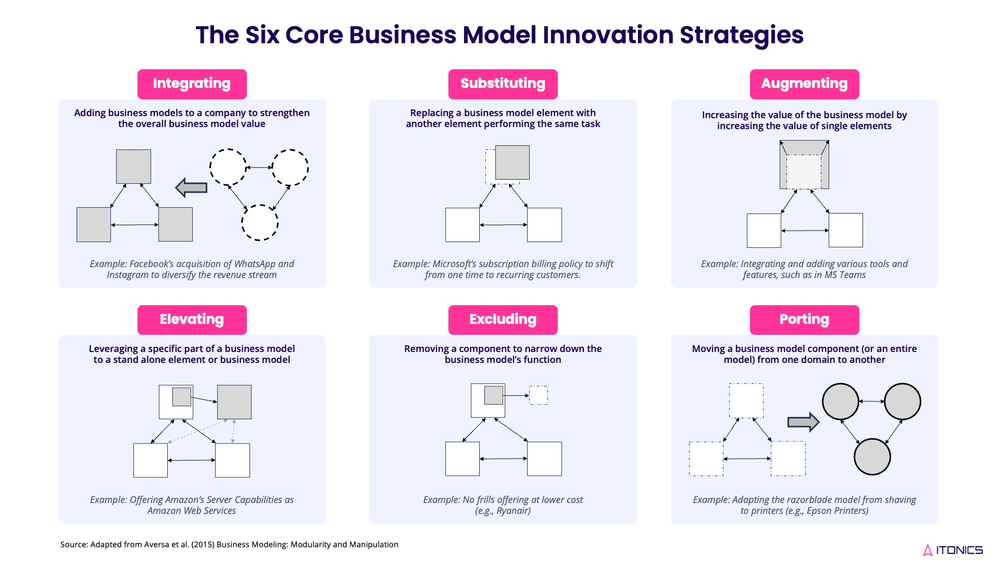
Integration involves adding another business model to strengthen the overall business model value. This strategy is related to M&A or company-building activities. It is also the most common innovation mode for innovating in Horizon 3, i.e., innovation in areas away from today’s core business.
Typically, larger companies observe the development of startups and, once proven promising, they integrate these startups and their business models into the organization. Famous examples of the integration business model innovation strategy are Facebook’s acquisitions of WhatsApp and Instagram or Google’s acquisitions of Android, YouTube, and Fitbit.
Substitution involves replacing a business model element with another element performing the same task. This approach is often related to process improvement or technological upgrade initiatives. It is particularly prevalent in industries undergoing rapid technological change, where maintaining competitiveness often depends on staying ahead of technological trends.
Typically, companies might substitute outdated technology or processes with newer, more efficient ones to enhance productivity and reduce costs. A classic example of substitution is the transition from brick-and-mortar stores to e-commerce platforms.
Prominent examples include Adobe and Microsoft, which substituted the selling of perpetual software licenses with subscription-based models. Another example is Hilti substituting one-time sales with leases of tools to construction companies, providing ongoing service, maintenance, and management of these tools.
Augmenting as a business model innovation strategy means increasing the value of the business model by increasing the value of single elements. This approach is often related to changing the value proposition, targeting a bigger audience, or enhancing the value promised by new features.
For example, Apple frequently uses this strategy by regularly updating its hardware and software ecosystems to enhance user experience and integrate new services, thereby maintaining a competitive edge and customer loyalty.
Similarly, companies like Netflix have augmented their value by expanding their content library and enhancing streaming technology, thus broadening their market reach and increasing subscriber engagement. This type of business model innovation is crucial for staying relevant and competitive in rapidly evolving industries.
Elevating means transforming a specific part of a business model into a standalone element or business model. This approach is often applied when an internal capability becomes so significant and valuable that it offers potential benefits to external market players.
Amazon's development of Amazon Web Services (AWS) is a good example. AWS originated from Amazon's internal infrastructure, which was so advanced that offering it as a cloud service to other businesses became a viable and lucrative model. This transformation allowed Amazon to capitalize on a key internal resource, turning it into one of the most dominant players in the cloud services industry.
Another example is Pixar's RenderMan: Initially developed as an in-house tool to create high-quality animation, RenderMan was so advanced that Pixar decided to sell it as a commercial product to other companies and studios. Subsequently, Universal Pictures and Marvel Studios used it to create several blockbusters without direct Pixar’s involvement.
Excluding involves removing a component to narrow down the business model’s function. This approach is exemplified by Ryanair’s no-frills offering at a lower cost.
Another example is furniture retailer IKEA, which removed the cost of assembly from its business model by requiring customers to assemble the products themselves. This not only reduces costs but also simplifies logistics and warehousing, allowing IKEA to focus on design and cost-effective manufacturing.
This strategy of exclusion helps streamline operations and can lead to a significant competitive advantage by enabling lower prices and distinct market positioning. It is a model often found in industries dominated by comfort and high prices.
Porting as a business model innovation strategy means moving a business model component (or an entire model) from one domain/industry to another. This approach can leverage the strengths of a business model in new, unexplored markets.
A classic example of this strategy is Starbucks' use of the fast-food service model in the coffee industry, where they applied quick-service concepts to coffee retailing, transforming the coffee shop experience into a faster, more streamlined service akin to fast food.
Another example is Netflix's shift from its DVD rental model to streaming, initially mirroring the traditional rental model in a digital format and subsequently revolutionizing content consumption in the entertainment industry. This strategy might be the easiest to apply in brainstorming sessions. By leveraging business model archetypes, contemplate how they might be transferable to another domain.
Business model innovation is a complex task since it involves arranging different components and their interrelationships. As such, visualizing business models has become a practical way to reduce the complexity of designing new business models or restructuring existing ones.
One of the most commonly used business model tools is the Business Model Canvas, which has millions of downloads.
The Business Model Canvas is a template to break down a business model into its core components, represented by boxes. The common template comes without further information.
Users are expected to fill it out with their thoughts. This form provides structure but won’t necessarily stimulate creativity since it doesn’t provide further options to consider. That is why this type of business model innovation tool is best used to map an existing structure and contemplate changes to the components.
This is often seen as the only way to represent a business model, yet this is only one out of ten business model innovation tools. We explore nine other business model innovation tools in the following paragraphs.
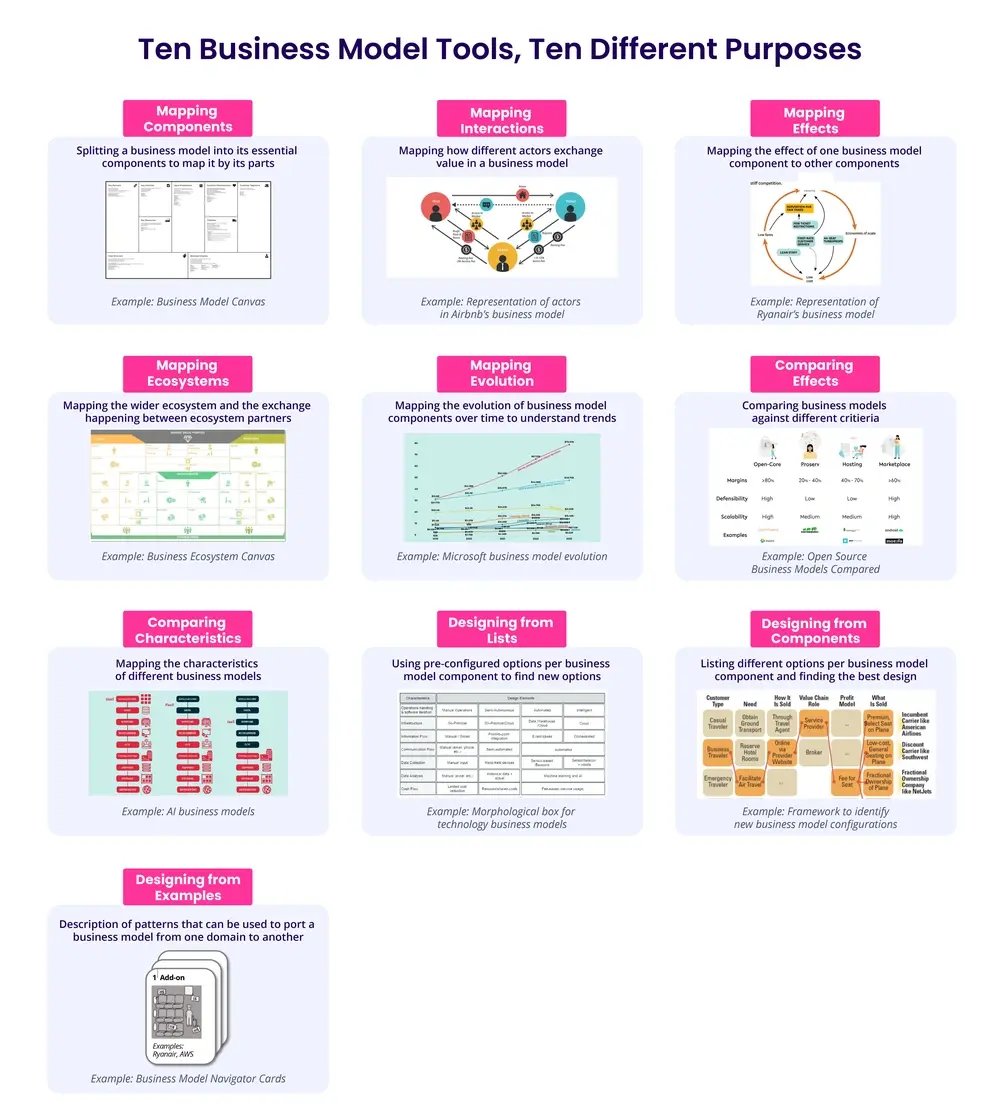
The second business model innovation tool, Mapping Interactions, has a completely different visual structure. It is not based on boxes and components but on actors and arrows.
The arrows represent how the actors in a business interact with each other. This allows users to map the interests of each actor group, what they value, and what they get in return for compensation.
The third tool, Mapping Effects, is a causal loop diagram. In contrast to Mapping Interactions, model components are the focal points here, not the actors.
Each business model component is related to another business model component, showing how they relate to each other. This way, it’s possible to visualize the critical business model components and analyze the effect of each one.
Tool number 4, Mapping Ecosystems, takes a broader perspective. It not only maps the business model components of a single firm but also allows users to map the relationships with partners in an ecosystem.
It helps in understanding partners’ motives more specifically and what value each partner brings to the business model ecosystem.
The fifth business model innovation tool, Mapping Evolution, is a timeline view of business models. This is particularly useful to communicate how individual business models within a larger firm have developed over time.
In contrast to the previous group of business model innovation tools, the second group is more helpful in contrasting different models and making decisions.
The Comparing Effects tool lists different business models and contrasts them according to their effects. This is a handy way to identify the business model that scores best according to the given criteria.
Another option is Comparing Characteristics, which lists the components of each business model and compares them to alternative designs.
While the first two groups of business model innovation tools require knowledge about existing business models, the following group provides more inspiration, which is helpful when designing a new business model.
In this group, the first tool, Designing from Lists, is similar to a morphological box. Each row represents a component, and the adjacent columns show options for that component. Users of this tool can then decide per component which alternative is best and ultimately combine their selections to shape a business model.
The second tool, Designing from Components, is similar. It also requires users first to write down alternatives per component. Users can then draw connections between the alternatives and decide on the business model design that seems most fitting.
Lastly, the approach of Designing from Examples involves cards that describe already existing business models. The characteristics described on the cards can be used to find inspiration and port one business model to another domain or industry.
When innovating a business model, you have the choice to transform and expand an existing business model or, alternatively, add a completely new business model. In the following sections, we provide three step-by-step guides with different degrees of innovativeness.
How does Bosch organize for different degrees of business model innovativeness?
We try to do so by differentiating between core, adjacent, and beyond core business innovation. Core innovation is mainly the responsibility of the business units. So, they are responsible for it and drive innovation within their core sphere. Beyond that, the adjacencies usually either come from the business units, cross-business units, or cross-domain activities. For example, in our mobility sector, a huge sector at Bosch, there is a dedicated unit searching for innovative new business models, attached to the mobility sector and fitting to the Bosch strategy. Beyond core innovations, some call it Horizon Three, can somehow be triggered by a certain business unit. But mainly, it is handled centrally. And, of course, there is a very strong central corporate development unit at Bosch. Also, the central IT department is looking for innovative talks. They focus strongly on innovation projects for future technologies and businesses. So we try to have all those under one roof but still being on different paths because there are different velocity, speed, and activities on those roads.
Manuel Krauß, Bosch Innovation Consulting
Transforming an existing business model is crucial for companies that want to stay competitive in an ever-evolving market. The first step in this transformation process is to thoroughly assess the current business model.
It's important to map the key components, such as value proposition, revenue streams, customer segments, and the overall cost structure. Analyzing the performance through financials, customer satisfaction, and market position can highlight strengths and pinpoint areas for improvement.
Additionally, gathering feedback from environmental scanning provides valuable insights into risks and opportunities emerging outside the firm’s boundaries. This step identifies the components that need to change, given the risks and opportunities from outside.
Once the assessment is complete and the key areas to innovate are identified, the next phase involves ideating and developing new business model options.
This can be achieved by listing alternatives for each critical component or consulting business model patterns as sources of inspiration (see the 10 Different Visual Tools for 10 Different Business Model Purposes). As a result of this step, the three to four most promising business model configurations should emerge.
Compare the potential and risks of each alternative, then select the best-fitting business model for further experimentation.
Testing a new business model is crucial and can be conducted through pilot projects in selected market segments. Only validation in the real world will show whether the assumptions made will hold true.
This phase allows the business to monitor performance closely and collect detailed feedback, using it to make quick iterative adjustments. Once the model has proven successful on a small scale, cautious planning for a broader rollout should ensure scalability and sustainability.
Implementing a new business model transforms the older business model. This requires a detailed transition plan, outlining how the shift from the old model to the new one will occur, including timing, impacts on current operations, and communication strategies.
It’s also important to provide training and support to all employees to ensure they understand their roles within the new model. Adjustments to the business infrastructure may be necessary to support the new model, including investing in new technologies or modifying physical layouts.
Finally, it is vital to set clear metrics to measure the success of the new business model and conduct regular reviews to assess performance against these metrics.
Continual improvement and staying agile are key, allowing the business to adapt further as industry trends shift and new opportunities arise. This ongoing cycle of monitoring and adapting ensures that the business model remains robust and relevant in the market.
Expanding an existing business model is a crucial step for any company looking to grow and sustain its presence in a competitive market.
It's about finding new avenues to increase the customer base, enhance product or service offerings, and enter new markets. A systematic approach to expansion not only streamlines the process but also improves the chances of success.
The expansion process begins with a critical evaluation of the market. What target groups are not yet well served? How big is the demand? Will it grow over time? What (technological or legislative) changes will open up new markets related to the core business?
Once the growth opportunities and markets are clear and prioritized, it is important to understand how to address these opportunities. Competitive analysis is also crucial to understand the business’ chances. Knowing competitors’ strategies, strengths, and weaknesses can provide valuable insights and help to craft a unique value proposition.
If the business can serve new opportunities with existing internal capabilities, develop strategies to enter these markets. If the capabilities are insufficient, formulate what is needed to build these capabilities.
Once the groundwork is laid, start developing specific expansion strategies. This might include considering geographical expansion, either internationally or into new regions within the current market, and analyzing various factors like regulatory, cultural, and economic conditions.
Diversifying product or service offerings is another avenue, either by enhancing existing ones or developing new ones. Forming partnerships and collaborations can also provide new channels, resources, or essential technologies.
Before fully committing to the expansion strategy, run a pilot program or limited release in the new market or with the new product/service.
This step allows companies to gather data on performance, including customer acquisition, sales, and feedback, and use this information to refine their approach.
Once validated, the new capabilities need to be incorporated into the existing core business model or spin-off into a new business model (read more about The Six Core Business Model Innovation Strategies). This can include revisiting or revising the value proposition, market segments, cost structure, and revenue streams.
Resource allocation is also critical; determining how to distribute capital, staff, and technology to support expansion efforts is a key factor. Additionally, develop risk management strategies to address potential challenges associated with expansion.
Finally, the expanded business must be regularly monitored to evaluate its performance against the set goals using relevant key performance indicators.
Companies must remain adaptable, continuously improving and adjusting their strategy based on real-world performance and feedback. Engaging stakeholders, including employees, partners, and customers throughout the process, is also crucial as their insights can significantly refine the expansion strategy.
This ongoing cycle of evaluation, adaptation, and optimization is essential for the sustained success of the expanded business model.
Creating or adding a new business model to an existing one is a strategic approach that can help a company diversify its revenue streams, reach new customer segments, and enhance its resilience against market fluctuations. It can be a strong growth lever, yet also a risky endeavor. The first step is to identify opportunities for new business models.
This involves conducting extensive market research to spot trends, changes in consumer behavior, technological advancements, and new businesses, such as startups, that inspire the creation or addition of new business models. Additionally, organizing innovation workshops with your team and external experts can foster creative ideas.
After identifying potential opportunities, the second step is to develop and validate demand assumptions. Is the offering attractive enough for a larger user group? Will they be willing to pay for a product or service?
Multiple assumptions should be generated and outlined using business model innovation tools. Develop the most promising models as rapid prototypes; these must be detailed enough to evaluate but flexible enough to adjust based on feedback.
Gathering input from relevant test users with different characteristics is crucial at this stage to validate assumptions and assess the demand potential. This will help get more buy-in and confidence for the next steps.
Once it is clear that there is demand for the solution, test assumptions about the feasibility.
What are the most efficient and scalable ways to produce the product or service? How can you scale the business model from an initial rapid prototype to full-fledged production?
After validating the demand and feasibility, it is important to define how to go to the market. Will the new solutions be promoted and sold under the current business model, or will they be spun off into an own entity?
Launch the model fully to your target market, making sure all systems and processes are in place to support the scale-up. Monitor the performance closely and continuously look for improvements, being responsive to feedback and ready to make further adjustments as necessary.
Also, look for ways to leverage synergies between your new and existing business models through shared resources, cross-marketing, or bundled offerings.
Once the new model has been refined, tested, and integrated, the final step is to scale and optimize. Review and iterate the new business model.
Set regular review points to assess how the new business model is performing within the context of the broader business strategy. Stay informed about industry trends and developments that may affect your business model. Be prepared to adapt and evolve as necessary to stay competitive and meet changing market demands.
In brief, here are the most important tips to approach business model innovation:
The ITONICS Innovation OS is the best innovation software and supports business model innovation in several ways. The ITONICS Innovation OS can be used to find new business model ideas, to grow systematically from a rough idea to a convincing business model, and to plan the development of a new business model.
Spot new opportunities: Horizon 3 opportunities don’t emerge in the core business—they require foresight. With ITONICS, use AI, collaborative workflows, and prioritization tools to scout and build a portfolio of new market opportunities that will transform your business.