5 Whys: Examples and templates to solve root causes, not just symptoms


The 5 Whys technique is a problem-solving method that explores the root cause of an issue by asking "why" multiple times. It helps teams move beyond symptoms to real causes.
By repeatedly asking why, teams reveal real issues rather than relying on quick fixes. This structured approach ensures that effective solutions are implemented instead of merely treating symptoms.
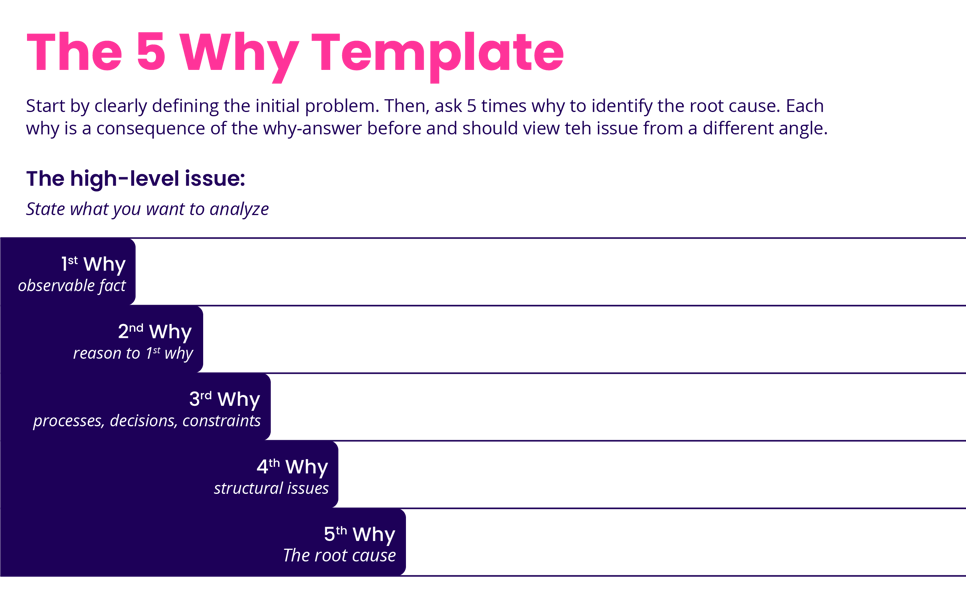
The 5 Whys method was pioneered by Toyota’s scientific approach to problem-solving. It became a core tool for addressing process inefficiencies and improving team problem-solving capabilities.
Toyota’s founder, Sakichi Toyoda, introduced this technique to the Toyota production system to uncover deeper issues within production lines. It later expanded into various scenarios, from business processes to healthcare.
Today, organizations across industries use 5 Whys analysis to uncover root causes and prevent issues from recurring. It is a key component of lean management and continuous improvement strategies.
Asking “why” five times forces teams to look beyond the initial problem and uncover the cause and multiple root causes. This eliminates assumptions and ensures powerful insights to complex problems.
Each “why” leads to a more detailed analysis, allowing teams to trace issues back to their original problem. This method works best when combined with team discussions and fact-based reasoning.
Unlike other analysis tools, the 5 Whys technique is simple, cost-effective, and doesn’t require specialized knowledge. It helps organizations fix problems at their source and achieve sustainable solutions.
This root cause analysis method is widely used in process improvement, preventing the same problem from recurring. Instead of treating symptoms, teams analyze the issue in depth, ensuring to find the behind-the-scene issues and drive continuous improvement.
The process begins by clearly defining the initial problem: For example, deadlines are not being met. The first why shows that tasks take longer than expected, but this is only a surface-level issue.
Asking why again reveals that requirements often change midway through the project. Further questioning uncovers that stakeholders frequently request last-minute adjustments to new product development initiatives, disrupting planned workflows.
A deeper examination asks why stakeholders make frequent changes. The answer points to the absence of a structured process for handling requests, leading to reactive rather than proactive decision-making.
Continuing the questioning, the analysis uncovers that hypotheses are made about accommodating changes, rather than having a defined protocol for managing them. This lack of structure causes inefficiencies.
The final why traces the root cause to the absence of a formal project planning framework. Without a clear process for setting expectations, scope changes continue unchecked, leading to missed deadlines.
By knowing the real problem, a structured change request system is implemented. This ensures continuous improvement, preventing the same problem from recurring.
Exploring the root cause is crucial, and one major mistake is stopping at assumptions instead of reaching the root causes. This leads to ineffective actions.
Another error is focusing on small details rather than addressing root problems. This results in temporary fixes instead of sustainable improvements.
Failing to involve the entire team in the process limits insights, reducing the method’s effectiveness.

The Five Whys technique is widely applied across industries to unpack the root cause of inefficiencies and create a consistent approach to addressing challenges. Whether in manufacturing, customer service, or healthcare, plenty of examples exist of how this method helps teams thoroughly investigate what is truly happening rather than relying on guesswork.
For example, a factory experiences frequent production delays. Using Five Whys, the team discovers that the cause is outdated maintenance schedules. Further questioning reveals that maintenance protocols were originally developed for older machines and haven’t been updated for new features.
By refining the system, production efficiency improves, and future delays are avoided.
A company, for example, receives repeated customer complaints about delayed deliveries. The team applies the Five Whys method to find the primary reason why dispatch schedules aren’t optimized.
Asking further why, they learn that outdated software, originally developed years ago, cannot process orders in real time. After upgrading the system, customer satisfaction improves significantly.
A hospital investigates the cause of why medication errors are happening, for example. The five Whys uncovers that labeling instructions are unclear due to a team miscommunication. The process is developed further with standardized labels, reducing errors and ensuring patient safety.
Identifying the reason is essential when a problem occurs and needs a structured approach to resolution. The five Whys method and other RCA tools help teams see and resolve specific problems, but each has its strengths.
The five whys are a powerful tool for quickly uncovering the reason for an issue through a simple questioning process. It works best for specific problems with a single root cause.
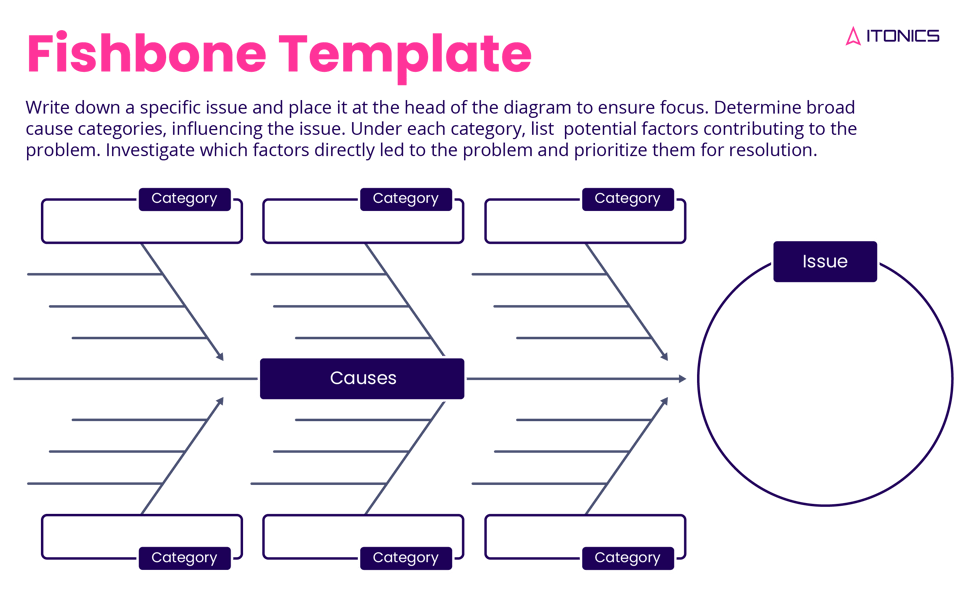
The Fishbone Diagram, also known as the Ishikawa Diagram, is better suited when multiple factors contribute to a problem occurring. Instead of a linear questioning approach, it helps a team visually categorize causes under different categories like process, people, or materials.
Unlike five whys, Six Sigma uses data-driven analysis and statistical inference to resolve complex problems. While Six Sigma is highly structured, five whys is a simpler powerful tool that any team can apply quickly. Both can complement each other depending on the complexity of the issue.
For quick identification of a single root cause, five whys are ideal. For complex issues with multiple variables, Six Sigma or Fishbone Diagrams may work better.
To standardize your approach, download our five whys template that provides structured guidance for your next root cause analysis workshop.
The first question should clearly define what happened. The answer should focus on an observable fact.
For example, if you ask, Why are customer satisfaction scores dropping?, you might hear: Customers report frustration with late deliveries.
The second question should shift focus to the immediate reason behind the first answer.
For example, Why are deliveries arriving late? The answer might be: The warehouse is experiencing shipping delays.

The third why should dive into processes, decisions, or constraints that led to the second answer. It moves beyond surface-level issues.
For example, Why is the warehouse experiencing delays? The answer could be that orders are not being processed on time due to staffing shortages.

This step explores the underlying cause, such as policies, resource limitations, or strategic gaps affecting the previous issue.
For example, Why is there a staffing shortage affecting order processing? The answer might be: Hiring freezes and budget cuts have reduced available personnel.

The final question should explore a fundamental issue that, if addressed, prevents future occurrences by identifying the underlying cause.
For example, Why were hiring freezes and budget cuts implemented? The answer could be: Forecasting errors underestimated demand, leading to resource misallocation.
By structuring the 5 whys technique this way, teams gain depth in their analysis and ensure that solutions address the primary goal.

Integrating the 5 whys method into a digital innovation management platform enhances knowledge management, improves innovation operation, and identifies the underlying cause of recurring problems efficiently.
The best innovation management platforms allow customized idea templates to reflect the structure of the 5 whys, helping stress-test and refine bright ideas. This structured data management allows organizations to track patterns across different innovation projects and determine the biggest problems happened.
Like, digital AI assistants guide users through the 5 Whys analysis template and make it obvious to apply the 5 whys technique effectively.
The ITONICS Innovation OS is the leading innovation operating system. The Innovation OS helps companies of all sorts to:
Eliminate Information Silos: Dispersed teams and disconnected data often result in missed opportunities and duplicated efforts. With ITONICS, all your innovation solutions, most innovative ideas, and market insights are centralized in one place. Create transparency and reduce inefficiencies by keeping everyone on the same page.
Streamline Idea Management: Managing a high volume of ideas from various sources can be overwhelming. ITONICS allows you to capture, determine, and prioritize solution ideas from across the organization, including customers and partners, all in one structured process. This helps focus resources on the most impactful solutions and reduces time wasted on less promising ones.
Foster collaboration: Innovative breakthroughs often come from collaboration. ITONICS enables your teams to collaborate in real time, regardless of location, by sharing insights, feedback, and updates directly within the platform. This fosters a culture of innovation where great ideas can emerge from any corner of your organization.