The real power of AI in innovation isn't generating text. It's stress-testing assumptions, surfacing blind spots, and pushing teams past the blank page faster than any brainstorming session could.
This article gives you 110+ copy-paste-ready AI prompts organized by use case. Each prompt is designed to generate actionable insights, not generic advice. Whether you're running design thinking workshops, conducting market research, or evaluating a new product idea, these prompts help your team focus on what matters.
One caveat: prompt engineering matters. A vague prompt produces vague AI outputs. Every prompt below includes a specific problem context so you can adapt it to your situation without starting from scratch.
Innovation teams adopt AI tools fast, but they use them slowly. The true gap is knowing which ChatGPT prompt to use and when. Most teams default to asking AI to explain things or summarize content. That's using a scalpel to stir coffee.
The latest AI tools, including Claude, ChatGPT, and Gemini, can simulate stakeholder perspectives, identify gaps in your value proposition, generate diverse perspectives on a market, and challenge your assumptions in real time.
The teams that stay ahead use AI as a thinking partner, not a writing assistant. The prompts below are built for that purpose.
AI prompts for creative thinking and problem-solving
These prompts push teams past obvious answers. They borrow from unrelated fields, challenge constraints, and force first-person perspective-taking from customers and competitors.
- "Imagine our [specific process or service] doesn't exist. How would our target audience solve this problem without us?"
- "How would [Steve Jobs / Elon Musk / a startup with unlimited resources] approach [specific problem]? What would they prioritize?"
- "What principles from [unrelated fields like aviation safety or game design] could we apply to improve [specific process]?"
- "If we had to solve [specific problem] using only our existing technology and zero new budget, what would we do?"
- "What's the most counterintuitive solution to [specific problem]? Why might conventional wisdom be wrong here?"
- "How might our best customer describe [specific problem] in their own words? What would they say we're missing?"
- "If we were starting this business today with no legacy constraints, what would we do differently on [specific process or service]?"
- "What would happen if we made [specific feature or process] ten times simpler? What would we have to remove?"
- "Identify three blind spots in our current approach to [specific problem] that a competitor might exploit."
- "What does [specific process] look like from the perspective of a new employee with no prior context? What confuses them first?"
- "If this were a product idea in a completely different industry, what unique features would make it stand out?"
- "What would we change about [specific process] if customer experience was the only metric that mattered?"
- "Describe three ways [specific problem] might get worse over the next five years. What does that tell us about what to fix now?"
- "What constraints are we treating as fixed that we could actually challenge? List five assumptions we've never questioned about [specific problem]."
- "If we could only solve one aspect of [specific problem], which one would create the most value? Why?"
- "How would we explain [specific process] to a ten-year-old? What does that simplification reveal?"
- "What would make our [product or service] irrelevant in three years? How do we prevent that?"
- "Imagine a competitor launches a product that makes ours obsolete next quarter. What does that product do differently?"
- "What would we build if we knew it would fail commercially but succeed technically? What can we learn from that?"
- "List five ways we could make [specific problem] worse. Now reverse each one into a solution."
- "How could we apply design patterns from [specific industry] to improve our [product or service]?"
- "What if we removed the constraint of [specific limitation]? What becomes possible?"
- "How might we reframe [specific problem] as an opportunity? What's the business model hidden inside it?"
- "If we had to explain our value proposition in one sentence to a skeptical CFO, what would we say?"
AI prompts for brainstorming sessions and team collaboration
These prompts are built for business workshops. They generate diverse perspectives, surface disagreement early, and keep brainstorming sessions from converging too fast on safe ideas.
- "Generate 20 new ideas for improving [specific process or product]. Include five that challenge our current business model."
- "What are the strongest arguments against pursuing [specific idea]? List them without softening."
- "How would different functions in our company, such as sales, engineering, and finance, each evaluate [specific idea] differently?"
- "What questions should we answer before committing resources to [specific idea]? Rank them by importance."
- "Describe three scenarios where [specific idea] succeeds and three where it fails. What determines the difference?"
- "What would a customer who hates this idea say? What would a customer who loves it say? Where do they overlap?"
- "How might we run a two-week experiment to test [specific idea] with minimal investment?"
- "What's the smallest version of [specific idea] we could launch in 30 days? What would we learn from it?"
- "List the top five risks of [specific idea]. For each one, describe a mitigation action we could take now."
- "What does success look like for [specific idea] at six months? At two years? What are the performance metrics for each stage?"
- "How would we explain [specific idea] to employees who will be affected by it? What concerns would they raise?"
- "What stakeholders are missing from our current brainstorming sessions on [specific topic]? Who should we involve?"
- "Design a 90-minute innovation workshop agenda focused on [specific problem]. Include activities, timings, and desired outcomes."
- "How might we use design thinking to reframe [specific problem] as a human-centered challenge?"
- "What's the most boring, obvious solution to [specific problem]? Now list five ways to make it interesting."
- "Generate a SCAMPER analysis for [specific product or process]: Substitute, Combine, Adapt, Modify, Put to other uses, Eliminate, Reverse."
AI prompts for market research and emerging technologies
Good market research finds what customers can't articulate. These prompts help teams analyze customer feedback, identify emerging technologies, and map competitive dynamics before they shift.
- "What are the three biggest unmet needs of [target audience] in [specific market]? Provide evidence-based reasoning."
- "How are emerging technologies like [AI, synthetic biology, quantum computing] likely to disrupt [specific industry] in the next five years?"
- "What signals in [specific market] suggest a new customer segment is forming? What does that segment want?"
- "Analyze the competitive landscape for [specific product category]. Who are the top five players? Where are the gaps?"
- "What would a PESTLE analysis of [specific market] reveal about risks and opportunities for our [product or service]?"
- "What questions should we ask in our next user research study to identify unmet needs in [specific market segment]?"
- "How might we use predictive analytics to forecast demand for [specific product or service] over the next 12 months?"
- "What trends in [adjacent industry] should we monitor to stay ahead in [specific market]? Identify the top five."
- "How do customers currently describe their pain around [specific problem]? Generate ten realistic customer quotes."
- "What does the adoption curve for [specific technology] look like? Where are we now, and what accelerates mainstream adoption?"
- "If we were to analyze customer feedback from our last 100 reviews, what themes would likely emerge? Use [specific product or service] as context."
- "What market research methods would give us the fastest actionable insights on [specific customer behavior]?"
- "How might the latest trends in [specific technology sector] change the value proposition of [specific product or service]?"
- "What's the most underserved segment in [specific market]? What would a product built specifically for them look like?"
- "How would we validate a new product idea in [specific market] in under 30 days? List five methods."
- "What do the latest trends in [specific geography or demographic] tell us about future demand for [specific product or service]?"
AI prompts for customer experience and user feedback
Customer experience failures are rarely about the product. They're about gaps between what teams assume and what users actually need. These prompts help teams analyze customer feedback and close that gap.
- "Walk through the customer journey for [specific product or service]. Identify the three moments most likely to cause frustration."
- "What would our ideal customer say about [specific feature] after using it for 30 days? What would they complain about?"
- "How might we redesign [specific touchpoint] to reduce friction for [target audience]?"
- "What user feedback patterns would indicate [specific product or service] is not meeting customer expectations? List five warning signs."
- "How could we use user research to identify the gap between what customers say they want and what they actually do?"
- "What does a customer who churned from [specific product] likely experienced? Reconstruct their journey."
- "Generate a usability test script for [specific product or feature]. Include five tasks and success criteria for each."
- "How might we incorporate user feedback from [specific channel] into our next product iteration?"
- "What customer experience benchmarks should we track for [specific product or service]? Name five with target ranges."
- "If we surveyed our top 20 customers about [specific feature], what would we expect to hear? Where might we be surprised?"
- "How would a first-time user describe [specific product] after their initial 10 minutes? What would confuse them?"
- "What customer experience improvements would have the highest impact on retention for [specific product or service]?"
- "How might we segment user feedback to identify patterns specific to [target audience] versus other segments?"
- "What's missing from our current approach to collecting and acting on user feedback? Identify three process gaps."
AI prompts for evaluating a new business model or product idea
Evaluating ideas early prevents expensive late-stage failures. These prompts simulate the scrutiny of investors, skeptical customers, and internal critics before you commit.
- "What are the three strongest arguments for [specific idea]? What are the three strongest against it?"
- "How does [specific idea] change our current business model? What does it replace, and what does it add?"
- "What's the total addressable market for [specific product idea]? What assumptions are required to reach that number?"
- "How might we test the core assumption behind [specific idea] in two weeks with under €5,000?"
- "What would a five-year financial model for [specific idea] look like? What are the key variables?"
- "What's the minimum viable version of [specific idea]? What does it include, and what does it exclude?"
- "If [specific idea] launched tomorrow, what would the top three customer objections be? How do we address each one?"
- "What regulatory or ethical considerations does [specific idea] trigger? How do we navigate them?"
- "How does [specific idea] affect our existing product line? Does it cannibalize or complement?"
- "What partnerships or capabilities would [specific idea] require that we currently lack?"
- "How would we position [specific idea] against the top competitor in this space? What's our differentiation?"
- "What's the cost of not pursuing [specific idea]? What opportunity are we forgoing by passing?"
- "How might customers discover [specific idea]? Map the top three acquisition channels."
- "What does the unit economics look like for [specific idea] at 100 customers? At 10,000?"
AI prompts for continuous improvement and performance metrics
Innovation doesn't end at launch. These prompts help teams build feedback loops, define performance metrics, and identify process failures before they compound.
- "What key performance indicators should we track to measure the success of [specific initiative]? Include leading and lagging indicators."
- "How would we know if [specific process] is underperforming? What are the early warning signals?"
- "What's the biggest bottleneck in our [specific innovation process]? How do we diagnose it?"
- "How might we streamline communication between [two specific teams or functions] to accelerate [specific process]?"
- "What continuous improvement methodology, such as Kaizen or OKRs, best fits our [specific innovation process] and why?"
- "How would we conduct an innovation audit of [specific capability]? What questions should we ask?"
- "What does a 90-day improvement plan for [specific process] look like? Include milestones and owners."
- "How might we use data to identify which steps in [specific process] add the most and least value?"
- "What feedback loops are missing from our current [specific process]? How do we build them in?"
- "If we benchmarked our [specific process] against a best-in-class competitor, where would we likely fall short?"
- "What automation opportunities exist in [specific process]? Which ones would have the highest ROI?"
- "How do we prevent [specific recurring failure] in our [specific process] from happening again?"
- "What would a retrospective on [specific completed project] reveal? Include what worked, what didn't, and what to change."
- "How might we involve employees more directly in identifying improvement opportunities in [specific process]?"
AI prompts for scenario planning and predictive analytics
Strategic foresight isn't about predicting the future. It's about reducing the cost of being wrong. These prompts help teams build scenarios, stress-test plans, and use predictive analytics to identify where assumptions break.
- "Build three scenarios for [specific market or business area] in 2030: optimistic, pessimistic, and most likely. What are the key drivers for each?"
- "If [specific external trend] accelerates by 50% faster than expected, how does that change our strategy for [specific business area]?"
- "What geopolitical or regulatory changes could disrupt our [specific supply chain or market position] in the next three years?"
- "How would a 20% drop in [specific resource or market segment] affect our business? What's our contingency plan?"
- "What signals would indicate that our [specific strategic assumption] is no longer valid? How do we monitor for them?"
- "How might we use predictive analytics to model the demand curve for [specific product] under three different pricing scenarios?"
- "What's our worst-case scenario for [specific initiative]? How do we build a plan that still works if it materializes?"
- "If a major competitor acquired [specific company or capability] tomorrow, how would that change our competitive position?"
- "What technology that doesn't yet exist commercially could make [specific core capability] obsolete? When might it arrive?"
- "How would we adapt [specific strategy] if consumer behavior shifted toward [specific behavioral trend] over the next 24 months?"
- "Build a pre-mortem for [specific initiative]. Assume it failed. What were the three most likely causes?"
- "How would [specific emerging technology] change the economics of [specific business process] over the next decade?"
- "What are the three most important decisions we need to make about [specific strategic area] in the next 90 days? What information do we need for each?"
- "If we had to bet on the one trend that will most reshape [specific industry] by 2030, what would it be? What does that mean for our portfolio today?"
ITONICS Prism: Connecting AI insights with strategic decisions
Generic AI tools don't know your company. They don't know your strategy, your portfolio, or which projects are burning budget without results. That's the core limitation of prompt-based AI for innovation management:
ITONICS PRISM is a purpose-built AI for strategic portfolio decisions (Exhibit 1). Unlike generic AI, Prism is built on the ITONICS innovation platform and understands the unique context of each organization.
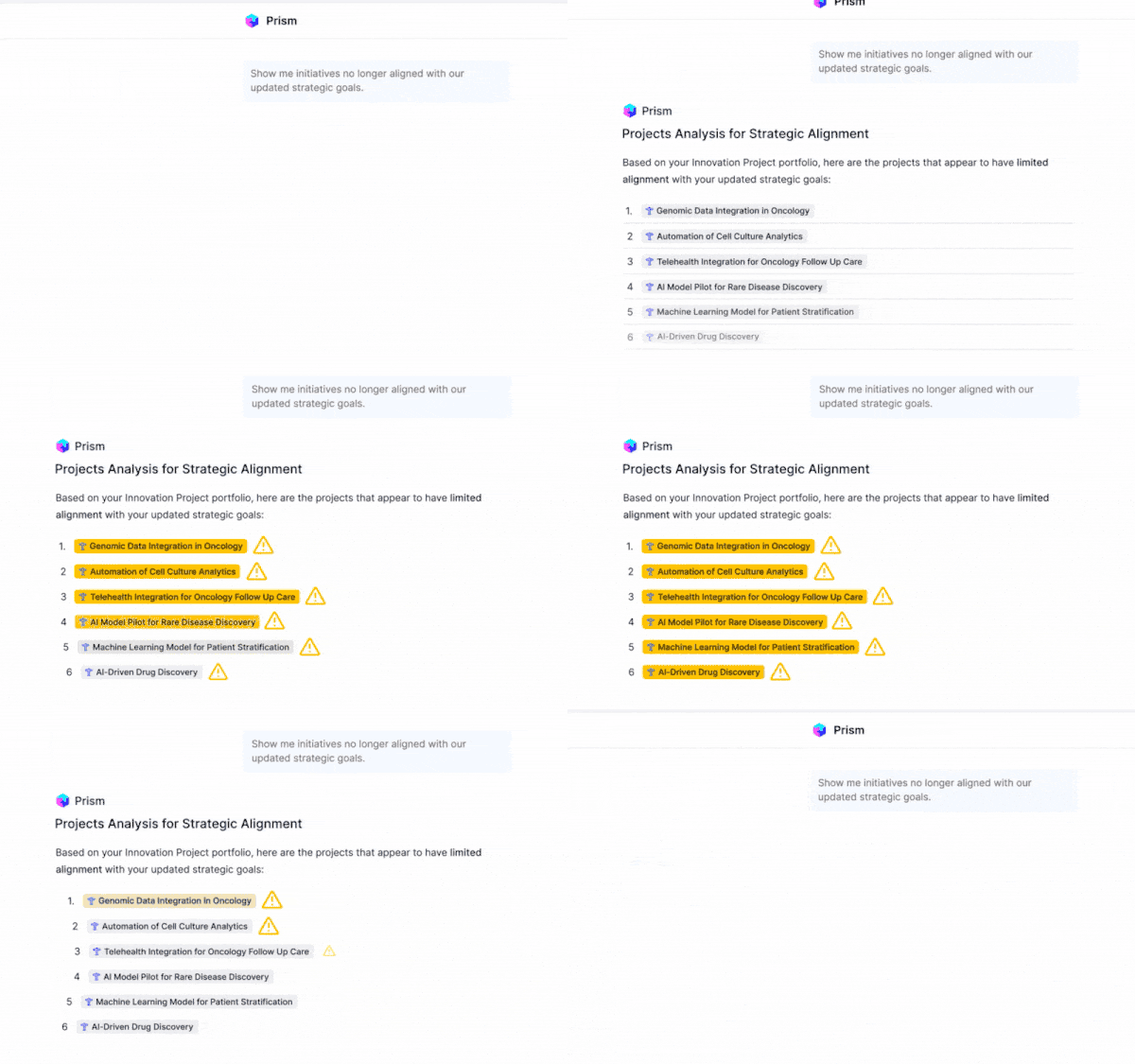
Exhibit 1: Prism checks every initiative against a strategy in real time, surfaces misalignment, and gives decision support
It operates as an AI co-pilot integrated into your strategy, portfolio management, and foresight workflows, not as a standalone chatbot.
Here's what that means in practice:
Prism checks every initiative against your strategy, surfaces misalignment, and gives you decision support.
-
It tracks portfolio health to instantly show what's over budget, underfunded, or delayed.
-
And it generates industry intelligence radars in seconds, tracking over 50 million real-world signals, including patents, publications, competitor moves, and market shifts.
The prompts in this article help teams think better. PRISM helps teams decide better. The difference is context.
Prism understands your strategy through a master context. It knows your data and delivers insights that are actionable, not abstract. When you ask which projects support your strategy and which should be stopped, Prism answers based on your actual portfolio data, not a generic simulation.
Use the prompts above to sharpen your thinking in workshops and brainstorming sessions. Use PRISM to act on that thinking inside a system that connects foresight, ideation, and portfolio execution.