Skip to content
Featured image: The 36 Most Effective ChatGPT Prompts for Strategic Foresight
Innovation

The 36 Most Effective ChatGPT Prompts for Strategic Foresight

Most people use ChatGPT for strategic foresight the wrong way. They type "what are the trends in my industry?" and get a list anyone could find on a trade blog. That is not foresight. That is Google with extra steps.

Strategic foresight means identifying key drivers, building plausible futures, and making informed decisions before your competitors do. ChatGPT can help. But only if you give it the right prompts.

This article gives you 36 prompts that generate real insights. Each one is designed to surface blind spots, challenge assumptions, and connect future trends to your specific business strategy. You also get a section on how to apply critical thinking to ChatGPT responses and how to turn AI outputs into an action plan your team can execute.

Why most ChatGPT prompts for strategic foresight fail

Vague inputs produce vague outputs. "What risks should I be aware of?" gets you a generic list. "What supply chain risks face mid-size pharmaceutical manufacturers if global trade tensions increase by 2030?" gets you something you can actually work with.

Most people also stop at the first response. They accept the output as analysis. It is a first draft. But strategic thinking requires follow-up. Therefore, ask ChatGPT to challenge its own conclusions. Ask it what would need to be true for it to be wrong. That is how you generate insights that matter.

There is one more problem: ChatGPT has no access to your organization's context, capabilities, or constraints. Prompts that include this context produce better results. The best ChatGPT prompts for strategic foresight are specific about

  • the industry,

  • the scenario,

  • the time horizon, and

  • the decision at stake.

Will AI replace strategic foresight professionals?

Let's settle this up front, because it shapes how you should use everything in this article.

ChatGPT can generate plausible scenarios, surface potential risks, and identify patterns across information at speed.

  • It cannot tell you which scenario matters most for your organization.

  • It cannot navigate internal politics, resource constraints, or organizational culture.

  • It cannot translate a plausible future into a decision that gets stakeholder buy-in.

The professionals who will fall behind are those who treat ChatGPT outputs as finished analysis. The ones who will lead are those who use AI as a thinking partner and apply critical thinking to every output before connecting insights to organizational action.

This article is written for the second group.

What strategic foresight actually means for your business

The goal is to prepare for different plausible futures, not accurate ones. Organizations that practice foresight do not try to pick the right scenario. They consider multiple scenarios so no outcome catches them flat-footed.

Most organizations plan in straight lines. They extrapolate current trends and assume the external environment stays roughly stable. It rarely does. The businesses that lose competitive advantage are almost always surprised by changes they could have anticipated.

 

Strategic thinking in foresight has three core tasks.

  1. Identify the key trends in your external environment.

  2. Build plausible futures based on how those drivers interact.

  3. Translate those futures into an action plan your organization can actually execute.

ChatGPT can accelerate all three. It cannot replace the judgment required to prioritize, communicate, and act.

The context variable that matters most

In practice, one context variable produces a bigger quality jump than any other: the decision you are trying to make. Not your industry. Not your company size. The specific choice your organization is wrestling with right now.

Compare these two openings:
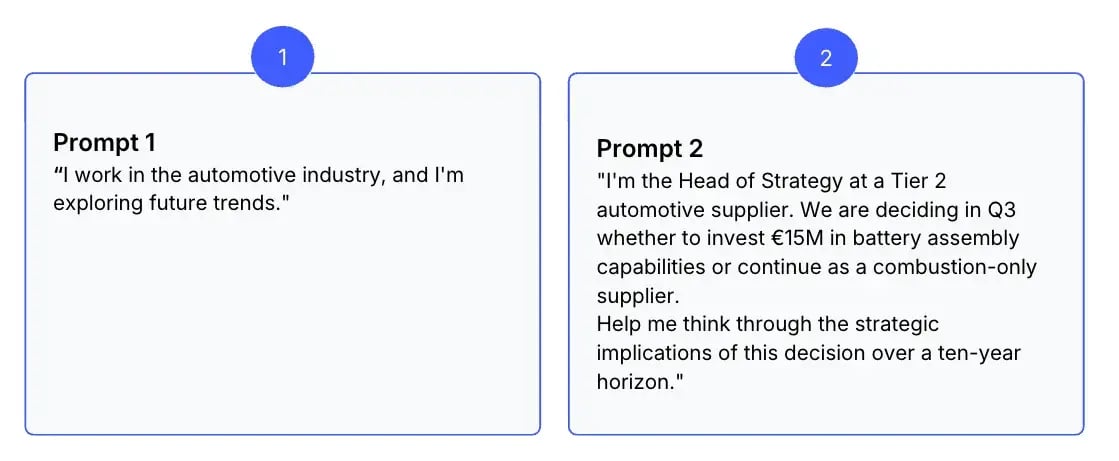
Comparing two prompt alternatives

Exhibit 1: Comparing two prompt alternatives

The second version forces ChatGPT to generate implications, not information. That is the difference between a list and an insight.

Time horizon is the second most powerful variable. "Over the next decade" produces very different outputs from "in the next 18 months." The second forces specificity about current trends and near-term risks. The first invites speculation. Use both deliberately, for different purposes.

Org size matters less than most people assume. What matters is whether you include your constraints:

  1. Are you a market leader defending a position, or a challenger trying to move fast?

  2. Do you have capital to invest, or do you need asset-light strategies?

That context shapes recommendations far more than headcount.

Weak prompt vs. strong prompt: a worked example

This is the clearest way to show what changes when you apply these principles. Therefore, consider the following example as a weak prompt: 

"What are the risks of AI adoption in financial services?"

What ChatGPT returns

A seven-point list covering data privacy concerns, regulatory uncertainty, model bias, cybersecurity risks, talent gaps, customer trust issues, and legacy system integration.

All accurate, but none of it actionable for your situation.

In contrast, you can consider the following as a strong prompt:

 "I am the Chief Risk Officer at a mid-size European retail bank. We are evaluating whether to deploy an AI-based credit scoring model to replace our existing rules-based system in the next 12 months. What are the top three risks specific to this transition? For each risk, describe what would need to be true for it to materialize, what early warning indicator I should monitor, and what a concrete mitigation action looks like."

What ChatGPT returns

Risk 1: Regulatory non-compliance under the EU AI Act. The Act classifies credit scoring as high-risk AI. For this risk to materialize, your model would need to go live without completing a conformity assessment or without adequate human oversight documentation. Early warning indicator: Your legal team has not yet reviewed the technical documentation against Article 13 requirements. Mitigation: Commission a gap analysis against EU AI Act obligations before the pilot launches, not after.

Risk 2: Model drift leading to systematic mispricing of credit risk. This materializes if your training data does not represent current economic conditions (post-2022 rate environment). Monitor your model's default rate predictions against actual defaults on a 90-day rolling basis. Mitigation: Build a performance dashboard before go-live that triggers a manual review if predicted vs. actual defaults diverge by more than 15%.

Risk 3: Staff circumvention due to low trust in AI outputs. Loan officers who distrust the model will override it systematically, creating a shadow process. Early warning: Override rates above 20% in the first 60 days. Mitigation: Involve loan officers in model validation before launch. Explainability matters more than accuracy for adoption.

The difference is not that the second prompt is longer. It specifies the decision, the timeline, the constraints, and the required output format. ChatGPT matched that structure precisely.

ChatGPT prompts for strategic planning

Strategic planning is the core method of strategic foresight. These prompts help you build plausible scenarios and explore their implications before committing resources.

  1. "Generate three plausible futures for [specific industry] over the next ten years. For each scenario, identify the key drivers, the core assumptions, and the first-order implications for businesses in this space."


  1. "What are the potential outcomes for [specific industry] if consumer behavior significantly shifts toward [specific change] in the next five years? Give me the best case, worst case, and most likely case. For each, describe what would need to happen for it to unfold."


  1. "Describe a specific scenario where [technology/regulation/economic shift] disrupts [industry]. What would be the first warning signs? How should businesses prepare in the next 12 months?"


  1. "How would [industry] change if [describe specific scenario]? Focus on the effects on supply chain, talent acquisition, and competitive dynamics."


  1. "Build a scenario where climate regulation becomes significantly stricter by 2030. Describe the second-order effects on [industry] and identify which business models are most vulnerable."


  1. "Describe possible scenarios for the global economy in 2030, considering AI adoption, demographic shifts, and the energy transition. Which scenario poses the greatest risk to [specific business model]? Why?"


After ChatGPT generates your scenarios, follow up with: "Now argue against the most likely scenario you just described. What are the key drivers that could make it wrong?" This surfaces blind spots your team needs to address.

ChatGPT prompts for trend scouting and analysis

Trend scouting is about identifying signals before they become obvious. These prompts help you understand current trends and their strategic implications for your business.

  1. "Identify the top five trends reshaping [specific industry] over the next five years. For each trend, describe the key driver, the current adoption stage, and the first-order implication for existing business models."


  1. "Analyze the trend of [specific trend] and describe its second-order effects on [specific sector]. What does this trend make more valuable? What does it make obsolete?"


  1. "What are the most underrated trends in [industry] that most organizations are currently ignoring? Describe why they are underrated and what would need to happen for them to become mainstream."


  1. "How might the trend toward [specific trend] interact with [another trend] in [specific sector]? Describe what happens at the intersection and which businesses are best positioned to benefit."


  1. "Analyze the emerging trend of [specific technology] and its potential applications in [industry]. Which applications are most likely to reach commercial scale in the next three years? What are the barriers to adoption?"

Follow-up prompt for any trend analysis: "What information would change this analysis? What are the key uncertainties I should monitor?"

ChatGPT prompts for emerging technologies

Evaluating emerging technologies requires more than listing what is new. These prompts help you assess adoption timelines, competitive implications, and the organizational capabilities required to act.

  1. "Identify emerging technologies in [specific industry] that could become disruptive within the next ten years. For each, assess the likelihood of disruption, the current readiness level, and the first movers already building in this space."


  2. "Explain the potential impacts and applications of [specific technology] in [specific industry]. What is a realistic timeline for widespread adoption? What are the key barriers holding adoption back today?"


  3. "Analyze the opportunities and challenges of implementing [specific technology] in [specific sector]. What organizational capabilities are required? Which companies have successfully done this and how?"


  4. "What are the competitive implications of [specific technology] for existing players in [industry]? Who benefits most from adoption? Who faces existential risk if they delay?"


  5. "How might machine learning change [specific business process] in [industry] over the next five years? Describe the workflow before and after. What roles are affected?"


  6. "Identify the ways [specific technology] could enable new business models in [industry] that do not exist today. What conditions would need to exist for these models to become viable?"

ChatGPT prompts for risk assessment

Most risk assessment looks backward. These prompts help you identify potential risks that are not yet visible in current data and turn them into a concrete mitigation plan.

  1. "What potential risks should businesses in [industry] prepare for as [specific trend] accelerates? Prioritize by likelihood and impact. For the top three risks, suggest specific mitigation actions."


  1. "Analyze the cybersecurity risks for organizations adopting [specific technology] at scale. What are the top three vulnerabilities? What controls reduce exposure most effectively?"

  1. "Identify potential financial risks for businesses in [sector] if [specific economic scenario] occurs within the next five years. What early warning indicators should organizations monitor?"


  1. "What operational risks face [industry] as climate regulations tighten? Describe each risk and suggest specific mitigation actions organizations should take now."


  1. "What are the supply chain risks for [industry] in a scenario of increasing trade tensions between [regions]? Which dependencies create the most concentrated risk? What should organizations address first?"


  1. "Analyze the legal and regulatory risks for businesses as AI is increasingly used in [specific decision-making context]. What compliance gaps are most organizations currently ignoring?"


  1. "Conduct a SWOT analysis for [company type] operating in [industry] in the context of [specific scenario]. Focus specifically on the threats and weaknesses that are most commonly overlooked by companies in this space."

Critical thinking reminder: Risk lists from ChatGPT are starting points. Validate the top risks against your actual data. Involve your team in stress-testing each risk against your specific business context and capabilities.

ChatGPT prompts for identifying blind spots

Most foresight processes have systematic blind spots. These prompts are designed to surface what your organization might be missing. They are among the most valuable prompts in this list.

  1. "What are the three most common strategic blind spots for organizations in [industry] when planning for [specific scenario]? How do they typically manifest, and what damage do they cause?"


  1. "Describe a future for [industry] that most people in this sector currently consider implausible, but that has a non-trivial probability of occurring. What key drivers would need to converge for it to unfold?"


  1. "What assumptions is my organization most likely making about [topic] that could be wrong? Challenge the most common pieces of conventional wisdom in [industry]."


  1. "If a new market entrant with no legacy constraints entered [industry] today, what would they do differently from incumbents? What does this reveal about the assumptions established organizations are making?"

ChatGPT prompts for business strategy development

These prompts translate foresight insights into concrete strategic planning outputs. Use them after you have completed scenario and trend analysis.

  1. "Based on [specific trend or scenario], develop three strategic options for a company in [industry]. For each option, describe the key actions required, the capabilities needed, and the potential risks."


  1. "Create a five-year roadmap for integrating AI tools into [specific business function]. Include key milestones, decision points, and the organizational changes required at each stage."


  1. "Identify the capabilities [company type] needs to build to maintain competitive advantage in [industry] as [specific change] unfolds. Prioritize by urgency and describe how to develop each capability."


  1. "Develop a market analysis framework for evaluating whether [specific opportunity] is worth pursuing. What are the five most important factors to assess, and what does good look like for each?"


  1. "Build an action plan for [company type] to establish a leadership position in [specific area] over the next three years. Detail the first 90 days specifically."

ChatGPT prompts for creative and strategic thinking

Strategic foresight requires exploring possibilities that feel uncomfortable or implausible. These prompts force creative thinking by removing the constraints that make most strategies feel predictable.

  1. "Imagine a world where [describe radical scenario]. How would this change the competitive dynamics in [industry]? What should your organization do in the next 12 months to prepare?"

  2. "What would the implications be if [specific assumption your industry makes] turns out to be wrong? Describe the cascade of effects on strategy, operations, and talent."
  3. "Describe a future where your organization's current competitive advantage no longer exists. What created that world? What would your organization need to become to stay relevant?"

How to turn ChatGPT insights into an action plan

ChatGPT generates first drafts of thinking. The strategic planning work starts after the output appears. Here is a five-step process to move from AI output to organizational action.

Step 1: Extract key drivers.

From any scenario or trend analysis, identify the two or three forces driving the most uncertainty. These become the axes of your scenario matrix and the focus of your monitoring plan.

Step 2: Test against your context.

Does this insight apply to your specific situation? Generic outputs need to be stress-tested against your actual capabilities, market position, and resource constraints. Involve your team in this step.

Step 3: Build a decision matrix.

For each potential outcome ChatGPT identifies, assess the likelihood and impact for your organization. Use this to prioritize where to focus strategic attention and resources.

Step 4: Create a monitoring plan.

Identify early warning indicators for each key risk or opportunity. Assign ownership. Set review cadences. Without this step, foresight work stays theoretical.

Step 5: Document and socialize.

Foresight value compounds when it is shared across the organization. Bring your team into the analysis. Challenge the conclusions. Build shared understanding of the plausible futures your organization is preparing for.

ITONICS Prism: When you want to connect external insights and your strategic planning

ChatGPT is a generalist. It answers from training data with no memory of your organization, no access to live signals, and no awareness of your portfolio. That is fine for generating hypotheses, but it is not enough to make strategic portfolio decisions.

This is the gap ITONICS Prism is built to close.
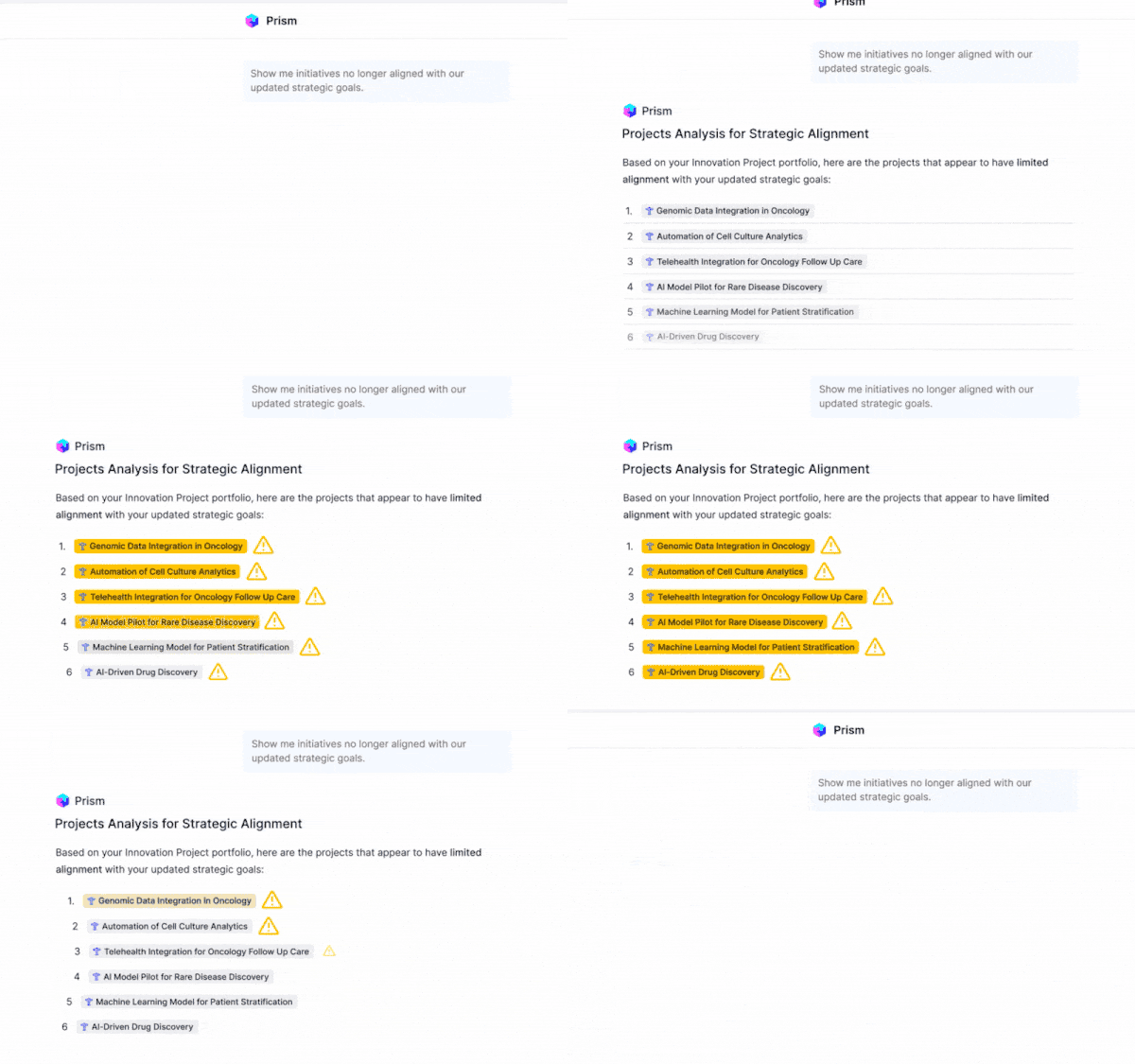
Prism-Use-Case-1

Exhibit 2: Prism checks every initiative against your strategy in real time, surfaces misalignment, and gives decision support

What Prism does that ChatGPT cannot

Prism knows your strategy. You define a master context once: your strategic priorities, goals, constraints, and industry situation. Every insight, alert, and recommendation Prism generates is evaluated against that context. ChatGPT gives you the best practices from a textbook. Prism gives you answers calibrated to your specific situation.

Prism works from 50M+ verified signals. Its signals pool covers news, patents, and scientific publications -  curated, source-linked, and traceable. When Prism surfaces a trend or technology signal, you can drill into its source, assess credibility, and share it with your team with full context intact. ChatGPT has no live data access and no source transparency. You cannot verify where its outputs come from.

Prism monitors your portfolio in real time. Its portfolio agent continuously checks every initiative against your strategy. It flags misalignment, surfaces budget overruns before they compound, and identifies schedule risks early enough to course-correct. ChatGPT has no awareness of your projects, your pipeline, or your execution health.

Prism auto-generates industry radars in seconds. Ask it what trends matter for your context, and it builds a custom technology and trend radar, tracks momentum over time, and alerts you when significant shifts occur. This replaces hours of manual signal aggregation with a structured, visual landscape your team can act on immediately.

Prism routes your questions to the right specialist automatically. It runs four expert agents: a master agent for strategy context, a signals agent for external intelligence, a portfolio agent for execution monitoring, and a knowledge agent for platform guidance. You ask once. Prism routes to the correct expert and returns a contextualized answer.

The workflow that connects foresight to decision

Use ChatGPT at the front of your foresight process. It is fast, flexible, and good at generating the hypotheses and scenario structures this article describes. Treat every output as a first draft.
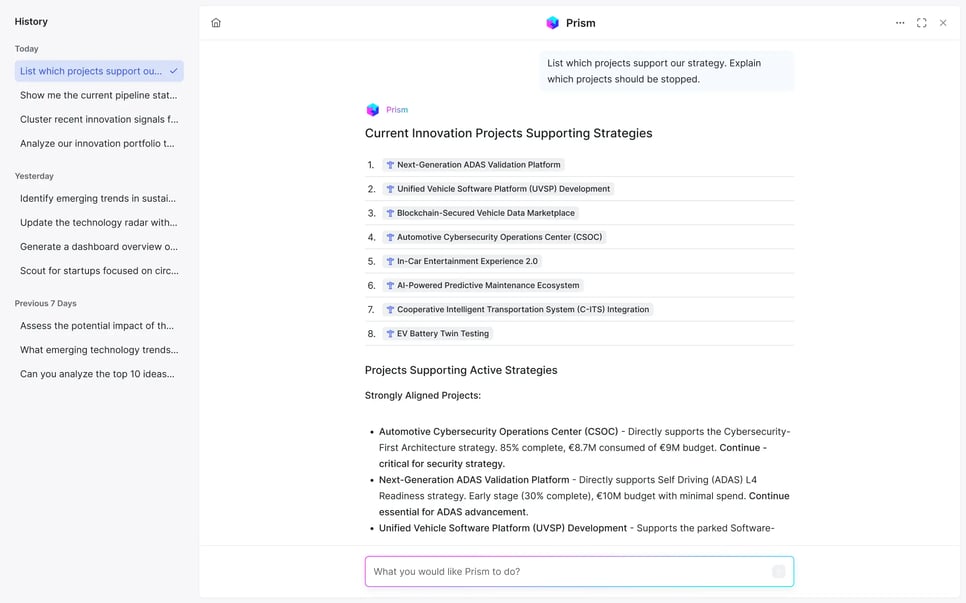
Define fields and strategies of action with innovation AI

Exhibit 3: Define fields and strategies of action with Prism

Then bring that thinking into ITONICS. Validate your hypotheses against Prism's verified signal pool. Connect emerging trends to your active portfolio. Ask Prism which of your current initiatives are exposed to the risks ChatGPT helped you identify. Build the radar. Assign ownership. Set monitoring cadences.

The difference is the shift from exploration to decision. ChatGPT helps you think. Prism helps you decide and act - with your strategy, your portfolio, and your data in the loop.


For organizations that are serious about strategic foresight, ITONICS Prism is where exploration becomes execution.


FAQs on ChatGPT prompts for strategic foresight

What are ChatGPT prompts for strategic foresight?

They are structured inputs designed to use ChatGPT as a strategic thinking partner. A good prompt defines the context, specifies the scenario, and asks for explicit reasoning rather than a generic list.

The goal is to generate insights that inform real decisions and help your organization prepare for plausible futures.

How do I write effective ChatGPT prompts for strategic foresight?

Be specific about your industry, time horizon, scenario, and the decision at stake. Ask for key drivers and underlying assumptions rather than just conclusions.

Follow up every output with critical questions: "What would make this wrong?" and "What are the blind spots in this analysis?" Chain prompts together to build depth. Single prompts produce first drafts. Chained prompts produce analysis worth acting on.

Can ChatGPT replace scenario planning and strategic foresight professionals?

No. ChatGPT produces plausible first drafts of analysis. It has no access to your organization's specific context, internal constraints, or stakeholder dynamics.

Strategic foresight professionals translate AI outputs into decisions that organizations can actually execute. AI accelerates the analysis. Professionals own the judgment.

How do I apply critical thinking to ChatGPT responses?

Ask the model to argue against its own conclusions. Identify the key assumptions embedded in each response. Cross-check trend data against primary sources and industry reports.

Involve your team in stress-testing AI outputs against your specific business context. Treat every ChatGPT response as a hypothesis, not a finding.

What separates a useful ChatGPT prompt from a generic one?

Specificity. A generic prompt asks: "What are the trends in my industry?" A useful prompt asks: "Identify the top five trends reshaping [industry] over the next five years. For each trend, describe the key driver, the current adoption stage, and the first-order implication for mid-size companies competing on [specific dimension]."

Specific prompts generate specific, actionable insights.

How does ITONICS complement ChatGPT for strategic foresight?

ChatGPT helps you rapidly explore ideas, generate scenarios, and identify potential risks. ITONICS provides the systematic infrastructure to track, validate, and act on those insights over time.

It connects external signals to strategic priorities, enables team collaboration on trends and technology scouting, and creates a documented trail from insight to decision. Together, they close the gap between foresight analysis and strategy execution.