47 powerful ChatGPT prompts for innovation portfolio management


Most innovation managers use ChatGPT the wrong way. They ask broad questions and get generic advice back. The tool reflects the quality of your input.
A vague prompt like "How do I improve my innovation portfolio?" returns textbook content. A specific prompt like "What KPIs should I track for a portfolio of 12 innovation projects across three risk tiers in the medical devices industry?" returns something you can actually use.
That gap is what this article addresses. Below you'll find 47 structured prompts for innovation portfolio management - organized by activity, built for specificity, and designed to support strategic decision making across your entire innovation pipeline.
ChatGPT is trained on general knowledge. Without context, it defaults to general answers.
Innovation portfolio management involves scarce resources, competing innovation initiatives, shifting market conditions, and complex trade-offs between incremental innovations and disruptive innovation. Generic advice doesn't help here.
Three things make a prompt useful for managing innovation projects:
The prompts below are built on these three principles. Each one is a starting point. Edit the bracketed fields to match your context.
Before using the prompts, apply these five rules to every query:
"Discuss the key factors to consider when evaluating and prioritizing innovation projects within a portfolio in [specific industry]."
"Discuss the importance of diversification in an innovation portfolio in [specific market]. How can a mix of short-term and long-term projects, as well as different types of innovations, contribute to overall portfolio success?"
"Imagine you are managing an innovation portfolio for a technology company. How would you allocate resources and prioritize projects across different areas, such as product development, research, and disruptive innovations?"
"Discuss the potential benefits and drawbacks of open innovation and collaboration when managing an innovation portfolio for [specific industry]. How can organizations effectively leverage external partnerships and acquisitions?"
"Explore the concept of resource allocation in innovation portfolio management. How can my organization optimize resource allocation to maximize portfolio value and minimize risks?"
"What steps can I take to align my innovation portfolio with the [sustainability/CSR] goals of my company?"
"What steps can I take to align the innovation projects in my innovation portfolio with [specific business objective]?"
"What radical innovation could completely redefine our [specific industry], and how might we pioneer it within our portfolio?"
"Imagine the most unconventional collaborations we could form to boost our innovation output. Who would we partner with and why?"
"In a world without resource constraints, what innovation projects would we undertake immediately in our innovation portfolio?"
"How can we leverage existing technologies from completely different industries to enhance our innovation pipeline?"
"If we were to focus on disruptive innovation for the next five years, what bold ideas might we explore?"
"How would our innovation portfolio look if it was designed to specifically cater to the emerging generation's needs?"
"What projects would we include in our innovation portfolio if our goal was to become the most sustainable company in our industry?"
"If we were to merge with our biggest competitor, how might that reshape our innovation portfolio?"
"What would our innovation portfolio look like if our primary goal was to maximize social impact?"
"If we were to create a spin-off company, what project from our innovation portfolio could it be based around?"
"What are some game-changing inventions in other sectors that we could integrate into our product or service?"
"What can we learn from failures, both ours and others, to inform the direction of our innovation portfolio?"
"How would our innovation portfolio look if our company were starting today, with no legacy products or services?"
"Imagine that our current customer base suddenly disappears. How would we innovate to find and serve new markets?"
"Describe a method for integrating market research and current market conditions into the direction of my innovation portfolio."
"What potential opportunities and challenges does [specific market trend] bring to my innovation portfolio?"
"What steps can my company take to adapt our innovation portfolio to the rise of [specific customer preference]?"
"Imagine a scenario where a disruptive technology emerges in my industry. Discuss the considerations and strategies for incorporating this technology into my innovation portfolio."
"Imagine a scenario where we have the opportunity to acquire a startup with ground-breaking technology. How would this integrate into our innovation pipeline?"
"Imagine a scenario where a new competitor enters the market with a disruptive innovation. How should our innovation portfolio respond?"
"Simulate a situation where our business has to pivot due to [specific regulatory change or market trend]. How would this impact my portfolio strategy?"
"Simulate a situation where the funding for our innovation portfolio is significantly reduced. How should we prioritize innovation projects and manage scarce resources?"
"Imagine a scenario where our company decides to pursue new markets. How should our innovation portfolio strategy adapt?"
"Discuss the role of metrics and key performance indicators in evaluating the success and progress of innovation projects within a portfolio."
"Define the metrics used to evaluate the success of an innovation portfolio."
"Considering my current KPIs [insert KPI names], what additional metrics should I include to ensure a comprehensive performance evaluation of my innovation portfolio?"
"What key performance indicators should I track to evaluate the success of my innovation portfolio in [specific industry]?"
"How can I measure the return on innovation investments across the projects within my portfolio?"
"Provide a step-by-step guide for conducting a performance review of my innovation portfolio."
"What are some common pitfalls in evaluating innovation portfolio performance, and how can I avoid them?"
"Given my current set of KPIs [insert KPI names], what steps should I take if these metrics show underperformance in my innovation portfolio?"
"Explore the strategies for balancing innovation risk and reward in a portfolio. How can organizations manage both high-risk, high-reward projects and more conservative, incremental innovations?"
"Explore the challenges and strategies for effectively managing a portfolio that includes both incremental innovations and breakthrough, disruptive innovation."
"What risk factors could [emerging technology] introduce to my innovation portfolio, and how can I manage them?"
"What key risk indicators should I track in my innovation portfolio?"
"How can I align my risk management strategies with the overall risk appetite of my organization?"
"Discuss the role of leadership and governance in innovation portfolio management."
"Imagine a scenario where a key team member leading a major innovation project in our portfolio leaves the company. How do we manage this situation?"
"What governance structures are most effective in overseeing an innovation portfolio in [specific industry]?"
"How should I, as a leader, respond when a major project in the innovation portfolio underperforms or fails?"
ChatGPT does not track your innovation pipeline. It doesn't score innovation projects against your strategy. It has no memory of last quarter's portfolio review. Every conversation starts from zero.
But Prism is built differently. It is purpose-built AI for strategic portfolio decisions, and it knows your context.
Before Prism answers anything, it knows where you are. It recognizes whether you are viewing a Radar, a project Table, or an individual Element, and interprets your prompts accordingly. Ask "summarize these elements," and Prism summarizes what is on your screen.
You can also set a manual context. Pin specific elements or views as scope to ensure Prism focuses on exactly the right data. Every response shows you what context was used, so there is full transparency on how each answer was generated.
This is the difference between generic AI and context-aware AI: ChatGPT answers based on training data, and Prism answers based on your portfolio.
Where ChatGPT generates text you then have to act on manually, Prism operates inside ITONICS. It can populate fields directly from conversational prompts, like titles, summaries, descriptions, ratings, dates, dropdown selections, and user assignments. One request can update multiple fields at once.
It also generates custom tech and trend radars in seconds. Ask what trends matter for your industry, and Prism builds the radar, tracks momentum over time, and alerts you when significant shifts occur.
ChatGPT is a useful thinking tool when used with the right prompts. The 40+ prompts in this article will help you get more out of it.
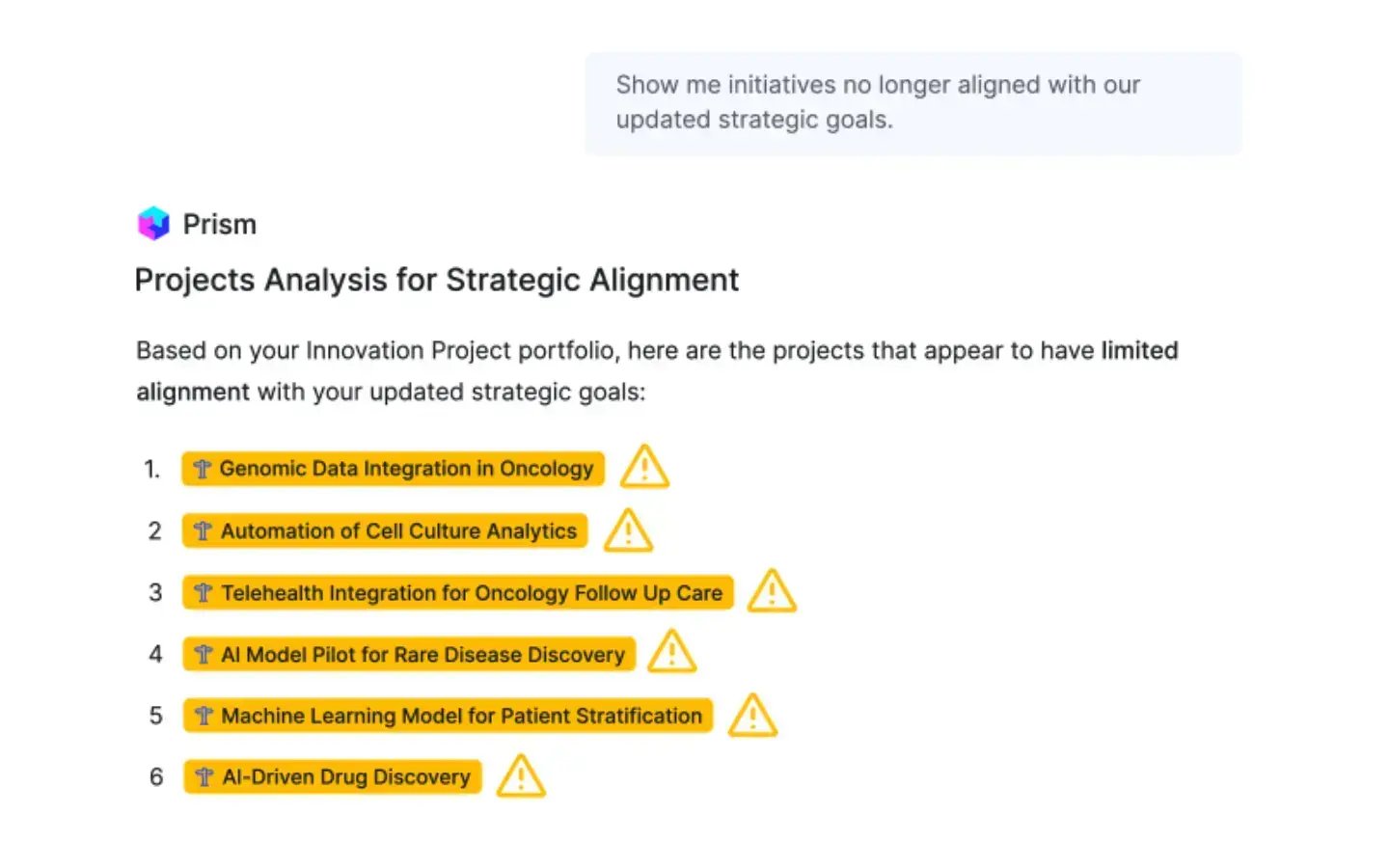
Exhibit 1: ITONICS AI assistant flags off-strategy projects
But thinking is only part of the job. Tracking, scoring, aligning, and monitoring your innovation portfolio over time requires a system. That system is ITONICS.
Looking to prioritize innovation initiatives with the highest potential and position your portfolio for future growth? Learn how to navigate your innovation portfolio with ITONICS in this 60-minute on-demand webinar.