Game on: How Ericsson fuses fun with foresight


In the world of technology and innovation, staying ahead of trends while fostering a dynamic work culture is no easy feat. Ericsson ConsumerLab has cracked this code by fusing foresight with play - turning serious tech conversations into something engaging and genuinely productive.
Jana Uthayakumar, Global Foresight, Data & Analytics Lead at Ericsson ConsumerLab, recently shared insights into how Ericsson approaches foresight, embeds innovation management into daily work, and uses virtual reality (VR) gaming to sharpen creativity and collaboration.
Ericsson ConsumerLab runs research that shapes how the company thinks about technology five, ten, and twenty years ahead. The team's mandate is corporate foresight grounded in data and analytics - identifying where the world is heading before that direction becomes obvious.
The focus is on understanding human behavior, societal shifts, and the economic forces that determine how new innovations will land in reality.
This is foresight as an organizational capability, not a one-off exercise. It requires a team with the knowledge, methods, and innovation culture to sustain it over time - and the creativity to keep it sharp.
Strategic foresight at Ericsson is about developing the organizational ability to navigate many different futures with confidence.
Jana's background spans marketing and data science. That combination matters. Foresight without data produces speculation. Data without foresight produces backward-looking analysis. The ConsumerLab team combines both to build a comprehensive picture of possible futures - and to identify which path is most plausible given current evidence.
Good foresight methods do not produce a single answer. They produce a systematic analysis of multiple possibilities.
At Ericsson, this means examining consumer behavior, technological development, and economic trends in parallel. The team explores probable futures alongside preferred futures and uses futures studies to define the full range of paths the world might take.
Horizon scanning is how Ericsson identifies what is emerging before it enters mainstream awareness. The team systematically monitors events, weak signals, and shifts across technological, economic, and social domains.
The goal is to identify the key drivers and driving forces that will shape different scenarios (Exhibit 1). Understanding those drivers allows the organization to anticipate how the world works under different conditions - and to prepare plans accordingly.
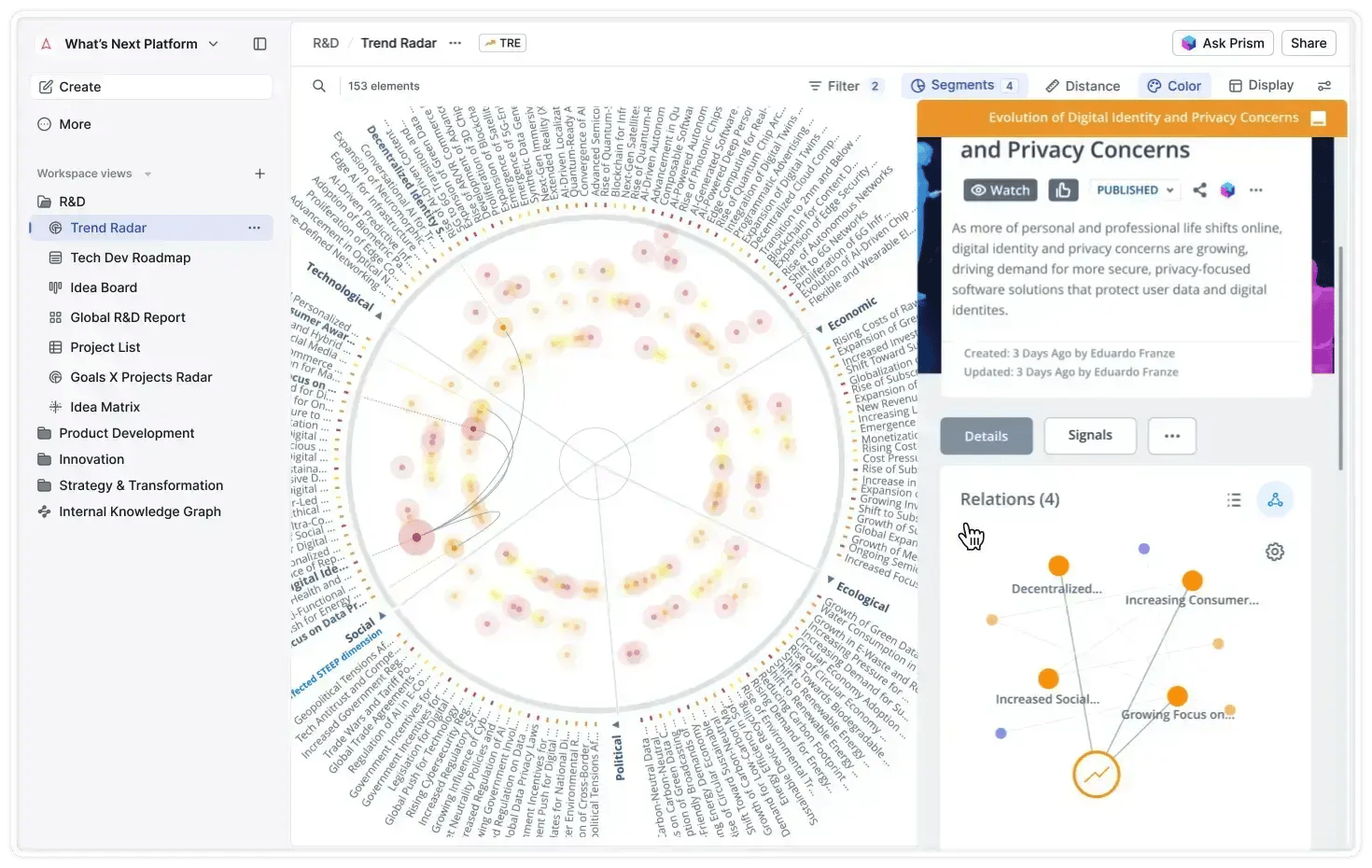
Exhibit 1: Use radars to compare dozens of trends in one clear view
Horizon scanning only creates value when its outputs reach the teams that make decisions. At Ericsson, insights from the ConsumerLab feed directly into business units working with industry partners on strategy and deployment.
Ericsson's foresight function is embedded in an innovation culture that values creative thinking alongside analytical discipline.
Jana describes an organization that deliberately creates space for developing ideas without immediate commercial pressure. That tolerance for uncertainty is not accidental. Organizations that cannot sit with ambiguity tend to miss the signals that matter most. At Ericsson, the ability to explore is treated as a strategic asset.
One of the more unusual elements of Ericsson's foresight practice is the weekly VR gaming session. Every Friday morning, the ConsumerLab team spends thirty minutes playing games in a virtual environment.
We have an ongoing weekly half-hour every Friday morning where we actually play games. You can virtually shoot at your manager. - It's a good way to remove some stress.
This is not a distraction from the foresight process. It is an extension of it. Playing VR games gives the team direct, hands-on experience with the foresight tools they research and write about. That firsthand experience builds intuition that no report can replicate.
It also reduces the personal distance between the team and the technology they study. That matters when your job is to assess the potential impact of XR for millions of consumers and companies across industries.
Creative thinking is easier to claim than to enable. At Ericsson, the conditions for it are deliberately built.
The VR sessions create an environment where risk-taking is normalized, and new ideas can emerge without judgment. That playfulness carries into how the team approaches critical issues in foresight - including how to challenge assumptions and surface the blind spots that form when teams stop questioning what they already believe.
Organizations that encourage creativity at a personal level tend to produce better foresight at an organizational level. The ability to explore possibilities freely is what separates teams that catch early signals from those that only react after the fact.
Scenario planning is how Ericsson moves from horizon scanning to decision-making. The team does not forecast a single outcome. It develops different scenarios that explore what might happen if key drivers play out in different ways.
These are not arbitrary thought experiments. Each scenario is built on a systematic analysis of driving forces and their second-order consequences. The output is a structured map of future possibilities - not a prediction, but a framework for thinking clearly under uncertainty.
The ConsumerLab team identifies the key drivers shaping each domain it researches. For XR, these include consumer appetite for immersive experience, hardware cost curves, network capacity, and AI-driven content generation.
The team then develops plausible scenarios that explore how those drivers might combine to create many different futures (Exhibit 2). Each scenario is a coherent narrative about how the world works if specific forces emerge, accelerate, or collide.
/Still%20images/Roadmap%20Mockups%202025/foresight-set-milestones-and-activities.webp?width=2160&height=1350&name=foresight-set-milestones-and-activities.webp)
Exhibit 2: Connect trends to strategic actions with roadmaps and define who does what, by when, and how it fuels growth
Jana's XR example illustrates this well. Early predictions suggested XR would replace the smartphone within a decade. Ericsson's scenario planning produced a different picture.
We don't think XR or AR will replace the smartphone, at least not in the next five to ten years. What we see is almost a duality of the devices. Each device - the smartphone and XR - will live together, and each will serve its own purpose.
That conclusion came from analyzing multiple possibilities honestly - not from anchoring on the most exciting scenario.
Cognitive biases are one of the biggest threats to good foresight. Confirmation bias, availability bias, and anchoring all distort how teams interpret signals and construct scenarios.
Ericsson addresses this partly through a method. Structured scenario planning forces the team to develop multiple possibilities rather than defaulting to a single preferred future. Making sense of different scenarios in parallel is what allows the team to achieve a genuinely open analysis.
It is also addressed through culture. A team comfortable with risk-taking, experimentation, and playful exploration is less likely to dismiss signals that challenge current assumptions. Innovation culture and foresight practice reinforce each other. They are not separate disciplines.
Generative AI is reshaping how foresight teams work. At Ericsson ConsumerLab, Jana describes AI as a "thinking partner" that supports decision-making across the full foresight process.
In the ideation phase, AI helps the team generate and stress-test new ideas. In the analysis phase, it simulates multiple futures and helps the team step into the perspective of different stakeholders. In synthesis, it identifies patterns across large bodies of research that human analysis alone would miss.
In practice, AI extends the team's ability to explore the possibility space. It can generate scenarios that the team might not have considered, making the foresight process more comprehensive without requiring more time.
Jana is clear about one important limit. More scenarios are not automatically better. "Just because you can generate a high volume of scenarios in an instant doesn't mean it's better," he warns.
/Still%20images/AI%20Mockups%202025/foresight-discover-new-insights-2025.webp?width=2160&height=1350&name=foresight-discover-new-insights-2025.webp)
Exhibit 3: Provide some context and receive relevant trends and inspirations from Prism
Generating possibilities at scale is only valuable when paired with the knowledge and judgment to evaluate them (Exhibit 3). AI in the foresight process is a tool - not a substitute for thinking.
One area where AI adds particular value is in tracing second-order consequences. A single technological shift creates cascades of effects across economic, social, and regulatory systems.
The challenge lies in making sense of those cascades systematically. AI helps Ericsson surface connections that might otherwise remain invisible - particularly at the edges of the analysis, where blind spots are most likely to form.
When the team assesses XR and generative AI in combination, the direct effects are relatively predictable. The second-order consequences - for privacy, content creation, and social interaction - require the kind of comprehensive, systematic analysis that AI can accelerate without replacing human judgment.
The real test of any foresight function is whether it changes decisions in a real business context. Ericsson's ConsumerLab passed that test with 5G.
In 2019, 5G was understood primarily as an enterprise technology. Consumer applications were underappreciated across the industry. Ericsson's ConsumerLab conducted a study that mapped consumer use cases across multiple sectors and identified the broader relevance of 5G in everyday life.
The findings shifted the internal narrative. 5G was not just an enterprise play. It had significant consumer relevance across health, mobility, and entertainment.
That strategic foresight had a direct impact on the organization. It equipped Ericsson's regional teams when they were in conversations with industry leaders about 5G deployment. The study also sparked broader discussions that shaped how the company approached 5G at scale.
This is what corporate foresight in a business context looks like: not a report on a shelf, but intelligence that reaches the people making decisions - and gives them a framework grounded in evidence, not assumptions.
Ericsson ConsumerLab demonstrates that rigor and playfulness are not in tension. VR gaming on Friday mornings, generative AI as a thinking partner, scenario planning across multiple futures - these are different expressions of the same commitment: understand what is coming before it arrives.
The team does not pursue a single preferred future. It maintains a portfolio approach to possible futures, developing a clear vision while staying prepared for different scenarios as they emerge.
That combination - creative thinking, systematic analysis, and a willingness to explore - is what separates effective foresight from expensive speculation. Companies that achieve this balance do not just anticipate change. They help define it.
/Still%20images/Element%20Mockups%202025/foresight-structure-foresight-work-2025.webp?width=2160&height=1350&name=foresight-structure-foresight-work-2025.webp)
Exhibit 5: Use repeatable workflows, evaluation criteria, and transparent governance - to turn insight collection into strategic action
At ITONICS, we build the tools that make this kind of foresight operational at scale. ITONICS Prism reads external market signals continuously, surfacing early signals before they become obvious trends. ITONICS connects horizon scanning to portfolio decisions, so foresight insights reach the teams that need them - not just the foresight function.