Partner governance: Decision rights, RACI, and program management


Partner ecosystems promise scale but deliver chaos. Organizations adding their third or fourth strategic partner report 40% more escalations and 30% longer delivery cycles.
Most organizations treat partner governance as process documentation rather than decision-making infrastructure. They build RACI charts that sit in shared drives and document decision-making authority that looks clear on paper but never gets enforced. The result: key decisions stall, project teams lose direction, and no one can identify who owns the outcome.
High performers architect three integrated mechanisms before scaling. Decision rights architecture defines authority boundaries. The RACI framework translates those rights into daily accountability for specific tasks. Program and project management orchestrates execution by enforcing both frameworks and ensuring projects align with strategic goals.
In this blog, you will learn to design decision rights that survive pressure, build a RACI matrix that teams actually use, and enable program managers to drive project success.
Partner governance fails when treated as process rather than architecture. Process describes activities; architecture allocates decision-making authority and creates the organizational structure through which key decisions flow.
Decision rights establish authority boundaries, the RACI model translates those rights into accountability for specific tasks, and program management enforces both through active orchestration. High performers deploy all three simultaneously and measure governance through decision velocity, not documentation completeness.
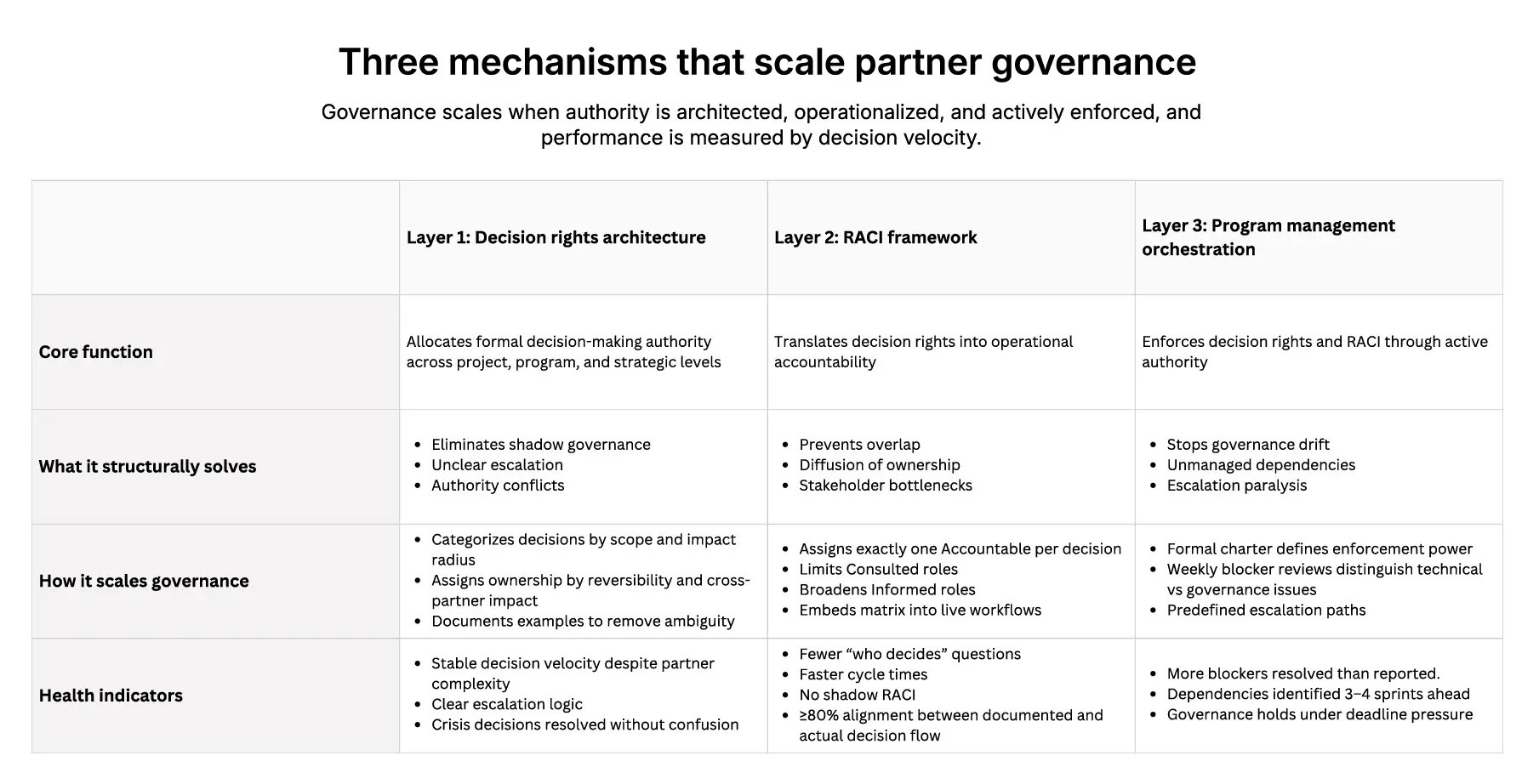
Exhibit 1: Three-layer partner governance model showing how decision rights, RACI, and program management drive decision velocity and execution clarity.
Research from Deloitte shows that organizations with clear decision rights enjoy 23% greater revenue growth than those with ambiguous authority. Unclear decision-making authority creates shadow governance where informal power structures replace formal ones, eroding stakeholder management and compounding coordination debt with each new partner.
Decision rights determine where decision-making authority sits across portfolios and partner organizations. Effective decision rights architecture separates individual projects from program decisions, builds accountability trails, and generates signals that verify the system holds under pressure.
Project decisions sit with individual project managers; program decisions span partners, affect strategic goals, and often involve managing multiple projects simultaneously. This separation collapses when boundaries are unclear, and team members understand their authority differently.
The test is straightforward. If a decision affects one deliverable within one workstream, the project manager owns it. If it affects cross-partner dependencies or alters strategic initiatives, it escalates to program leadership. This clarity reduces decision-making bottlenecks by 35 to 45 percent and keeps individual projects moving.
Best practice follows a three-step process. The first step is to categorize all decisions by scope:
Second, assign each category to the appropriate authority level based on impact radius and reversibility. Project managers own decisions affecting their workstream that can be reversed within a sprint. Program managers own decisions affecting multiple projects or requiring cross-workstream coordination. Executive sponsors own decisions that alter partnership strategy or commit significant capital.
Third, document decision examples in each category to eliminate ambiguity and provide guidance for future decision makers. A technical choice affecting one microservice is project-level; one affecting data exchange protocols across partners is program-level; one requiring platform migration is strategic-level. These concrete examples prevent every decision from becoming a negotiation about authority.
Define these rights at partnership kick-off, before execution begins. Organizations taking this proactive approach experience half the escalations of those building rights reactively. Proactive architecture ensures team members understand their authority from day one.
Decision rights require ownership trails that survive role transitions. In partner ecosystems, turnover creates accountability voids. A decision made six months ago by a departed program manager becomes no one's responsibility when issues surface.
Build this accountability through a decision rights matrix: a two-axis framework with decision types along one side (technical, commercial, operational, strategic) and organizational levels across the top (project manager, program manager, executive sponsor). A technical decision affecting a single deliverable sits with the project manager; one affecting partner roadmaps escalates to the program manager; one requiring capital reallocation escalates to the executive sponsor. Regularly reviewing this mapping quarterly prevents drift before it creates confusion.
Effective accountability also demands decision logs capturing what was decided, who held decision-making authority, and what constraints applied. When a new project manager questions a technical direction, the log gives relevant stakeholders a comprehensive view of how that key decision was reached. Research shows documented decision rights reduce "not my decision" responses by 70 percent.
Working decision rights show three clear patterns: partner complexity increases, but decision-making latency holds stable; escalations become purposeful rather than confusion-driven; and team members understand who decides without searching.
The pressure test reveals true governance resilience. When deadlines loom, and stakeholders push to "just decide and move," do project teams follow documented decision rights or bypass them? If program managers across three partners can answer "who decides X" in under 30 seconds during a crisis, the architecture holds. If the answer requires email threads or escalations dissolve into whoever shouts loudest, the organizational structure fails under stress.
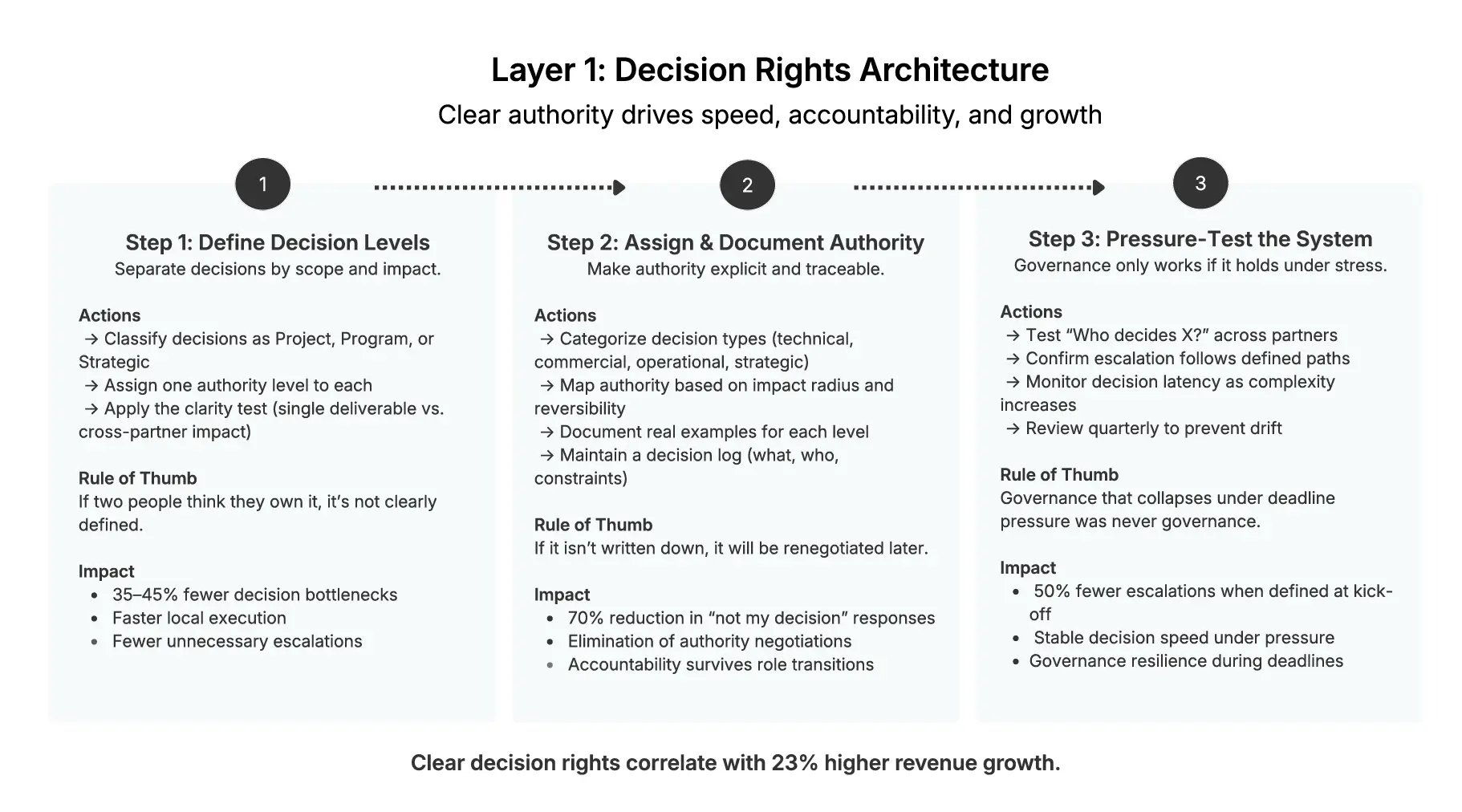
Exhibit 2: Decision rights architecture defining authority levels to reduce bottlenecks and strengthen governance resilience.
McKinsey research reveals that managers spend 37% of their time making decisions, with more than half of that time wasted. For Fortune 500 companies, this translates to 530,000 lost workdays and approximately $250 million in wasted labor annually. The cost of decision-making confusion compounds across complex projects.
The RACI model addresses this by pre-wiring accountability before decisions arrive. It assigns one of four roles to every significant decision and deliverable, creating a clear understanding of who contributes at each stage of the project management process. Organizations using RACI frameworks report 70 percent fewer "who decides" questions and 25 percent faster cycle times, with measurable improvements in customer satisfaction and business goals met on time.
The four components of RACI each carry a distinct function, and understanding them is essential for successful outcomes.
A life sciences firm refined its RACI framework as it scaled from two to five research partners. By ensuring each critical decision had exactly one accountable person and reducing consulted stakeholders from seven to three per decision, it achieved a 15% reduction in project completion time and a 20% decrease in decision-making bottlenecks within two quarters.
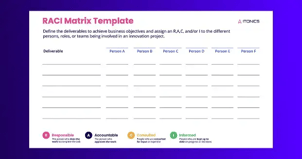
The RACI Matrix is a powerful tool to bring structure and transparency to any project. Use our editable template to align stakeholders, assign clear responsibilities, and avoid the classic “who’s doing what?” chaos before it starts.
RACI charts display decisions in rows and roles in columns, with each cell showing R, A, C, or I. Effective RACI charts function as navigation tools during project planning and execution, not as historical records. Yet active usage appears in fewer than 30 percent of organizations that create them.
Active tools live where project teams work; archived tools die in shared drives. RACI templates built during kick-off achieve 60 percent higher reference rates than charts built mid-flight.
Build your RACI matrix through a focused 90-minute workshop during partnership kick-off. Map your 10 to 15 most critical decisions: cross-partner dependencies, major milestone approvals, resource allocation, and technical architecture choices. For each, assign exactly one accountable person, identify all responsible parties, limit consulted individuals to three or fewer, and distribute the informed party role broadly. Test each with a simple question: "If this fails at 2 AM, who gets the call?" That person is your accountable person.
Working RACI matrices generate three signals: team members reference the matrix proactively during project planning, not reactively during conflicts; updates happen as roles change, not annually; and no shadow RACI emerges to replace the official one.
Shadow RACI appears when the official matrix no longer reflects actual decision flow. Verify this by sampling: select 10 recent decisions and check that the documented accountable person made the final call and consulted individuals who were engaged before finalization. If 80 percent or more match documented governance, the system is healthy. Below 60 percent, it requires rebuilding.
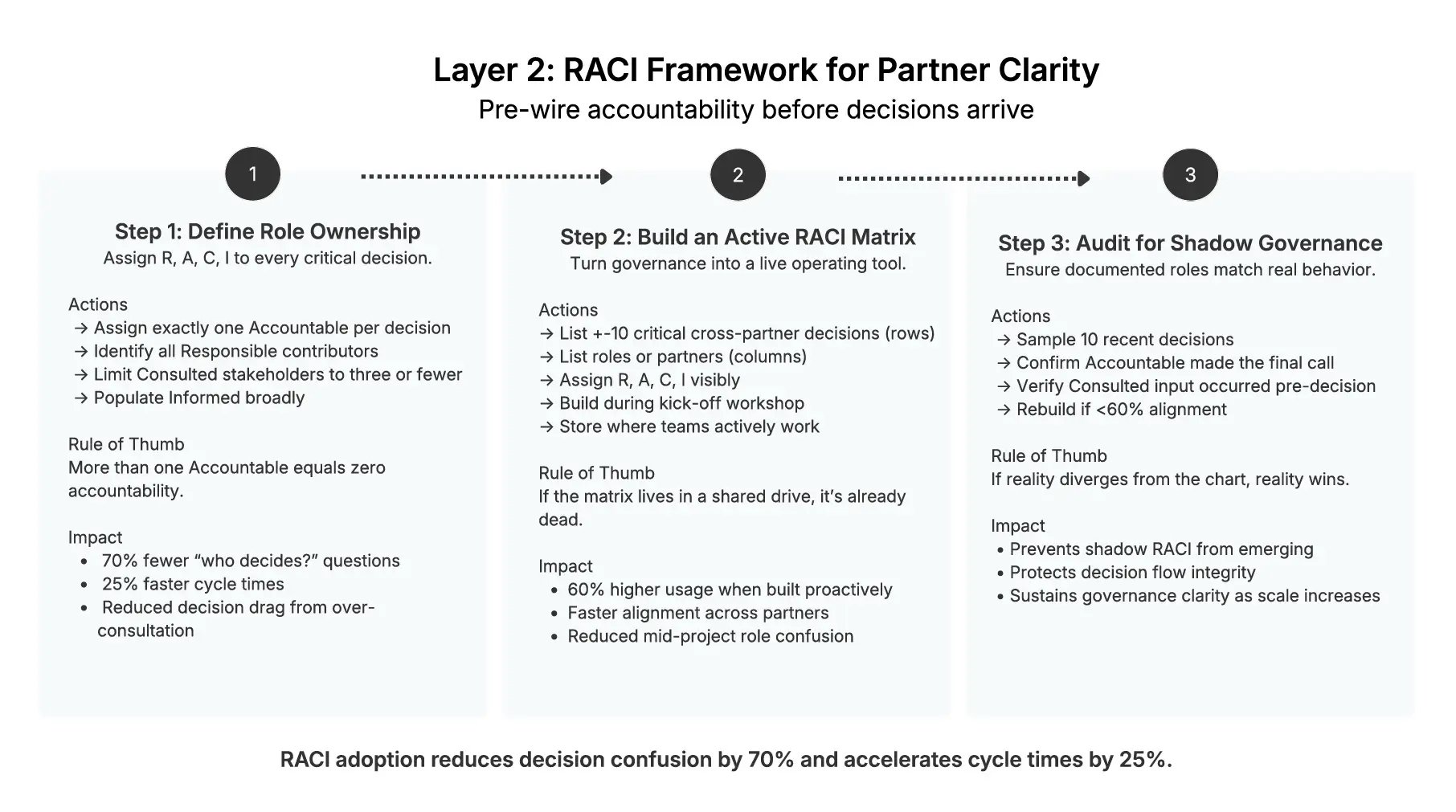
Exhibit 3: RACI framework assigning clear roles to decisions, accelerating execution and eliminating accountability gaps.
Organizations with strong program management report 50 percent fewer missed milestones and 40 percent faster dependency resolution across complex projects. The difference comes down to authority: effective program managers have explicit power to enforce decision rights and RACI structures, while weak ones have visibility but no enforcement mechanism. This gap determines whether governance delivers successful outcomes or collapses under pressure.
Program managers gain this authority through a charter documented during the partnership kick-off. It specifies enforcement powers (escalating blocked decisions, halting work that violates decision rights, and allocating resources effectively), decision-making authority (what the program manager owns versus escalates), and escalation paths to executive sponsors or a managing director. Without this explicit charter, program managers default to coordination roles with no power to enforce governance.
Execution velocity depends on dependency management. Project A cannot deliver until Partner B completes Component X, and Partner B cannot start until Partner C provides Specification Y. These chains across related projects are visible; why they stall is not.
Program managers intervene before delays cascade. Consider a program manager who identifies that Partner C has not prioritized Specification Y because they assume it is Partner B's decision to request it. The program manager clarifies decision-making authority, confirms Partner C owns the specification, and removes the blocker, cutting decision-making time from three weeks to two days.
Research shows 60 percent of cross-partner delays stem from decision-making confusion rather than technical complexity. The critical skill for program managers is treating blockers as governance failures rather than scheduling problems, fixing the underlying gap across all related projects rather than just the immediate instance.
Make this systematic through weekly blocker resolution. Dedicate the first 15 minutes of your program review to blocker identification. Determine for each whether the root cause is technical complexity or governance ambiguity. Technical blockers require technical solutions; governance blockers require immediate clarification of decision rights and RACI updates. If governance blockers consistently resolve faster than technical ones, your architecture supports project success.
Partner ecosystems generate constant change. Change management that maintains velocity requires matching change authority to decision rights. Effective stakeholder management means ensuring relevant stakeholders receive relevant information at the right level of the organizational structure, not routing every decision upward through the approval process.
High performers categorize changes by impact before routing them. Single-partner changes remain project decisions; multi-partner changes that alter timelines or require decisions about how to allocate resources effectively escalate to program decisions. This classification ensures decision makers operate at the appropriate level.
The RACI matrix determines who evaluates impact and who needs to be consulted or informed. If a change affects architecture, the accountable person for architecture evaluates it, maintaining risk management discipline without creating bottlenecks. Organizations routing every change through program leadership create 40 percent longer approval cycles; those delegating through decision rights and RACI matrices maintain velocity and keep projects aligned with organizational goals.
Effective program managers remove blockers rather than explain delays. Track time allocation in reviews: if 60 percent of the discussion describes obstacles and 40 percent describes resolutions, your program manager is a reporter. If those ratios invert, they are an orchestrator driving real project success.
Cross-partner dependencies should surface early in program reviews, not at crisis points. Strong program managers identify dependency risks three to four sprints ahead, ensure accountability across project teams, and systematically track progress toward organizational goals. When decision rights hold under deadline pressure, program management is working; when they dissolve, managers lack the authority they were chartered with.
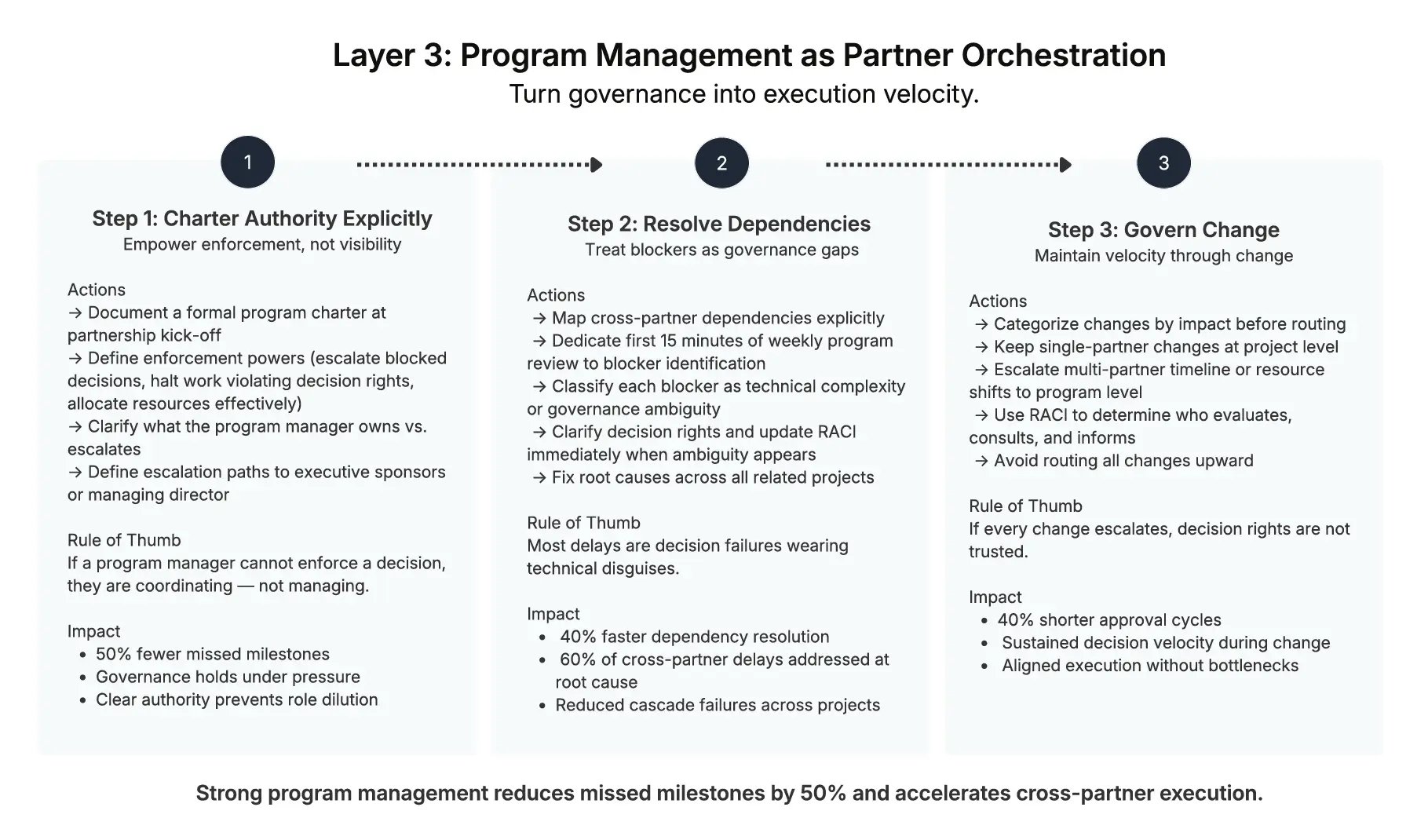
Exhibit 4: Program management charter and enforcement model driving faster dependency resolution and milestone delivery.
The operating model determines whether governance survives reality. It specifies how decision rights, RACI structures, and program management integrate into daily operations, defines communication channels, and ensures team members understand how key decisions move through the project management process.
High-performing operating models establish governance during kick-off, scale through program manager orchestration, and monitor progress as complexity grows.
Governance built during kick-off achieves 70 percent higher adoption than governance retrofitted mid-flight. Project teams starting with clear structures default to using them; teams adding governance later treat it as overhead rather than as a core part of the project management process.
Effective kick-offs produce three artifacts: decision rights documentation specifying what sits at project versus program levels, RACI matrices mapping accountability for major deliverables, and program manager authority charters specifying enforcement powers. Together, these give every team member a clear understanding of how key decisions will be made before work begins.
Execute this through a structured pre-kick-off process. Two weeks before, draft your decision rights matrix and pre-populate RACI templates for your 10 to 15 critical decisions. One week before, distribute both documents to key stakeholders. During kick-off, conduct a two-hour workshop to review and refine both frameworks, document all agreed changes within 24 hours, and embed final versions into your partnership charter. Schedule a 30-day review to catch early drift. Research on organizational change shows leadership modeling drives 60 percent of governance adoption: when a managing director references decision rights in early meetings, project teams internalize the framework.
Scaling from two partners to five or eight requires governance consistency and organizational standards that apply across all projects. The failure mode is governance customization, where each new partner requests slightly different decision processes, creating fragmentation that kills the program manager's ability to maintain a comprehensive view across the portfolio.
High performers maintain strict organizational standards across various projects. Partner A and Partner B might use different software solutions or sprint cadences, but both operate under the same decision-making authority model. This consistency enables portfolio-scale orchestration and ensures accountability across all related projects.
Embed governance checks at existing touchpoints rather than creating separate processes. During project planning, review RACI assignments. In daily standups, flag decision-making bottlenecks for same-day resolution. During retrospectives, identify governance gaps. In quarterly business reviews, audit decision rights across the full portfolio. Program managers who embed governance into existing ceremonies achieve 50 percent higher compliance and ensure accountability without adding overhead.
Governance health appears in decision-making speed, not documentation completeness. Monitor the average time from decision need to execution as partner count grows. If decision time remains stable while complexity increases, governance scales effectively toward successful outcomes.
Track escalation patterns. Confusion-driven escalations should trend toward zero as governance matures; authority conflicts may remain stable, reflecting genuine judgment calls and effective stakeholder management. Regularly reviewing a sample of ten recent decisions quarterly identifies drift early. If 80 percent or more match documented governance, the system is healthy. Below 60 percent, it requires rebuilding.

Research shows firms with explicit decision rights, active RACI frameworks, and strong program management deliver projects 30 percent faster and experience 40 percent fewer cost overruns. The performance gap between high-governance and low-governance organizations grows with scale and shows up directly in business goals achieved and customer satisfaction.
Assess governance across three categories. For decision rights, measure whether latency remains stable and escalations are purposeful. For RACI matrices, verify whether team members reference them proactively during project planning. For program management, confirm that managers remove blockers and dependencies that surface early.
If 70 percent of signals are positive, that layer works. Between 40 and 70 percent, the layer is fragile. Below 40 percent, rebuild it before expanding further.
Fix one layer at a time. Simultaneous fixes create change fatigue and make it harder to attribute improvements in organizational performance to specific interventions. Fix decision rights if escalations increase faster than partner count. Fix RACI if decision rights are clear, but overlapping responsibilities persist. Fix program management if structures exist, but project teams bypass them under pressure.
The layer causing visible pain is rarely the root cause. Most organizations observe slow decisions and add program management resources. The root cause is often unclear decision-making authority. Adding program managers without fixing it amplifies the dysfunction.
Research shows organizations implementing governance before their third partner achieve 35 percent faster delivery than those implementing after five. The timing of your governance investment determines whether partner ecosystems support organizational goals or become a coordination liability. Get it right, and each new partner accelerates delivery; get it wrong, and each one adds overhead.
Architecting governance before scaling prevents three distinct failures: coordination debt, where each partner added without governance compounds decision-making bottlenecks over time; authority precedent failures, since the first major decision sets behavioral patterns that outlast the decision itself; and structural lock-in that makes organizational change costly later.
Organizations spend 50 percent more effort retrofitting governance and achieve 40 percent lower adoption rates. High performers invest 30 days defining rights, building RACI matrices, and establishing program management authority, recovering that investment within two quarters through faster decisions and fewer escalations.
Implement governance before adding your third partner if: partners execute more than five joint initiatives annually; initiatives involve more than $1 million in combined resources; customer satisfaction depends on coordinated delivery; or decision-making takes more than three business days. These thresholds indicate coordination costs without governance already exceed the cost of implementing it.
Partner scale becomes advantage when additional partners accelerate delivery rather than add overhead. This happens when governance eliminates coordination drag, reduces risk management failures from unclear ownership, and ensures projects align with strategic goals. The sixth partnership should see decision-making latency equal to the third; without governance, it creates 60 percent more overhead.
Program managers orchestrating five partners using consistent governance and modern software solutions gain a comprehensive view invisible to those managing inconsistently. They identify which decision rights configurations reduce latency, which RACI structures prevent overlapping responsibilities, and which interventions improve organizational performance. Partner six benefits from everything learned through partners one through five; without governance standardization, it simply repeats their failures.
/Videos/HiFi-Animation-Portfolio-Monitor-Portfolio-Health.webp?width=1190&height=714&name=HiFi-Animation-Portfolio-Monitor-Portfolio-Health.webp)
Exhibit 5: ITONICS governance dashboard making decision rights, RACI roles, and cross-partner dependencies visible in real time.
Partner governance is decision infrastructure, not process documentation. Organizations that architect decision rights, implement active RACI frameworks, and empower program managers convert complexity into competitive advantage and partner scale into consistent project success.
Build governance before scaling, or spend twice the effort retrofitting it with half the adoption rate. High performers invest 30 days upfront to gain 30 percent velocity advantages that compound over three years.
The three layers work only when integrated. Evaluate your current governance against the signals described here, identify which layer needs attention, and build it properly before moving to the next.
ITONICS enables this architecture through integrated program and project management capabilities that make decision rights visible, RACI structures operational, and program manager orchestration effective across your partner portfolio.