Why CPG product development is slow - and 9 frameworks to fix it

Consumer goods product development takes 18 to 36 months on average. Here are eight frameworks to fix your new product development process and cut time-to-market by 40%.
Consumer goods companies spend an average of 18 to 36 months on new product development, but consumer preferences shift in weeks. That gap is where products go to die and where private label wins by default.
The culprit is the structure: Most consumer goods companies inherited a product development process designed for a slower world and have barely revised it since. Thus, the lack of structure also means missed feedback and poor market alignment. Without integrating customer insight and thorough market research, a product can fail to resonate with consumers.
This article follows the new product development (short: NPD) process phase by phase, diagnosing where it breaks down in consumer goods specifically, and provides eight concrete frameworks to fix it.
Consumer goods sits in an uncomfortable middle ground as products are physical, which means they face regulatory, manufacturing, and supply chain constraints. But they compete in markets that move at the pace of digital. A trending ingredient or a private label copy can reshape a category in 90 days. Most NPD frameworks were not built for this environment.
The discovery phase fails in two ways: market research is commissioned once and never updated, and customer feedback is collected after launch rather than before development. Neither input is positioned where it does the most work.
Market research: a one-time investment that expires mid-development
An 18-month development cycle means the market research that anchored a product concept is 18 months old at launch:
Consumer preferences shift.
Competing products enter.
Target market segments fragment or disappear.
When Colgate-Palmolive launched a premium oral care line in 2019, category research from 18 months prior had underestimated the shift toward natural ingredients - a gap that required post-launch reformulation.
Most consumer goods teams collect customer feedback twice - at concept and after launch. Both are too far apart to prevent late-stage rework.
Teams running all three touchpoints reduce late-stage redesigns by 45% and improve customer satisfaction scores at launch by an average of 18 points.
The front end of the product development process is where most consumer goods companies lose time without realizing it. Annual ideation sessions at companies like Reckitt or Henkel routinely produce 150 to 200 ideas. A leadership group reviews the list manually over four to six weeks. By the time decisions land, the seasonal launch window has closed, and momentum is gone.
The problem is the absence of a scoring system that connects idea generation directly to validated customer needs and strategic criteria.
Most consumer goods companies treat idea screening as a qualitative discussion. Senior managers debate ideas in meetings without scoring criteria or time limits. Ideas survive based on who champions them, not on market evidence.
The Product Development and Management Association reports that companies with structured idea screening processes launch 35% more successful products per dollar of development spend than those relying on informal review.
Run by a cross-functional squad of three to four people, the complete screening process takes three to five business days - replacing a six-week manual review with no reduction in decision quality.
Concept development stalls when teams try to perfect a product concept before consumers see it. Concepts exist to be tested, not polished: A rough concept tested in week two beats a polished concept tested in week eight.
Nestlé's internal innovation programs run rapid concept tests within the first two weeks of a new brief - not to get a final answer, but to eliminate weak directions early and focus development effort on what consumers actually respond to.
Most consumer goods teams take four to six weeks to select a concept for further development. That latency delays the entire downstream process.
Teams running this sprint reach a validated product concept in one week instead of six.
Business analysis is essential, but the problem is scale and timing. Consumer goods companies routinely produce 40-page business cases before a single prototype exists: finance builds net present value sensitivity models, the marketing team adds consumer research appendices, and senior management requests three-year scenario analyses. Writing the business case takes longer than building the first prototype.
This is the wrong level of rigor at the wrong stage. A product concept that has not been prototyped does not need a 40-page financial model. It needs a one-page viability check.
This approach reduces total business analysis time by 60% per project. The business case becomes a living document that grows in detail as real data replaces assumptions - rather than front-loading effort at the stage where assumptions are least reliable.
Stage-matched business analysis aligns the depth of financial evaluation with the maturity of the project.
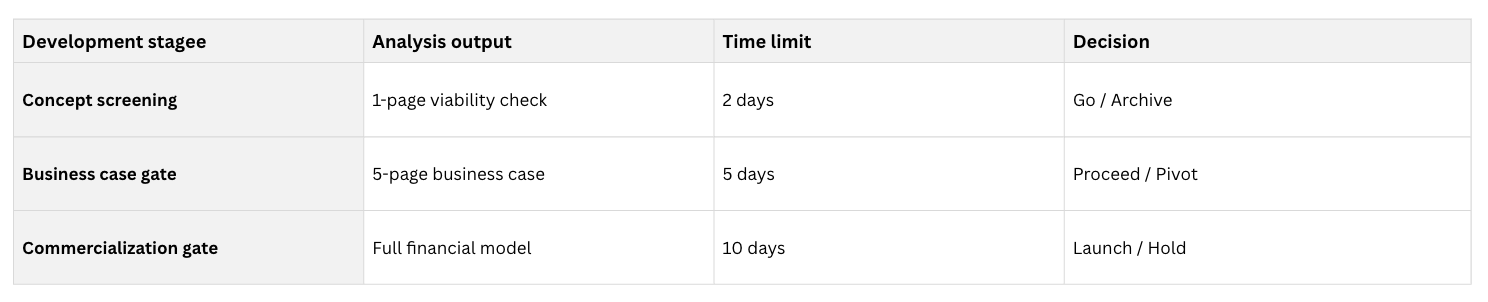
Early-stage concepts receive a one-page viability check focused on margin logic and strategic fit. As uncertainty decreases and prototypes generate real data, the analysis expands in scope. This prevents weeks of modeling built on assumptions and ensures analytical effort scales only when evidence justifies it.
The development phase loses time in two places: inside teams, through functional silos and sequential handoffs, and at gates, through slow approval processes. Both are structural problems.
Most consumer goods development teams are organized by function. R&D finishes formulation, then hands off to packaging. Packaging finishes, then the supply chain begins. Each handoff adds three to eight weeks. A project touching five functions in sequence accumulates up to 40 weeks of handoff time before a consumer ever sees the product.
Unilever and Reckitt have both reported cycle time reductions of 20 to 35% after switching from functional review structures to dedicated cross-functional product teams. Decisions that previously required four function heads to align happen in a 30-minute squad meeting. Right-size the squad by product tier: a line extension on existing product lines may only need R&D, marketing, and supply chain.
Gates designed to catch risk have become approval queues. A decision that should take 48 hours waits three weeks for a senior management calendar slot. Companies that redesign gate reviews around a 5-day decision SLA reduce average gate wait time by 65% without reducing rigor.
Teams adopting this format cut average decision latency from 18 days to 4 days per gate - recovering 84 days across a six-gate development process. P&G piloted a version of this format across its personal care division and reported a 25% reduction in time-to-concept-approval.
Two stages appear in every NPD framework and are consistently removed under schedule pressure. Both failures are expensive.
Technical feasibility assessment belongs at Gate 2, after concept selection and before the full development effort begins. Most consumer goods teams skip it or run a superficial version that checks formula viability without checking manufacturing and regulatory constraints.
A complete assessment answers four questions:
Can the formula deliver the claimed performance benefits using commercially available ingredients?
Are the required manufacturing capabilities accessible within the project budget?
Are there regulatory constraints that affect the formula, claims, or packaging in the target market?
Does the projected cost of goods support the business case margin?
A technical failure caught at Gate 2 costs five to ten times less to resolve than the same failure discovered at Gate 4. The assessment takes five to seven business days. The alternative is discovering a $2M tooling incompatibility nine months into development - a scenario that cost one major European personal care brand an estimated 14-month launch delay on a core skin care line.
Test marketing is the most skipped stage in the consumer goods new product development. The reasoning: it costs money, delays the launch, and tips off competitors. The cost of skipping it is a 40% higher launch failure rate.
The average cost of a failed national launch in consumer goods is $5 to $10M in write-offs, retailer penalties, and distressed inventory. A regional test market costs $300,000 to $500,000. Unilever runs regional test markets as standard practice before national rollouts on innovation projects above a defined revenue threshold. The return is a 40% lower launch failure rate.
Individual projects fail because the product development strategy was unclear, or because the portfolio management process allowed too many projects to run simultaneously for the available development effort.
Assign every active development project to one of three strategic intents before development begins:
Grow projects target new customer segments or new markets and require the most development effort.
Hold projects defend existing product lines and market share.
Harvest projects extend the revenue life of mature store-keeping units (short: SKUs) through cost optimization or minor renovation.
Therefore, set explicit allocation targets - for example, 60% of capacity on grow, 25% on hold, 15% on harvest - and review quarterly. Projects that fit no bucket exit the portfolio. This exercise alone eliminates 20 to 30% of active projects in most consumer goods companies, freeing the development capacity that accelerates everything remaining.
Core SKUs generate 70 to 80% of consumer goods revenue but receive less than 20% of development attention. Neglected existing product lines lose shelf relevance. Retailers replace them with private label. Recovering lost distribution costs is twice the investment that maintaining it would have required.
Run a 24-month renovation cycle on every core SKU. Evaluate each on three criteria: consumer relevance, competitive positioning against private label, and margin health. A SKU that fails one criterion gets a focused development team assigned to fix that specific issue within 90 days - without pulling resources from innovation projects.
Consumer goods teams managing a development portfolio across spreadsheets and email threads face three compounding problems that no process redesign alone can solve.
Pipeline structure and idea scoring. ITONICS provides a configurable screening workflow where product ideas are scored against custom criteria at every stage. Idea screening that typically takes six weeks in a manual review takes three to five days in the platform. Senior management sees a ranked, auditable backlog instead of a chaotic list.
Portfolio visibility and gate discipline. ITONICS maps every active development project to strategic objectives. Gate workflows are built into the platform: documents are assembled automatically, decision-makers are notified on schedule, and approvals are recorded with date and owner. The stage gate process runs with discipline - without manual coordination from the product lead.
Full-cycle progress tracking. As projects move through the development process, ITONICS tracks milestone completion and gate readiness in real time. Customer feedback, market research outputs, and prototype test data are linked directly to project records - visible to the marketing team, R&D, and the sales team in one place.

.webp?width=900&height=450&name=Top-10-project-portfolio-software-tech-and-development-teams-use-for-managing-innovation-projects-fullwidth%20(1).webp)