What AI competitor analysis tools must prove to strategists


Patent offices processed more than 3.55 million applications in 2023, according to WIPO. A 2026 McKinsey survey of more than 1,250 executives found that close to two-thirds of organizations sometimes or often miss a growth opportunity because a competitor moved first, even when their own company was better positioned to win it.
A rival files a patent. A competitor changes its product features. Signal volume was never the constraint.
Market trends shift a full quarter before anyone notices. None of that raw data makes a resourcing decision by itself.
The real bottleneck is proving which signals deserve a governed decision. Most competitive analysis tools are built to surface more of them. Strategy teams need signals that have already survived scrutiny.
This article sets out what AI platforms actually have to prove before a strategy team trusts one with a resourcing decision.

Strategy teams already have abundant competitor research: patent filings, product launches, market share shifts, hiring patterns. Most of it arrives faster than a team can review it.
The problem is what happens after a signal is found. Traditional tools were built for continuous monitoring: alert volume, dashboard counts, more competitors tracked.
Monitoring answers whether something happened. Deciding whether it changes what gets funded is a separate question, and most tools leave that question to the team.
A signal about a top competitor's move often sits in a shared inbox with no owner for the decision. Three months later, the same signal resurfaces in a quarterly review, after the team has already lost the window to act on it.
Competitive analysis tools that only add more monitoring add more alerts competing for the same review capacity. The fix is fewer signals that already cleared a filter before they reach a person.
Most teams already run several AI tools, none of them connected to company-specific context. That repeats a familiar problem.
Parallel systems produce parallel, disconnected pictures, the same pattern that spreadsheets and shared drives created before AI arrived. A tool that scores or summarizes a signal against public data alone produces an answer disconnected from a team's actual strategic priorities.
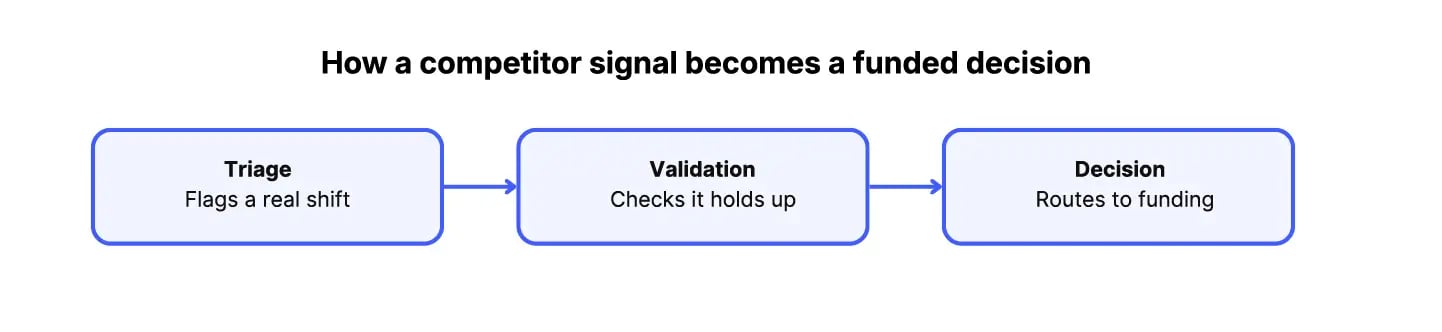
Exhibit 1: A competitive intelligence platform should carry a signal through triage, validation, and a governed decision gate before it reaches funding.
Competitive intelligence work happens in three stages, and most tools only cover the first one.
Most tools marketed as a competitive intelligence tool stop at triage. They aggregate, alert, and visualize.
That's useful, and it's also the easier half of the problem. The harder work, validating a signal and routing it to a decision, is where most competitor analysis software falls short.
A strategy team evaluating competitor analysis software should ask which of these three stages a given tool actually completes.
A competitive analysis tool earns its spend when it covers triage, validation, and decision end to end. That's the full arc a strategy team should hold every vendor to, and the same arc strategic portfolio intelligence describes at the category level: signals connected all the way to a fund, stop, or scale call.
Most vendors pitch AI as reducing headcount on monitoring, the triage layer. The real disagreement is where the human checkpoint belongs within validation, before a signal reaches the pipeline, or after.
A platform that skips a named reviewer at the decision stage moves the risk further downstream, into a funded initiative nobody signed off on. That risk becomes real once the initiative is already running, with budget and people committed.
A wrong governed decision costs more than a wrong dashboard alert. An ignored alert disappears quietly. A funded initiative built on an unvalidated signal resurfaces in the next portfolio review as a resourcing decision that failed, after the team has already spent the budget and the time.
A trustworthy competitive analysis tool earns trust the same way a good analyst does, by being right often enough, and transparent enough about sourcing, that a reviewer stops re-checking every output. A platform should offer fewer decisions a team has to re-litigate, from the first flagged signal all the way to the initiative it eventually funds.
Use these seven questions to test any AI platform's coverage across triage, validation, and decision. Score a vendor demo against them directly.
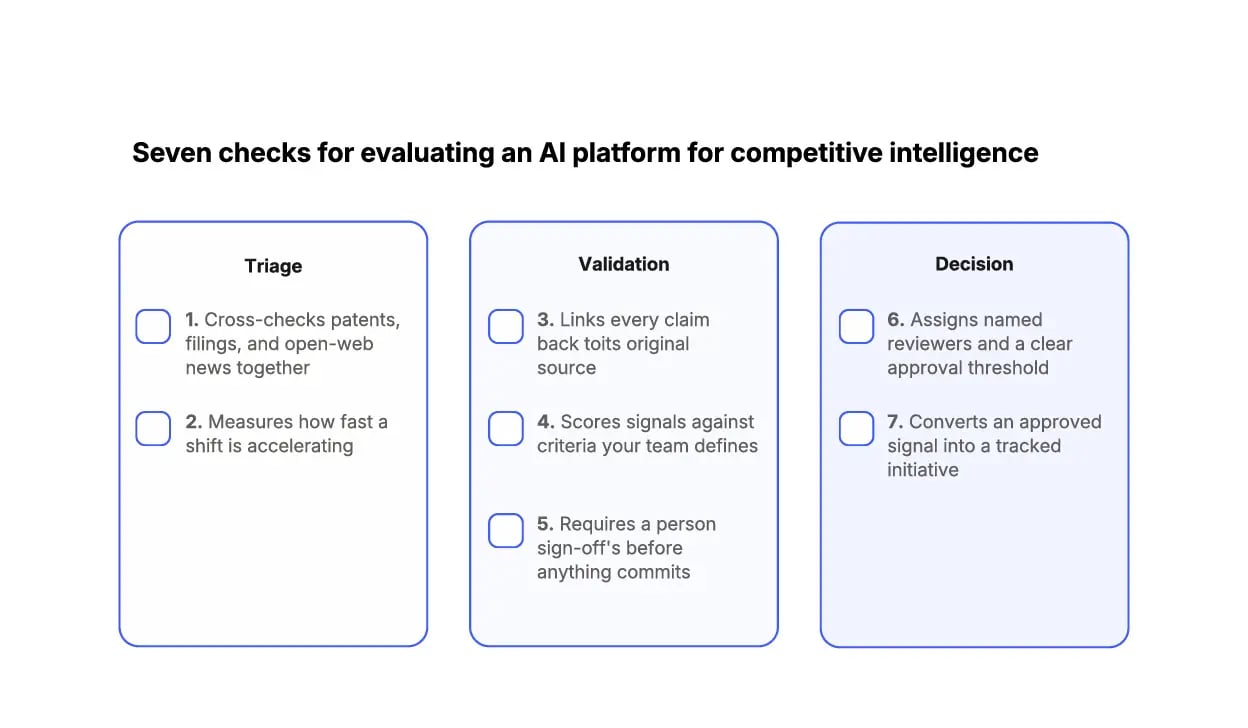
Exhibit 2: Seven proof points span three stages: triage tests if a signal is real, validation tests if the evidence holds, decision tests if it reaches funding.
Triage
/Still%20images/AI%20Mockups%202025/portfolio-find-new-hot-projects-2025.webp?width=1440&height=900&name=portfolio-find-new-hot-projects-2025.webp)
Exhibit 3: Prism compares trends to a team's existing portfolio, scores each by market potential, and suggests new projects to pursue.
Validation
/Still%20images/Element%20Mockups%202025/ideation-add-unbiased-evidence-2025.webp?width=1440&height=900&name=ideation-add-unbiased-evidence-2025.webp)
Exhibit 4: Prism rates an idea against criteria a team selects, like customer benefit and complexity, then scores each one automatically.
Decision
/Still%20images/Workflow%20Builder%20Mockups%202025/capabilities-workflow-define-clear-approval-rules.webp?width=1440&height=900&name=capabilities-workflow-define-clear-approval-rules.webp)
Exhibit 5: ITONICS workflow gates let a team name reviewers and set an approval rule before a signal converts into a funded initiative.
Most competitive analysis tools pass one or two of these. A handful pass four or five. Very few complete all seven, because validation and decision require product features that monitoring tools were never built to include: source citation infrastructure, configurable scoring, and governed approval workflows.
This is also where most competitor insights lose their value. A signal that scores high on relevance but carries no citation trail remains an unverified claim. A validated signal with no named reviewer still sits in someone's inbox, waiting.
The seven criteria above describe what to look for in a vendor demo. These two companies show what it looks like once a tool actually clears them.
Toyota Motor Europe runs technology and competitor scouting across more than 200 R&D projects, with more than 500 platform users across the region. Trends, competitor activity, and technology signals collect in one place, then route into virtual pitch events where experts evaluate each proposal.
Only the proposals that hold up convert into a funded R&D or production-engineering initiative. Toyota already has more potential signals than any team could manually triage. The real constraint is deciding, project by project, which signals are structural enough to change a resourcing call, then routing only those into review.
Sartorius connects market trends and technology signals directly into its Corporate Research pipeline in the biopharmaceutical space. Sixty members across multiple product development areas work from a single connected system, with discussions tracked across departments and time zones.
That connection surfaced 450 collaboration opportunities the team could act on. The signal and the pipeline decision sit in the same system, with no separate competitive intelligence function producing reports for someone else to act on. A validated signal moves directly into the roadmap, with no second team re-entering it.
Both cases point to the same mechanism: fewer, better filtered signals reaching the people who can act on them. Neither company solved this by adding competitor research staff. Both shortened the distance between a validated signal and a decision.
ITONICS Prism runs this same mechanism for any strategy team.
Triage draws on a data lake of 172.2 million patents and 325.9 million scholarly works, alongside live open-web search. A citation-network capability traces a signal from a patent back through the science that produced it, giving a reviewer a sourcing trail to check.
Validation runs on criteria the team sets, using a persistent Master Context that keeps every output grounded in the company's own strategic priorities. Every proposed change to a strategy element shows up as an accept or reject card, so a person confirms it before anything writes into the pipeline.
Decision runs through a gate that names reviewers and sets an approval rule before a signal can convert. Once approved, it moves directly into the tracked initiative the team already runs, with no manual re-entry and no second system to reconcile. From there, a 7-step framework for turning competitive intelligence into decisions covers what happens next inside the portfolio review.
Strategy teams should hold every competitive intelligence tool to that standard: how much of what it finds is trustworthy enough to fund.