12 automotive funding programs to watch in 2027

Public funding programs give automotive companies extra budget to share the cost of technology bets that are too risky to fund alone. EU programs cover 70% to 100% of a company's eligible costs. For 2027, we used Prism to find 12 programs open to automotive companies, with €286M in EU calls alone. Batteries, materials and manufacturing take about 70% of that money, and most calls open between 17 November and 15 December 2026.
Timing matters, because competition is tough. Only 16.4% of eligible Horizon Europe proposals were funded in the program's first years. The call texts are published months before a call opens, so companies that track them early have time to find partners and write a strong proposal.
The list also shows where governments want the industry to go. In July 2026, the European Commission offered up to €1.5bn in interest-free loans for EV battery cell factories, but only to companies building their first large-scale cell plant. Japan is pushing in the same direction with subsidies for battery factories.
Here are the 12 funding programs to watch in 2027, grouped by technology and sorted by how much money each area receives.
|
Program |
Region |
Topic budget |
Deadline |
|---|---|---|---|
|
Flexible lithium-ion and sodium-ion cell production |
EU |
€37.8M |
31 Mar 2027 |
|
Low-cost battery concepts with fewer critical raw materials |
EU |
€48M |
14 Apr 2027 |
|
Recycling of mixed battery feedstocks |
EU |
€18.8M |
31 Mar 2027 |
|
Battery supply-security subsidy |
Japan |
cumulative ¥671bn |
20 Nov 2026 |
|
Advanced manufacturing for key products |
EU |
€36M |
2 Feb 2027 |
|
Critical raw material substitution |
EU |
€36M |
2 Feb 2027 |
|
Circular EV components and charging infrastructure |
EU |
€24M |
14 Apr 2027 |
|
AI challenge booster with an autonomous driving track |
EU |
€42M |
18 Mar 2027 |
|
Automated driving in critical scenarios |
EU |
€5.5M |
7 Oct 2027 |
|
High-voltage truck powertrain for megawatt charging |
EU |
€16M |
14 Apr 2027 |
|
Long-distance zero-emission coaches and buses |
EU |
€13.5M |
14 Apr 2027 |
|
EV fire safety in confined spaces |
EU |
€8M |
14 Apr 2027 |
Exhibit 1: Automotive funding programs to watch in 2027, by technology area
Batteries get the most money, €104.6M across three EU calls, plus Japan's subsidy for battery factories. Materials and manufacturing follow closely with €96M. Together, that is 70% of the EU budget in this overview. The recycling call aims to reduce Europe's reliance on imported raw materials, and the manufacturing call targets parts Europe risks losing to other regions.
Who owns a company now matters as much as what it does. Eight of the 11 EU calls exclude companies controlled from China, even if they are registered in the EU. The call on critical raw materials goes further and only accepts partners from the EU, associated countries, OECD countries and a few partner regions. In Japan, the project itself has to be in Japan.
Automated driving gets far less. The AI booster call has €42M, but it covers three industries and promises only one €14M project to autonomous driving. Add the €5.5M call on critical driving situations, and €19.5M is set aside for driving, about 7% of the total. The largest automated driving grant of this EU funding period, a single €100M pilot project, closed on 8 October 2026.
|
Technology area |
EU call budgets |
Share of EU budget |
Programs |
|---|---|---|---|
|
Batteries |
€104.6M, plus Japan's battery subsidy |
37% |
4 (3 EU, 1 Japan) |
|
Materials and manufacturing |
€96.0M |
34% |
3 |
|
AI and automated driving |
€47.5M |
17% |
2 |
|
Electric vehicles on the road |
€37.5M |
13% |
3 |
|
Total |
€285.6M |
100% |
12 |
Exhibit 2: Funding by technology area
Shares are rounded and refer to the EU budget. Japan's battery subsidy has no budget per application round; METI has approved up to ¥671bn in battery subsidies so far. The AI figure includes the full €42M booster, of which €14M is guaranteed for autonomous driving.
Compared with our 2027 automotive trend radar, the money is in sync on supply chains and out of step on software.
Export controls on rare earths, battery materials and chips rate as a very high impact trend on the radar, and the EU answers with calls for battery production, recycling and substitutes for critical raw materials.
Sodium-ion batteries entered the radar this year as a new trend, and the battery production call names them explicitly.
The surprise is software. Zonal E/E architectures also rate very high on the radar, but none of the open or upcoming EU calls we found funds them, and a 2026 call on software-defined electric vehicles closed in April.
End-to-end AI driving, another new trend, gets only the €19.5M described above. With Western carmakers' profits under pressure, these are the areas where companies will have to pay their own way or keep buying know-how from partners in China.
Batteries receive the largest share. Three EU calls follow the chain from making cells to designing new chemistries to recycling. Japan adds subsidies for battery factories.
This call pays for new ways to make battery cells more cheaply and with less energy. The pilot lines it funds must be able to switch between lithium-ion and sodium-ion cells, with new methods for mixing materials and making electrodes. The previous round had a different focus. It spent €100M on scaling up next-generation lithium cells such as solid-state. This time the EU wants factories that can change chemistry.
The call suits European cell makers, carmakers' battery joint ventures and the companies that build their machines. Evaluators will likely look for a sodium-ion plan, because the call text names it.
Budget and deadline: €37.8M for two projects of about €18.9M each, with 70% of a company's costs covered. Opens 3 December 2026, closes 31 March 2027. Companies controlled from China are excluded. Visit the call page.
This call funds research into new battery designs. One track looks for cheap batteries for passenger EVs and stationary storage that use as few critical raw materials as possible, for example through simpler casings or cooling. A second track covers high-performance batteries for aircraft and ships. In 2026 the EU funded better electrode materials. Now it moves on to complete battery concepts, with cost for passenger EVs at the top of the list.
The passenger EV track fits carmakers' battery research teams working with research institutes and materials start-ups. With about ten grants, this call offers more chances than any other battery call here, and the first stage only asks for a short proposal.
Budget and deadline: €48M for about ten projects of €4.8M each, with 100% of costs covered. Opens 15 December 2026. The first stage closes 14 April 2027, the second on 7 October 2027. Visit the call page.
This call helps existing recycling plants process a messier mix of input, such as gigafactory scrap and different lithium-ion chemistries, sometimes in the same batch. The goal is battery-grade material that can go back into European cell production. Applicants must show the costs and environmental footprint of their process. The 2026 round funded research into new direct recycling methods. This round invests in plants that already run at scale and links the results to the recovery targets of the EU Batteries Regulation.
It fits recyclers with running plants that team up with carmakers and cell makers, who carry the obligations under that regulation. Recovery rates will weigh heavily, since the call asks for proof that the targets are met.
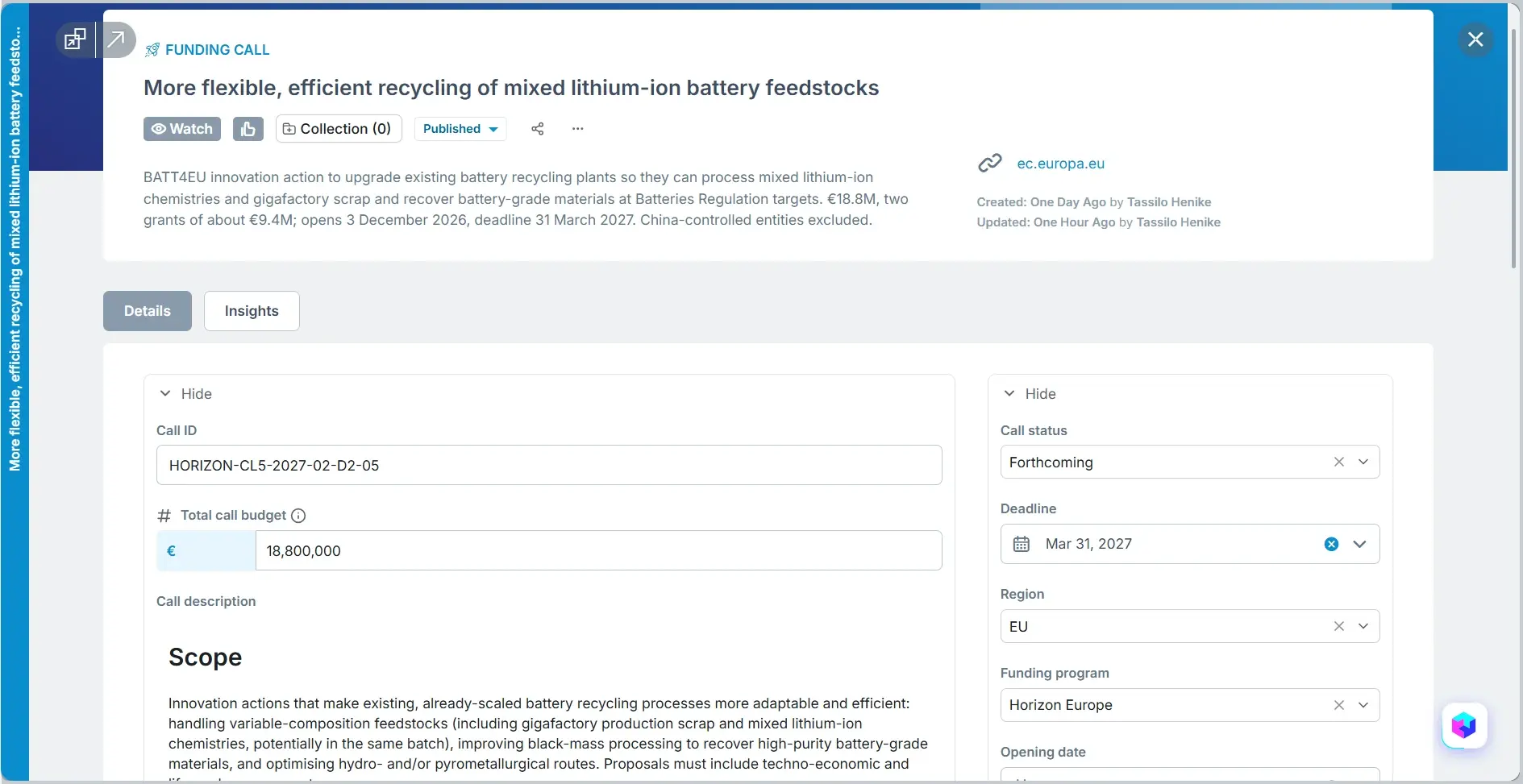 Exhibit 3: Funding call "Recycling of mixed lithium-ion battery feedstocks" details shown inside ITONICS
Budget and deadline: €18.8M for two projects of about €9.4M each, with 70% of a company's costs covered. Opens 3 December 2026, closes 31 March 2027. Companies controlled from China are excluded. Visit the call page.
Japan's Ministry of Economy, Trade and Industry (METI) pays part of the cost of new battery capacity in Japan. The subsidy covers cell plants, materials and components, and production equipment, once METI approves a company's supply plan under Japan's economic security law. Most approved plans are now upstream of the cell: 27 of 42 cover components and materials, and 8 cover equipment. Only 7 are cell plants. The eight plans approved on 17 February 2026 alone add up to ¥116.7bn in investment, with up to ¥44.4bn in subsidies.
It fits cell, material and equipment makers that produce in Japan. METI measures progress against a national target of 150 GWh of battery production capacity by 2030.
Budget and deadline: one third of investment costs and half of development costs. The current application window closes on 20 November 2026, and METI expects applicants to talk to its battery division first. Visit the call page.
Materials and manufacturing receive €96M, almost as much as batteries. Two of the three calls are already open and close on 2 February 2027.
This call funds machines and production methods for high-performance components that Europe risks losing, or that depend on parts and raw materials bought mostly outside Europe. Examples include 3D printing combined with machining, new joining methods and composite manufacturing. Battery production has its own calls. In 2026, this call guaranteed at least one automotive project. The 2027 text only says that automotive applications "may be considered", so carmakers and suppliers have to win on merit.
It fits production engineering teams at carmakers and Tier 1 suppliers, together with machine builders. The first awards will show whether automotive projects still win without the guarantee.
Budget and deadline: €36M for projects of €6–8M, with 70% of a company's costs covered. Open now, closes 2 February 2027. Companies controlled from China are excluded. Visit the call page.
This call funds new materials and production processes that replace critical raw materials or use less of them, from the first material design to the finished product. Mobility is one of the target sectors named in the call. It also has the strictest rules in this overview. Only partners from the EU, associated countries, OECD countries and a few selected regions can join, and the call text cites the protection of the EU's strategic interests.
It fits suppliers of electric motors, magnets and power electronics that rely on rare earths. Rare-earth-free motors are the technology to watch here. On the ITONICS trend radar, they have gained strategic weight since China's magnet export controls.
Budget and deadline: €36M for projects of €6–7.5M, with 70% of a company's costs covered. Open now, closes 2 February 2027. Visit the call page.
This call is about giving EV parts a longer life. It funds reuse, repair and recycling of parts such as power electronics, electric motors, gearboxes and battery-system components, plus charging stations. Battery cells are covered by other calls. Funded approaches include shared product data, more durable designs, predictive maintenance, refurbishment and designs that are easy to take apart. With this call, circularity funding moves from the battery to the rest of the electric drivetrain.
It fits aftersales and remanufacturing teams at carmakers, and suppliers of e-drives and power electronics. Shared product data for drivetrain parts is the piece to watch, because the call treats it as the basis for design and business decisions.
Budget and deadline: €24M for about four projects of €5–7M, with 70% of a company's costs covered. Opens 15 December 2026, closes 14 April 2027. Companies controlled from China are excluded. Visit the call page.
AI and automated driving receive €47.5M on paper, but only €19.5M of it is reserved for driving. Both calls come out of the EU's plan to bring AI into key industries.
This call funds competitions in which AI developers solve challenges set by industry. Each project picks one of three industries: healthcare, advanced manufacturing or in-vehicle autonomous driving. Companies from that industry must be core partners, and part of the grant goes to the start-ups and teams that compete. At least one project will focus on autonomous driving, provided the proposals are good enough. The call is part of the EU's Apply AI Strategy and, for driving, its Automotive Action Plan.
It fits carmakers and Tier 1 suppliers that want to set the challenges and get early access to AI talent. Keep an eye on who joins the Connected and Autonomous Vehicle Alliance the EU has announced, since the funded driving project must work with it.
Budget and deadline: €42M for three projects of €14M each, with 100% of costs covered. Opens 17 November 2026, closes 18 March 2027. Companies controlled from China are excluded. Visit the call page.
This call looks at rare, high-risk situations for automated vehicles: extreme weather, accidents, cyberattacks, traffic disruptions, or the moment a vehicle suddenly leaves the conditions it was designed for. It builds on five earlier EU projects, including HEADSTART and SUNRISE. The EU's large €100M pilot project for automated driving closed in October 2026. This call is the next, much smaller step, focused on edge cases.
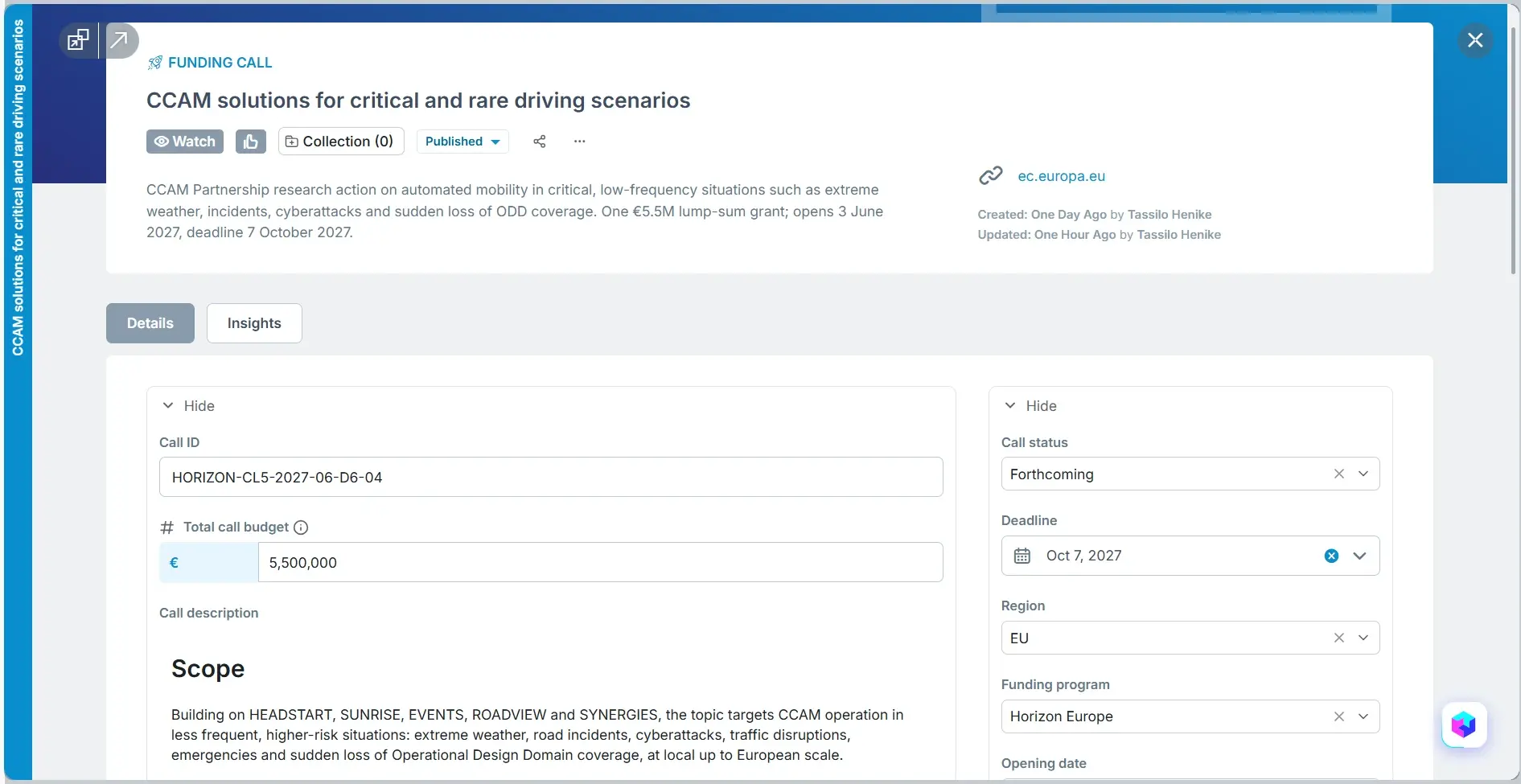 Exhibit 4: Funding call "Automated driving in critical scenarios" details stored inside ITONICS
It fits ADAS teams at carmakers and Tier 1 suppliers working with road operators and safety researchers. One expected result is a service that interprets traffic situations in real time for road operators.
Budget and deadline: €5.5M for one project, with 100% of costs covered. Opens 3 June 2027, closes 7 October 2027. Visit the call page.
Electric vehicles in daily operation get the smallest share, €37.5M across three calls. All three open on 15 December 2026 and close on 14 April 2027.
Battery-electric trucks are still expensive and slow to charge. This call funds modular truck powertrains that run above 800 volts and work with the Megawatt Charging System (MCS), the charging standard for heavy trucks. The target is 10% lower charging losses inside the vehicle. Projects should also show what higher voltage does for systems such as thermal management, and consider battery modules that can be removed for a second life. In 2026, the EU spent €68M on putting MCS trucks into long-haul fleets. This round goes one level deeper, into the powertrain itself.
It fits truck makers and suppliers of e-axles, inverters and battery systems. The voltage level the winning teams choose is worth watching, because the call asks them to find the best balance of efficiency, cost and MCS compatibility.
Budget and deadline: €16M for two projects of €8M each, with 70% of a company's costs covered. Companies controlled from China are excluded. Visit the call page.
Electric city buses work well, according to the call text. Long-distance coaches are still held back by range, vehicle weight and charging. This call funds demonstrations with at least five coaches and buses on routes that average 500 km or more outside cities, across several countries. Projects also build charging hubs that several operators and vehicle types can share.
It fits bus and coach makers working with fleet operators and charging providers. Operators should commit vehicles and routes early, because the demonstration is the heart of the project.
Budget and deadline: €13.5M for one project, with 70% of a company's costs covered. Companies controlled from China are excluded. Visit the call page.
Many people still worry about EV fires, even though the call text itself says the risk is much lower than for combustion cars. This call funds a European database of EV fire incidents, better ways to stop a battery fire from spreading, early warning inside the vehicle, and affordable detection and extinguishing systems for car parks, garages, ferries and depots with charging points.
It fits safety engineers at carmakers and battery suppliers, working with car park and ferry operators. The results will feed standard risk assessments and fire protocols, both listed as expected outcomes.
Budget and deadline: €8M for one project, with 70% of a company's costs covered. Visit the call page.
Four more funding streams are worth following in addition to the 12 programs above. None of them fits the list today. One is a Japanese program open to all industries that starts in late November. The other three are between rounds.
NEDO pilots for large companies and start-ups (Japan). NEDO, Japan's main R&D funding agency, pays start-ups to adapt and test their products inside a large company that plans to buy them. A separate track covers climate technologies. The call is planned from late November 2026 to early January 2027. Applicants need a Japanese GBizID account, which NEDO says can take two weeks or more to get. Advance notice
Battery Booster. The €1.5bn loan call for first-of-a-kind EV cell plants closed on 30 September 2026. Its awards will show which European cell projects the Commission considers bankable.
Clean Hydrogen Partnership. The EU's hydrogen program closed its 2026 call on 15 April 2026. That call included standardized hydrogen tanks for heavy trucks and buses and longer-lasting fuel cell systems. The 2027 calls are still to be published.
Alternative Fuels Infrastructure Facility. The EU's 2026 round for charging infrastructure offered €130M, including truck charging parks with at least four megawatt chargers, and closed on 6 October 2026. Truck makers and their charging joint ventures should watch for the next deadline.
The US is the gap in this overview. On 15 October 2026, Grants.gov, the federal grants portal, listed zero open federal calls for vehicle or battery R&D.
The Department of Energy's last large battery round offered $500M for processing critical materials, making battery components, and recycling. It closed on 24 April 2026. A $69M critical minerals program followed and closed in July 2026. Both focused on materials and components, far from the vehicle itself.
Federal loans have stopped as well. In its 2027 budget request, the Department of Energy states that, with its loan subsidy funding rescinded, it does not expect to make new loans under the Advanced Technology Vehicles Manufacturing program. That program has mainly financed EV and component factories.
European and Japanese carmakers with US plants should plan their 2027 projects there without federal R&D money. The Department of Energy's critical minerals calls are the closest thing to monitor.
Most of the calls that will fund your 2027 projects are already published. Prism, the AI in ITONICS, collects them in your workspace, where your team can check them, rate them, and link them to the trends and projects they support.
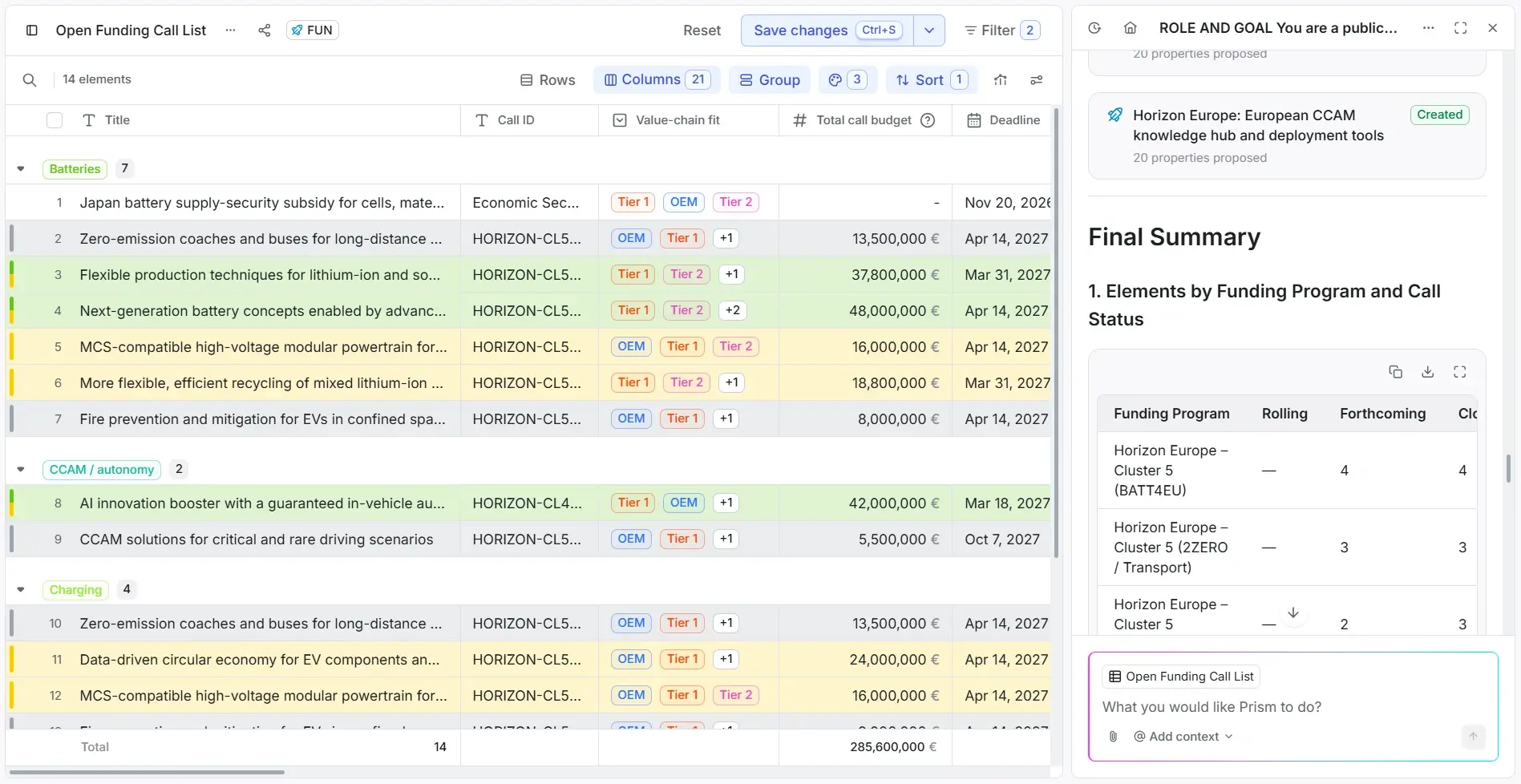 Exhibit 5: ITONICS Prism collects funding calls for automotive companies
That makes it easier to answer the questions R&D and funding teams keep asking:
ITONICS is the leading software for innovation and R&D management. It helps innovation and R&D leaders identify emerging technologies, prioritize investment opportunities with evidence, and steer execution across business units.
Toyota Motor Europe tested 40 innovation software systems before choosing ITONICS.