Best 11 innovation management software for large enterprises in 2027


Most innovation management software looks identical before the demo, because vendor websites make the same claims. This review checks those claims against public help centers, documentation, and user reviews, and counts verified capabilities higher than marketing copy. On that basis, the best innovation management software for large enterprises is ITONICS, at 4.6 out of 5. HYPE Innovation follows at 4.3, Qmarkets at 3.9, and Wazoku at 3.8.
|
Tool |
Score |
Best for |
|---|---|---|
|
ITONICS |
4.6 / 5 |
R&D, product, and innovation portfolios that link trend and technology intelligence to gate decisions. Full marks on five of eight criteria, including reporting and flexibility. |
|
HYPE Innovation |
4.3 / 5 |
Idea management and continuous improvement programs in Microsoft-centric enterprises, with strong ISO 56000 adherence. |
|
Qmarkets |
4.0 / 5 |
Programs that start with one module and add foresight and portfolio modules later. Self-admin configuration documented in its public help center. |
|
Wazoku |
3.7 / 5 |
Organizations that pair internal challenges with open challenges to external experts. The Wazoku Crowd, built on InnoCentive, has millions of registered problem solvers. |
Exhibit 1: Top four innovation management tools by evidence-weighted score
Feature pages promise AI, no-code configuration, and native integrations, while the proof sits in help centers, developer documentation, and user reviews that most buyers read only after signing. This review lists the 11 best tools on the nine essential criteria that innovation management software has to meet.
Innovation management software pays for itself when it helps organizations turn ideas into funded projects faster than spreadsheets do. Until a fund, stop, or scale decision happens, innovation efforts sit on the cost side of the ledger.
The category grew up from collecting ideas and engaging employees in continuous improvement initiatives. Today, innovation management is strategic portfolio management, and it runs on data-driven decision-making. Efficient portfolio management and prioritization is the biggest challenge of leaders in R&D, strategy, and innovation. This is followed by workflow and governance topics.
Idea volume has become the wrong scorecard for innovation success. An innovation management platform that doubles new ideas and leaves evaluation in email lengthens the backlog. Most of the return comes from four decisions:
The arithmetic favors early decisions. Take an R&D portfolio of $100 million in which 20% of the budget sits in low-impact projects. If sharper gate reviews stop a quarter of them one stage earlier, the company frees $5 million a year. Even at $50,000 a year, an enterprise subscription costs 1% of that, so one corrected portfolio decision alone pays for the innovation software, before any innovation rent from new products.
Coordination costs come on top. Dräxlmaier saves hundreds of hours a year through automated workflows and cut manual project reporting effort by 70%.
Enterprise buyers bring the same problems to every evaluation: more initiatives than budget, governance spread across spreadsheets, board reports built by hand, and occasional contributors who use a tool only when it is easy.
Each problem calls for a specific capability set, and nine criteria cover them all: flexibility and configurability, AI, automation and workflows, analytics and reporting, single source of record, integration features, ease of use, deep permission controls, collaboration and engagement, and security and compliance.
Innovation processes differ by industry and by company. A pharma stage-gate and a consumer-goods sprint follow different rules, so the right innovation software lets business admins reshape objects, workflows, and views in the interface, code-free. Flexibility and configurability thus are as important in our scoring model (20%) as more specific features like AI, automation, and workflows, which decide how fast new information reaches a gate decision.
Innovation in large enterprises spans many teams that see innovation work as extra effort. The right tool meets them in Teams, Slack, and on their phones, keeps the interface simple, and protects confidential work with fine-grained permissions. Integration, ease of use, and permission control carry 10% each. Collaboration and engagement carry 5%, because participation pays off in innovation programs only once the decision process works.
|
Criterion |
Weight |
Why relevant |
Five capability checks |
|---|---|---|---|
|
Flexibility and configurability |
20% |
Fits each business unit's process through admin changes, code-free |
No-code data model, no-code workflows, user-built views, branded landing pages, setup per business unit |
|
AI, automation, and workflows |
20% |
Moves ideas to gate decisions faster and cuts manual evaluation |
Stage gates, automation, AI evaluation, AI scouting, AI portfolio analysis |
|
Analytics and reporting |
15% |
Gives leadership live portfolio visibility between quarterly reviews |
Dashboards, value tracking, PowerPoint export, radar or matrix views, roadmaps with dependencies |
|
Single source of truth |
10% |
Limits complexity and eases analytics and follow-through |
Trends, technologies, startups, ideas, and projects as linked objects for end-to-end innovation management |
|
Integration capabilities |
10% |
Keeps innovation work inside the existing tools teams use daily |
REST API, MCP server, Power BI or Tableau, Teams or Slack app, Jira, SAP, or PPM connectors |
|
Ease of use |
10% |
Lowers the extra effort for occasional contributors |
Mobile app, Teams or Slack access, AI help for contributors, role-based home pages, Capterra ease of use of 4.5+ |
|
Deep permission control |
10% |
Protects confidential projects across business units and partners |
Separate spaces, custom roles, granular permissions, SSO, SCIM or MFA |
|
Collaboration and engagement |
5% |
Brings ideas and expertise from employees and partners into the pipeline |
Campaigns, comments and voting, gamification, external portals, notifications |
|
Security and compliance |
Pass or fail |
IT signs off before purchase |
SOC 2 or ISO 27001 certification |
Exhibit 2: Nine criteria to evaluate innovation management software
Each of the 40 capability checks earns one point when a public help center, developer documentation, release notes, or a user review from the last 36 months confirms it. A check backed only by marketing copy earns 0.75. A partial match, such as a low-code setup in place of a no-code one or a capability sold as a separate product, earns half of that.
The verified share shows how much of a score rests on documentation: ITONICS 96%, Brightidea 83%, IdeaScale 76%, HYPE Innovation and Wazoku 61%, Qmarkets 48%, Planview IdeaPlace 30%, and Traction Technology and Wellspring Accolade 0%. Vendors that keep their help centers private score lower here, and a demo can close that gap.
Security is increasingly important, and IT nowadays already joins first demo calls. IT approval works as a gate for any innovation software purchase, so run that check first.
The tools fall into three groups. ITONICS, HYPE Innovation, Qmarkets, and Wazoku each work as a comprehensive innovation management platform across the entire innovation lifecycle. Brightidea, IdeaScale, Wellspring Accolade, Traction Technology, and Planview IdeaPlace focus on one job, from idea collection to technology scouting to stage-gate governance.
Score: 4.6 / 5 (flexibility 5, AI and workflows 4.8, reporting 5, single source 5, integration 4, ease of use 4, permissions 5, engagement 5)
Best for: Enterprise R&D, product, and innovation teams that steer trends, technologies, ideas, and projects as one portfolio.
ITONICS stores market intelligence, ideas, and projects as linked elements in one database. The workflow moves innovation initiatives through phases and gates. Prism, the built-in AI, works with signals and external search, auto-generates radars, rates elements, and drafts evaluations against your innovation goals. KSB cut idea processing time by 60%.
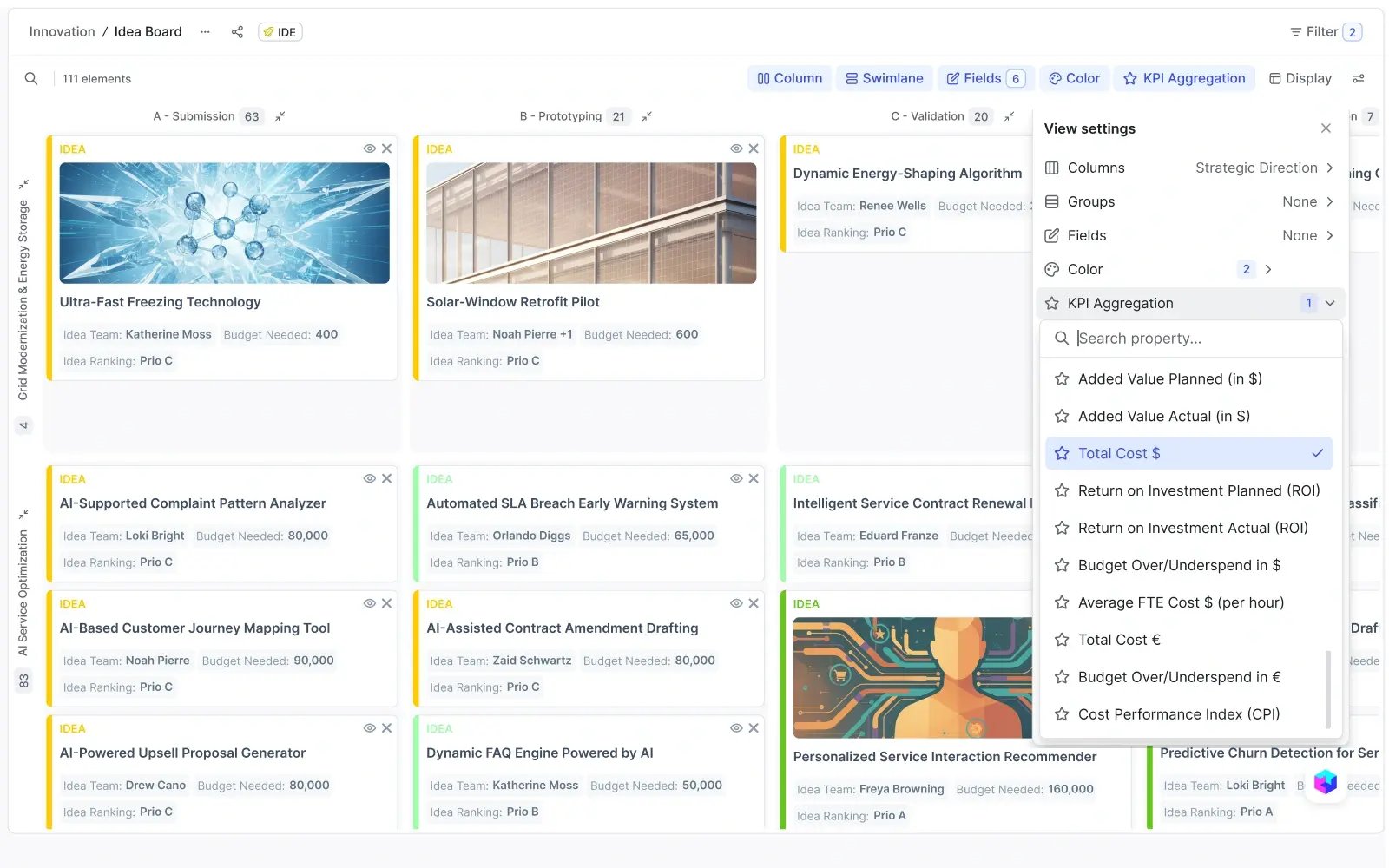
Exhibit 3: An innovation project portfolio board with KPI aggregation inside ITONICS
Pros
Cons
Pricing: ITONICS runs three tiers by team size and complexity, starting at $250 per full-user seat per month, with unlimited viewing users, giving executives the same portfolio visibility. Free guided trial.
Security: SOC 2, ISO 27001, SSO, SCIM, two-factor authentication, full audit trail.
Score: 4.3 / 5 (flexibility 4.5, AI and workflows 4.3, reporting 3.9, single source 4, integration 4.5, ease of use 4.1, permissions 4.3, engagement 5)
Best for: Enterprises that run idea management, continuous improvement, and employee engagement programs on one governed platform.
HYPE Innovation covers idea management, trend and technology discovery, partnering, and innovation portfolio management. Strategic innovation areas link innovation activities to business goals. AI features include an idea coach, AI triage to prioritize ideas, and an Innovation Graph. Custom phase-gate processes for strategic initiatives run code-free, and TD Bank implemented 16,000 ideas on the platform.
Pros
Cons
Pricing: Enterprise subscription from $15,000 per year, scaled by scope, users, and capabilities.
Security: ISO 27001, GDPR compliant, Microsoft Entra ID sign-in.
Score: 4.0 / 5 (flexibility 4.8, AI and workflows 4.3, reporting 2.6, single source 4.3, integration 3, ease of use 3.9, permissions 4.8, engagement 4.8)
Best for: Enterprises that start with one module and grow toward end-to-end innovation coverage.
Qmarkets sells a modular innovation management suite: Q-ideate for idea management, Q-optimize for continuous improvement and operational efficiency, Horizon for foresight, Q-scout for technology scouting, and Q-impact for innovation portfolios. Horizon enables organizations to identify trends and emerging technologies for any strategic topic and keeps watching after the first report.
Pros
Cons
Pricing: Annual license with an on-premise option, tailored to organization size and scope.
Security: ISO 27001, SSO, SCIM, MFA, and configurable data residency.
Score: 3.7 / 5 (flexibility 3.8, AI and workflows 4.5, reporting 2.6, single source 3.9, integration 3.8, ease of use 3.1, permissions 3.5, engagement 5)
Best for: Organizations that manage ideas from internal programs and open challenges to a large external solver crowd.
Wazoku.ai connects discovery, challenges, portfolio governance, and value measurement. It adds AI trend scanning, technology radar mapping, and startup discovery with Crunchbase and PitchBook enrichment.
Pros
Cons
Pricing: $15,000 per admin per year.
Security: ISO 27001.
Score: 3.3 / 5 (flexibility 2.9, AI and workflows 3, reporting 2.4, single source 2.8, integration 4.5, ease of use 3.8, permissions 4.5, engagement 4.5)
Best for: Companies that put employee engagement, challenges, and hackathons at the center of their innovation programs.
Brightidea sells separate products for idea collection (Idea Box), crowdsourcing challenges (Program), hackathons, experiment tracking (Lab), open innovation (Ecosystem), and company-wide change (Transformation). Lab lets teams track progress after an idea is selected. The 2026 summer release added an MCP Server and a headless API.
Pros
Cons
Pricing: Through Brightidea's sales team.
Security: SOC 2 Type II, SAML SSO, SCIM.
Score: 3.3 / 5 (flexibility 3.9, AI and workflows 3.5, reporting 2.4, single source 1.9, integration 2.5, ease of use 2.6, permissions 5, engagement 4.8)
Best for: Public sector bodies and enterprises that crowdsource new ideas from large internal and external communities.
IdeaScale runs campaigns, idea submission, voting, evaluation, and outcome tracking for more than 4.5 million participants. Each campaign opens collaborative discussion environments where users comment and vote. IdeaScale AI turns ideas, comments, and votes into themes and a feasibility versus impact matrix.
Pros
Cons
Pricing: Custom subscriptions for enterprise, government, and education.
Security: SSO, SCIM, two-factor authentication. IdeaScale's Capterra listing cites FedRAMP certification.
Score: 2.4 / 5 (flexibility 3, AI and workflows 2.3, reporting 3, single source 3, integration 1.9, ease of use 1.5, permissions 1.9, engagement 1.5)
Best for: Product-heavy R&D organizations that run formal stage-gate new product development.
Accolade is Wellspring's modular platform for new product development and strategic portfolio management. Accolade Core defines custom fields, metrics, and KPIs and automates workflows. Modules cover ideas, projects, and CAPEX, with inter-portfolio roadmaps and dependency management. Mondelēz reports a 50% reduction in time preparing for gate meetings.
Pros
Cons
Pricing: Through Wellspring's sales team.
Security: Request documentation.
Score: 2.4 / 5 (flexibility 2.3, AI and workflows 3.4, reporting 1.9, single source 3.4, integration 1.5, ease of use 0.8, permissions 2.6, engagement 2.6)
Best for: Enterprise teams that run startup and vendor pilots at scale.
Traction runs technology scouting, open innovation challenges, idea management, RFIs, pilots, and portfolio reporting in one innovation management platform. Traction AI searches a database of more than 1 million companies and produces trend reports and company snapshots.
Pros
Cons
Pricing: $4,000 per Standard seat per year, setup included.
Security: SOC 2 Type II, SSO/SAML.
Score: 2.3 / 5 (flexibility 2.6, AI and workflows 2, reporting 2.3, single source 2, integration 3.1, ease of use 1.1, permissions 1.9, engagement 3.9)
Best for: Organizations that already implement ideas through Planview Portfolios, AdaptiveWork, or ProjectPlace.
IdeaPlace, formerly Spigit, runs time-bound challenges with templates, mobile access, and external crowds that log in with social media credentials.
Pros
Cons
Pricing: Through Planview's sales team, as part of Planview licensing.
Security: Request documentation.
Score: 3.2 / 5 (flexibility 4.5, AI and workflows 2, reporting 2.5, single source 2, integration 4, ease of use 4, permissions 4, engagement 2.5)
Best for: Single teams that track a short list of innovation activities on boards.
Monday.com and ClickUp track initiatives as tasks with statuses, owners, and dashboards. Miro adds whiteboards for brainstorming.
Pros
Cons
Pricing: Per-seat subscriptions, often already in place.
Security: Depends on the vendor and plan.
Score: 2.2 / 5 (flexibility 2, AI and workflows 1, reporting 1.5, single source 1, integration 3.5, ease of use 3.5, permissions 5, engagement 1.5)
Best for: Programs with one owner and a short idea list.
Ideas arrive by email or form, land in Excel or SharePoint, get scored by hand, and turn into slides before each review.
Pros
Cons
Pricing: Existing Microsoft 365 licenses. The cost sits in staff hours.
Security: Inherits the company's Microsoft 365 controls.
Choosing innovation management software starts with the decision it has to support. Organizations manage innovation against different board KPIs, from continuous improvement and operational efficiency to portfolio value against strategic goals. Before the first demo, map your innovation management process, the challenges you face, and the pain points an innovation management platform must address.
|
Pain point |
Capability to look for |
What to see in the demo |
|---|---|---|
|
Too many projects in the innovation portfolio and little basis to stop any |
Portfolio scoring against strategic objectives and stage gates with evidence |
One live project through a gate, with a stop or fund decision and its rationale on record |
|
Board reports built by hand before every review |
Live dashboards and PowerPoint export with templates |
The next steering committee view built from live data, timed against your slide routine |
|
Signals from technology scouting sit in slides, apart from projects |
Trends, technologies, ideas, and projects as linked objects, with technology scouting in the same platform |
One trend linked to two ideas and a project, then the portfolio filtered by that trend |
|
Ideas collected in an idea management platform wait months for a decision |
Stage gates with named decision owners and deadlines |
Five ideas moved through a gate, with a documented decision sent to each submitter |
|
Each business unit runs its own process |
No-code configuration of objects, workflows, and views |
One evaluation criterion changed live by your own admin |
|
Contributors see another tool as extra work |
Teams or Slack access, a mobile app, role-based home pages |
An idea submitted from Teams or a phone in under a minute |
|
Duplicate pilots across business units |
AI duplicate detection and cross-unit portfolio views |
AI flagging an overlap between two submitted ideas |
|
Confidential projects need tight access |
Separate spaces, custom roles, granular permissions, and SSO for open innovation partners |
One project visible only to its team while the portfolio view stays complete |
|
AI output that reviewers struggle to audit |
AI evaluation with human review |
AI ratings for five ideas, one override, and the audit trail behind it |
Exhibit 4: Pain points and what innovation management tools should show in a demo
Several vendors in the innovation management market changed owners in recent years. Ask each one for its ownership history, its release notes from the last 12 months, and the address of its public help center.
Test the tools in a dedicated environment with your own innovation data, then use the rollout guide for the next step.
ITONICS leads this review at 4.6, and public help centers document nearly every capability it claims. Market signals, ideas, and projects live in one connected platform that business admins configure code-free.
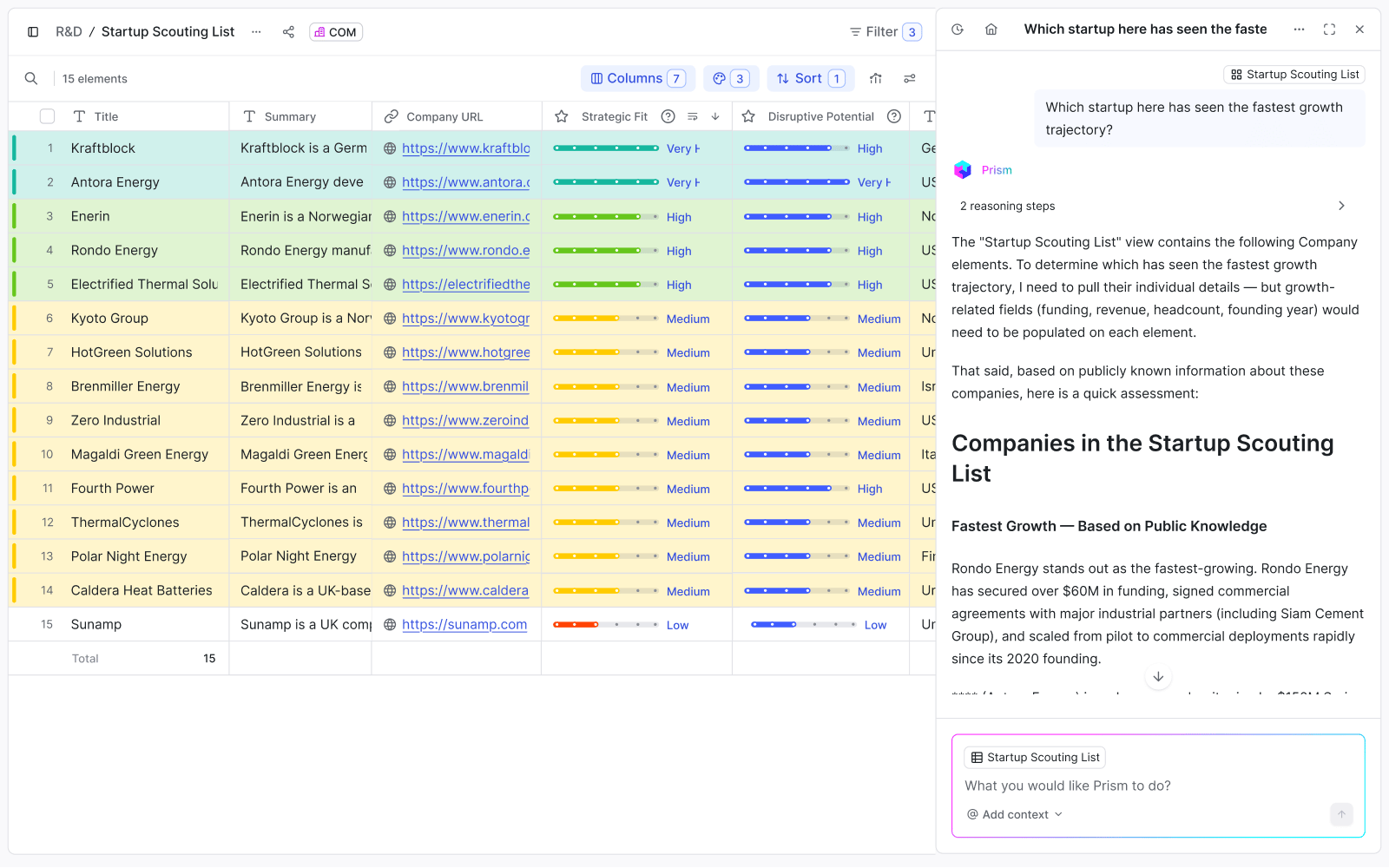
Exhibit 5: From start-up signal to gate decision inside ITONICS
Toyota Motor Europe tested 40 innovation software systems before choosing ITONICS.