Skip to content
Featured image: 3 Strategic Portfolio Management Challenges That Compound (If Unfixed)
Strategy

3 Strategic Portfolio Management Challenges That Compound (If Unfixed)

Enterprise organizations route the majority of their strategic innovation spend through portfolio structures, making portfolio decisions among the most consequential they make. Yet decision velocity drops by half as project portfolios scale past 50 active projects. The slowdown isn't a capacity problem. It's the compounding challenges of oversight, alignment, and governance that create drag.

Strategic portfolio management creates reinforcing loops. Each decision either sharpens the next or makes it harder. The pattern is invisible until the cost becomes obvious. Misalignment between strategic objectives and how resources are deployed accumulates decision by decision until portfolio management no longer serves organizational strategy.

This article maps the negative flywheel that undermines portfolio performance and the counter-flywheel that high-performing organizations deliberately design. The difference determines whether your strategic portfolio compounds clarity or risk.

Why the strategy-execution gap widens as organizations scale

Scale increases interdependence faster than decision capacity. Managing multiple projects requires coordination across functions. Managing project portfolios of 100 or more requires coordination across business processes, geographies, and stakeholders' business objectives. Portfolio governance built for smaller project portfolios creates friction at scale, limiting operational efficiency and business agility. The result is reduced operational efficiency at the moments that matter most.
The gap widens from two forces working together. Portfolio management systems were designed for conditions that no longer exist. Organizational strategy now evolves faster than portfolio management decisions can keep pace. The mismatch between system design and operational reality compounds with every cycle, challenging continuous strategic alignment and informed decisions.

Strategic portfolio management outgrew its original design

Portfolio management emerged to standardize project selection and oversight across program management functions. The model assumed stable strategic goals and predictable resource needs. It worked when business strategy changed annually, and portfolio components stayed within known categories.

Today's environment forces decisions under continuous uncertainty. Market trends shift quarterly. Organizational strategy adapts to competitive moves. Strategic initiatives demand resources before business cases solidify. Governance practices designed for stability now slow organizations that need agility.

The mismatch compounds invisibly as the portfolio manager applies rigorous practices to frameworks that no longer match business needs. Portfolio strategy emphasizes control, while leaders need speed. Organizational governance ensures compliance, while strategic alignment requires flexibility.

When business strategy moves faster than portfolio decisions

Business strategy now evolves continuously. Senior stakeholders adjust project priorities based on emerging data. Key stakeholders shift optimization targets as competitive conditions change. Organization's strategic objectives are clarified through experimentation rather than planning cycles.

Project portfolio management still operates episodically. Governance functions convene quarterly. Processes require completed documentation. Investment decisions wait for scheduled reviews. Each delay between the portfolio plan and execution compounds misalignment.

The cost isn't immediately visible. Individual projects deliver on scope. Teams execute well. Yet the portfolio drifts from strategic vision quarter by quarter. Resources flow to yesterday's priorities while today's opportunities go underfunded. By the time misalignment becomes obvious in business outcomes, it's structural: not a project problem but a system problem. The negative flywheel is already spinning.

The negative flywheel in strategic portfolio management

Three mechanisms reinforce each other. Oversight degrades from a portfolio management decision-making tool to a status tracker. Portfolio alignment shifts from structural to symbolic. Portfolio governance slows as it reacts to accumulating risk.

Each element weakens the others, multiplying dysfunction until business outcomes miss targets.

Weak portfolio oversight erodes decision confidence

When oversight tracks only execution metrics (budget variance, milestone completion, resource utilization), it becomes reporting rather than decision support. Decision confidence requires visibility into uncertainty, not just progress.

Dashboards show project performance but not strategic trade-offs. Portfolio management reporting answers "what happened" but not "what should we do." Leadership requests additional data before deciding, while the portfolio management office spends 70% of its time collecting information and only 30% framing choices. The project manager struggles to explain how their work connects to organizational goals.

PMI research confirms that inadequate oversight directly impacts portfolio performance. Organizations where oversight focuses on activity tracking rather than decision framing report 40% longer decision cycles. Slow decisions erode confidence further, causing leadership to request even more data. The cycle deepens.

Portfolio alignment becomes symbolic, not structural

Portfolio alignment measures how spending follows strategic direction. Symbolic alignment occurs when portfolio components reference strategic goals in documentation, but resources follow different logic: local optimization, political negotiation, or historical precedent.

Strategic initiatives receive verbal support but insufficient resources. Business units pursue conflicting project priorities that each pass individual governance review. Portfolio plans contain projects competing for the same capabilities without forced trade-offs. Annual planning and quarterly reviews operate independently. Resource allocation doesn't shift when organization's strategy changes.

R&D portfolio studies show best-performing innovators generate 38% of revenue from products less than three years old, while average performers generate only 27%. The difference isn't innovation capability. It's whether portfolio management is aligned to business strategy. High performers enforce strategic direction by funding ranked priorities, while average performers simply declare it through planning documents.

Portfolio governance slows as risk accumulates

Portfolio governance defines decision-making authority across project portfolios, ensuring compliance, transparency, and strategic objectives are met while balancing stakeholder interests and managing risk. A reactive governance model waits for problems to accumulate before addressing them. Risk compounds between governance cycles. Each review confronts larger, more complex decisions with higher stakes.

Governance functions run longer but resolve fewer decisions. Portfolio risks get escalated repeatedly without resolution. Business leaders request additional analysis before committing. Processes add review layers and approval gates. Decision authority becomes unclear, and the governance calendar extends as monthly reviews become quarterly and quarterly reviews become biannual.

Organizations with reactive governance report 40% longer decision cycles and 35% higher portfolio risks than those with continuous governance models. The lag compounds problems as projects consume resources while strategic clarity deteriorates.

These three mechanisms form a self-reinforcing loop. Weak oversight reduces decision confidence. Low confidence slows governance. Slow governance allows misalignment. Misalignment hides behind weak oversight. Each rotation degrades portfolio performance further, pulling the portfolio further from organizational strategy.
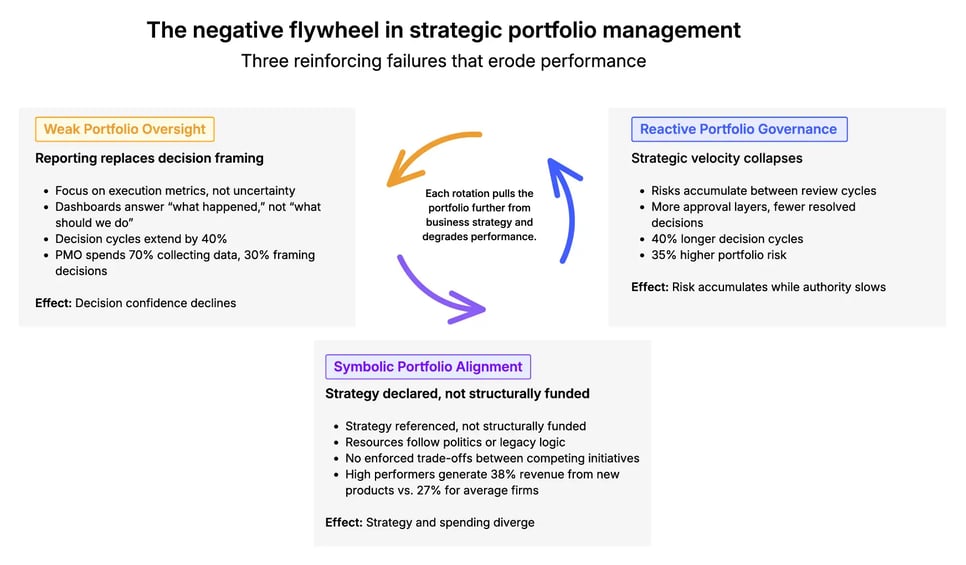
Strategic Portfolio Management Flywheel

Exhibit 1: The negative flywheel in strategic portfolio management, showing how weak oversight, symbolic alignment, and reactive governance reinforce decline.

Why portfolio managers struggle despite their capabilities

The negative flywheel reveals a system problem: the project manager and portfolio manager operate inside governance frameworks that limit authority over the decisions they're accountable for. This isn't a capability gap. It's a design gap with consequences.

Portfolio managers cannot resolve the structural issues that perpetuate the dysfunction, and proactive decision-making weakens as the portfolio management office becomes a reporting layer. The solution isn't more qualified individuals. It's a better system architecture.

The portfolio manager's role can't fix structural blind spots

The portfolio manager's role carries accountability for portfolio performance without decision authority over the trade-offs that determine performance. They see resource conflicts across business units but cannot reallocate without senior stakeholder approval. They identify governance risk from competing initiatives, but cannot resolve the conflict.

Strategic alignment requires business leaders to choose between valid priorities. Improving returns requires authority over business capabilities that span organizational structure. Project governance operates at the portfolio level. Organizational governance happens above it. The portfolio manager sits between these layers without power to connect them.

Portfolio management processes can't see what portfolio governance structures don't reveal. When business units optimize locally, the project manager lacks visibility into strategic conflicts until they manifest as resource shortages or competing roadmaps. When governance slows, portfolio managers escalate the same issues repeatedly without resolution. Senior stakeholders acknowledge the problems but defer decisions to future governance cycles.

Portfolio managers respond by working harder, building more detailed analyses, refining reporting, and creating sophisticated dashboards. Effort increases, but impact doesn't. The governance framework remains unchanged, and the negative flywheel continues spinning.

Research on portfolio management success factors shows that success depends more on people, culture, governance practices, and transformational change in attitudes and processes than on any specific tool or technique. High-performing portfolio managers recognize this and shift focus from compensating for system limits to redesigning the system itself.

The project management office becomes a reporting layer

The portfolio management office standardizes information flow across project portfolios, creating consistent project performance metrics. Portfolio performance reporting becomes reliable, yet decision signal weakens as it moves upward.

Portfolio management processes optimize for data completeness rather than decision clarity. Business leaders receive dashboards showing project execution status across the strategic portfolio. The information answers "what happened" but not "what should we do." Metrics track portfolio processes outputs (on-time delivery, budget variance, scope completion) but don't surface the project priorities conflicts that require strategic guidance.

Portfolio management questions require portfolio-level visibility. Which work should continue given resource constraints? Where do portfolio components duplicate business capabilities? What portfolio risks emerge from dependencies between project portfolios? Individual project status doesn't answer these questions even when aggregated. The project management office collects project data but lacks the authority to interpret strategic implications, leaving every project manager without the context to connect their work to organizational strategic objectives.

The counter-flywheel redesigns how decisions repeat. It distributes authority to match accountability. It surfaces uncertainty when decisions can act on it. It creates forcing functions that maintain alignment automatically. The shift from managing the negative flywheel to building the counter-flywheel starts with recognizing that capable people need capable systems.

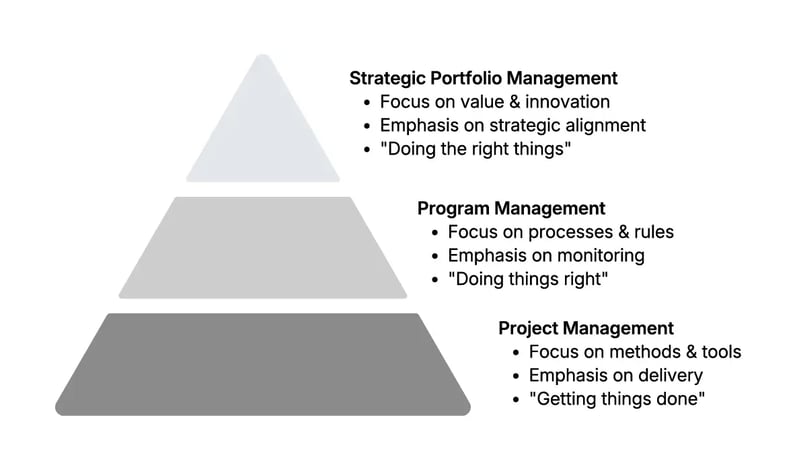
Portfolio Management vs Program Management vs Project Management

Exhibit 2: Hierarchy of project, program, and portfolio management, contrasting delivery, monitoring, and strategic value focus.

The counter-flywheel in strategic portfolio management

High-performing organizations redesign how portfolio management decisions repeat. Visibility shifts from status tracking to decision framing, sharpening judgment. Strategic alignment becomes structural through explicit funding decisions. Portfolio governance operates continuously to prevent risk accumulation. Each decision improves the next one.

Portfolio oversight that sharpens leadership judgment

Decision-ready visibility surfaces the uncertainty leadership must resolve rather than reporting activity that already occurred. Dashboards show where initiatives compete for scarce capabilities. Portfolio management reporting frames trade-offs between valid priorities. Metrics reveal portfolio performance, not just project management outputs.

The shift becomes visible when governance meetings spend 70% of time deciding and 30% reviewing status. Portfolio managers present options with explicit trade-offs rather than requesting approval for recommendations. Business leaders can see which strategic objectives face resource exposure before projects fail. Portfolio risks get quantified in terms of strategic benefits at risk. The organization knows which portfolio components to stop, not just which to continue.

Decision quality compounds through repeated practice. Decisions per meeting increase while decision reversal rates drop. Business leaders build judgment through structured practice with portfolio trade-offs.

Decision-ready visibility feeds forward to continuous portfolio governance. When governance teams receive decision-ready information, they can act frequently without overload. This clarity also reinforces structural alignment. Tracking resource allocation versus the portfolio plan creates natural pressure to align them. Misalignment becomes uncomfortable when it's visible.

Business strategy alignment through resource allocation

Structural alignment enforces business strategy through how portfolio governance processes prioritize and fund work. Resource allocation follows the portfolio strategy and ranked strategic priorities automatically. Portfolio components that don't serve the organization's strategy don't receive funding, regardless of business unit advocacy.

Business leaders can't add projects without identifying what gets deprioritized. Resource management follows a portfolio plan that cascades directly from business strategy. Portfolio governance ensures work that serves business needs but not strategic goals is rejected. Business units coordinate around shared strategic goals because portfolio management processes force resolution of conflicts.

Research confirms organizations with structural alignment mechanisms deliver 50% more strategic benefits from their innovation project portfolios than those relying on governance statements alone. The difference isn't intent. It's forcing functions. High performers design portfolio management processes that make alignment automatic.

Structural alignment feeds back to oversight quality. When resource allocation follows business strategy mechanically, oversight can focus on the quality of strategic direction rather than policing alignment. Structural alignment also reduces governance load. Fewer conflicts require escalation. Governance teams can operate more frequently without creating bottlenecks.

Continuous governance prevents risk accumulation

Continuous portfolio governance reduces portfolio risks incrementally through frequent small corrections rather than periodically through large interventions. Governance functions meet often enough to act on emerging data before decisions harden into locked commitments. Risk management replaces reactive control through incremental steering.
Portfolio governance ensures reviews occur monthly or more frequently. Portfolio risks get addressed within 30 days of identification. Investment decisions remain reversible. Business leaders reallocate resources between portfolio components based on evidence from execution. Decision authority is distributed to the lowest level that can act with strategic coherence.

Organizations that shift from annual planning to monthly portfolio reviews increase portfolio churn, indicating learning rather than instability. Projects showing weak market fit get stopped early rather than continuing through budget cycles. Resources shift to validated opportunities faster.
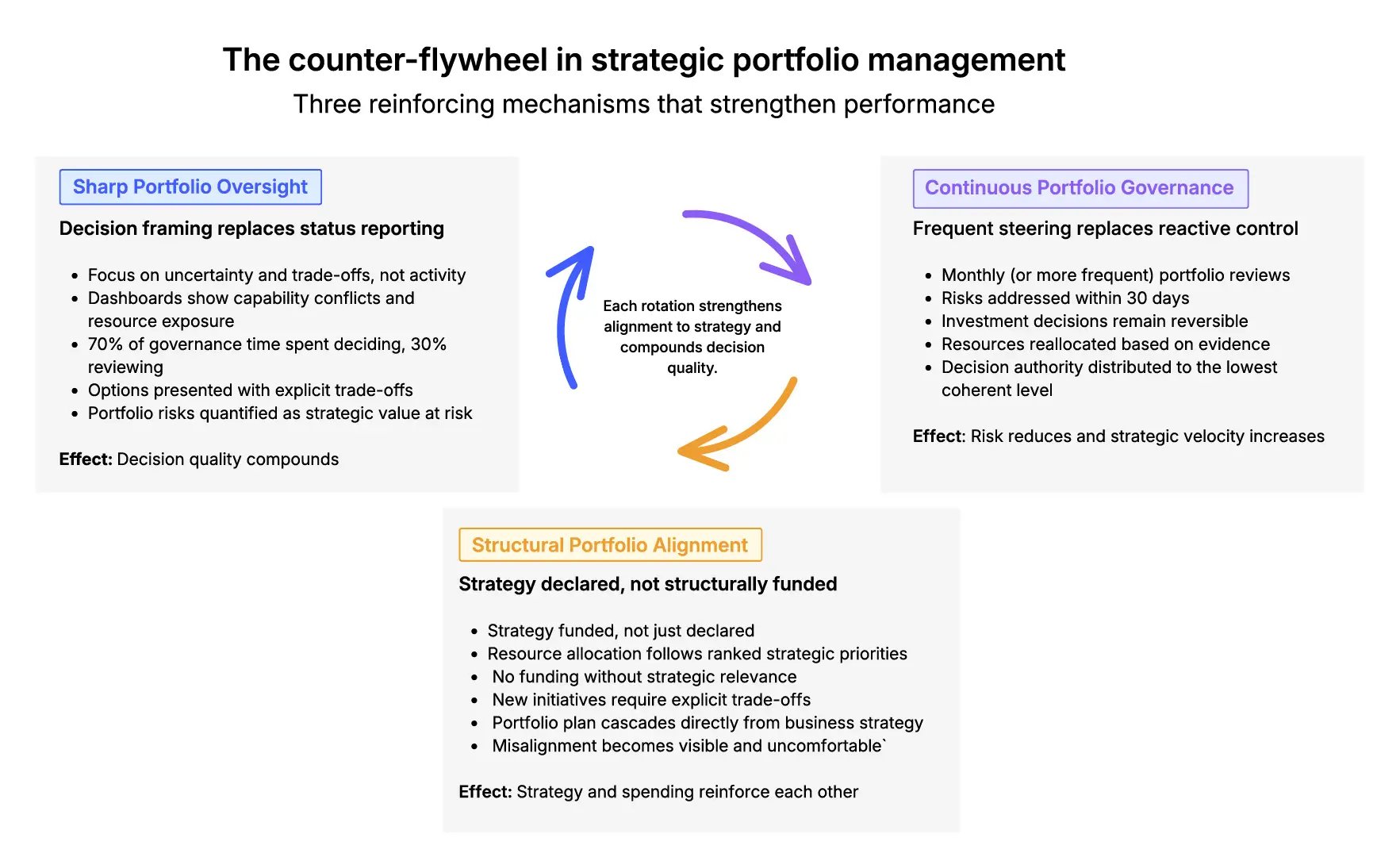
Continuous portfolio governance also enables sharp oversight. Frequent governance cycles can consume detailed uncertainty analysis, and oversight evolves to provide it. Continuous portfolio governance also sustains structural alignment through small course corrections that prevent drift from the strategic plan.

These three mechanisms form a self-reinforcing loop. Sharp oversight improves governance decisions. Good portfolio governance sustains structural alignment. Structural alignment simplifies oversight. Each rotation strengthens portfolio performance. Strategic portfolio management becomes the mechanism that translates organization's strategic objectives into business value. This is what an effective portfolio strategy looks like in practice.

Strategic Portfolio Management Counter-Flywheel

Exhibit 3: The counter-flywheel showing how sharp oversight, structural alignment, and continuous governance compound strategic performance.

What changes when the counter-flywheel starts working

Three shifts become visible. Financial management shifts from capital lock-in to evidence-based learning. Metrics reflect portfolio performance rather than just project management outputs. Portfolio governance framework enables speed without sacrificing control.

Financial management shifts from lock-in to learning

Traditional portfolio governance locks capital into annual budgets and project approvals. Shifting resources requires governance escalation and business case revision. Investment decisions happen episodically based on projections that age as portfolio projects execute. Sunk cost thinking dominates. Projects continue because they started, not because they remain aligned to business strategy.

High-performing organizations design financial management for learning. Capital follows evidence from project portfolios rather than initial projections. Portfolio governance processes enable resource reallocation as strategic benefits clarify or organizational goals shift. Decisions remain reversible when governance cycles meet frequently enough to act on emerging data.

Organizations that master this transition monitor:

  • Capital velocity: Time from investment decision to evidence generation, targeting under 90 days for exploration projects
  • Reallocation rate: Percentage of portfolio budget redistributed quarterly, with high performers at 25-35%
  • Evidence lag: Time between strategic signal and portfolio response, targeting under 45 days
  • Failure cost efficiency: Average investment before stopping non-performing projects, with high performers stopping at less than 40% of originally projected spend
  • Learning cycles: Number of plan-execute-learn cycles per project per year, with high performers at 4 or more

Focus on portfolio learning velocity, not just project ROI. How fast does the organization identify what works? How quickly does it shift resources toward validated opportunities?

Metrics that reflect portfolio health

Key performance indicators in most organizations measure project management outputs: on-time delivery, budget variance, scope completion. These metrics track individual projects but don't signal portfolio performance at scale.

Portfolio health metrics show balance and risk exposure across portfolio components. What percentage of resources align to top business objectives? How concentrated is risk across project portfolios? What's the ratio of exploratory initiatives to optimization work?

Organizations that redesign portfolio management around strategic health track:

  • Strategic alignment index: Resources flowing to top-three strategic priorities, targeting >75%
  • Portfolio balance: Distribution across innovation horizons (core 60-70%, adjacent 20-30%, transformational 10-15%)
  • Risk exposure: Maximum portfolio value dependent on single assumption, targeting <30%
  • Capability coverage: Strategic goals with adequate resources allocated, targeting 100% of tier-1 goals
  • Decision throughput: Average time from issue identification to resolution, with high performers under 30 days
  • Benefits realization rate: Percentage of projected strategic benefits actually delivered, with high performers above 70%

Portfolio management KPIs should trigger governance action, not document history. Track leading indicators: resource alignment to business strategy predicts future value delivery, risk concentration predicts failure clustering, and capability coverage predicts strategic objectives achievement. Pair each metric with a decision threshold. When alignment drops below 75%, governance convenes to rebalance. Metrics drive steering.

Governance structure supports speed without control loss

High-performing governance structures distribute decision rights to match decision types. Business strategy direction stays centralized. Funding within strategic boundaries gets delegated. Operational trade-offs move to portfolio managers. Decision authority aligns with decision frequency and information availability.

Effective portfolio governance reveals itself through:

  • Decision cycle time: Days from issue identification to resolution by decision type (strategic under 30 days, portfolio under 14 days, operational under 7 days)
  • Escalation rate: Percentage of decisions requiring next-level approval, targeting <20% of portfolio management decisions escalating to executive level
  • Decision reversal rate: Percentage of decisions revisited within 90 days, with high performers under 15%
  • Governance efficiency: Decisions per governance hour, targeting >4 meaningful decisions per executive hour
  • Authority clarity: Percentage of decision scenarios with pre-agreed ownership, targeting >90%

Portfolio governance structure effectiveness shows in decision quality and velocity together. Fast, bad decisions destroy value. Slow, good decisions miss opportunities. High-performing organizations achieve less than 15% reversal rate and less than 14-day cycle time for portfolio management decisions.

More than 80% of executives believe that effective portfolio management strategy is critical for long-term business success. Yet organizations with reactive governance report 35% higher portfolio risks. The difference is how governance is designed. Structure determines what compounds.

The SPM Flywheel

Exhibit 4: Observable shifts in finance, metrics, and governance as the positive portfolio flywheel begins to compound performance.

Where to start reversing the flywheel

Implementation begins with diagnostic honesty. Choose one reinforcing loop to interrupt, prove the intervention works, then scale the new behavior. Momentum builds through designed repetition, not comprehensive overhaul.

Diagnose which flywheel is currently compounding

How long does it take to reallocate resources when priorities shift? How many governance cycles occur between identifying portfolio risks and resolving them? The gap between business strategy and portfolio response reveals whether the system compounds clarity or delay.

Measure where decision visibility creates delay versus clarity. Do governance functions spend more time reviewing project management status or framing strategic trade-offs? If dashboards show execution metrics but governance still defers decisions, oversight is compounding the wrong signal.

Assess whether portfolio governance is reacting or steering. Reactive governance sees rising portfolio risks and adds review layers. It postpones decisions to gather more data. Steering governance reduces risk management load incrementally through frequent small corrections. Organizations stuck in reactive mode show accumulating governance risk despite increasing governance effort.

Locate the dominant loop. Projects deliver on scope but strategic benefits lag. Business units optimize locally while business strategy demands coordination. Portfolio managers escalate the same resource conflicts repeatedly without resolution. Choose oversight as the intervention point. Improving decision visibility feeds better information to governance functions and reveals hidden misalignment.

Interrupt the negative loop at its weakest point

Start with visibility before changing how decisions are governed. Most organizations can improve decision clarity faster than they can redesign the portfolio governance management plan and underlying processes.

Redesign oversight around strategic alignment visibility. New dashboards show: (1) funding against each strategic goal versus the strategic plan, (2) portfolio components that don't serve top-tier business objectives, (3) resource conflicts where projects compete for the same capabilities.

Make implicit trade-offs explicit in a single high-stakes area. Choose one priority that matters enough to force difficult choices. Require business leaders to rank portfolio components against it. Use the ranking to drive resource management decisions. The forcing function proves that structural alignment is possible before expanding to other areas.

Build evidence before scaling. Run one portfolio governance cycle with the new approach. Measure whether decision velocity improved. Track whether portfolio risks reduced. Document whether resource allocation matched business strategy more closely than before. Let results convince key stakeholders that the counter-flywheel design works.

Design the first positive repetition

Choose one portfolio governance review to redesign completely. Create a parallel version focused on one strategic objective. Strip out status reporting. Frame the agenda around decisions that need resolution.

Shift from status reporting to decision framing. Instead of showing percentage complete across project portfolios, show strategic benefits at risk from resource constraints. Instead of listing project milestones, surface portfolio priorities and project priorities that require senior stakeholder guidance.

Portfolio managers present three views: (1) strategic benefits by project with resource sufficiency indicator, (2) capability conflicts showing which projects compete for the same resources, (3) decision options with explicit trade-offs.

Establish a single forcing function for resource allocation tied to organizational goals. Business leaders can't add projects without identifying what gets deprioritized. Capital efficiency follows ranked business strategy priorities rather than available budget. The constraint creates designed repetition of strategic alignment.

Let the new pattern prove itself before expanding. One governance cycle becomes three. Three becomes six. Each repetition strengthens organizational capability to make portfolio management decisions this way. Portfolio managers gain confidence. Business leaders build judgment. The counter-flywheel starts with designed consistency. It scales through demonstrated value.

The counter-flywheel is running. Each portfolio governance cycle strengthens the next. Oversight reveals trade-offs. Governance resolves them. Resolution maintains alignment. Alignment simplifies oversight. The system compounds clarity instead of risk.

Strategic portfolio management determines what compounds. Organizations repeat portfolio management decisions hundreds of times annually. Those decisions either sharpen each other or create friction. The difference isn't intent. It's system design.

ITONICS provides the portfolio governance technology that enables the counter-flywheel. Our platform gives business leaders decision-ready visibility into portfolio risks, strategic alignment, and resource optimization. We help organizations shift from reporting what happened to framing what matters. When portfolio governance needs to compound clarity instead of delay, the system itself has to change.

FAQs about Strategic Portfolio Management Challenges

What is strategic portfolio management and why does it matter?

Strategic portfolio management is the process of selecting, prioritizing, and governing a collection of projects and initiatives to deliver on organizational strategy. It connects investment decisions to strategic objectives so that resources flow to the work that matters most, not just the work that is easiest to justify internally.

Without it, business units optimize locally, project priorities drift from strategic goals, and portfolio governance becomes a compliance exercise rather than a decision-making tool. The result is a portfolio that looks active but compounds misalignment instead of business value. At scale, that misalignment becomes structural, and the gap between organizational strategy and execution widens with every planning cycle.

What are the most common strategic portfolio management challenges?

The three challenges that compound most consistently are weak portfolio oversight, symbolic rather than structural portfolio alignment, and reactive portfolio governance. Each reinforces the others. Oversight that tracks activity rather than decisions slows governance. Slow governance allows misalignment to accumulate. Misalignment hides behind dashboards that show project progress but not strategic trade-offs.

Organizations often treat these as separate problems and address them independently. They are not separate. They form a self-reinforcing loop that degrades portfolio performance with every governance cycle. By the time the dysfunction becomes visible in business outcomes, it is already structural, and no amount of individual effort by the portfolio manager can resolve it without redesigning the system itself.

How does portfolio governance affect strategic alignment?

Portfolio governance defines how investment decisions get made and who has the authority to make them. When governance operates reactively, portfolio risks accumulate between review cycles and resource allocation drifts from organizational strategy. Strategic alignment becomes a statement in a planning document rather than an operational reality that the portfolio plan enforces.

Continuous portfolio governance prevents this by creating frequent, small course corrections instead of large, high-stakes interventions. When governance cycles are short enough to act on emerging data, the portfolio stays connected to business strategy. Organizations that shift from quarterly reviews to monthly governance cycles see measurable improvements in strategic benefits realization and decision velocity.

What is the difference between portfolio alignment and project management?

Project management focuses on delivering individual projects on time, on budget, and on scope. Portfolio alignment focuses on whether the right projects are being funded in the first place. A portfolio can achieve strong project execution metrics while drifting entirely from organizational strategy. These are different problems that require different visibility.

The portfolio manager's role is to surface that gap before it becomes costly. This requires portfolio-level visibility into how resource allocation maps to strategic priorities, not just whether individual projects are hitting milestones. When that visibility is missing, business units optimize locally and portfolio alignment remains symbolic rather than something the governance structure actually enforces.

How do high-performing organizations improve portfolio governance?

High performers redesign portfolio governance around decision velocity rather than reporting completeness. They shift governance meetings from status reviews to structured trade-off decisions, where portfolio managers present options with explicit consequences rather than summaries of what already happened. Portfolio risks get resolved within 30 days of identification rather than deferred to the next quarterly cycle.

They also distribute decision authority to match decision type. Strategic portfolio direction stays centralized while operational trade-offs move to the portfolio manager. This reduces escalation rates and shortens decision cycle times. The portfolio management office shifts from a reporting layer to a decision-enabling function, and governance structure starts compounding clarity instead of delay.