The CPG playbook that worked for decades - incremental innovation, predictable cycles, stage-gate rigor - now guarantees irrelevance. Consumer preferences shift in months while product development crawls through years, and the gap between market signal and shelf presence has become a competitive chasm.
The companies winning today are rewriting the old model around seven core principles: they validate rapidly through iterative market testing, manage innovation as balanced portfolios across risk horizons, build open networks to compress R&D cycles, deploy AI for pattern recognition while humans drive strategy, test in regional clusters before scaling nationally, match business models to product ambition, and leverage social proof over traditional advertising. Each principle is supported by practical frameworks you can implement immediately.
This article breaks down where traditional CPG innovation fractures under modern market pressure, examines the specific challenges CPG companies face in consumer insight management and process design, and provides a concrete playbook - with tools and examples - for how leading companies accelerate time to market while maintaining strategic discipline.
Why CPG product innovation has become an innovation imperative
The CPG industry is experiencing compression on all sides. Consumer preferences shift faster than product cycles can accommodate, and market saturation turns every shelf into a battleground where incremental tweaks no longer justify premium positioning.
For most CPG companies, the question is whether they can innovate fast enough to stay relevant.
Structural pressure from consumer demand and market saturation
Consumer demand fragments across micro-segments while private label brands close the quality gap at competitive prices. What used to be a stable category now resembles a high-stakes auction where brand loyalty erodes with every mediocre product launch.
CPG brands face a dual threat: Challenger brands enter with lower barriers to scale, testing innovative products through direct-to-consumer channels that bypass traditional retail gatekeepers. Take the example of Olipop: founded in 2018 with just $100,000, the prebiotic soda brand now operates in 50,000 stores and achieved $400 million in revenue by 2024, with a valuation of $1.85 billion. Or consider the brand Poppi, which went from a Shark Tank pitch in 2018 to a $1.95 billion acquisition by PepsiCo in 2025, reaching $500 million in annual sales along the way.
Meanwhile, private label products have shed their budget reputation, offering comparable quality that makes premium pricing harder to defend. The result? Shrinking market share for established players who can't demonstrate clear differentiation.
Market saturation compounds the problem. In categories where shelf space is finite and consumer attention is fractured, launching another range extension won't move the needle. Companies need disruptive innovation that redefines consumer expectations. Thus, the CPG sector has entered an era where first-mover advantage matters more than brand heritage.
Why incremental innovation no longer protects CPG brands
Incremental innovation used to be the safe bet. Optimize formulations, refresh packaging, and extend proven product lines. It kept existing customers satisfied while minimizing risk. But in the past few years, incremental moves have become a liability disguised as prudence.
The issue is velocity. While established CPG brands iterate cautiously through stage-gate processes, smaller brands launch, learn, and iterate in half the time. They use rapid prototyping and data-driven approaches to test product concepts in real market conditions. By the time a legacy player approves a minor formula tweak, a challenger has validated three new products and captured emerging consumer segments.
PepsiCo learned this lesson directly: The company initially planned to launch its own better-for-you soda called Soulboost but killed the project after determining it wouldn't succeed against Poppi and Olipop. Despite PepsiCo's massive R&D budget and distribution network, they concluded it was faster to acquire the competition than to develop and launch their own challenger. That's the velocity problem in sharp relief.
Incremental innovation also misreads the competitive landscape. Consumers don't compare your new variant to your old one, but they compare it to the most innovative products across categories. A slightly improved laundry detergent competes for attention against subscription models, refill stations, and brands built entirely around sustainability narratives. Incremental gains are invisible when competitors rewrite category rules.
There's also an opportunity cost. Resources spent perfecting minor improvements could fund exploratory bets on disruptive models. Innovation portfolios tilted toward incremental projects deliver predictable mediocrity. They protect existing market position in the short term while surrendering the competitive edge needed for the near future. The brands winning today took calculated risks on unmet needs that incumbents ignored.
The strategic cost of slow innovation cycles in the CPG industry
Time to market is a strategic weapon. In the CPG industry, where consumer trends evolve in months and cultural shifts reshape categories overnight, slow innovation cycles cost more than delayed revenue. They cost market intelligence, competitive positioning, and the ability to shape rather than follow demand.
But slow cycles also destroy learning velocity. Companies that launch quickly generate real purchasing data and market signals that inform the next iteration. Those locked in prolonged development cycles rely on pre-launch research that becomes stale before products hit shelves. They miss the feedback loop that turns innovation into a repeatable capability. Speed compounds: fast innovators get smarter faster, while slow movers fall further behind with each cycle.
The strategic cost extends beyond individual product launches. Slow innovation cycles allow challenger brands and private label competitors to define new spaces before incumbents arrive. They cede first mover advantage in emerging trends, forcing established CPG companies into reactive positions where they're perpetually catching up. In categories driven by novelty and relevance, arriving late means arriving irrelevant - regardless of R&D investment or brand equity.
The consumer insight challenge: From data overload to decision clarity
Consumer trends arrive as noise before they become a signal. For CPG companies, the challenge is knowing which insights justify resource allocation and which are distractions dressed as opportunities. With the evolving consumer constantly shifting preferences and expectations, understanding these changes is critical for driving effective CPG product innovation.
Most companies drown in consumer insights while starving for decision clarity.
Why most CPG companies struggle with consumer insights
Market research generates more data than most innovation teams can process. Social listening tools surface thousands of consumer behavior patterns daily, retail analytics track shifting purchasing data across channels, and trend reports proliferate from consultancies, each declaring the next big thing. The result without frameworks? Analysis paralysis disguised as diligence.
More insights produce scattered attention and resource fragmentation instead of better results. When every trend report, ethnographic study, and retail analytics dashboard feels urgent, innovation teams attempt to pursue everything simultaneously. The result is portfolio incoherence: products aimed at contradictory consumer segments, launched without sufficient support, each representing a diluted bet.
Insight overload stems from treating all consumer data as equally strategic. A new flavor preference emerging in Gen Z carries different implications than a fundamental shift in how consumers evaluate brand trust. Without clear prioritization logic, companies spread innovation budgets across dozens of projects, none funded adequately to achieve breakthrough impact.
The translation gap compounds the problem: Raw consumer insights are inert until translated into innovation mandates. A focus group expressing frustration with packaging waste doesn't automatically yield a product roadmap. The gap between "consumers want sustainability" and "launch a refillable format in Q2" is where most innovation stalls.
How leading CPG companies turn insights into action
The difference between reactive trend-chasing and strategic innovation lies in how rigorously you filter, validate, and operationalize what consumers are actually telling you. Leading CPG companies apply three disciplines:
Signal separation through structured frameworks. They distinguish between fads, emerging trends, and structural shifts by asking three questions: Is this behavior change observable across multiple data points? Does it align with deeper cultural shifts or economic realities? Can we trace a plausible path from early adoption to mainstream relevance?
Unilever's People Data Centre operates in 27 languages across 30 global centers, processing consumer insights in real-time. This scale enables pattern recognition across markets - identifying whether a trend emerging in one region represents noise or a signal worth amplifying globally.
When they tracked the viral #VaselineHacks hashtag, which garnered 3.5 million organic posts from Gen Z consumers sharing creative uses for Vaseline, they recognized it as a signal about product versatility and launched the Dove x Crumbl collaboration, which became a top-performing launch by responding to cultural moments in real-time.
Signal looks like durable insight that enables multiple product concepts, not single-use inspiration. Market intelligence teams that separate signal from noise operate more like intelligence analysts than researchers. They triangulate qualitative insights with quantitative behavior. They test whether stated preferences match actual purchasing patterns. They distinguish between what consumers say they want and what they consistently choose when faced with real tradeoffs at the shelf.
Translation into decision-ready specifications. Decision-ready input requires specificity. Vague insights like "consumers seek convenience" or "wellness is trending" are analytically true and strategically useless. Useful insights answer: Which consumer segments demonstrate this preference through behavior, not just surveys? What job are they hiring products to do? What would they sacrifice for this benefit - price, performance, availability?
The innovation process benefits from structuring insights around these dimensions: magnitude (how many consumers care deeply), momentum (is this growing or plateauing), and monetization (will they pay a premium or expect parity pricing). An insight scoring high on all three becomes a strategic imperative. One scoring high on momentum but low on monetization might warrant exploratory bets, not portfolio transformation. This triage prevents CPG brands from treating all insights as equally actionable.
Unilever's DataLab exemplifies this translation capability. Using Microsoft's Azure Quantum Elements, they can simulate millions of molecular combinations in silico before physical prototyping. When developing the Knorr Zero Salt Cube, AI modeled countless ingredient combinations to replicate salt's flavor and texture profile.
For Hellmann's Vegan mayonnaise, predictive models tested consumer liking across plant-based protein alternatives, compressing months of reformulation work into weeks. Decision-ready input is pre-translated for each stakeholder, with tradeoffs and dependencies made explicit upfront.
Deliberate curation discipline. Leading CPG companies implement insight quotas - deliberate constraints on how many strategic themes guide innovation at any time. Three to five core consumer tensions become the lens through which all opportunities get evaluated. An emerging trend that doesn't connect to one of your declared strategic themes either displaces an existing priority or waits.
Companies that excel here build what amounts to an insight-to-brief factory: standardized templates, rapid validation protocols, and clear accountability for translating research into innovation guardrails. They compress weeks of ambiguous interpretation into days of focused execution.
Artificial intelligence tools promise to help filter and prioritize, but they inherit the biases of their training. AI can surface patterns across vast datasets, but it can't tell you which patterns align with your strategic positioning or organizational capabilities. Unilever has deployed over 500 AI projects across its business, but human judgment still determines which AI-surfaced patterns warrant resource commitment.
Where the innovation process breaks inside CPG companies
The failure points in CPG innovation rarely appear on project post-mortems. They're embedded in org charts, incentive structures, and process design inherited from an era when predictability mattered more than speed.
Most CPG companies know their innovation process is slow. But only a few recognize that the process itself, and not the people executing it, is the constraint.
Handovers, gates, and incentives as hidden bottlenecks
Every handover between functions is a translation error waiting to happen. Consumer insights pass from research to marketing, marketing briefs innovation teams, innovation specifies for supply chain, and supply chain negotiates with procurement. Each transition introduces delay, ambiguity, and the risk that strategic intent gets diluted into tactical compromise.
1. Gates compounds the problem. Stage-gate models were designed to kill bad ideas early and allocate resources to winners. In practice, they've become risk mitigation theater. Each gate requires documentation, approvals, and presentations that consume weeks of calendar time but add minimal learning.
2. Incentives complete the dysfunction. When success metrics misalign across functions, every project becomes a negotiation where compromise erodes differentiation. Innovation teams get measured on technical feasibility and cost targets, not market impact. Marketing optimizes for launch volume and first-year sales, not long-term brand building or category creation.
3. The most insidious bottleneck is risk aversion masquerading as rigor. Innovation processes designed to prevent failure also prevent breakthrough success. Disruptive innovation - the kind that creates new consumer segments or business models - requires different evaluation logic, separate funding pools, and tolerance for learning through market experimentation rather than conference room validation.
CPG companies that recognize these hidden bottlenecks redesign around different principles:
-
small cross-functional teams with decision authority,
-
rapid iteration cycles that prioritize market learning over gate approvals, and
-
success metrics that reward speed to insight.
The goal is to remove the illusion that process rigor substitutes for market judgment.
Why linear stage-gate models fail under volatility
The CPG industry now operates in an environment where market trends pivot faster than linear processes can adapt. Stage-gate processes assume stability of consumer preferences, predictable competitive dynamics, and stable supply chain parameters. These assumptions held when innovation cycles matched market stability, but they collapse under current volatility.
Imagine the following scenario: A product concept validated through consumer research in Q1 may face a transformed competitive landscape by Q4 launch. New regulations can obsolete formulations mid-development. Raw materials supply disruptions can force reformulation after packaging is printed.
This rigidity shows up most clearly in how stage-gate treats learning: The model assumes each stage reveals information that allows the next stage to proceed with higher confidence. In reality, the most valuable learning often comes from market exposure, like actual consumer reactions, retailer feedback, and competitive responses.
Volatility also exposes another flaw: stage-gate optimizes for resource efficiency at the cost of learning efficiency. The process minimizes "waste" by killing projects before full development. Companies need innovation cycles that test more concepts with less investment per test, learning through market signals rather than extended internal analysis.
Seven principles for accelerating CPG product innovation
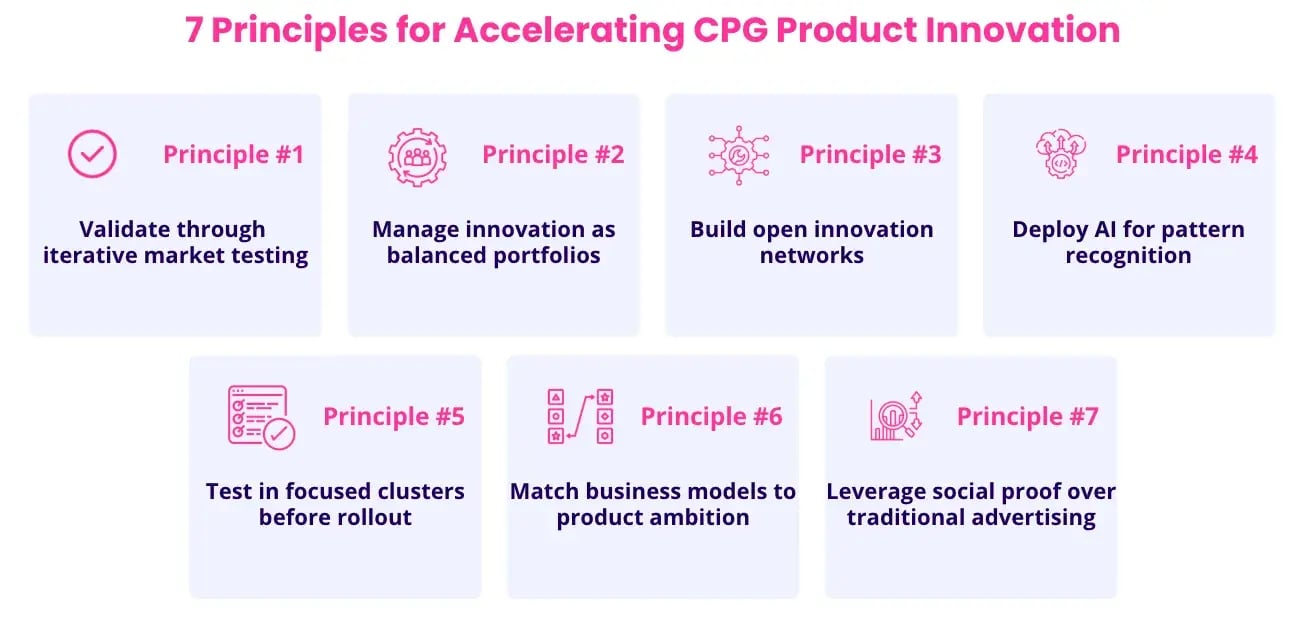
The companies redefining CPG innovation speed have rewritten the playbook around seven core principles (Exhibit 1). These are operational disciplines backed by real company examples and supported by practical frameworks you can implement.

Exhibit 1: Seven principles for accelerating CPG product innovation
Each principle includes the strategic logic, a company example, and a specific tool or framework to apply it in your organization.
Principle 1: Validate rapidly through iterative market testing
Traditional CPG thinking demands exhaustive pre-launch validation through research, focus groups, and internal reviews before market exposure. Market leaders flip this logic: they validate more frequently but at lower cost per iteration, using real market feedback to guide refinement. This is validating smarter through rapid iteration cycles that generate learning velocity.
Company example
Olipop launched in just 40 stores in Northern California in 2019, using actual sales data to refine formulations and identify which flavors resonated.
Each store functioned as a live testing ground, generating purchasing data that informed the next iteration.
By 2024, they operated in 50,000 stores with $400 million in revenue. The key was compressing validation cycles through market exposure that generated learning competitors couldn't match.
Practical framework
The 3-Horizon Validation Model
Structure your validation approach across three time horizons, with different methods and investment levels for each:
- Horizon 1 (Weeks 1-4): Concept validation – Test core value proposition through digital surveys, social media polls, and small focus groups. Investment: <$10K. Decision gate: Does this solve a real problem for a defined segment?
- Horizon 2 (Weeks 5-12): Market validation – Launch in 10-50 locations (physical or digital). Track actual purchase behavior, repeat rates, and price sensitivity. Investment: $50K-$200K. Decision gate: Do consumers buy repeatedly at target pricing?
- Horizon 3 (Weeks 13-26): Scale validation – Expand to 500-2,000 locations across 2-3 geographic clusters. Validate supply chain, retailer relationships, and unit economics. Investment: $500K-$2M. Decision gate: Can we deliver profitably at scale?
Each horizon generates data that informs the next. Failed concepts get killed quickly and cheaply. Promising ones advance with real market evidence, not internal assumptions. The entire cycle - from concept to scale decision - completes in six months instead of eighteen.
Principle 2: Manage innovation as balanced portfolios, not linear pipelines
Pipelines assume linearity: ideas enter, stages advance, products exit. Portfolios acknowledge reality: innovation requires simultaneous bets across horizons, risk levels, and strategic objectives. Leading CPG companies have abandoned the fiction that all innovation projects should be evaluated against identical criteria. Instead, they deliberately balance three portfolio layers.
Company example
Unilever's Health & Wellbeing division exemplifies portfolio discipline - generating $2 billion in revenue with 20% growth by acquiring wellness brands that sit adjacent to their core categories but reach new consumer segments.
Simultaneously, they invest in biotech firms developing sustainable ingredients (transformational layer) while optimizing existing product lines (core layer).
Each layer operates under different governance, different success metrics, and different resource allocation models.
Practical framework
The 70-20-10 Allocation Rule
Apply this resource allocation model across your innovation portfolio:
- 70% to Core Innovation – Extending existing product lines, optimizing formulations, refreshing packaging. Evaluated on: margin improvement, volume growth, market share defense. Timeline: 6-12 months. Success rate target: 70-80%.
- 20% to Adjacent Innovation – New consumer segments, channels, or category spaces within reach of current capabilities. Evaluated on: market validation milestones, consumer adoption curves, capability building. Timeline: 12-24 months. Success rate target: 40-50%.
- 10% to Transformational Innovation – Disruptive business models, new category creation, fundamentally different value propositions. Evaluated on: strategic learning, option value, whether they generate insights even if they fail commercially. Timeline: 24-60 months. Success rate target: 10-20%.
Implementation guide
- Audit current portfolio: Calculate actual resource distribution across these three layers
- Identify misalignment: Most companies discover 90%+ resources flow to core innovation
- Reallocate deliberately: Move 20-30% of resources to adjacent and transformational bets over 12 months
- Differentiate governance: Create separate approval processes, success metrics, and review cadences for each layer
- Protect transformational budget: Ring-fence 10% allocation from quarterly pressure to reallocate to "safer" bets
The discipline lies in maintaining balance: Companies that drift entirely into core innovation lose growth. Those that over-rotate to transformation starve near-term performance. The right portfolio composition depends on market position and category maturity, but the principle holds: deliberate allocation across risk profiles, ruthless transparency about which layer each project occupies, and differentiated success metrics that match innovation type to evaluation logic.
Principle 3: Build open innovation networks to compress R&D cycles
Internal R&D capabilities matter, but exclusive reliance on them creates speed bottlenecks and capability gaps. Leaders augment internal teams with external innovation networks - startups, universities, technology partners - that bring specialized capabilities without fixed overhead. This is orchestrating a broader innovation ecosystem.
Company example
Unilever's Foundry platform has launched over 400 pilots and invested in 170+ startups, creating a direct pipeline to emerging technologies and consumer trends.
This open innovation model reduces time-to-market by up to 40% compared to traditional R&D.
When Unilever needed sustainable ingredients, partnering with biotech startups delivered solutions faster than building in-house capabilities. When they needed AI-powered consumer insights, collaborating with Microsoft provided capabilities that would have taken years to develop internally.
Practical framework
The Innovation Partnership Playbook
Build your external innovation network across four partnership types:
1. Technology Scouts (Continuous scanning)
- What: Dedicated team monitoring 50-100 startups, technology platforms, and research institutions in your category
- How: Monthly touchpoints, quarterly deep dives, annual partnership summits
- Investment: 1-2 FTEs, $200K-$500K annual budget
- Output: Pipeline of 10-15 partnership opportunities per year
2. Pilot Partnerships (Fast validation)
- What: 90-day pilots with 3-5 external partners annually to test specific capabilities
- How: Clear success criteria, dedicated internal champion, ring-fenced budget
- Investment: $50K-$200K per pilot
- Output: 1-2 partnerships that advance to scale per year
3. Strategic Alliances (Capability building)
- What: Multi-year partnerships with technology platforms (Microsoft, NVIDIA) or ingredient suppliers
- How: Joint development roadmaps, shared IP agreements, cross-functional working teams
- Investment: $1M-$5M annually
- Output: Proprietary capabilities that create competitive advantage
4. Acquisition Pipeline (Market access)
- What: Tracking 20-30 high-growth brands for potential acquisition
- How: Maintain relationships, provide retail/distribution support, option agreements
- Investment: Variable, based on acquisition opportunities
- Output: 1-2 acquisitions every 3-5 years that bring new categories or business models
Key implementation guideline
Open innovation works when you're clear about what you're buying: speed, specialized expertise, or market-tested products.
It fails when you expect external partners to replace internal strategic judgment or when integration planning starts after the deal closes rather than before.
Principle 4: Deploy AI for pattern recognition, reserve strategy for humans
AI's value is eliminating bottlenecks in data processing, simulation, and scenario modeling that slow decisions. The highest-performing organizations use AI to compress analysis cycles from weeks to hours, freeing strategic talent to focus on choices AI can't make: where to compete, which consumer tensions to address, and what tradeoffs to accept.
Company example
Unilever deployed over 500 AI applications across R&D, supply chain, and marketing. When developing Knorr Zero Salt Cube, AI modeled millions of ingredient combinations, identifying viable alternatives in weeks instead of months.
But humans still decided which formulations aligned with brand positioning and consumer expectations. Using digital twin technology with NVIDIA's Omniverse platform, Unilever reduced content creation costs by 87% by generating marketing assets from a single master file rather than conducting separate photoshoots.
Through its 100+ Accelerator partnership, Unilever piloted AI-powered cleaning optimization at its Poland foods factory, cutting utility use by 10%, reducing machine cleaning times by 20%, and saving €100,000 annually.
Practical framework
The AI Decision Stack
Map your innovation process to identify where AI creates value vs. where human judgment is irreplaceable:
Layer 1: AI-Accelerated Tasks (Automate fully)
- Ingredient combination screening against regulatory constraints
- Packaging design variant generation
- Consumer review sentiment analysis across thousands of data points
- Supply chain scenario modeling across dozens of variables
- Competitive price monitoring across channels and geographies
- Time savings: 70-90% reduction in analysis time
- Investment: SaaS platforms, $50K-$200K annually
Layer 2: AI-Augmented Decisions (Human + AI collaboration)
- Consumer trend identification (AI surfaces patterns, humans determine strategic relevance)
- Formulation optimization (AI models combinations, humans select based on brand fit)
- Market sizing (AI processes data, humans interpret implications)
- Portfolio prioritization (AI models outcomes, humans weigh strategic tradeoffs)
- Time savings: 40-60% reduction in decision cycles
- Investment: Custom models + platforms, $200K-$1M annually
Layer 3: Human-Driven Choices (AI provides inputs only)
- Which consumer segments to target
- Brand positioning and value proposition
- Business model selection
- Strategic partnership decisions
- Portfolio allocation across risk horizons
- AI role: Provides analyzed data, not recommendations
- Investment: Executive time, supported by Layer 1 and 2 tools
Implementation checklist
- Audit current innovation process: identify bottleneck tasks consuming >5 hours/week
- Categorize each task into Layer 1, 2, or 3
- Pilot AI tools on 2-3 Layer 1 tasks first (highest ROI, lowest risk)
- Expand to Layer 2 after demonstrating 50%+ time savings on Layer 1
- Train teams on how to interpret AI outputs and when to override AI recommendations
- Measure success on decision velocity, not prediction accuracy
The competitive advantage comes from velocity: making better-informed decisions faster than rivals, iterating through more options in less time. Thus, AI doesn't replace innovation expertise, but it multiplies its impact.
Principle 5: Test in focused clusters before national rollout
Mass market launches amplify both success and failure. Leaders de-risk innovation by testing in concentrated geographies where they can gather dense feedback before scaling. Regional clusters generate clearer signals about consumer adoption, operational challenges, and unit economics than dispersed national launches, while costing a fraction of full-scale rollouts.
Company example
Olipop's expansion strategy focused on West Coast markets before national distribution, building density that supported supply chain economics while generating regional brand momentum.
This cluster approach allowed them to refine retail partnerships, optimize shelf placement, and validate consumer adoption before committing to nationwide infrastructure. When they did expand nationally, they had proof points that justified retailer confidence and investment, and operational playbooks tested across hundreds of stores.
Practical framework
The 3-Cluster Launch Model
Structure market expansion across three sequential clusters with clear learning objectives:
Cluster 1: Urban Early Adopter Markets (Months 1-6)
- Geographies: 2-3 cities known for trend adoption (San Francisco, Austin, Portland, Brooklyn)
- Store count: 50-200 locations
- Learning objectives:
- Consumer trial and repeat purchase rates
- Price sensitivity and willingness to pay premium
- Which product variants/flavors resonate
- Optimal shelf placement and merchandising
- Success criteria: >15% trial rate, >30% repeat purchase within 90 days, positive unit economics
- Investment: $200K-$500K
Cluster 2: Regional Scale Markets (Months 7-18)
- Geographies: Entire regions with logistics density (Pacific Northwest, Northeast Corridor)
- Store count: 500-2,000 locations
- Learning objectives:
- Supply chain reliability at volume
- Retailer partnership models and support requirements
- Marketing efficiency (cost per trial, cost per repeat customer)
- Seasonal demand patterns
- Success criteria: Maintain >25% repeat rate, achieve target gross margins, retailer reorder rates >80%
- Investment: $1M-$3M
Cluster 3: National Expansion (Months 19-36)
- Geographies: Remaining markets, prioritized by demographics matching Cluster 1-2 success
- Store count: 5,000-50,000 locations
- Learning objectives:
- Brand awareness and trial in non-early-adopter markets
- Distribution partnerships with national retailers
- Manufacturing scale and cost optimization
- Success criteria: Achieve profitability at full scale, establish category leadership metrics
- Investment: $5M-$20M
Kill criteria between clusters
-
If Cluster 1 trial <10% or repeat <20% after 6 months → reformulate or kill
- If Cluster 2 can't maintain margins or retailer reorders <70% → fix operations or kill
- Only proceed to Cluster 3 when Cluster 2 demonstrates repeatable success across 3+ markets
The key advantage of this approach lets you fail fast and cheap (killing after $200K in Cluster 1) or scale with confidence (backed by data from 2,000 stores before committing $20M to national launch). You learn what works before betting the company.
Principle 6: Match business models to product ambition, not the reverse
Innovative products often fail not because consumers reject them but because the business model required to deliver them clashes with existing organizational structures. Subscription models demand different capabilities than retail distribution. Direct-to-consumer requires digital expertise that legacy CPG companies lack. Leaders build or partner for the business model each product needs to succeed, as they don't force breakthrough ideas into legacy infrastructure.
Company example
Poppi built brand equity through direct-to-consumer and regional retail before PepsiCo's acquisition provided mass distribution infrastructure.
This sequencing let them validate product-market fit under sustainable unit economics before the operational complexity of national distribution.
PepsiCo recognized that acquiring Poppi's established business model was faster than forcing Soulboost (their internal competitor) through traditional launch infrastructure. They bought both a product formula and a playbook for digital-native brand building that legacy teams hadn't mastered internally.
Practical framework
The Business Model Alignment Matrix
Map product concepts to the business model they require for success, then assess your organizational capability gaps:
Step 1: Classify your product concept by business model requirements
| Business Model Type | Channel Requirements | Margin Profile | Go-to-Market Motion | Example Products |
|---|---|---|---|---|
| Mass Retail | National distribution, retailer relationships | 30-40% gross margins | Trade spend, retailer co-marketing | Standard CPG products, range extensions |
| Premium Retail | Specialty channels, limited distribution | 50-60% gross margins | Brand storytelling, influencer partnerships | Organic, artisanal, functional products |
| Direct-to-Consumer | E-commerce platform, fulfillment infrastructure | 60-70% gross margins | Digital marketing, social proof | Subscription boxes, personalized products |
| Omnichannel Hybrid | Retail + DTC simultaneously | 40-50% gross margins | Integrated marketing, unified inventory | Products with high repeat purchase |
| B2B Ingredients | Industrial sales, technical support | 40-50% gross margins | Technical sales, application development | White-label, ingredient suppliers |
Step 2: Assess organizational capability gaps
For each business model type, rate your organization 1-5 (1=no capability, 5=world-class):
- Mass Retail: Distributor relationships [ ], trade marketing [ ], slotting fee negotiation [ ]
- Premium Retail: Brand storytelling [ ], specialty channel partnerships [ ], premium positioning [ ]
- Direct-to-Consumer: E-commerce platform [ ], digital marketing [ ], fulfillment operations [ ]
- Omnichannel Hybrid: Inventory integration [ ], unified customer data [ ], cross-channel attribution [ ]
- B2B Ingredients: Technical sales [ ], application development [ ], industrial partnerships [ ]
Step 3: Choose your build/buy/partner strategy
- Build (12-24 months): Gaps rated 3-4 where you have foundation to build on
- Partner (3-6 months): Gaps rated 1-2 where specialist partners provide faster access
- Acquire (6-12 months): Multiple gaps rated 1-2 where acquiring an existing brand brings proven model
Step 4: Create separate P&L and success metrics
Don't force DTC products to meet mass retail margin expectations. Don't evaluate subscription models on first-year revenue. Separate financial models by business model type:
- Mass Retail: Measure distribution points, velocity per store, trade spend ROI
- DTC: Measure CAC, LTV, repeat purchase rate, subscription retention
- Premium Retail: Measure brand equity, price premium vs. category, specialty retailer penetration
Red flag criteria
If you're forcing a product concept into your existing business model because "that's what we know how to do," you're optimizing for organizational comfort over market success.
If the gap between the required model and current capability is >3 points across multiple dimensions, either acquire the capability or don't launch the product.
Principle 7: Leverage social proof over traditional advertising
Brand awareness used to require television budgets and national campaigns. Digital platforms and influencer networks now provide faster, cheaper paths to consumer trust: if you design products and brands for organic sharing, and not just consumption. Social proof compounds faster than advertising reach in fragmented media landscapes.
Company example
Olipop's TikTok strategy generated over 1.3 billion views through influencer seeding and creator partnerships rather than paid advertising. They sent products to micro-influencers who created authentic content showing usage occasions, flavors, and benefits.
This approach built cultural credibility with Gen Z and millennial audiences faster than traditional advertising could achieve—and cost a fraction of what national TV campaigns would require.
Poppi followed similar mechanics: leveraging vibrant packaging designed for Instagram, social-first content, and viral campaigns that encouraged user-generated content. When PepsiCo acquired them, they bought a playbook for digital-native brand building that legacy teams hadn't mastered internally.
Practical framework
The Social Proof Flywheel
Build brand awareness through a systematic approach to organic reach and earned media:
Phase 1: Product-Led Virality (Design for sharing)
Make your product inherently shareable before launch:
- Visual distinctiveness: Packaging that photographs well and stands out on social feeds
- Metric: User-generated content (UGC) posts per 1,000 customers
- Target: >10 UGC posts per 1,000 customers in first 90 days
- Unboxing experience: If DTC, create moments worth sharing
- Metric: Unboxing video/photo posts
- Target: >5% of DTC orders result in social posts
- Unexpected details: Easter eggs, personality, or brand story elements that spark conversation
- Metric: Organic mention sentiment and share rate
- Target: >80% positive sentiment, >15% share rate on brand mentions
Phase 2: Seed with Micro-Influencers (Months 1-3)
Don't pay for reach—trade product for authentic content:
- Identify 100-500 micro-influencers (5K-50K followers) in your category
- Send product + brand story (no creative direction, no payment for posts)
- Track who creates content organically (typically 20-30% will post)
- Build relationships with top performers (send new products first, exclusive access)
Budget: $10K-$30K in product cost
Expected reach: 2-5M impressions from authentic creator content
Cost per impression: $0.003-$0.015 (vs. $0.10-$0.50 for paid social)
Phase 3: Amplify What's Working (Months 4-9)
Once organic content proves resonance, amplify strategically:
- Identify top-performing creator content (high engagement rate, positive sentiment)
- Request rights to repurpose (most creators will grant for additional product or small fee)
- Run paid amplification of best organic content (not branded ads)
- Incentivize more creation through affiliate programs or exclusive product access
Budget: $50K-$200K in paid amplification + affiliate commissions Expected reach: 10-30M impressions, now with conversion tracking Cost per acquisition: $15-$40 (vs. $50-$150 for traditional digital advertising)
Phase 4: Community Building (Months 10+)
Convert awareness into owned audience:
- Create exclusive community perks (Discord, private Facebook group, SMS club)
- Offer first access to new products, limited editions, or brand collaborations
- Enable peer-to-peer advocacy (referral programs, ambassador status)
- Generate continuous UGC through challenges, contests, feature opportunities
Budget: $30K-$100K annually in community management + perks
Expected outcome: 10,000-100,000 opted-in community members who drive 30-50% of revenue
Success metrics to track:
| Metric | Traditional Advertising | Social Proof Approach |
|---|---|---|
| Cost per thousand impressions (CPM) | $10-$50 | $1-$5 |
| Cost per acquisition (CPA) | $50-$150 | $15-$40 |
| Customer lifetime value (LTV) | $100-$200 | $200-$400 (higher engagement = higher retention) |
| Organic reach multiplier | 1.0x (paid reach only) | 3-5x (paid + earned + owned) |
| Brand trust scores | Moderate (ad-driven skepticism) | High (peer recommendation) |
Key principle
In fragmented media landscapes, design products and brands for organic sharing first, then amplify what already resonates.
Don't create content for social, but create products and experiences that consumers want to share, then provide them the tools and incentives to do so instead.
Turning CPG product innovation into a repeatable capability with ITONICS
Most CPG companies treat innovation as discrete projects. The best treat it as a capability: a system that learns and compounds advantage over time. ITONICS provides the infrastructure to operationalize these seven principles into sustained performance.
The platform addresses the core problems identified throughout this article:
-
eliminating handover errors between functions,
-
compressing decision cycles by creating a single source of truth, and
-
managing portfolios with the risk balance and governance differentiation that transformational innovation requires.
It visualizes resource allocation in real-time, answers whether pipelines address strategic priorities before quarterly reviews, and enables the discipline required when time to market determines competitive outcomes.
Most critically, ITONICS facilitates learning across innovation cycles. Insights from launched products feed future evaluations, creating institutional intelligence that makes each cycle more effective than the last. In an industry where innovation has become imperative, efficiency determines who leads and who follows.
The question in this case is whether you'll build it before competitors use it to redefine your categories.
FAQs on accelerating product innovation
Why is incremental innovation no longer sufficient for CPG companies?
Incremental innovation fails because it cannot keep pace with shifting consumer demand and competitive velocity.
While legacy CPG companies refine existing products through long stage-gate cycles, challenger brands launch, test, and iterate in real markets within months. Consumers now compare products across categories and business models, not just within brand portfolios. As a result, small improvements are invisible when competitors redefine expectations through speed, relevance, and new value propositions.
How can CPG companies accelerate product innovation without increasing risk?

Leading CPG companies reduce risk by validating faster and more frequently, not by skipping validation. They use rapid, low-cost market tests, regional launches, and iterative feedback loops to generate real purchasing data early.
This shifts risk from large, late-stage bets to smaller, earlier experiments. The outcome is higher learning velocity, clearer decision-making, and fewer large-scale failures at launch.
What is the advantage of managing innovation as a portfolio rather than a pipeline?
Pipeline-based innovation assumes linear progression and uniform evaluation criteria. Portfolio-based innovation recognizes that different initiatives have different risk profiles, time horizons, and success metrics.
By balancing core, adjacent, and transformational innovation, CPG companies can protect near-term performance while investing in future growth. Portfolio management enables differentiated governance, clearer resource allocation, and better alignment between innovation ambition and business reality.
What role does artificial intelligence play in accelerating CPG product innovation?
Artificial intelligence accelerates innovation by compressing analysis and decision cycles, not by replacing human judgment. It is most effective for pattern recognition, simulation, and scenario modeling across large datasets such as consumer reviews, formulation options, or supply chain variables.
Strategic choices - such as which consumer tensions to prioritize or which business models to pursue - remain human decisions. Used correctly, AI increases decision velocity and expands option space without dictating strategy.