How to run a strategy review that drives real decisions

Most strategy reviews are theater. Executives sit through slide decks. They nod at familiar metrics. Then they leave the room and keep doing exactly what they were doing before.
The problem is the process: Strategy reviews fail when they confuse reporting with deciding, when they prioritize looking rigorous over being useful. A real strategy review doesn't summarize the past but shapes the future by forcing hard choices about where to play and how to win.
This guide shows you how to design and execute strategy reviews that actually move the needle. You'll learn what separates a strategic review from a business review, how to structure the review process so leadership engages deeply, and how to use a four-step decision checklist that turns evaluation into action.
You'll see how companies like Microsoft, Unilever, and Siemens run these sessions as decision engines rather than compliance exercises. And you'll understand when to schedule reviews based on your business context - because timing matters as much as process.
A strategy review is a structured process for evaluating whether your current business strategy still makes sense given new information. It assesses
It is not a quarterly business review. It is not a budget defense. It is not a performance review dressed up with strategy language.
But the distinction matters:
Too many organizations conflate the two. They calendar quarterly strategy sessions but fill them with operational metrics. These numbers matter for assessing progress on day to day operations. They rarely illuminate strategic choice.
A genuine strategic review confronts three questions:
Strategic objectives are specific choices about where you will compete, how you will win, and what you will stop doing to make that possible. Thus, the difference between goals and objectives and true strategic objectives is testability.
A goal says, "become a leader in sustainable materials." A strategic objective says "capture 30% share of the bio-based polymer market in automotive applications by 2027 through exclusive partnerships with three tier-one suppliers."
Effective strategy reviews demand this precision because vague objectives can't be validated against reality. You can't assess progress if you haven't defined what progress looks like. You can't identify gaps between the current strategy and desired outcomes if the outcomes remain fuzzy.
The best strategic objectives share three characteristics:
Who participates and what they prepare beforehand
Strategy reviews fail when the wrong people participate or the right people show up unprepared. The composition of your review session determines whether you get rubber-stamping or rigorous debate.
Start with decision makers. These are the business leaders and department heads who control resource allocation. They need sufficient context to challenge assumptions and sufficient authority to commit to strategic changes.
Add key stakeholders who inform strategic decisions without making them. In R&D and innovation contexts, this often includes technical fellows who understand feasibility, business development leaders who see market trends, and finance partners who model scenarios. These voices provide necessary perspectives without diluting decision rights
Limit the room. The management team or leadership team shouldn't attend en masse: Fifteen people debating leads to compromise, not clarity. Thus, six to eight is optimal.
Now address preparation: As the best strategy reviews happen before the meeting, participants should receive three things at least one week in advance (Exhibit 1).
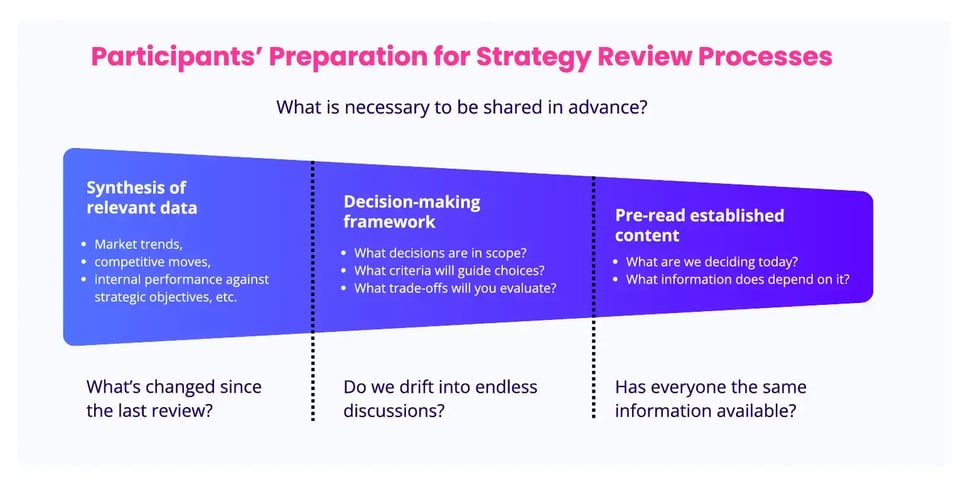
Exhibit 1: Three necessary steps for the participants' preparation for a strategy review process
Teams that skip pre-work end up spending the first hour of the review getting everyone on the same page. That's an hour you can't spend making decisions. But with the right participants prepared properly, you can focus on designing a review process that drives real outcomes.
A credible strategy review process balances rigor with pragmatism. It needs enough structure to force critical thinking and enough flexibility to adapt to the business context (Exhibit 2).
Start by defining the evaluation process itself: What questions will you answer? In what order? With what information? The sequence matters. If you start with budget discussions, you are biased toward incremental thinking. If you start with "what's changed in our environment," you open space for strategic changes.
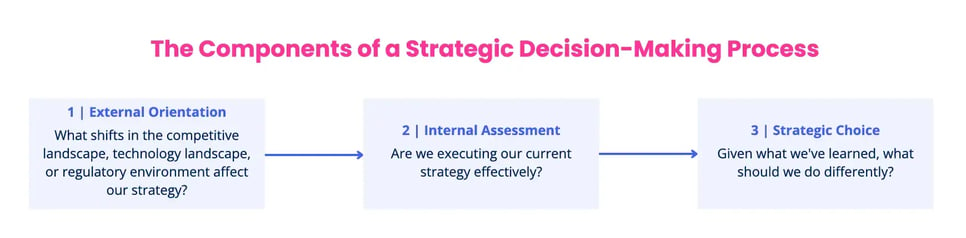
Exhibit 2: The strategy review process
This flow prevents a common failure mode as many teams jump straight to "what should we do" without establishing why anything should change. The result is a random walk strategy, new priorities emerging from whoever argued most forcefully rather than from data driven decision making.
Effective strategy reviews also separate evaluation from decision. Spend the first portion of your session diagnosing: What's working? What's not? What's changed? Resist the urge to solve problems as they surface. Once you've built a complete picture, then shift to decisions.
The timeline matters too. Don't try to run a comprehensive strategic review in two hours. You'll either rush through critical analysis or skip decisions entirely. Block four to six hours minimum. If that feels impossible, your strategy is too complex, or your objectives aren't clear enough.
Document everything. Not as theater, but as institutional memory. What did you decide? What assumptions are you making? What would cause you to revisit this decision? Future reviews depend on understanding what you committed to and why.
Build in accountability mechanisms. Who owns each decision? What's the deadline? How will you track progress? Strategy reviews that end without an action plan are just expensive conversations.
The review process itself is only as good as the inputs feeding it. Let's examine how to gather and evaluate the right information.
Annual strategy reviews made sense when markets moved slowly. In R&D and innovation contexts, waiting twelve months between evaluations guarantees you're funding obsolete bets.
Most innovation organizations benefit from a dual-rhythm approach: Run comprehensive strategy reviews twice per year, aligned with fiscal planning cycles. These sessions validate objectives, test assumptions, and make major resource allocation decisions. Between these, run lighter quarterly check-ins that track progress and address emerging issues without reiterating the entire strategy.
Adjust frequency based on portfolio maturity. Early-stage initiatives need quarterly evaluation due to high uncertainty. Mature programs can extend to semi-annual or annual reviews.
Trigger ad-hoc reviews when the landscape shifts materially: major competitive moves, regulatory changes, technology breakthroughs, M&A activity, or leadership transitions. The test isn't "something happened" but "something happened that questions whether our strategy still makes sense."
Thus, match your cadence to your planning cycle and rate of environmental change. If you're mostly rehashing the same discussions, you're reviewing too often. If major assumptions broke months ago without detection, you're reviewing too infrequently.
Strategic decisions require different inputs than operational reviews:
The challenge is separating signal from noise, as every stakeholder brings relevant data. And not all of it matters strategically.
Data collection is necessary but insufficient, as the value lies in data analysis that extracts meaning for decision makers. Therefore, it is necessary to distinguish between performance metrics and strategic indicators.
Both matter, and they answer different questions.
The best data-driven decision-making combines multiple sources:
But numbers alone miss context: A declining market share number might indicate strategic failure, or it might reflect a deliberate choice to focus on more profitable segments.
This is where qualitative insight adds depth. To these count customer interviews, technical assessments, or competitive intelligence. The goal is not to collect data, but to gather it systematically around the questions a review must answer.
A golden rule of thumb is to be ruthless about filtering: If a data point doesn't inform a decision in scope, exclude it. Progress reports on initiatives you're not reconsidering don't belong in a strategy revies and they can be saved for operational reviews.
Focus groups are a double-edged tool in strategy reviews: Used well, they provide valuable insights about customer needs, user behavior, and market perception. Used poorly, they create false confidence in ideas that won't scale.
But focus groups distort the signal in predictable ways: Participants tell you what they think you want to hear.
What is even worse is that focus groups can't predict behavior. People are terrible at forecasting their future choices. Asking "Would you buy this?" yields unreliable answers. Observing what people actually do beats asking what they'd hypothetically do.
This is where most strategy reviews fail because they blend performance evaluation with strategic evaluation until neither gets proper attention. What performance discussion really asks: Are we executing our current strategy effectively? Are key performance indicators trending in the right direction? Where are we behind the plan and why?
Instead, strategic choice asks: Is this still the right strategy? Should we double down, pivot, or exit? What new initiatives should we start? What existing programs should we stop?
These are different conversations requiring different mindsets. Performance discussion is diagnostic: It's about problem-solving and course correction within an established framework. Strategic choice is generative: It's about questioning the framework itself.
When you mix them, people optimize locally rather than thinking systemically.
Separate them explicitly in your agenda.
Better yet, handle performance reviews in separate forums, as your strategy review should assume everyone has seen the performance data and focus entirely on strategic choice. This keeps the conversation at the right altitude.
Decision frameworks fail when they're too abstract or too rigid. Therefore, the checklist below provides structure without constraining judgment. It forces the critical thinking that separates real strategy reviews from performative ones (Exhibit 3).
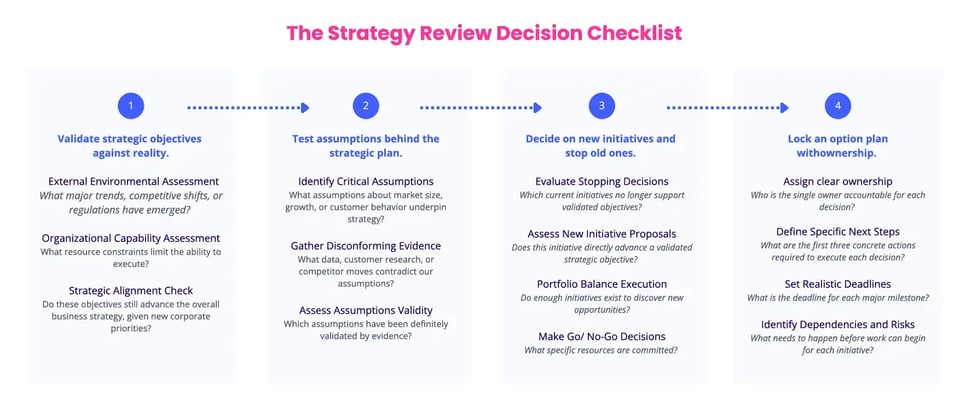
Exhibit 3: The strategy review decision checklist
This isn't a linear sequence, and you'll loop back as new information surfaces. But working through these four steps systematically ensures you make strategic decisions based on evidence rather than momentum.
Start by testing whether your strategic objectives still align with the world as it actually is, not as you hoped it would be.
External Environmental Assessment
What major trends, competitive shifts, or regulatory changes have emerged since the last review? How do these changes affect our ability to achieve current strategic objectives?
Organizational Capability Assessment
What resource constraints or capability gaps limit your ability to execute these objectives? Is organizational focus sufficient, or are resources fragmented across competing priorities?
Strategic Alignment Check
Do these objectives still advance the overall business strategy, given new corporate priorities? Have any objectives become less relevant or misaligned with the company's direction?
Every strategic plan rests on assumptions regarding market size, customer behavior, technology readiness, competitive response, or regulatory environment. The question is whether those assumptions still hold.
Identify Critical Assumptions
What assumptions about market size, growth, or customer behavior underpin this strategy? What technology readiness or competitive response assumptions drive the timeline? Write them down. A vague understanding doesn't survive scrutiny.
Gather Disconfirming Evidence
What data, customer research, or competitor moves contradict our core assumptions? Where are we seeing weak signals that challenge our strategic thesis?
Assess Assumption Validity
Identify which assumptions have been validated or invalidated by evidence since the last review. This is where brutal honesty matters. Executives often cling to assumptions because changing them requires changing strategy. But proceeding on false assumptions guarantees failure.
This is the moment that separates real strategy reviews from theater. You must make actual decisions about resource allocation.
Evaluate Stopping Decisions
Which current initiatives no longer support validated objectives or are based on invalidated assumptions? What initiatives consume disproportionate resources relative to their strategic value?
Assess New Initiative Proposals
Does this initiative directly advance a validated objective with measurable outcomes? If it doesn't, it's not strategic, no matter how attractive it looks. What unique strategic capabilities does this initiative build? If it's just catching up to competitors rather than building differentiation, be clear about that.
Portfolio Balance Check
Do enough exploratory initiatives exist to discover new opportunities versus exploit current ones? Does the portfolio balance short-term wins, long-term positioning, and defensive versus offensive moves? Are you over-indexed on short-term wins at the expense of long-term positioning?
Make Go/No-Go Decisions
Make yes/no decisions. Maybe means no. Pilot testing means maybe. If something is worth doing, commit resources. If it's not, kill it.
Checklist step 4: Lock an action plan with ownership
Lock in the who, what, and when before leaving the room. Decisions without execution plans are only wishes.
Assign Clear Ownership
Who is the single owner accountable for each decision with the authority to execute? What decision rights does the owner have versus what requires approval or escalation?
Define Specific Next Steps
What are the first three concrete actions required with specific deliverables for the next 30/60/90 days? Who needs to be involved in execution, and what handoffs are required?
Set Realistic Deadlines
What are the deadlines for major milestones aligned with planning cycles? Which deadlines are immovable constraints versus aspirational targets?
Identify Dependencies and Risks
What must happen before work can begin, including cross-functional and external dependencies? What critical dependencies could block or delay execution?
Establish Accountability
How will you track progress between strategy reviews? Monthly updates? Quarterly deep dives?
ITONICS was built specifically for innovation and R&D strategy execution. The platform consolidates horizon scanning, technology monitoring, competitive intelligence, and portfolio data into a single workspace (Exhibit 4).
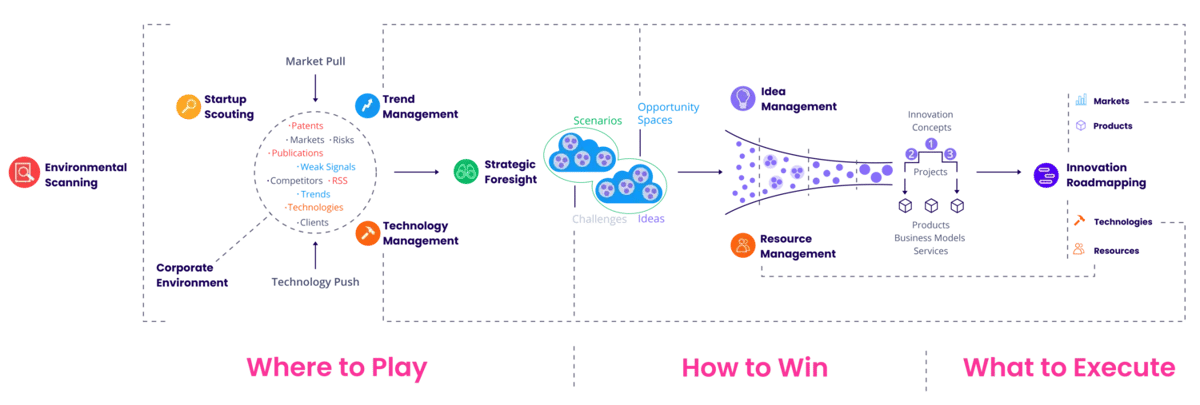
Exhibit 4: The ITONICS innovation methodology
Market trends, emerging technologies, and internal project performance become accessible without jumping between systems. This eliminates the pre-review scramble where teams waste days compiling data from disconnected sources.
The platform mirrors how innovation leaders actually think - providing structure where it helps and flexibility where innovation demands it. You spend less time wrangling data and more time debating what matters.
Ready to transform how your organization connects strategy to execution? Explore how ITONICS enables integrated strategic roadmapping, innovation management, and portfolio governance.