Who owns digital transformation? Rethinking governance models in CPG

CPG companies are pouring billions into digital transformation initiatives. New platforms. Cloud migrations. AI-powered analytics. Yet most fail to deliver expected value.
The numbers tell a brutal story: 70% of digital transformation efforts fail to meet their strategic objectives. $2.3 trillion in digital transformation investments is wasted annually on stalled initiatives. In CPG specifically, companies rank among the poorest performers in digital maturity, with 70% stuck in what McKinsey calls "pilot purgatory".
Without clear decision-making authority, simple questions - like whether to adjust delivery zones based on demand - took weeks to resolve. The fix was structural clarity about who decides what.
Thus, we've created a practical tool to bridge the gap between generic frameworks and custom approaches: The CPG Governance Canvas. The Canvas helps to assess a specific context, map decision rights, and select the governance model that fits an organization's needs.
Whereas theory offers clean models, reality is often messier. Here's how leading CPG companies actually govern digital transformation: what works, what breaks, and when to choose each governance approach.
CPG companies face unique governance challenges that generic transformation governance frameworks miss entirely.
Multi-brand portfolio complexity. Unilever manages 400+ brands across business units. P&G oversees 65. Each brand has different business needs, market dynamics, and digital maturity. Centralized governance structures create bottlenecks, whereas decentralized governance creates fragmentation. Thus, finding the balance requires a structured approach to defining roles and decision rights.
Direct-to-consumer (DTC) channel disruption. Traditional CPG companies built their business through distributors and retailers. Now they're launching direct channels that compete with their largest customers. Who owns the DTC platform - the brand team or enterprise IT? Who decides pricing when it undercuts retail partners? These are governance questions about strategic importance and business objectives.
Regulatory intensity variation. A shampoo brand can experiment with customer data freely. An infant nutrition brand can't because FDA regulations mandate centralized control and regulatory compliance oversight. One governance model can't serve both, and thus, different departments face different governance requirements.
Scattered data sources. CPG companies don't own the full customer relationship: Retailers control transaction data, suppliers control ingredient data, and manufacturers control production data. Digital transformation requires integrating these sources, but who governs access, quality, and usage rights across the entire organization?
A PwC survey of 200+ CPG executives revealed the core problem: 60% say their financial reporting doesn't align with business structure, obscuring visibility into digital transformation plans. Nearly 50% cite misaligned stakeholders as the top barrier to digital success.
Governance failures show up as stalling progress, duplicated digital transformation investments, and abandoned pilots. But the root cause is structural: CPG companies are forcing transformation initiatives through org charts designed for a pre-digital era without proper change management or governance processes.
Theory offers clean models, but reality is messier. Here's how leading CPG companies actually govern digital transformation: what works, what breaks, and when to choose each approach.
Centralized control: The P&G approach
Procter & Gamble invested over $1.1 billion in digital transformation investments to build what they call "Supply Chain 3.0": a centralized digital transformation governance model spanning 100+ plants globally.
The governance structure works once senior executives and digital leaders own digital strategies, platforms, and major investments. Individual plants can't choose their own manufacturing IT systems. They implement what's deployed. Quality control processes run on centralized artificial intelligence models that make real-time insights without human intervention.
The approach will be best suited for pharmaceutical CPG, early-stage transformations, supply chain digitization, and companies with strong regulatory requirements.
Unilever runs 400+ brands across 190 countries with $990 million in annual digital transformation investments. Their transformation governance framework splits authority deliberately through a strong governance model.
The governance mechanism uses clear decision-making thresholds: Brands can customize anything that doesn't require backend platform changes. Backend changes require approval from the governance framework's executive tier with a two-week decision SLA. If a brand needs a custom capability that violates platform standards, they can build it, but must fund it entirely and accept no production support or integration.
This creates economic pressure toward standardization without mandates, enabling informed decisions about resource allocation.
Results. Unilever's Manufacturing System (UMS) delivered 3% OEE (Overall Equipment Effectiveness) increases, 5% productivity gains, and 20% capacity increases at facilities: clear value delivery from centralized digital operations. But these gains came from shared technical infrastructure. Simultaneously, brands maintained the agility to launch market-specific digital services - like Dove's subscription models in Southeast Asia - without waiting for enterprise approval.
Unilever addressed this by creating a three-tier governance structure:
Enterprise (platform decisions affecting the entire organization),
Business Unit (portfolio decisions for value creation), and
Brand (execution decisions for digital innovation).
Decision makers and escalation paths are explicit at each tier, with key performance indicators tracking both local and enterprise desired outcomes.
Large multi-brand CPG companies, organizations with moderate-to-high digital maturity, or companies operating across diverse markets are the ones that are best-suited for this approach.
Some CPG companies push decision rights to the edges - business units, regions, or brands - while maintaining minimum viable standards through governance processes.
This governance model works when speed outweighs consistency, when markets have genuinely different business needs (beauty products in Asia vs. North America require different digital approaches), and when digital maturity is high enough that local teams can make informed decisions without central coordination.
The regional adaptation model works best for regionally diverse CPG companies, high digital maturity organizations, or any categories where speed-to-market is a competitive advantage and where innovation drives value creation.
Choosing a digital transformation governance model isn't theoretical, but operational. Yet most CPG leaders struggle with where to start: caught between generic frameworks that ignore industry realities and custom approaches that take months to design. Thus, we've created a practical tool to bridge that gap: The CPG Governance Canvas (Exhibit 1).
This structured approach helps you assess your specific context, map decision rights for the scenarios you'll actually face, and select the governance model that fits your organization's needs. It's designed for CPG executives who need clarity fast.
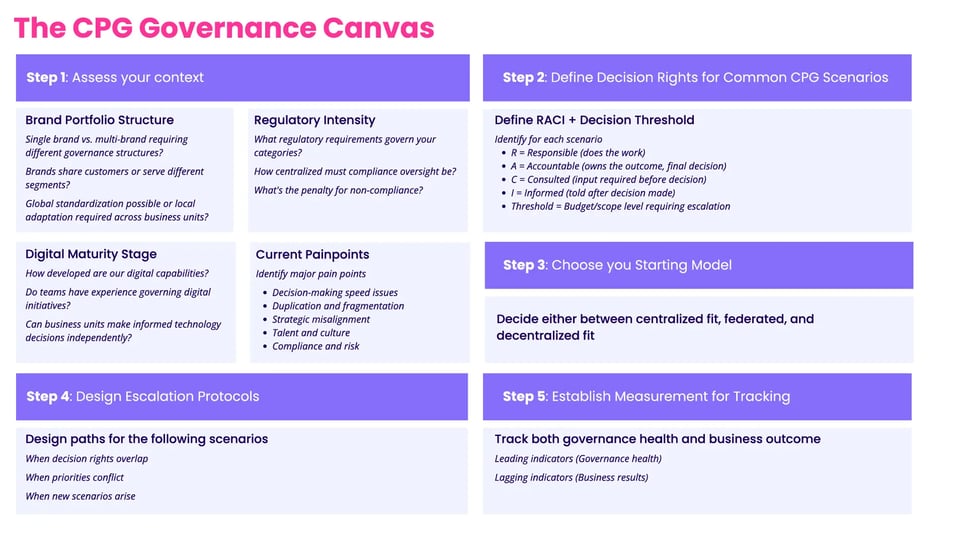
Exhibit 1: The CPG Governance Canvas
The Canvas walks through five critical steps: assessing your CPG-specific context (brand portfolio, regulatory intensity, digital maturity), defining decision rights for eight common scenarios every CPG company faces, choosing your starting governance model, designing escalation protocols that actually work, and establishing the right performance measurement approach.
In preparation, the following thoughts shall be kept under consideration:
Start with reality, not aspiration. Document how decisions actually get made today and not how your org chart says they should. Most governance failures happen because companies design for an idealized state that doesn't match operational reality.
Focus on recurring decisions. The Canvas covers eight scenarios that represent 80% of digital governance challenges in CPG: DTC launches, retailer integrations, customer data platforms, supply chain, Internet of Things, brand websites, marketing automation, product innovation tools, and compliance systems. Master these, and edge cases become manageable.
Make it visible. Fill out the Canvas with your leadership team in one working session. When everyone sees the same decision map, ambiguity disappears. Post it where teams can reference it and governance only works when people know it exists.
Iterate based on measurement. The Canvas includes both leading indicators (decision velocity, escalation frequency) and lagging indicators (time to market, ROI, adoption rates). Use these to know when your model is working, and when it's time to redesign.
The Canvas helps you plot where you are on each dimension. This isn't about judgment but about the proper fit. A highly regulated pharmaceutical CPG at early digital maturity needs centralized control. A beauty brand portfolio with high digital maturity across regions benefits from decentralized models with guardrails.
Most importantly, identify your current governance pain points. Is decision-making too slow? Are you funding duplicate digital transformation investments across business units? Are digital initiatives misaligned with strategic objectives? Different problems point to different solutions. The Canvas makes these patterns visible.
The following cases show examples of companies and how they dealt with their governance challenge, and how they fixed it.
What happened. Three business units at a large CPG company each built separate customer data platforms over 18 months with total digital transformation investments: $12M. But the integration level is zero, and the customer view is fragmented across different departments.
The root cause lies in decentralized governance without guardrails. Each unit was optimized locally for immediate business needs, but no one managed the portfolio or conducted risk assessment. The lack of change management meant units didn't understand the strategic importance of integration.
The fix. The company shifted to a federated governance model in which the central team selected an enterprise customer data platform as core technical infrastructure, business units customize data collection and activation, but build on a shared platform. This saved $8M in duplicate costs and created a unified customer view, delivering expected value through better resource allocation.
Lesson. Decentralization requires mandatory technical standards. Freedom on what to build, alignment on how systems connect. Governance helps by setting boundaries without blocking innovation.
What happened. A brand team wanted to launch a subscription DTC model to achieve strategic goals, but IT said it violated enterprise commerce platform standards, legal said regulatory compliance was unclear, and marketing insisted they owned customer experience. Nine months later: nothing shipped. Competitor launched a similar model and captured the market - a failure in decision-making.
Thus, no decision rights for new channel types are affected and will affect digital programs. Everyone had veto power, but nobody had the authority to decide, and in the end, the stalling progress cost market share.
The fix. The company created an explicit ownership model by defining roles: Brand owns P&L and customer experience decisions. IT owns platform enablement and sets feasibility boundaries based on technical requirements. Legal has a compliance veto only. Final decision authority: Brand GM with 72-hour escalation to CMO if conflicts remain unresolved. This enables informed decisions under time pressure.
Lesson. New digital opportunities require decision protocols before they emerge. Design for speed when windows are narrow. Change management must prepare the organization for rapid decisions on transformation initiatives.
What happened. The centralized quality control team became an approval bottleneck for 40+ digital manufacturing initiatives. In the end, wait times stretched to 6-8 weeks, and plants started working around the process, creating regulatory compliance risks that could have been caught through proper risk management.
The cause lies in a centralized governance structure without any capacity to scale. Thus, a primarily good intent (consistency, managing risks) became an execution blocker, but senior management didn't realize governance processes were stalling progress across the entire organization.
The fix. P&G's solution was automated quality control using artificial intelligence with real-time insights, making touchless decisions. These removed the human bottleneck while maintaining standards through digital tools. Governance shifted from approving every decision to governing the AI model's training and thresholds: a new operating model for digital operations.
Lesson. Centralized governance must automate what it can and escalate only what requires human judgment. New technologies can enable governance, not just be governed by it. Digital transformation governance should enhance, not impede, value creation.
Real governance failures follow predictable patterns. Therefore, to successfully avoid them, it is necessary to discover them as early as possible. With the following diagnostic framework, governance breakdowns can be identified earlier, and solutions to fix them can be provided.
Pattern 1: The Duplication Trap
When business units operate independently without shared standards, they inevitably build the same solutions multiple times. This isn't malicious, as each team is solving real problems. But without portfolio visibility, a $12M investment becomes three separate $4M platforms that can't talk to each other.
Pattern 2: The Authority Vacuum
New digital opportunities don't fit neatly into old org charts. When a subscription DTC model emerges, who decides: the brand team, IT, marketing, or legal? Without explicit decision rights for these scenarios, initiatives enter a limbo where everyone has input, but no one has authority.
Pattern 3: The Centralized Chokepoint
Centralized governance works well at a small scale, but only until volume overwhelms capacity. A quality control team designed to approve 10 initiatives per quarter can't handle 40 without becoming a bottleneck. What started as risk management becomes the biggest risk: stalled innovation and shadow IT workarounds.
Decision Tree: Which Pattern Are You Facing?
The three patterns above - Duplication Trap, Authority Vacuum, and Centralized Chokepoint are symptoms of a deeper misalignment between your governance model and your organizational reality. Most CPG companies experience at least one of these breakdowns during digital transformation, and many face multiple patterns simultaneously.
Use this decision tree (Exhibit 2) to diagnose which pattern you're facing, understand its root cause, and map the fastest path to resolution:
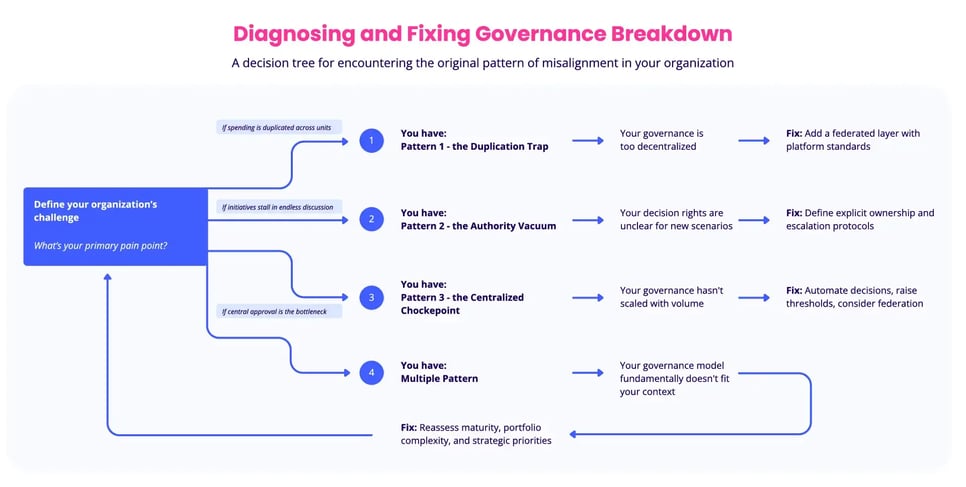
Exhibit 2: How to diagnose and fix governance breakdown
Governance breakdowns are signals that your organization has evolved beyond your current model:
P&G's bottleneck led them to AI-powered automation.
The CDP duplication forced a necessary shift to federated standards.
The DTC paralysis revealed missing decision protocols for new business models.
Each breakdown contains the blueprint for its own fix. The companies that treat these patterns as learning opportunities, not embarrassments, are the ones that build governance frameworks resilient enough to scale with their digital ambitions. The key is catching the pattern early, diagnosing it accurately, and fixing it decisively before it costs market share or millions in duplicate investments.
Digital transformation governance frameworks need operational infrastructure to work. Without portfolio visibility, governance becomes guesswork. Most CPG companies can't answer basic questions: How many transformation initiatives are running? Which serve strategic objectives? Which digital programs are stalled?
ITONICS centralizes visibility for multi-brand organizations. Decision makers see what's funded, what's delivering expected value, and what's at risk: enabling performance tracking across the entire organization.
For Centralized Models: Senior executives spot duplication and ensure governance requirements are followed without micromanaging digital operation s.
For Federated Models: When brand needs conflict with platform standards, cross-functional teams have the data to make informed decisions about resource allocation and manage risks proactively.
For Decentralized Models: C-level executives see the full portfolio - catching fragmentation before it becomes expensive.
ITONICS structures the decision-making complexity CPG governance requires: scoring digital initiatives against strategic goals, surfacing technical dependencies, and flagging risks before they escalate.
As digital maturity evolves, ITONICS adapts: from centralized portfolio management to federated decision rights to value creation oversight as digital innovation becomes continuous. Your governance framework sets the rules. ITONICS ensures alignment through real-time insights and turns governance processes into strategic advantages for value delivery.