Most innovation communities fail quietly. Not from lack of ideas, but from lack of structure. People join, contribute once, and disappear. Engagement drops off. The community becomes a graveyard of half-started projects.
Building one that works requires more than enthusiasm. It requires clear roles, smart community management, and a process designed to turn ideas into outcomes
What is an innovation community?
An innovation community is a structured group that shares, discusses, and develops new ideas together. It includes members from different backgrounds and often forms based on a mutual interest, often topic- or motivation-driven.
Thus, an innovation community can consist of internal teams like R&D, product, and operations - plus external stakeholders such as customers, partners, and suppliers.
The goal is to solve challenges collaboratively and move with the Zeitgeist.
What high-performing communities have in common is diversity. Diverse perspectives reveal problems and solutions that homogeneous groups miss. That diversity must be managed, not just assembled.
Why innovation community management is the real foundation
Here's what many organizations get wrong: they treat community engagement as a communication task. It is actually a decision-making task.
When key stakeholders feel excluded, they don't just disengage. They block. They slow down approvals. They raise concerns late in the development process - when changes are expensive.
Good innovation community management prevents that. It maps influence early, builds shared ownership, and keeps the innovation process moving. Organizations that invest in it see faster implementation, fewer surprises, and better outcomes.
The second blind spot: most organizations focus on high-profile stakeholders and ignore the middle. People with moderate influence and high interest - specialists, team leads, technical experts - often hold the most useful knowledge. Neglect them, and you lose market insights, implementation knowledge, and critical feedback.
Common mistakes in innovation community building
Even well-resourced innovation communities make the same avoidable errors. Most stem from moving too fast in the setup phase - launching before the structure, roles, and feedback mechanisms are in place. Recognizing these patterns early saves significant time later.
Keeping it too small. Communities limited to the innovation department miss the cross-functional perspectives that produce strong ideas. Bring in operations, finance, legal, and customer-facing teams early.
Launching without a structured process. Open innovation without a framework produces noise, not insights. Define how ideas are submitted, evaluated, and prioritized before the community launches.
Treating engagement as optional. Feedback loops need to be built into the process - not requested occasionally. Communities without regular feedback cycles lose momentum fast.
Conflating activity with progress. High participation is a vanity metric. What matters is how many ideas move through the development process to implementation. Track that.
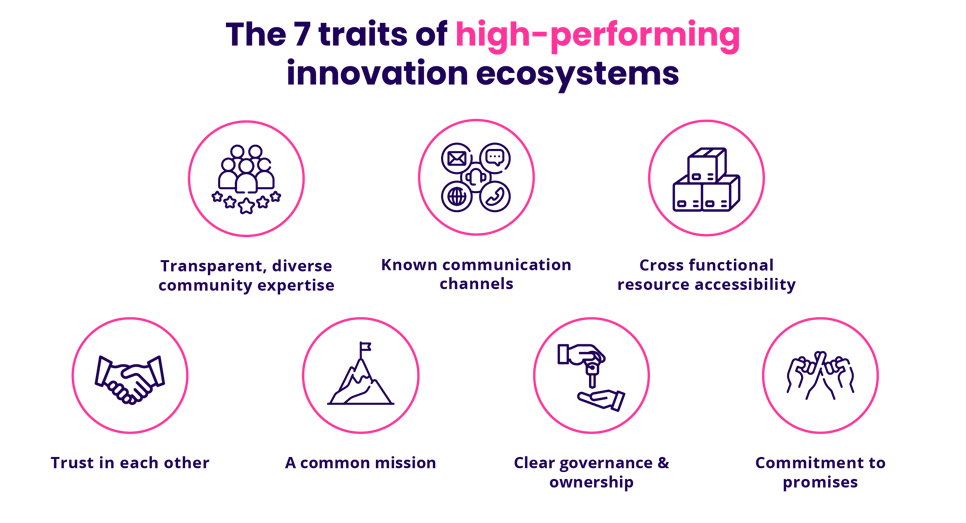
Exhibit 1: The 7 traits of a high-performing innovation ecosystem
Each of these actors plays a distinct role in advancing ideas to value creation (Exhibit 1). Some provide resources and technical expertise, others provide ideas, feedback, or help scale and implement solutions. Together, they form an interconnected system working toward shared objectives.
Who belongs in your innovation community
Choosing the right members is not about casting a wide net. It is about selecting people who represent different parts of the problem and different stages of implementation. The best communities balance internal expertise with external perspective - and make sure both are genuinely included in the process from the start.
Internal teams
Start with the people who can test, build, and scale ideas. That means R&D, product, operations, and leadership. Each group plays a different role.
Product teams evaluate feasibility. Operations teams plan implementation. Leadership removes roadblocks and connects innovation efforts to business strategy.
Without cross-functional involvement from the start, ideas stall at handoff. Include these stakeholders in the early stages, not just for final sign-off.
External stakeholders and partners
External partners bring fresh perspectives that internal teams often can't generate. Customers reveal unmet needs. Suppliers' surface material and cost constraints. Startups introduce emerging technologies. Academic partners offer research depth.
Treat external members as co-creators, not consultants. Consultants give advice. Co-creators share ownership - and shared ownership drives better outcomes.
The practical distinction: consultants are briefed and asked for input. Co-creators are included in problem framing from the start. That difference determines the quality of what they contribute.
Building your internal innovation community
The internal community is where ideas are tested, refined, and prepared for implementation. Getting it right requires more than assembling the right people - it requires deliberate structure, clear roles, and consistent management.
The following practices form the operational backbone of a high-functioning internal community.
#1 Map influence and interest before you engage
Stakeholder mapping is not a one-time exercise. It is the foundation of your engagement strategy.
List every internal stakeholder. Assess their influence on the innovation process and their genuine interest in its success. High-influence, high-interest stakeholders need close involvement and regular communication. Others need to stay informed, but require less time.
Prioritization is the point. Innovation community management breaks down when teams try to engage everyone equally. Focus resources on the people whose support or resistance will determine success. Update your map every quarter - influence and interest shift as projects evolve.
#2 Assign roles beyond contributors
Most communities over-invest in contributors - people who generate ideas - and under-invest in connectors. Connectors bridge teams, surface insights from unexpected places, and keep the community's energy moving.
Networkers build relationships across departments. Promotors create momentum around promising ideas. Community managers keep the process on track and prevent good ideas from falling through the cracks.
These roles are often informal. Make them explicit. Assign them intentionally.
#3 Build structured feedback loops
Ad hoc feedback doesn't work at scale. Structured feedback collection does.
Schedule regular touchpoints - not just status updates. Create formats where participants can raise concerns, propose adjustments, and validate direction. Use a RACI matrix to clarify who gets informed, who gets consulted, and who decides.
The most effective innovation communities treat feedback as an input to the development process, not a report card at the end. That shift alone accelerates implementation.
#4 Communicate with precision, not volume
Effective communication means tailoring messages to each group. Executives need risk and return. Innovation teams need process and resources. Operations need timelines and feasibility.
Sending the same update to everyone is efficient but ineffective. It erodes trust because people feel unseen as individuals. Promote transparency on decisions and changes - even when the news is uncomfortable. And keep communication two-directional: every update should invite a response.
#5 Break down silos deliberately
Silos are the default state of most organizations. Breaking them requires deliberate intervention, not goodwill.
Run cross-functional workshops on shared problems. Create project teams with members from multiple departments. Make information about innovation projects visible across the organization - not just to the teams directly involved.
Transparency is a structural choice. Without it, great ideas get stuck in one department while another team solves the same problem from a different angle.
#6 Secure and maintain leadership visibility
Leadership buy-in is necessary but not sufficient. Leaders need to be visibly engaged throughout the innovation process - not just at launch.
When leaders show up at key moments, acknowledge contributions, and act on feedback, it signals that innovation is a genuine priority. That signal changes how the rest of the organization participates.
Make it easy for leaders to engage. Give them concise briefings. Invite them to specific milestones. Don't ask for open-ended time commitments.
Expanding your external innovation ecosystem
Once the internal community is stable, the next lever is external. A broader innovation ecosystem - with customers, partners, startups, research institutions, and industry groups - brings knowledge and market insights that no internal team can fully replicate.
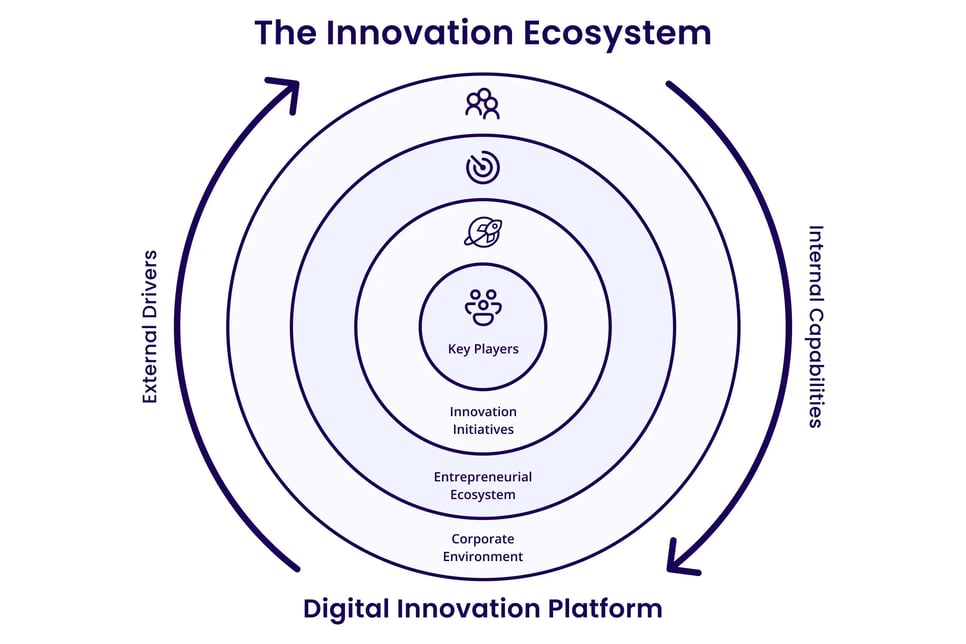
Exhibit 2: The innovation ecosystem
But it also includes an organization's departments like R&D, marketing, and operations, as well as external partners such as suppliers, startups, universities, customers, and industry associations.
Understand your innovation ecosystem: Map the actors, environemnts and initiatives shaping your landscape.
Managing it well requires the same rigor applied internally, adapted for relationships that cross organizational boundaries.
Treat external partners as co-owners, not sources
Most organizations extract from their external ecosystem rather than build with it. They run surveys, host panels, or invite partners to pitch - then make decisions internally. This produces shallow input, not genuine collaboration.
The shift is structural. Include external partners in problem framing, not just solution evaluation. Give them visibility into how their contributions shape direction. When external stakeholders see their input create real change, engagement deepens, and knowledge sharing improves.
Use open innovation to access emerging technologies
External ecosystems are the fastest path to emerging technologies and adjacent market insights. Startups move faster than internal R&D on many fronts. Academic partners investigate problems that have no commercial urgency yet. Local businesses often have operational knowledge that large organizations have lost.
Structure your external community to tap these sources deliberately. Define what each partner type brings, and design participation formats that match their capacity and incentives.
Create external feedback loops, with real consequences
Collecting external feedback is easy. Acting on it visibly is what sustains external engagement.
Build feedback mechanisms that close the loop. When a customer's insight leads to a product change, tell them. When a partner's input shifts a project direction, acknowledge it. External participants disengage fast when they sense their input disappears into a process they cannot see.
Launch quick wins that include external partners
The first 90 days of external ecosystem engagement are critical. Early wins prove that collaboration produces real outcomes - not just goodwill.
Choose low-risk, high-visibility projects where an external partner plays a meaningful role. Deliver results fast. Communicate the outcomes to the broader community. Quick wins convert skeptical external stakeholders into active participants and build the organizational credibility needed for more complex open innovation projects.
Blend digital and physical engagement
Digital platforms make external communities scalable. They centralize ideas, track progress across organizations, and enable asynchronous feedback collection across time zones and geographies.
But digital tools don't replace the depth of in-person interaction. Physical workshops and co-creation sessions build the trust that sustains long-term external relationships. They also surface concerns that rarely appear in structured digital formats — the ones that determine whether a partnership succeeds or stalls.
Use digital tools for process continuity. Use physical meetings to build the relationships that hold the process together.
Recognize and reward external contributions
External partners have limited time and competing priorities. Recognition is what keeps them engaged beyond the initial invitation.
Visibility matters more than financial reward for most external contributors. Showcase their contributions publicly - in case studies, partner communications, or industry forums. Give them early access to innovation outcomes. Connect them to senior leaders.
Build recognition into the process as a regular practice, not a one-off gesture. Consistent acknowledgment creates a reputation that attracts better external partners over time.
How ITONICS supports innovation community management
Running an innovation community generates significant operational complexity: ideas coming from many sources, stakeholders with different needs, projects at different stages, and feedback that needs to be tracked and acted on.
Most organizations try to manage this with a combination of spreadsheets, email threads, and presentation decks. It works on a small scale. At the scale where innovation communities produce real business impact, it breaks down.
ITONICS centralizes that complexity in one tool - built specifically for the way innovation communities operate.
Exhibit: Filtering the product initiative portfolio by strategic relevance
Eliminate information silos. Dispersed teams and disconnected data create duplicated efforts and missed opportunities. With ITONICS, all innovation projects, submitted ideas, and market insights live in one place. Every stakeholder - both internal and external - works from the same information. That shared visibility reduces misalignment and keeps the innovation process moving.
Prioritize ideas, not noise. Managing a high volume of ideas from diverse contributors is one of the hardest operational challenges in innovation community management. ITONICS provides a structured process for capturing, evaluating, and prioritizing ideas from across the organization and beyond - including customers and external partners. Teams spend time on the ideas with the highest potential, not on managing the volume.
Track progress across teams in real time. Monitoring multiple innovation projects across departments is difficult without a dedicated system. ITONICS provides visual dashboards and roadmapping tools that give a live overview of where every project stands. Roadblocks become visible early. Risks surface before they become delays. Leaders have the information they need to make fast, informed decisions.
The result: an innovation community that runs as a structured, scalable process instead of a series of conversations that depend on a few individuals to hold everything together.
FAQs on innovation community
What is the difference between an innovation community and an innovation team?
An innovation team is a fixed group within an organization, usually dedicated to running innovation programs.
An innovation community is broader - it includes internal teams, external partners, customers, and other stakeholders who contribute to the innovation process.
The community model distributes idea generation and problem-solving beyond a single department.
How many stakeholders should an innovation community include?
There is no fixed number. The right size depends on the scope of your innovation efforts and the complexity of your organization.
Start with a core group of high-influence, high-interest stakeholders from key internal teams. Expand deliberately — adding external partners and specialist contributors once the internal community has a working structure and clear processes in place.
How do you keep external partners engaged over time?
Sustained external engagement requires closing the feedback loop. External partners disengage when they cannot see how their contributions influence decisions.
Make participation outcomes visible - acknowledge when a customer insight shaped a product direction or a partner's input shifted a project. Pair that with structured touchpoints, digital collaboration tools, and in-person sessions that build genuine relationships rather than transactional exchanges.
What is the biggest reason innovation communities lose momentum?
Misalignment between activity and progress. Communities often generate high participation early - idea submissions, workshop attendance, digital engagement - but lack the process infrastructure to move ideas forward.
Participants disengage when contributions seem to disappear. The fix is structural: build clear pathways from idea submission to evaluation, prioritization, and implementation - and communicate progress at every stage.
How does innovation community management differ from general stakeholder management?
General stakeholder management focuses on managing relationships and expectations around a defined project or initiative.
Innovation community management is ongoing. It builds and maintains a network of contributors across the full innovation lifecycle - from idea generation through to implementation. It requires consistent engagement, structured feedback loops, and deliberate management of both internal teams and external partners simultaneously.
When should an organization involve external stakeholders in the innovation process?
Earlier than most organizations do. External partners are typically brought in for validation - to review a solution that has already been defined internally. That limits the value they can add.
Involving customers, suppliers, and partners during problem framing - before solutions are being developed - produces richer insights and builds the shared ownership that sustains collaboration through implementation.

/Still%20images/Explorer%20Mockups%202025/capabilities-integrations-one-filterable-database.webp?width=2160&height=1350&name=capabilities-integrations-one-filterable-database.webp)