The ultimate strategic management glossary: 80+ definitions

Strategic management means discipline. Discipline in defining direction. Discipline in tracking execution progress, and discipline in using vocabulary.
Terms like competitive moat, flywheel effect, or playing-to-win cascade are practical tools that shape how leaders frame problems, evaluate options, and make bets. Knowing the language means knowing how to use the tools.
This glossary defines over 80 of the most important strategy terms, frameworks, and concepts used across strategic planning, competitive intelligence, portfolio management, foresight, and execution.
A B C D E F G H I M L O P R S T V W Z
Adjacent growth
Expansion into markets, products, or capabilities that are close to your current core business. Adjacency moves are lower-risk than transformational bets but higher-reward than core optimization.
See also: How to Build a Winning Innovation Strategy: The 3 Building Blocks
Agile strategy
An approach to strategic planning that allows plans to be updated continuously as new information emerges, rather than waiting for annual review cycles. Agile strategy teams run quarterly or monthly portfolio reviews instead of committing to fixed 12-month plans.
See also: A, B or C: Multi-criteria scenario analysis to nail strategic planning
Assumption mapping
A structured technique to identify and test the key assumptions on which a strategy rests. Teams map assumptions by confidence level and impact, then prioritize which ones to validate first.
Balanced scorecard
A strategic performance management framework developed by Kaplan and Norton that measures organizational performance across four dimensions: financial, customer, internal processes, and learning and growth. It connects strategy to operations by translating high-level goals into measurable indicators. Used alongside OKRs, it provides a complete view of strategy execution health.
Benchmarking
The process of comparing your organization's performance, processes, or capabilities against industry standards or direct competitors. Benchmarking answers the question: "Where do we stand relative to the best?" It drives improvement but should not replace strategic ambition. Companies that only benchmark tend to converge on industry norms, limiting differentiation.
Blue Ocean Strategy
A framework developed by W. Chan Kim and Renée Mauborgne that argues companies should create uncontested market spaces rather than compete in existing ones. Blue Ocean strategy focuses on value innovation: simultaneously reducing costs and increasing buyer value.
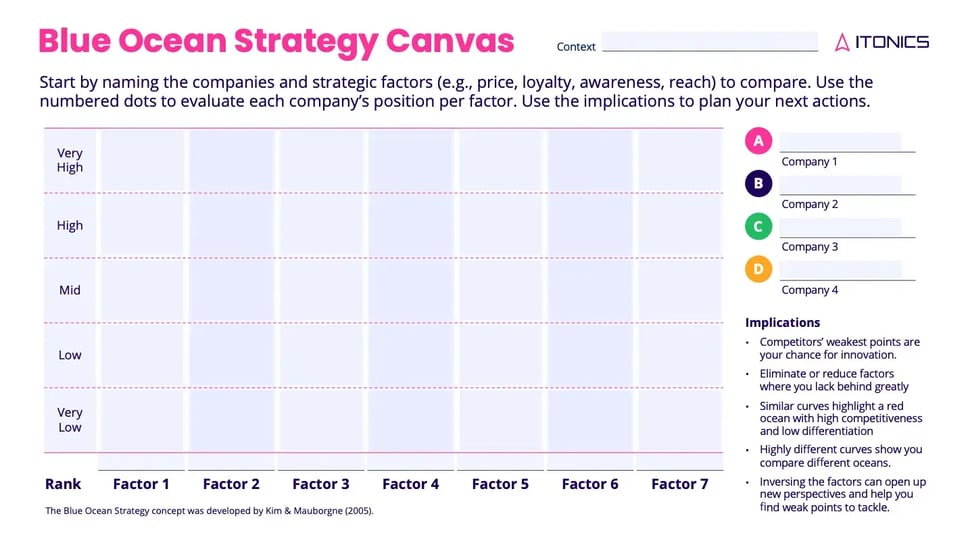
See also: A free Blue Ocean Strategy Canvas template to help map competitive landscapes and identify untapped opportunities.
Build-buy partner
A strategic decision framework for determining how an organization should acquire a capability: develop it internally (build), acquire it through M&A or licensing (buy), or access it through alliances and ecosystems (partner). The right answer depends on strategic fit, execution capacity, economic reality, and ecosystem intelligence. Organizations implementing structured build-buy-partner decision processes report 30 to 40 percent fewer implementation failures.
See also: The 7 evidence-based rules for grounding build-buy-partner decisions in evidence
Business model innovation
Changing how an organization creates, delivers, or captures value rather than just improving its products or services. Business model innovation is harder to copy than product innovation and more durable as a source of competitive advantage.
Capabilities assessment
A structured evaluation of what an organization can actually do well, as distinct from what it aspires to do. Capabilities assessments compare current skills, technologies, and processes against what the strategy requires. Strategies that ignore capability gaps fail at execution, regardless of how well-designed the plan looks on paper.
Cascading objectives
The process of translating high-level organizational strategy into specific goals for business units, teams, and individuals. Cascading ensures alignment from the boardroom to the front line. Most cascading failures occur at the middle-management level, where strategic intent gets diluted or lost before it reaches execution teams.
Competitive advantage
A condition that allows an organization to outperform its competitors sustainably. Michael Porter identified two primary sources: cost leadership and differentiation. Modern strategy adds a third: speed. Organizations that learn faster, adapt faster, and deploy faster can sustain competitive advantage even without traditional structural barriers.
Competitive intelligence
The systematic process of gathering, analyzing, and acting on information about competitors, markets, and industry dynamics. Effective competitive intelligence is decision-triggered, not report-triggered. The goal is not to generate analysis but to inform specific decisions about positioning, investment, and resource allocation.
See also: The 7-step framework for turning competitive intelligence into decisions
Competitive landscape
A map of all players in a market, their positioning, capabilities, and strategic intent. Competitive landscape analysis goes beyond direct competitors to include substitutes, new entrants, and adjacent players who could enter your space. Static landscape maps become dangerous within 12-18 months in fast-moving industries.
Core competency
A bundle of skills and technologies that enables an organization to provide a particular benefit to customers, as defined by Prahalad and Hamel. Core competencies are hard to imitate, applicable across multiple markets, and valuable to customers. Identifying and protecting core competencies is central to long-term strategic positioning.
Corporate strategy
The overarching plan that defines what businesses a company will compete in and how the corporate parent will add value to its business units. Corporate strategy answers three questions: where to compete, how to win, and how to organize. Most strategy failures occur at the second question.
Cost leadership strategy
A competitive strategy where an organization seeks to become the lowest-cost producer in its industry while maintaining acceptable margins. Cost leadership requires relentless operational efficiency, economies of scale, and tight control of overhead. It is one of Michael Porter's three generic strategies. The risk: a cost leader who stops innovating eventually gets undercut by a new entrant with a structurally cheaper model.
Critical path/ path dependencies
The critical path is the longest sequence of dependent tasks in a project plan that determines the minimum time needed to complete it. Path dependencies are the constraints that require certain tasks or capabilities to be in place before others can proceed. In strategy, path dependencies explain why some strategic options are only available to organizations with specific prior investments or capabilities. Ignoring path dependencies is one of the most common reasons strategic plans fail at the implementation stage.
Decision log
A record of strategic decisions made, the evidence that supported them, who made the decision, and the actions assigned. Decision logs replace annual strategy decks as the primary artifact of a functioning strategy process. When competitive intelligence indicates a shift, the decision log captures what was decided and why.
See also: Competitive intelligence into decision workflows
Differentiation strategy
A competitive approach where an organization offers unique products or services that justify a price premium. Differentiation creates customer loyalty but requires continuous investment to stay ahead of imitators. Effective differentiation goes beyond pure product features with deep customer understanding.
Disruptive innovation
A concept developed by Clayton Christensen describing innovations that initially target overlooked customer segments with simpler, cheaper solutions before eventually displacing established players. Most incumbents miss disruptive threats because their competitive intelligence focuses on current performance metrics instead of emerging trajectories.
See also: Digital innovation strategy
Dynamic capabilities
An organization's ability to sense opportunities and threats, seize opportunities, and reconfigure resources in response to change. Dynamic capabilities go beyond operational efficiency. Organizations with strong dynamic capabilities adapt their strategic posture faster than competitors, making them more resilient in volatile environments.
Ecosystem management
The practice of building, governing, and evolving a network of partners, startups, customers, and complementors to create value that no single organization could generate alone. Ecosystem management goes beyond traditional partnership management: it requires designing incentive structures, governance frameworks, and shared platforms that keep participants engaged and aligned. Companies building thriving ecosystems manage relationships and engineer systems.
See also: Operationalizing partner ecosystems and building a partner program that drives growth, as well as an overview of corporate innovation ecosystems
Environmental scanning
The systematic process of monitoring and interpreting signals from the external environment to inform strategic decisions. Environmental scanning covers technological, competitive, regulatory, social, and economic dimensions. It is the foundation of strategic foresight and should be continuous, not episodic.
/environmental-scanning-process.webp?width=966&height=544&name=environmental-scanning-process.webp)
See also: Effective environmental scanning in 5 principles and a 3-step guide from signals to strategy
Emergent strategy
A pattern of strategic behavior that emerges from an organization's actions rather than from a formal plan, as described by Henry Mintzberg. Emergent strategies often capture real market learning that planned strategies miss. High-performing organizations combine deliberate strategy with space for emergent adaptation.
Execution gap
The difference between a strategy's stated intent and what actually gets implemented. Studies show that 67% of well-formulated strategies fail due to poor execution. The execution gap most often results from unclear ownership, misaligned incentives, or a lack of connection between strategic priorities and resource allocation.
See also: Strategic planning
F
Flywheel effect
A concept popularized by Jim Collins describing how small, consistent strategic actions compound over time to generate self-reinforcing momentum. A flywheel gains speed gradually but becomes harder to stop once moving. Amazon's flywheel connects lower prices to more customers to more sellers to a lower cost structure back to lower prices. Identifying your organization's flywheel is one of the most powerful strategic exercises a leadership team can undertake.
Gap analysis
A tool that compares an organization's current state against its desired future state to identify what needs to change. Gap analysis answers: "Where are we now, where do we want to be, and what is missing?" It drives capability building, resource allocation decisions, and portfolio prioritization.
Governance
The structure of decision rights, accountability, and oversight that guides how strategy is set and executed. Poor governance is a leading cause of strategy execution failure. Organizations with strong governance clearly define who decides, who advises, and who implements at each stage of the strategy process.
Growth-share matrix (BCG matrix)
A portfolio analysis tool developed by the Boston Consulting Group that categorizes business units into four quadrants: Stars, Cash Cows, Question Marks, and Dogs. The matrix helps allocate resources across a portfolio based on market growth and relative market share. It remains useful as a starting point for portfolio conversations, though its binary logic has real limits in complex markets.
Horizon 1, 2, 3 framework
A planning model that segments innovation investment across three timeframes: Horizon 1 (optimizing the current core), Horizon 2 (building new growth businesses), and Horizon 3 (exploring transformational bets). The framework, developed by McKinsey, gives organizations a practical way to balance short-term performance with long-term renewal. Most organizations over-invest in Horizon 1 and starve Horizons 2 and 3.
See also: End-to-end innovation process
Horizon scanning
A forward-looking process that continuously monitors emerging trends, technologies, and signals to identify strategic threats and opportunities at the edge of the current business environment. Horizon scanning is the operational foundation of strategic foresight. It feeds scenario planning, technology roadmapping, and opportunity identification.
See also: Environmental scanning guide
Innovation strategy
A plan that defines where and how an organization will invest in innovation to achieve its strategic objectives. A strong innovation strategy specifies investment levels across horizons, defines innovation types (core, adjacent, transformational), and connects to the overall corporate strategy. More than 50% of innovation investment is wasted, often because it lacks strategic focus.
See also: Building a winning innovation strategy
K
Key performance indicator (KPI)
A quantifiable measure used to evaluate progress toward a specific strategic objective. KPIs only work when they are tied to decisions, whereas when nobody acts on it's a metric. Strong strategy processes define KPIs before launching initiatives
See also: KPI tracking in strategic planning guide
Kill criteria
Pre-defined conditions that trigger the termination of a project or initiative. Kill criteria remove political friction from portfolio decisions by establishing objective exit thresholds before a project starts. Organizations that celebrate teams for applying kill criteria well build healthier portfolios than those that only reward launches.
See also: Kill criteria in innovation leadership principles
L
Landscape mapping
A systematic visualization of an industry, technology space, or competitive environment that surfaces relationships, clusters, and gaps. Landscape mapping provides a shared view of the strategic terrain. It is especially useful in technology scouting, where understanding the full ecosystem of players and capabilities shapes investment decisions.
Long-range planning
A structured process for defining organizational goals and strategies over a multi-year time horizon, typically 3 to 10 years. Long-range planning provides direction but must be paired with agile review cycles to remain relevant. Organizations that treat long-range plans as fixed commitments often find them obsolete within 18 months.
M
M&A (Mergers and acquisitions)
The consolidation of companies through transactions where one company purchases another (acquisition) or two companies combine to form a new entity (merger). M&A is a common mechanism for the build-buy-partner decision when speed to capability matters more than organic development costs. Between 70 and 90 percent of acquisitions fail to create expected value, most often because of poor strategic fit assessment, cultural misalignment, or failure to integrate capabilities into the acquiring organization's strategy.
Make-buy partner
In manufacturing and operations contexts, the same framework is often referred to as make-buy-partner or make-or-buy. The strategic logic is identical: choose the sourcing mode that best serves competitive advantage given real constraints on time, cost, capability, and risk.
See also: Build-buy partner
Management by objectives (MBO)
A management framework developed by Peter Drucker in which managers and employees jointly set specific, measurable objectives and are evaluated against them. MBO aligns individual performance with organizational strategy by making goals explicit and shared. It is a precursor to the OKR framework. The main limitation of MBO is that it can encourage short-term thinking when objectives are set annually and disconnected from evolving strategic priorities
Market intelligence
The systematic collection and analysis of data about markets, customers, and competitors to inform strategic decisions. Market intelligence describes what is happening. Competitive intelligence explains what it means for a specific decision. The difference between the two is interpretation tied to action.
Market intelligence radar
A visualization tool that maps trends by their current maturity and potential impact on an organization's industry or strategic direction. Trend radars make it easy for strategy and innovation teams to build a shared understanding of the external environment and prioritize where to invest foresight attention.
See also: Interactive trend radars within foresight platforms
Megatrend
A large-scale, long-term shift in society, technology, economics, or the environment that affects multiple industries and geographies over decades. Examples include digital transformation, demographic aging, and the energy transition. Megatrends are relatively predictable in direction but uncertain in speed and impact. They provide the macro context for innovation and strategy planning.
See also: Megatrends in foresight tools
Milestones
Predefined checkpoints in a plan or project that signal the completion of a significant phase or the achievement of a key deliverable. Milestones create accountability and provide decision points for continuing, adjusting, or stopping a strategic initiative. They differ from tasks: milestones mark outcomes, not activities. Strong roadmapping practice ties milestones to strategic objectives so that progress means something beyond on-time delivery.
See also: Connecting milestones to strategy through roadmapping capabilities
Mission statement
A concise declaration of an organization's purpose and the value it creates for its stakeholders. A strong mission statement guides strategic choices by clarifying what the organization is for and, implicitly, what it will not do. Mission statements that try to include everything provide no strategic guidance.
MECE (Mutually Exclusive, Collectively Exhaustive)
A principle used in strategic analysis to ensure that categories do not overlap (mutually exclusive) and together cover all relevant cases (collectively exhaustive). MECE thinking reduces confusion in strategic communication and ensures that analysis covers the full problem space without redundancy. It is foundational to structured problem-solving and frameworks like PESTLE.
Moat
A sustainable competitive advantage that protects an organization's market position and profitability from erosion by competitors, borrowed from Warren Buffett's investment vocabulary. Moats can derive from network effects, switching costs, cost advantages, intangible assets, or efficient scale. Identifying and widening moats is a central task of long-term strategy. The key question is not whether a moat exists today but whether it will still exist in ten years, given how the industry is evolving.
N
Niche strategy
A competitive approach in which an organization focuses its resources on a narrow, well-defined market segment rather than competing across the whole industry. Niche strategies succeed when the chosen segment has distinct needs that larger competitors serve poorly, and when the focused organization can serve those needs better than any generalist. Michael Porter calls this "focus" strategy. The risk is that the niche shrinks or that a larger competitor decides the segment is worth targeting.
North star
A single, clear metric or qualitative ambition that an organization uses to orient its strategy and measure whether it is moving in the right direction. The North Star cuts through competing priorities by providing an anchor for resource allocation and decision-making. It differs from a KPI in that it is forward-looking and aspirational, not just a measure of current performance. When teams disagree on priorities, the North Star provides a resolution mechanism.
OKR (Objectives and Key Results)
A goal-setting framework that pairs a qualitative objective with quantitative key results to measure progress. OKRs drive alignment and focus by making strategic intent measurable at every organizational level. They work best when set quarterly, publicly shared, and graded honestly. Google popularized OKRs at scale, but many organizations adopt the format without the discipline.
See also: OKRs in a strategic planning guide
Open innovation
A strategy where organizations use both internal ideas and external knowledge, from partners, startups, customers, and universities, to drive innovation. Open innovation addresses the limitation that no single organization has a monopoly on good ideas. It works best when governed by clear intellectual property agreements and structured contribution frameworks.
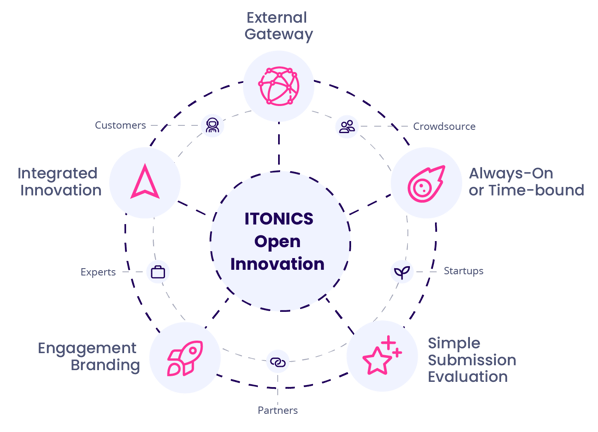
See also: Open innovation strategies and examples
Open strategy
An approach to strategy development that expands input beyond the executive suite to include frontline employees, customers, and external experts. As leadership sets the direction, open strategy doesn't mean consensus-driven decision-making.
See also: Open strategy and strategic decision-making
Opportunity portfolio
A structured collection of identified market opportunities that an organization is evaluating, developing, or monitoring. An opportunity portfolio gives foresight teams a way to manage and prioritize potential futures. It connects environmental scanning outputs to resource allocation decisions.
See also: Opportunity portfolios
Outsourcing
The practice of contracting a business function or capability to an external provider rather than performing it internally. Outsourcing makes strategic sense when a capability is not a source of competitive differentiation, when external providers can deliver it cheaper or better, and when the organization can effectively manage the vendor relationship. The risk is losing strategic control over capabilities that become more critical than anticipated. Outsourcing core competencies is one of the most common strategic mistakes in mature organizations.
PESTLE analysis
A framework for analyzing the external environment across six dimensions: Political, Economic, Social, Technological, Legal, and Environmental. PESTLE (also called STEEP or PEST) structures environmental scanning efforts and prevents teams from fixating on the loudest signals while missing quieter but more consequential ones. It is a standard tool in strategic foresight and planning.
See also: Integrating PESTLE in environmental scanning processes
Playing to win cascade (Where-to-play/ how-to-win framework)
A strategic logic developed by A.G. Lafley and Roger Martin that defines strategy as a set of five integrated choices: a winning aspiration, where to play (which markets, customers, and channels), how to win (what competitive advantage), what capabilities must be in place, and what management systems are required. The cascade is designed to prevent organizations from confusing strategic planning with strategic choosing. Strategy is not a plan. It is a set of bets on where you can win and why.
See also: Connect strategic choices to execution in the strategic planning guide
Porter's Five Forces
A framework developed by Michael Porter that analyzes the competitive intensity of an industry through five forces: threat of new entrants, bargaining power of suppliers, bargaining power of buyers, threat of substitute products, and rivalry among existing competitors. Five Forces analysis informs strategic positioning decisions by revealing where an industry's profit pools are protected or vulnerable.
Portfolio rationalization
The process of reviewing and streamlining a portfolio to eliminate redundancy, cut underperforming initiatives, and realign remaining investments with strategic priorities. Most organizations accumulate portfolio bloat over time. Systematic rationalization, done quarterly rather than annually, keeps resource allocation connected to the current strategy.
Prioritization framework
A structured method for ranking competing initiatives, investments, or opportunities based on defined criteria such as strategic fit, feasibility, market potential, and resource requirements. Prioritization frameworks remove subjectivity and political influence from resource allocation. The specific criteria matter less than applying them consistently.
Product roadmap
A visual plan that communicates the strategic direction of a product or product line over time, connecting business goals to development priorities. A strong product roadmap makes the strategic reasoning transparent and testable. It is not a commitment to specific features but a statement of current priorities based on current evidence.
See also: Product roadmap alignment in detail
Program management
The coordinated management of related projects to achieve outcomes that would not be possible if managed independently. Program management sits between project management (individual deliverables) and portfolio management (strategic investment decisions). It focuses on interdependencies, shared resources, and collective benefit realization.
Resource allocation
The process of distributing an organization's financial, human, and technological resources across competing priorities. Resource allocation is where strategy becomes real. Organizations that say their strategy is innovation but allocate 90% of resources to core operations are not pursuing an innovation strategy. They are pursuing a maintenance strategy with aspirational messaging.
See also: Scenario-based resource allocation
Risk management
The identification, assessment, and prioritization of risks followed by coordinated action to minimize, monitor, and control their impact. In strategic contexts, risk management covers both downside protection and the risk of inaction. Companies that treat only external threats as risks often miss the strategic risk of failing to innovate fast enough.
Roadmap
A visual plan that links strategic objectives to initiatives, timelines, and resource commitments. Roadmaps serve as a bridge between strategy and execution. They are most effective when maintained continuously rather than rebuilt annually. A roadmap that is not updated when conditions change becomes a source of misalignment rather than alignment.
See also: Strategic planning platform and its roadmapping capabilities.
Scenario analysis
A technique for evaluating how a strategy or portfolio would perform under different future conditions. Scenario analysis builds multiple plausible futures (Plan A, Plan B, Plan C) and stress-tests strategic decisions against each one. It prevents organizations from over-committing to a single forecast.
See also: Multi-criteria scenario analysis for strategic planning
Stakeholder management
The ongoing process of identifying, understanding, and engaging the individuals and groups who affect or are affected by an organization's strategy. Effective stakeholder management is not just about communication. It is about understanding what each stakeholder group needs from the strategy and designing the engagement process accordingly. Strategies that skip stakeholder management get implemented more slowly, face more internal resistance, and achieve lower alignment in execution.
Stakeholder mapping
The process of identifying all parties affected by or influencing a strategy and understanding their interests, influence, and relationships. Stakeholder mapping is essential for strategy communication and change management. Strategies that fail to account for key stakeholders encounter resistance that could have been anticipated.
Strategic alignment
The degree to which an organization's resources, processes, and activities are pointed in the same direction as its stated strategy. Strategic alignment is a continuous management challenge. As strategies evolve and conditions change, misalignment accumulates unless actively managed through connected planning and execution systems.
Strategic fit
The degree to which an initiative, acquisition, or capability matches an organization's strategic direction and competitive positioning. Strategic fit is a necessary but not sufficient condition for investment decisions. An initiative that fits the strategy but lacks execution feasibility or market timing will still fail.
Strategic foresight
A discipline that combines systematic environmental scanning, scenario planning, and trend analysis to help organizations make proactive rather than reactive strategic decisions. Strategic foresight transforms uncertainty from a threat into a source of competitive advantage. Organizations with mature foresight capabilities have earlier warning of disruption and more time to respond.
See also: Strategic foresight
Strategic intent
A long-term aspiration that is deliberately disproportionate to current resources and capabilities, designed to create competitive stretch. Coined by Hamel and Prahalad, strategic intent contrasts with strategic fit: it asks not what we can do today but what we are willing to build toward. Komatsu's stated intent to "encircle Caterpillar" is a classic example.
Strategic management
The ongoing process of formulating, implementing, and evaluating decisions that allow an organization to achieve its long-term objectives. Strategic management integrates strategy development with execution tracking and performance review. Organizations that separate strategy from operations consistently underperform those that connect them.
Strategic planning
The formal process of defining an organization's direction, setting objectives, and allocating resources to pursue them. Strategic planning is valuable as a forcing function for alignment but destructive when treated as a substitute for strategic thinking. Plans that cannot be updated between annual cycles create rigidity that kills performance.
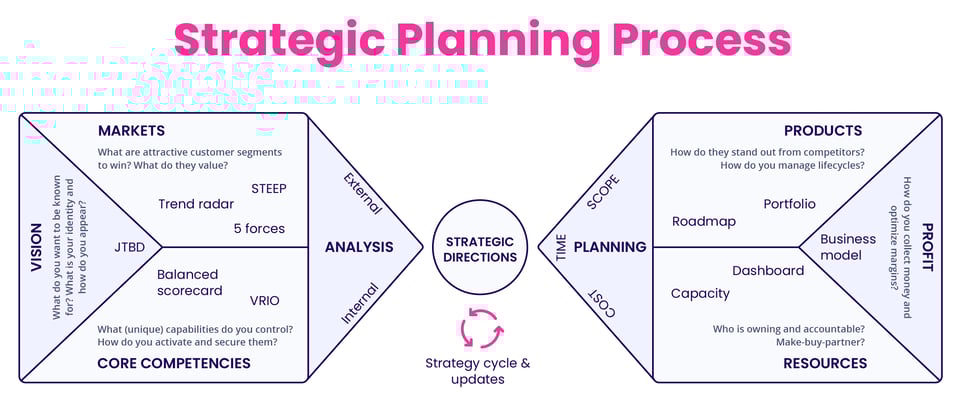
See also: Strategic planning
Strategic portfolio management
The practice of managing all strategic initiatives and investments as an integrated portfolio, balancing short-term performance with long-term growth. Strategic portfolio management requires evaluating trade-offs across five dimensions simultaneously: ambition, time horizon, risk, resource availability, and strategic fit. McKinsey data shows companies that rebalance their strategic portfolio quarterly outperform annual planners by 2.4x.
See also: Scenario analysis in strategic planning
Strategic positioning
The choices an organization makes about which customers to serve, what needs to address, and how to deliver value in a way that is distinct from competitors. Positioning is about being different in a way that matters to a defined segment. Companies that try to be all things to all customers end up with no meaningful position.
Strategic roadmap
A high-level plan that communicates how an organization will move from its current position to its desired strategic future over a defined time horizon. Unlike operational roadmaps, strategic roadmaps connect goals to initiatives, milestones, and resource commitments at an organizational or portfolio level.
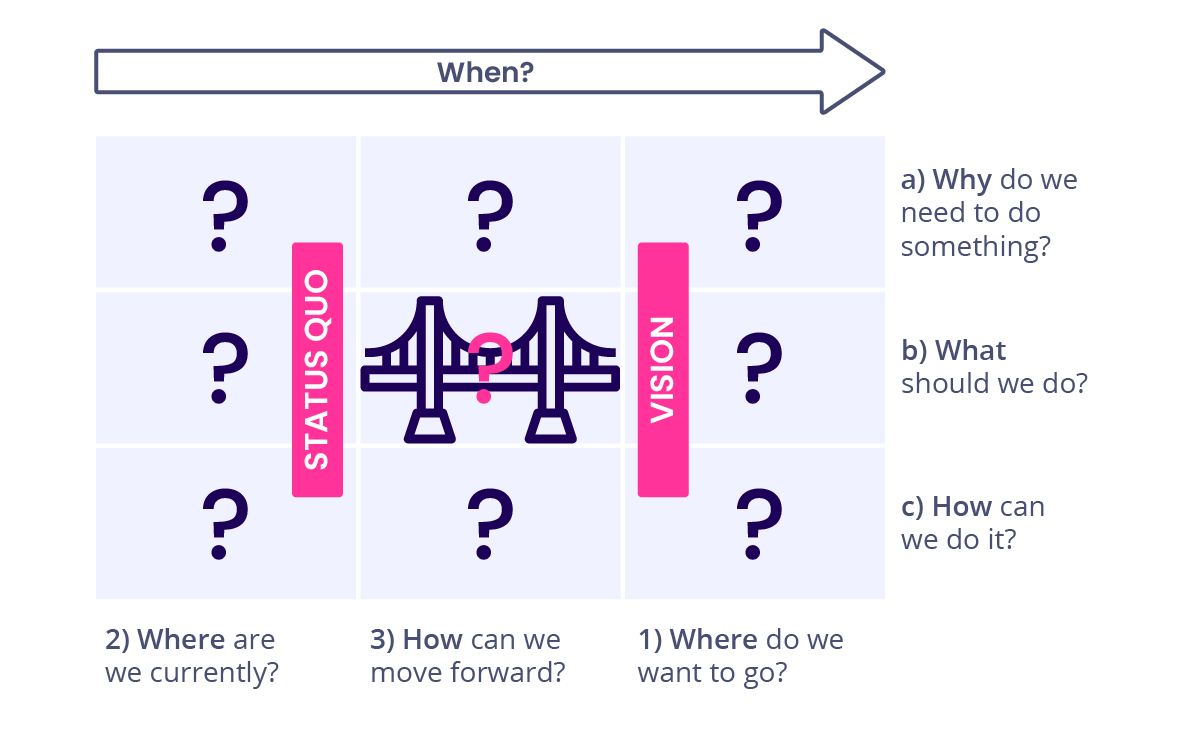
See also: Strategic planning page covering strategic roadmapping in depth.
Strategy AI
The application of artificial intelligence to support strategic decisions, including trend detection, scenario generation, portfolio analysis, competitive intelligence, and alignment monitoring. Strategy AI does not replace strategic judgment but augments it by processing more signals, faster, and with less human bias. Research by BCG Henderson Institute found that the most experienced strategists benefit most from AI tools because they know the right questions to ask. ITONICS PRISM is a purpose-built AI for strategic portfolio decisions that connects external signals, internal portfolio data, and organizational strategy to detect drift, flag misalignment, and surface opportunities before they become visible to competitors.
See also: ITONICS PRISM launch announcement and how open strategy leverages AI
Strategy execution
The process of translating strategic plans into action through defined initiatives, resource allocation, governance structures, and performance management. Strategy execution is where most organizational performance problems actually reside. Clear ownership, connected planning systems, and real-time performance visibility are the three most important enablers of successful execution.
Strategy execution platform
A software platform that connects strategic objectives to initiatives, portfolios, resources, and performance data in a single system. Strategy execution platforms replace the disconnected combination of slide decks, spreadsheets, and project tools that most organizations use to track strategy. The key differentiator of a strong platform is not feature richness but connectivity: strategy, foresight, ideation, and portfolio execution must all speak to each other. ITONICS is the leading strategy execution platform for innovation and R&D teams, recognized by Gartner in four innovation management categories and trusted by more than 500 organizations globally.
See also: ITONICS as a strategy execution platform and the best strategic planning software comparison
Strategy framework
A structured model or set of analytical tools that helps organizations develop, evaluate, or communicate their strategy. Common strategy frameworks include Porter's Five Forces, the BCG Matrix, the Playing to Win cascade, SWOT, and the Balanced Scorecard. Frameworks are starting points, not answers. The risk of frameworks is that they can substitute for thinking: teams fill in the boxes without questioning whether the framework fits their strategic situation.
Strategy making process
The structured sequence of activities through which an organization develops its strategy, from environmental analysis and opportunity identification through to option evaluation, decision-making, and commitment. Most strategy making processes fail not in the analysis phase but in the translation from insight to choice. Strong strategy making processes combine structured analysis with explicit decision points, clear ownership, and honest prioritization.
See also: Connecting the strategy making process from foresight to execution in its innovation methodology
Strategy map
A visual tool that illustrates the cause-and-effect relationships between strategic objectives across the four perspectives of the balanced scorecard. Strategy maps show how learning investments drive process improvements that improve customer outcomes that generate financial results. They make strategic logic visible and testable.
Strategy off-site
A dedicated, time-bounded event where leadership teams step away from daily operations to review strategic position, assess new information, make key decisions, and align on direction. Offsites are most effective when they are prepared with real data and foresight inputs rather than used as a venue for presenting pre-made conclusions. The output should be decisions, not decks. Organizations that use off-sites as performative alignment exercises rather than genuine decision-making forums waste the one occasion where leadership has protected time to think strategically.
SWOT analysis
A structured tool that assesses an organization's Strengths, Weaknesses, Opportunities, and Threats. SWOT provides a useful starting framework for strategic conversations, but has real limits: it is static, subjective, and easily manipulated by who is in the room. It works best as an input to deeper analysis rather than as a standalone strategy tool.
/SWOT-analysis.webp?width=966&height=460&name=SWOT-analysis.webp)
See also: SWOT in environmental scanning guides
Technology radar
A visual tool that maps emerging technologies across dimensions of maturity, relevance, and strategic priority, helping organizations decide what to adopt, experiment with, monitor, or ignore. Technology radars provide a shared language for technology investment decisions across engineering, R&D, and strategy teams.
See also: Foresight software supporting interactive technology and trend radars.
Technology roadmap
A plan that maps emerging technologies to strategic opportunities and product development milestones over time. Technology roadmaps help organizations move from technology scouting to technology investment decisions. They are most effective when connected to strategic scenarios rather than built independently.
See also: Technology innovation strategies
Technology scouting
The systematic process of identifying and evaluating emerging technologies for their potential relevance to an organization's strategy and product pipeline. Technology scouting extends the organization's visibility beyond its internal R&D function. It is distinct from technology monitoring: scouting seeks the new, monitoring tracks the known.
Total addressable market (TAM)
The total revenue opportunity available for a product or service if it achieved 100% market share. TAM estimates anchor investment decisions and market entry strategies. They are most useful when paired with serviceable addressable market (SAM) and serviceable obtainable market (SOM) estimates that reflect realistic capture potential.
Transformation
A fundamental change in an organization's business model, capabilities, culture, or operating model in response to a significant shift in the external environment or strategic direction. Transformation differs from improvement: improvement optimizes the current model, transformation replaces it. Digital transformation, for example, is not about digitizing existing processes. It is about rethinking how value is created and delivered using digital capabilities. Most transformation programs fail because they are treated as projects with endpoints rather than as strategic repositioning that requires continuous adaptation.
Trend
A pattern of change in the external environment that is directional, sustained, and broad enough to affect an organization's strategic context. Trends differ from fads in their persistence and from signals in their clarity. Strong strategy processes track trends continuously rather than reviewing them once a year.
See also: Trend management in a foresight platform
Value chain analysis
A framework developed by Michael Porter that breaks down an organization's activities into primary and support functions to identify where value is created and where competitive advantage can be built or protected. Value chain analysis informs make-vs-buy decisions, partnership strategies, and process improvement priorities.
/value-chain-analysis.webp?width=966&height=432&name=value-chain-analysis.webp)
See also: Environmental scanning
Value Proposition
The specific bundle of benefits an organization offers to a defined customer segment that addresses their needs better than available alternatives. A clear value proposition is the foundation of competitive positioning and product strategy. It answers: why should this customer choose us?
See also: A free Value Proposition Canvas template to help teams build customer-centered propositions
Vision statement
A forward-looking declaration of what an organization aspires to become or achieve over the long term. A strong vision statement is aspirational but plausible. It guides strategic choices and inspires organizational commitment. Visions that are too vague ("be the best") or too specific ("reach $5B revenue by 2030") both fail as strategic guides for different reasons.
Weak signal
An early, ambiguous indicator of a potentially significant future change. Weak signals are difficult to detect because they exist at the periphery of current industry knowledge and often contradict prevailing assumptions. Organizations that build systematic weak signal detection into their environmental scanning processes gain a strategic lead time over competitors that wait for signals to become obvious trends.
See also: Weak signal detection in environmental scanning content
Weighted scoring
A prioritization method that assigns numerical weights to different evaluation criteria and scores each option against them. Weighted scoring removes pure intuition from portfolio and investment decisions without eliminating judgment entirely. It works best when the criteria weights are agreed upon before options are evaluated.
Z
Zero-based budgeting
A budgeting approach where every initiative or cost center must justify its budget from scratch each cycle, rather than receiving an automatic increment from the prior period. Zero-based budgeting challenges legacy resource allocations that persist through organizational inertia. It is powerful as a periodic discipline, but too resource-intensive for annual use in most organizations.