Innovation operating system: Command your future growth portfolio


Your company will generate significant revenue next year. Most of it comes from products you launched 3-10 years ago. Everything beyond that, your future growth, depends on what you're developing right now.
Yet most organizations can't answer basic questions about their innovation management. Which 20 projects matter most? Which will deliver ROI in 2028? What great ideas get funding?
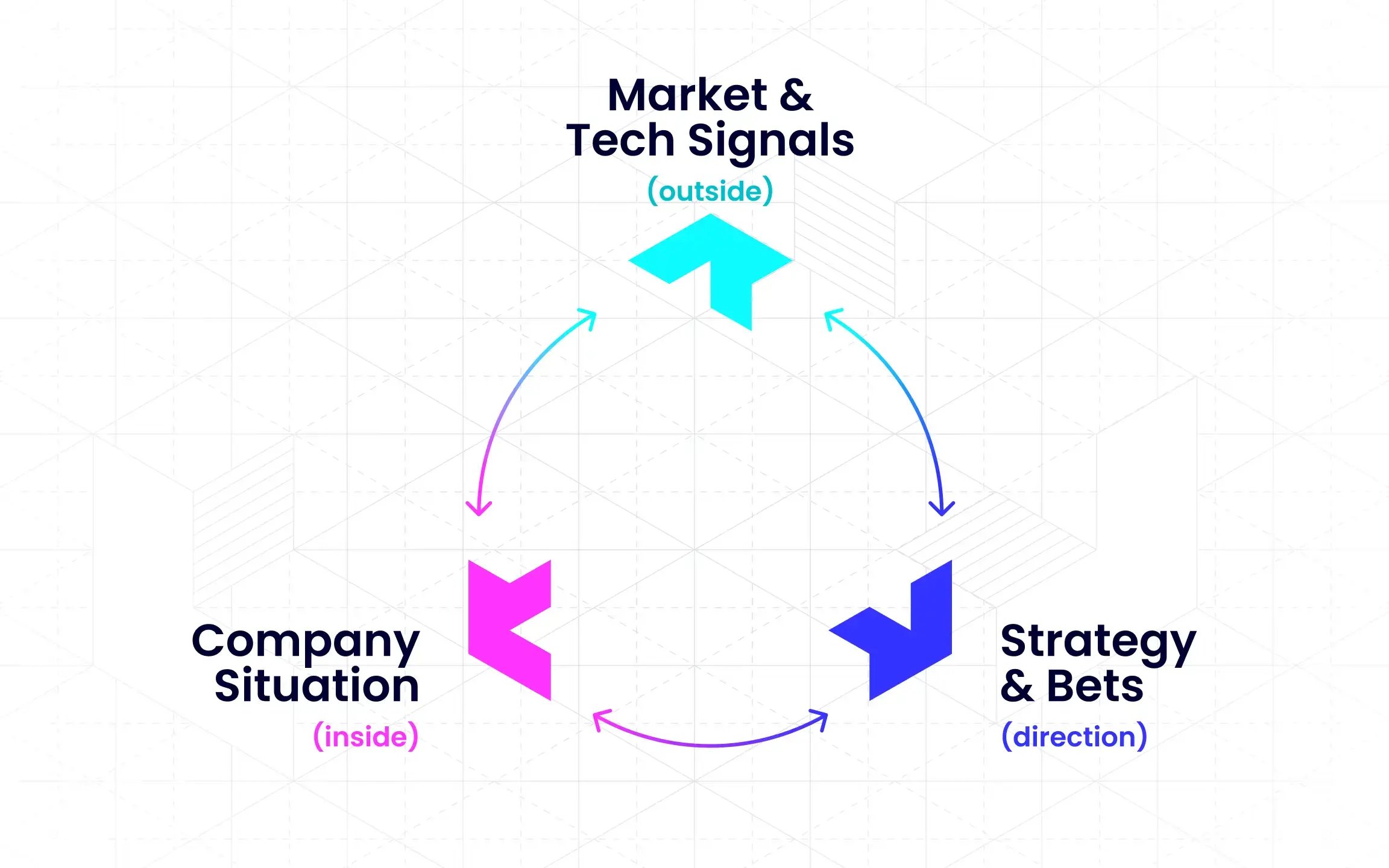
The problem isn't a lack of innovation activities. It's a lack of an innovation management system. When research lives in one tool, customer feedback in another, and roadmaps in spreadsheets, strategic control becomes impossible.
An Innovation OS changes this. One platform that connects market and tech intelligence, aligns strategies and portfolio management, and takes ideas to implementation. Real-time visibility from market signal to launched product. Strategic planning is linked to resource allocation.
Your opportunity pipeline determines every dollar of revenue beyond what current products generate. Yet most organizations can't answer basic questions about which initiatives will deliver returns or why resources flow where they do.
Here are three signs your future profits are in danger.
Sign 1: You're funding 200 projects, but can't rank them by strategic importance
Your organization runs hundreds of development activities. Product improvements. Technology bets. Market expansion initiatives. But ask "which 20 initiatives matter most to our 2028 strategy?" and you get silence.
Without clear prioritization tied to strategic planning, resources get allocated by politics instead of potential. High-value work starves while low-impact work consumes budget. Capital spreads thin across too many initiatives. Nothing gets the investment needed to succeed.
/Still%20images/List%20Mockups%202025/portfolio-oversee-tasks-and-assignments-2025.webp?width=2160&height=1350&name=portfolio-oversee-tasks-and-assignments-2025.webp)
This isn't a tooling problem. It's a transparency problem. When your innovation portfolio lives across spreadsheets, slide decks, and disconnected tools, strategic decision-making becomes impossible.
Sign 2: Competitors launched three innovations you identified 18 months ago
Your trend scouts spotted emerging technologies early. Market analysis confirmed the opportunity. But 18 months later, competitors are launching products while your new products are still in planning.
The gap between identification and project execution destroys competitive advantage. Speed matters. When market signals take six months to become funded programs, first-mover advantage disappears. You're paying for foresight but getting zero return.
Sign 3: Your new product pipeline is empty for 2027-2028
Look at what's launching two years out. If the pipeline is thin or non-existent, future revenue growth is at risk. Today's innovation efforts determine tomorrow's business success.
An empty pipeline means current activities aren't translating into market-ready solutions. Ideas exist, but don't progress. New products start but never reach launch. Your organization is busy with innovation activities, but not generating innovation outcomes.
/Still%20images/Kanban%20Board%20Mockups%202025/capabilities-views-configure-cards-and-views.webp?width=2160&height=1350&name=capabilities-views-configure-cards-and-views.webp)
These signs indicate your future growth needs systematic management - not more ideas or bigger budgets.
Idea management tools collect ideas. An Innovation Operating System (Innovation OS) manages your entire future growth pipeline.
The difference matters. Most innovation management software focuses on one phase: capturing and voting on ideas. You run ideation campaigns. Employees submit suggestions. Teams evaluate concepts. But then what? Ideas sit in a database. The connection between trends, strategic priorities, and project execution doesn't exist.
An Innovation OS connects three critical levels that others leave disconnected:
Strategy: Track emerging technologies and trends that inform your strategic decisions. Connect environmental scanning to strategic planning. Know which opportunities align with business goals and where to invest.
Operations: Manage hundreds of projects with real-time insights. Allocate resources based on evidence, not politics. Artificial intelligence automates trend analysis and surfaces insights that drive decisions about what to execute.
Culture: Engage employees across the organization in meaningful innovation efforts. Break down silos between trend scouts, ideation teams, and program managers. Create transparency so everyone sees how their work contributes to the financial impact.
Think of it like your computer. Individual apps handle specific tasks. But the operating system connects everything: managing resources, enabling communication between tools, and providing unified insights.
Most organizations use 5-7 disconnected tools. Every team uses its own tooling. An Innovation OS eliminates this fragmentation. One platform. One source of truth from market signal to launched product.
That's the difference between collecting ideas and commanding your growth pipeline. An Innovation OS turns innovation into a systematic capability you can measure, repeat, and sustain. It ties all initiatives to corporate goals and measurable KPIs, helping leaders decide "where to play", "how to win", and "what to execute".
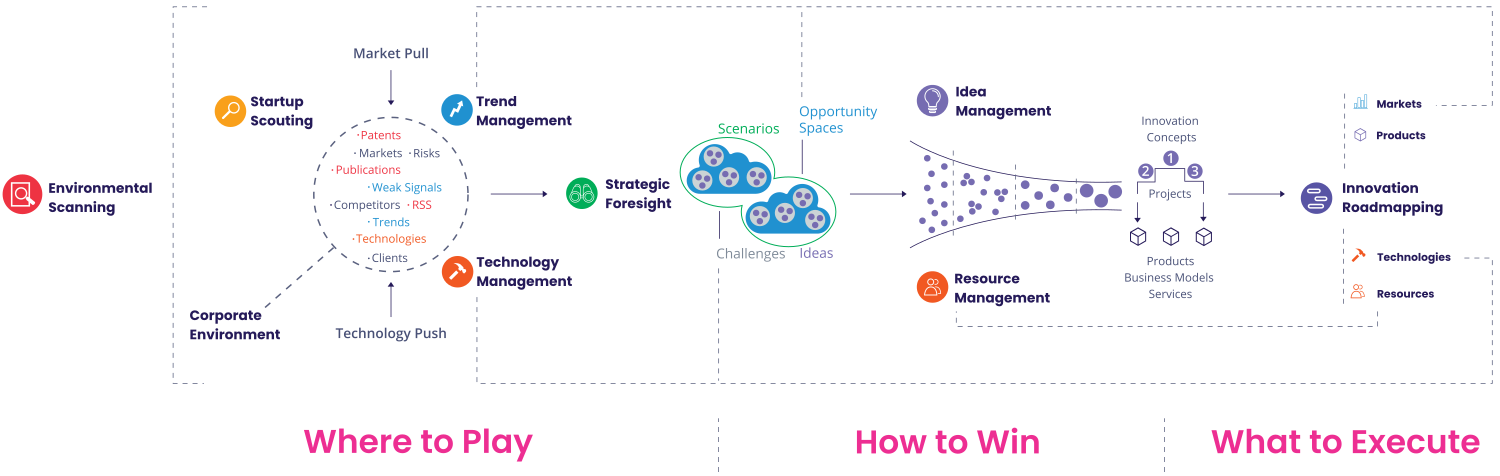
Most companies manage the corporate future in silos. Trend scouts monitor new technologies in one system. Employees submit new ideas in another way. Program managers track investment in spreadsheets. Critical innovation connections never happen.
An Innovation OS eliminates these gaps.
Your trend scouts identify an emerging technology in January. With disconnected tools, that insight sits in a research database until the quarterly review. By then, competitors have moved.
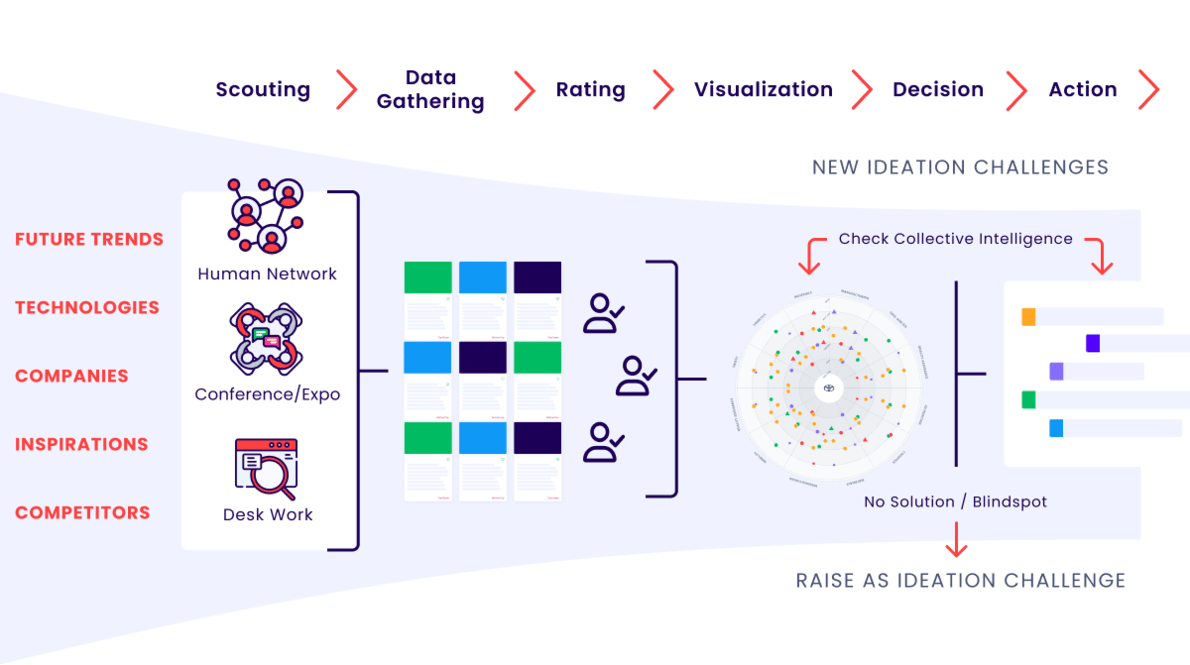
An Innovation OS connects environmental scanning directly to operational decisions. When scouts flag a shift in customers' behaviors, it's immediately visible to product managers. They see which features the trend impacts. Which business goals does it support? Whether the current investment aligns with the opportunity.
Artificial intelligence automates this process. The system monitors thousands of sources, tags relevant signals, and surfaces insights that inform strategy. No manual reporting. No information is lost between teams.
Decision-makers get the context they need when resource allocation matters most.
Most ideation campaigns generate hundreds of new ideas that go nowhere. Employees participate once, see nothing happen, then disengage.
An Innovation OS closes this loop. When users submit ideas, they see transparent evaluation against strategic criteria. The best ideas, those backed by industry evidence and aligned with business goals, get fast-tracked to funded initiatives.
Workflow management moves concepts through clear stages. Contributors track progress. When their idea becomes a launched product, the connection is visible. This creates sustained engagement because people see their work generates measurable impact, not just fills a suggestion box.
Collecting ideas is easy. Knowing which ones address your strategic challenges is hard.
An Innovation OS links idea collection directly to strategic priorities. Product managers identify specific needs: address new customer needs, reduce total cost in operations, and solve technical problems with external partners.
These needs become focused campaigns. Instead of asking "what's your idea?" you ask "how would you solve this specific challenge?" Submissions include implementation features, scale requirements, and resource estimates.
The process filters for solutions that fit actual business goals. You don't just collect ideas. You create a pipeline of actionable concepts designed to create strategic value.
That's how an Innovation OS turns innovation activities into innovation outcomes.
Not all innovation management platforms deliver the same value. Point solutions offer narrow features. Comprehensive systems provide the key features needed to manage your entire growth pipeline.
Here are four capabilities that separate true Innovation OS from basic innovation software.
Manual market and tech intelligence doesn't scale. One analyst can monitor maybe 50 sources monthly. Your organization needs to track thousands.
/Still%20images/Element%20Mockups%202025/portfolio-receive-risk-alerts-2025.webp?width=2160&height=1350&name=portfolio-receive-risk-alerts-2025.webp)
AI changes the economics. The platform monitors new technologies, patent filings, competitor moves, and start-up news across 10,000+ sources automatically. It tags signals by relevance to your strategy.
Alike, AI surfaces bottlenecks and inefficiencies in your operations. It flags off-strategy initiatives and generates summary reports for the top management in a few clicks.
This isn't just automation. It's about leverage. Your team focuses on evaluation and decision-making instead of data collection. One person can manage what previously required five. You can course-correct in minutes what took weeks of preparation before.
The effective way to handle information overflow is to let artificial intelligence do the filtering. The result: better insights, lower costs, faster responses, and effective innovation.
Traditional collaboration tools create bottlenecks. Ideas move sequentially through chats and departments. Each handoff adds delays. Decisions wait for monthly meetings.
An Innovation OS enables parallel work. When employees submit concepts during idea generation, all relevant teams see them immediately. Trend scouts and AI add knowledge and evidence. Technical experts evaluate feasibility. Leadership assesses strategic fit. Everyone contributes simultaneously.
/Still%20images/Workflow%20Builder%20Mockups%202025/capabilities-workflow-define-clear-approval-rules.webp?width=875&height=547&name=capabilities-workflow-define-clear-approval-rules.webp)
Workflow management routes work to the right users at the right time. Approval processes that took weeks are compressed to days. The team can innovate faster because collaboration happens in one platform, not across email threads and disconnected software.
This architecture supports rapid experimentation. Test ideas quickly. Kill bad concepts early. Scale innovation management.
You can't manage 200 initiatives effectively in spreadsheets. Too many variables. Resource allocation. Timeline conflicts. Business alignment. Intellectual property considerations.
/Still%20images/Reports%20Mockups%202025/portfolio-optimize-portfolio-returns-2025.webp?width=2160&height=1350&name=portfolio-optimize-portfolio-returns-2025.webp)
An Innovation OS provides command-center visibility. See all development activities in one view. Filter by business unit, technology area, or customer segment. Understand where money flows. Which initiatives support which business goals?
Real-time means in time. When a milestone completes, status reports update instantly. No waiting for monthly reports. Decision-makers access current data whenever needed.
This process enables better resource allocation. You see overcapacity in one area, underfunding in another. Services competing for the same resources become obvious. Trade-off decisions improve because you're working with complete information.
Implementing new software shouldn't mean replacing everything. An Innovation OS must connect with tools your organization already uses.
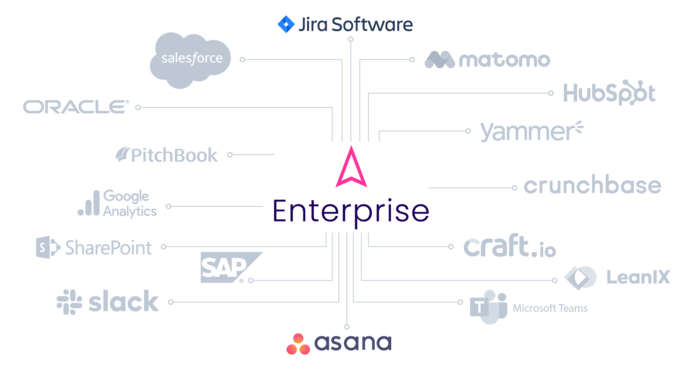
Open APIs enable integration with Jira for project management. SharePoint for documentation. SAP for financial planning. Salesforce for customer insights. The platform becomes a central hub, not another silo.
This matters for end users and the implementation team. Employees don't learn entirely new systems. They work with familiar tools while the Innovation OS coordinates the innovation process behind the scenes. This is the effective way to drive adoption without disrupting existing workflows.
The platform creates value by connecting existing solutions, not replacing them. One source of truth that leverages your current tech landscape.
Enterprise organizations face a common challenge: managing innovation across the entire innovation lifecycle without losing operational control. Three companies show how an enterprise Innovation OS delivers measurable results.
Siemens Energy needed better portfolio management across hundreds of development activities. Using the Innovation OS, they gained real-time insights into resource allocation and program performance. The result: 5x ROI through systematic optimization. Decision-makers could finally see which initiatives delivered value and kill solutions that didn't.
Bosch built an Open Innovation Gateway to connect with external technology partners. The platform processes ~1,000 partner applications annually, evaluates them against strategic priorities, and initiates ~20 collaborations with a combined net present value of €8M. The innovation process reached another level. Users across business units access the same knowledge base to evaluate organizations.
Toyota leveraged internal crowdsourcing through structured idea campaigns to tap employee expertise. By connecting frontline insights to R&D decisions, they created €120M in net present value. The key: linking idea generation directly to strategic gaps instead of collecting random suggestions.
These enterprise teams don't just run innovation activities. They command their growth portfolios. They see which business models need investment. Track performance across the entire innovation lifecycle. Make resource allocation decisions based on evidence, not politics.
The ITONICS Innovation OS provides unified visibility and control over your entire future revenue streams, from environmental scanning to portfolio management.
/Still%20images/Kanban%20Board%20Mockups%202025/capabilities-views-kpi-aggregation.webp?width=2160&height=1350&name=capabilities-views-kpi-aggregation.webp)
Eliminate tool sprawl and data silos: Managing innovation across 5-7 disconnected systems creates gaps where critical insights get lost. With ITONICS, environmental scanning, idea management, and roadmap decisions happen in one integrated system. See how environment signals connect to active spending. Innovate based on complete information, not fragmented data.
Connect strategy to execution in real-time: ITONICS connects external developments directly to internal decisions. When your team identifies a new business solution, it's immediately visible to decision-makers. Prism automates solution monitoring and surfaces relevant signals. You move from new knowledge to funding decisions with clarity, not debates.
Manage 200+ development activities with command-center control: ITONICS provides real-time insights across all development activities. See resource allocation. Identify competing priorities. Understand which features and products deliver ROI. Portfolio managers at Siemens Energy, Bosch, and Toyota use ITONICS to systematically optimize their innovation management.