Gamification and nudging mechanisms in idea management software


Companies lose millions in untapped ideas every year. Employees have insights. They just don't share them.
But what is the problem, if it's not motivation? It's process design, as most innovation processes feel like admin work: Forms to fill, systems to navigate, and committees that evaluate ideas and never respond.
Two approaches fix this: nudging and gamification. Together, they use elements to make participation rewarding, visible, and self-sustaining. The result is better ideas, stronger collaboration, and measurable business results.
The term gamification refers to applying game mechanics and game design elements in non-game contexts. Think points, leaderboards, badges, and progress tracking embedded inside business applications.
In innovation management, gamification means turning the ideation process into an experience employees want to engage with. Not because they have to, but because it's engaging and, frankly, fun.
This isn't about making work feel like computer games. Such games exist on their own terms. Gamification borrows specific motivating factors from games: challenge, feedback, progress, and social interaction. It applies them to online tasks like submitting new ideas or helping teams evaluate proposals across different departments.
The term gamification gets misused constantly. Companies add a badge system and call it a gamification strategy. That's not effective gamification.
A true gamification strategy means designing the full experience.
Define which behaviors to encourage.
Choose which game design elements will reinforce them.
Build in nudges that prompt action at the right moment.
Then measure the business results.
Points alone do not generate ideas. Structured game mechanics paired with well-timed nudges do.
Game mechanics are the rules that govern the system. Game design elements are the features that make those rules visible and rewarding.
In innovation management, this distinction matters for implementation.
A comment function is a game design element.
The rule "comments earn 5 points" is a game mechanic.
Together, they increase social interaction around new ideas, keep user engagement high, and nudge employees back to the platform regularly.
The best gamification platform combines both. It doesn't just add features. It builds a coherent system where every action has clear consequences, rewards, and nudges. Organizations that treat game mechanics and nudging as separate initiatives develop fragmented innovation efforts that fail to sustain participation.
Nudging is the other half of the equation, and most companies ignore it entirely.
In the world of innovation management, nudging and gamification are complementary: Gamification creates the system, and nudging creates the behavior within it.
Effective gamification without nudging is just a point counter. Nudging without a gamification platform lacks structure. Together, they create an ideation process that employees genuinely want to participate in.
Most innovation processes send ideas into a void. Employees submit, and then nothing happens. Thus, they stop contributing.
Gamification works because it closes this loop. Progress tracking shows contributors exactly where their ideas stand. That visibility changes behavior. Across the world, companies that implement progress tracking in ideation report faster participation cycles.
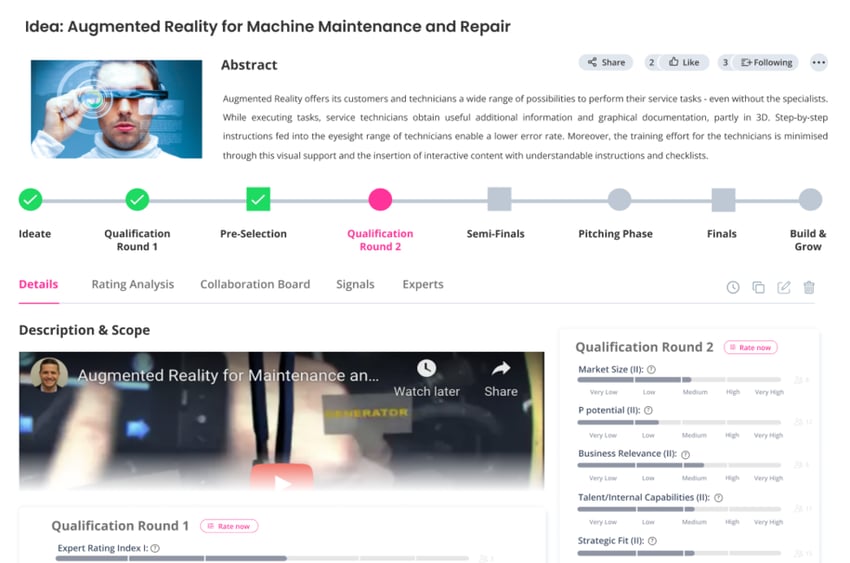
Exhibit 1: Connecting ideation activities to business opportunities
Such games in the consumer world use this combined approach constantly.
Fitness apps show streaks and send push reminders.
Language apps award points per lesson and nudge users back after three days of inactivity.
These concepts are not new. What is new is applying them systematically to business applications and innovation efforts inside organizations.
IBM's Innovation Jam is one of the most cited examples of gamified ideation at scale. In 2006, IBM ran two 72-hour online ideation sessions, open to more than 150,000 participants: employees, business partners, clients from 67 companies, and university researchers across 104 countries.
The sessions were structured around 25 technologies in six broad categories. Participants competed to build on each other's submissions. The competitive, time-bound format nudged contributors to stay active throughout each session rather than submitting once and disengaging. The result: 46,000 ideas posted. IBM then used text analysis and a team of 50 managers to evaluate and prioritize ideas, ultimately funding 10 distinct new businesses.
Effective gamification does three things that standard innovation processes don't:
It removes friction. Employees don't need extra meetings or formal proposals. They log into the platform, submit an idea, and earn points. The system rewards participation immediately, which is critical when you want to engage customers, partners, and internal teams alike.
It nudges without mandating. Game elements prompt employees to take action through social visibility and progress feedback, not top-down pressure. This preserves autonomy while increasing participation across the organization.
It makes evaluation collaborative. Instead of one committee deciding which ideas have merit, all participants evaluate submissions. This distributes judgment across the organization and surfaces the best ideas faster.
Not all game elements work equally. These five drive the most measurable impact across innovation processes:
A gamification strategy for innovation isn't built overnight. Adding gamification elements without a nudging layer produces short-term spikes and long-term decline. Build both together from the start (Exhibit 2).
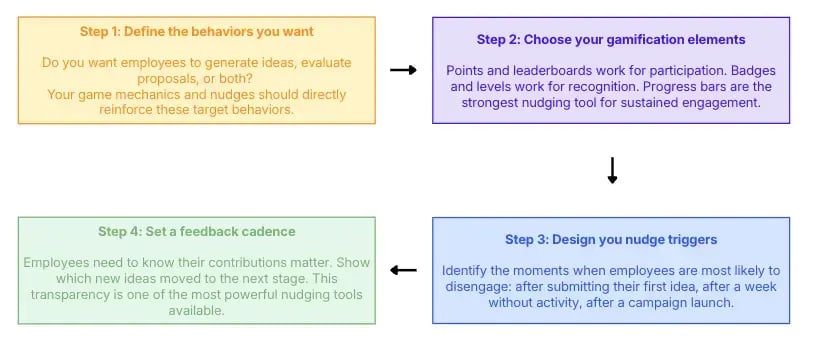
Exhibit 2: A gamification strategy built on nudging
Adding gamification elements too fast creates confusion and undermines the subtlety that makes nudging effective. Start with one or two mechanics. Points for idea submissions. A leaderboard for visibility.
Let employees get comfortable with the system before expanding.
Introduce badges after the first ideation campaign completes.
Add investment mechanics, where users bet tokens on the ideas they believe in, once the platform has active participants.
This phased approach respects how people learn new systems. It also gives you data to evaluate which game elements and nudges actually increase engagement before you scale them across different departments.
ITONICS is built with a gamification strategy and nudging at its core. It doesn't add game elements as an afterthought. It integrates them into every step of the ideation process with built-in nudge triggers that keep participation alive between campaigns.
Here is how the platform drives engagement and delivers business results:
Points, badges, and leaderboards. Users earn badges and points when they complete a certain activity: submitting an idea, rating a proposal, or commenting on a trend (Exhibit 3). Points can expire to nudge ongoing involvement. Campaign managers display leaderboards to recognize top contributors and keep competition visible across different departments.
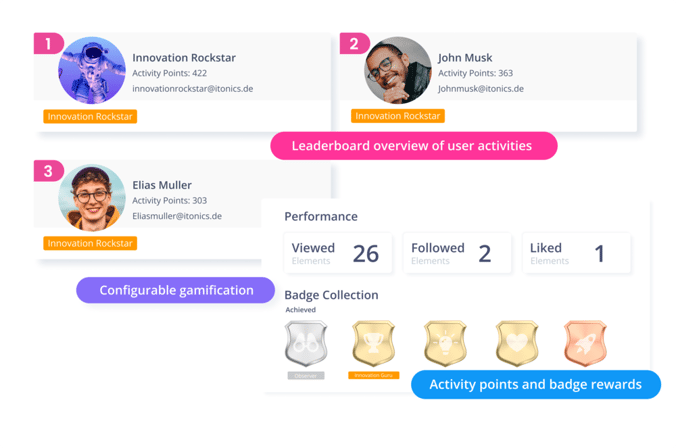
Collaborative evaluation. Teams prioritize ideas using predefined or custom rating criteria. Results appear in real time, replacing top-down selection with collective judgment. In one client project, ITONICS developed an investment system where users bet tokens on the ideas they believe in most.
Structured ideation campaigns. ITONICS runs ideation campaigns with defined timelines, topics, and evaluation workflows. Automated nudges prompt participants at campaign launch, midpoint, and close -keeping engagement alive without requiring manual follow-up.
Progress tracking. Every user sees their contribution history, rank, and point balance. This transparency creates the motivating factors that sustain participation over months, not just during individual campaigns.
With ITONICS, organizations don't just collect innovative ideas. They build a community that generates, evaluates, and refines the best ideas continuously, turning innovation efforts into a repeatable competitive advantage.