Idea management system: 25 requirements for software selection


An enterprise needs an idea management system once two business units feed one pipeline or ideas receive budget. Write the requirements against the spreadsheet the system replaces, and make vendors prove they fix its failures. Tier 25 requirements by program type and treat about ten as knock-outs. Score every answer by its evidence, and test three vendors on your own ideas.
That spreadsheet looks the same in most large companies. It holds hundreds of ideas and three scoring scales from three business units. Its status column dates from before the last steering meeting. Submitters email the owner to ask what happened to their idea. When leadership asks which ideas became projects, someone spends a week building slides.
Each of those moments points to a requirement: one scale for every idea reviewer, a status every submitter can see, and a report built from live data. The spreadsheet is also the benchmark to beat. In two years of our sales calls, Excel came up as the alternative almost six times as often as any dedicated innovation management software vendor.
Still, most buyers benchmark vendors against each other. Their requirement list grows to several hundred lines, mostly about gathering ideas, the one task a spreadsheet handles well. Every vendor answers yes, and price decides. This guide builds the list from the other end. Its 25 requirements test what the spreadsheet fails at, in three tiers, scored on evidence.
| Question | Short answer |
|---|---|
| How do I score idea management software tools? | By evidence: demo or documentation 1.0, marketing copy 0.75, workaround 0.5, roadmap 0 |
| What should I cut? | Whiteboards, chat, leaderboards, custom code, on-premise hosting |
| Formal RFP or pilot? | A formal RFP for tenders and company-wide programs, a structured evaluation for a one-unit pilot |
| How long does it take? | 8 to 12 weeks to select, then 16 weeks from signature to go-live |
Exhibit 1: Short answers to the questions buyers ask before selecting an idea management system
An idea management system is software plus the rules to manage ideas from submission to a funding decision. It keeps one record per idea, scores it on shared criteria, and routes it through gates with named owners. It tells every submitter the outcome and hands the best ideas to the teams that implement ideas.
The rules carry more weight than the software. Idea management software minus owners, gates, and criteria is a digital suggestion box. Many idea management tools end at capture and voting, so your RFP has to test everything after idea submission.
Our idea management guide covers how to design the idea management process. This guide covers how to buy the system that runs it, often as one module of an innovation management platform.
You need an idea management system once ideas cross team boundaries. Before that point, spreadsheets, Microsoft Forms, and SharePoint lists work. One owner can manage ideas, organize ideas in columns, and prepare the status deck.
Watch for four signals:
One signal is a warning. Two or more mean the ideation process needs owners, gates, and a structured process. Then dedicated idea software pays off. With zero signals, keep the spreadsheet and check again in 12 months.
The business case starts with that week of slide-building. Dräxlmaier centralized idea management and pre-development workflows and cut manual project reporting effort by 70%. Its automated workflows save hundreds of hours a year.
An RFP picks the wrong vendor when its requirement list makes every vendor look alike. Four patterns cause it. The seven steps below fix each one.
IT adds integrations, HR adds gamification for employee engagement, and the innovation team adds AI. A missing gate workflow then weighs as much as a missing badge design, and the longest feature list wins.
Many idea management software RFP templates come from vendors as essential lists. Each mirrors its author's features. Test each tool against the decisions your program makes: fund a pilot, merge two ideas, reject with a reason, or hand an idea to R&D.
Vendors answer yes to roadmap features, Zapier workarounds, and custom development alike. A yes-or-no column gives all three full credit.
Sum the points, and a vendor missing SSO can still finish first. Knock-outs need their own pass before any weighting.
Give every requirement a tier before vendors see the list. The tier decides how it is scored.
Keep tier 1 near ten requirements. With twenty knock-outs, only the idea management tools with the longest feature lists survive.
Your program type decides tier 2, and tier 2 decides the right idea management software. The best idea management software for an employee suggestion scheme is the wrong choice for an R&D pipeline. Employee programs collect ideas from employees across the workforce. R&D pipelines collect ideas from experts and develop ideas into complex projects.
| Program type | Requirements that move into tier 2 |
|---|---|
| Employee ideas and continuous improvement | Submission from Teams or Slack (2), mobile app (5), recognition (18), participation analytics (20) |
| Time-boxed challenges and hackathons | AI help for contributors (3), expert reviewers (7), rule-based automation (13) |
| Open innovation with external solvers | Submission portals (4) and separate spaces and roles (15), for public challenges that crowdsource ideas and ask outside experts to solve complex problems |
| Strategic idea pipeline into R&D and product portfolios | Decision views (14), links to strategy, trends, and technologies (22), connectors to project management tools (24). Conversion to projects (21) becomes a knock-out |
Exhibit 2: Program types and the requirements they move into tier 2
If you run several programs, tier for the program where one idea carries the most budget. Then check that the shortlist covers the rest.
The 25 requirements follow the five stages of the idea management process, from capture to handover into the wider innovation process. Each comes with a default tier and the proof to request.
Vendors differ least at gathering ideas, so keep most idea collection requirements in tier 2 or 3. Move them up when frontline staff shares ideas from their phones, or when customer feedback is a main idea source.
| # | Requirement | Default tier | Proof to request |
|---|---|---|---|
| 1 | Campaigns for idea collection with goal, owner, audience, and public or private visibility | 1 | Demo: set up a private campaign |
| 2 | Idea submission from Microsoft Teams or Slack | 2 | Demo in your Teams tenant: native app or API? |
| 3 | AI help for contributors to generate ideas or complete a submission | 2 | Demo and written AI data policy |
| 4 | Idea submission portals for external stakeholders such as partners, suppliers, and customers | 2 or 3 | Documentation and pricing for external users |
| 5 | Mobile app for frontline staff | 3 | App store listing and demo |
Exhibit 3: Capture requirements 1 to 5 with default tier and proof to request
Shared idea evaluation criteria let reviewers from every business unit evaluate ideas on one scale. On separate scales, the best ideas from one unit lose to average ideas from another.
| # | Requirement | Default tier | Proof to request |
|---|---|---|---|
| 6 | Weighted evaluation criteria shared by every reviewer | 1 | Demo: configure a criteria set live |
| 7 | Expert reviewers, suggested by expertise | 2 | Demo with your reviewer list |
| 8 | Comments and voting on every idea | 1 | Documentation |
| 9 | Duplicate detection during idea submission, with merging | 1 for multi-unit programs, otherwise 2 | Demo: submit a near-duplicate of one of your ideas |
| 10 | AI-supported idea evaluation with human confirmation | 2 | Demo, AI data policy, hosting location |
Exhibit 4: Evaluation requirements 6 to 10 with default tier and proof to request
Duplicate detection compares new ideas with existing ones before anyone scores them, so two units stop funding the same idea twice. More on evaluating ideas with one scoring model.
These requirements show whether your own admins can change the process. Ask each vendor which changes need a support ticket.
| # | Requirement | Default tier | Proof to request |
|---|---|---|---|
| 11 | Stage gates and structured workflows, configured code-free | 1 | Demo: an admin adds a gate in under ten minutes |
| 12 | A named owner and a due date at every gate | 1 | Demo |
| 13 | Rule-based automation such as reminders and escalations | 2 | Documentation |
| 14 | Matrix or Kanban views to prioritize ideas | 2 or 3 | Demo with your ideas |
| 15 | Separate spaces and roles per business unit, with one portfolio view | 1 for multi-unit programs | Demo and role documentation |
Exhibit 5: Decision requirements 11 to 15 with default tier and proof to request
Requirement 15 separates an enterprise idea management platform from basic idea management tools. Each unit works in its own space, and leadership sees one portfolio. Requirement 12 keeps decisions on schedule. An ownerless gate parks the best ideas until the next quarterly review, so build a phase-gate process for ideation with owners and dates.
Feedback decides whether people submit a second idea.
| # | Requirement | Default tier | Proof to request |
|---|---|---|---|
| 16 | Automatic notifications to submitters at every status change | 1 | Demo: change a status and show the email |
| 17 | Status visible to submitters, so they track progress themselves | 2 | Demo from a submitter account |
| 18 | Recognition such as points or badges | 3 | Documentation |
| 19 | A decision reason recorded at every gate and sent to the submitter | 1 | Demo: reject an idea with a reason |
| 20 | Participation and decision-time analytics by business unit and campaign | 2 | Sample dashboard |
Exhibit 6: Feedback requirements 16 to 20 with default tier and proof to request
Advanced analytics earn their place when they show which units need targeted campaigns and at which gate ideas wait longest. More on participation in idea campaigns.
Handover decides whether the best ideas reach a project and a budget.
| # | Requirement | Default tier | Proof to request |
|---|---|---|---|
| 21 | Conversion of selected ideas into projects in the same system, with evaluation history | 2, or 1 for R&D pipelines | Demo: convert an approved idea |
| 22 | Links from ideas to strategy themes, trends, or technologies | 2 or 3 | Demo |
| 23 | REST API or MCP connector with full data export | 1 | API documentation |
| 24 | Connectors to project management tools, SAP, or PPM systems | 2 | Documentation: native, partner, or Zapier? |
| 25 | PowerPoint export or Power BI and Tableau dashboards | 3 | Sample export |
Exhibit 7: Handover requirements 21 to 25 with default tier and proof to request
Requirement 21 settles who will implement ideas and whether their evaluation history travels with them. Requirement 23 is your exit option if the vendor relationship ends. Every vendor promises seamless integration with existing workflows, so ask for the API documentation.
That leaves eight knock-outs for every program: requirements 1, 6, 8, 11, 12, 16, 19, and 23. Requirements 9 and 15 join them once a second business unit submits ideas, and 21 joins for R&D pipelines.
Security sits outside the scoring. An idea management platform that fails the gate leaves the shortlist, whatever its score.
Require SOC 2 or ISO 27001, SSO, SCIM, an audit trail, data residency rules, and a written AI data policy. Security tends to arrive late, once IT joins, and then it decides the whole selection. SSO, data residency, and vendor risk reviews trigger it most often. Send the security questionnaire in week one so it runs alongside the demos.
Cut anything your existing tools already cover and anything for a program you skip. If your steering committee worries about paying for a Rolls Royce when a smaller platform does the job, this list is your answer.
| Cut | Reason |
|---|---|
| Whiteboards | Collaboration tools already host brainstorming sessions. A second whiteboard splits the ideation process |
| Built-in chat | Employee short messaging already runs in Teams, Slack, and other collaboration tools |
| Leaderboards | Volume buries the most innovative ideas under small suggestions. Keep them for a first campaign that needs more ideas from employees |
| Custom development | It ties you to vendor services and slows every upgrade |
| On-premise hosting | SaaS with defined data residency passes most enterprise security reviews. Keep it where regulation demands it |
Exhibit 8: What to cut from an idea management software RFP, and why
Points and badges stay in tier 3. They recognize contributors of valuable ideas.
Credit every answer by the evidence behind it. Full credit requires a demo, help center, developer documentation, release notes, or a recent user review.
| Evidence | Credit |
|---|---|
| Shown in a demo with your own data | 1.0 |
| Documented in a public help center, API documentation, or release notes | 1.0 |
| Found only on a marketing page or in a sales deck | 0.75 |
| Partial, for example through Zapier, a partner, or a workaround | 0.5 |
| On the roadmap or only through custom development | 0 |
Exhibit 9: Credit per type of evidence when scoring vendor answers
Ask each idea management software vendor to link its evidence. Documented features take minutes to prove, and vague answers on tier 1 tell you a lot.
Drop every vendor that fails a knock-out. Then multiply tier 2 credits by 3 and tier 3 credits by 1. In an R&D pipeline, a Zapier connector for requirement 24 earns 0.5 credit, so 1.5 of 3 points.
Give the sheet one column each for tier, vendor answer, evidence link, credit, and weighted score. When two finalists score within a few points, three-year cost and reference calls pick the right idea management tool.
Three vendors keep demos comparable, because each extra vendor adds a demo, a reference round, and a security review. Our idea management software comparison scores eight vendors on these 25 requirements and names the best idea management software per program type. Take the three that lead for yours.
Send every vendor the same script, your gate model, and three real ideas, including one of last year's best ideas. Watch how reviewers evaluate ideas and prioritize ideas, and score live against the 25 requirements.
| Minutes | Task | Requirements tested |
|---|---|---|
| 0 to 15 | Submit three ideas, one as a near-duplicate of another | 1, 2, 9 |
| 15 to 35 | Score the ideas with your criteria and suggested reviewers | 6, 7, 8, 10 |
| 35 to 55 | Run a gate decision and reject one idea with a reason | 12, 16, 19 |
| 55 to 70 | Convert the approved idea into a project and link it to a strategy theme | 21, 22 |
| 70 to 80 | Import your current idea spreadsheet | Data migration |
| 80 to 90 | Let an admin add a new gate | 11 |
Exhibit 10: A 90-minute demo script that tests the knock-outs on your own ideas
A trial on your own data beats any vendor tour.
Add up licensing, implementation, training, support, and add-on modules over three years. Model how pricing grows with users and workspaces, because price jumps often surprise buyers in year two.
Ask for two references with a similar program. Ask how long a decision takes, what share of submitters gets an answer, and whether occasional contributors face a steep learning curve.
Run a formal RFP when tender rules, a procurement threshold, or a company-wide scope require one. It adds written answers and a documented award decision. For a one-unit pilot, three vendors and a trial on your own data are faster.
Either way, bring procurement, IT security, and the works council in before the first vendor call.
Idea management platform vendors differ as much in onboarding as in features. Ask for a rollout plan, the configuration work included, admin training, and support channels for feature requests. Plan 16 weeks from signature to go-live and 12 more to stabilize. Our rollout guide for innovation management software covers each phase.
| Phase | Timing | Tasks |
|---|---|---|
| Preparation | 16 to 9 weeks before go-live | Works council approval, security review, configuration, rollout plan |
| Communication | 8 to 4 weeks before go-live | Communication plan, example use cases, internal communications briefing |
| Testing | 3 to 1 weeks before go-live | Test users, support forms, collect feedback, fix issues |
| Launch | Go-live week | Company-wide announcement, first campaign |
| Post-launch | Weeks 1 to 12 after go-live | Early success stories, structured feedback, support for low-activity groups |
Exhibit 11: 16 weeks from signature to go-live, plus 12 weeks after launch
Show contributors how to share ideas in two minutes. Review new ideas weekly in month one. Publish the first decisions within four weeks. A visible decision is the fastest way to engage employees and sustain active participation.
A soft rollout starts with one business unit and collects success stories from its best ideas first. A big-bang rollout launches one campaign to collect ideas from all departments at once. Go soft when units run different idea programs, and go big-bang when leadership backs one company-wide challenge.
KSB shows the scale a rollout can reach. Its platform has 7,043 active users across 16 locations and more than 1,100 ideas submitted since launch.
ITONICS keeps ideas as elements next to the trends, technologies, and projects they relate to across the innovation process. That makes it strongest where the best ideas compete with running projects for budget. Toyota Motor Europe put 40 innovation software systems through their paces before it chose ITONICS.
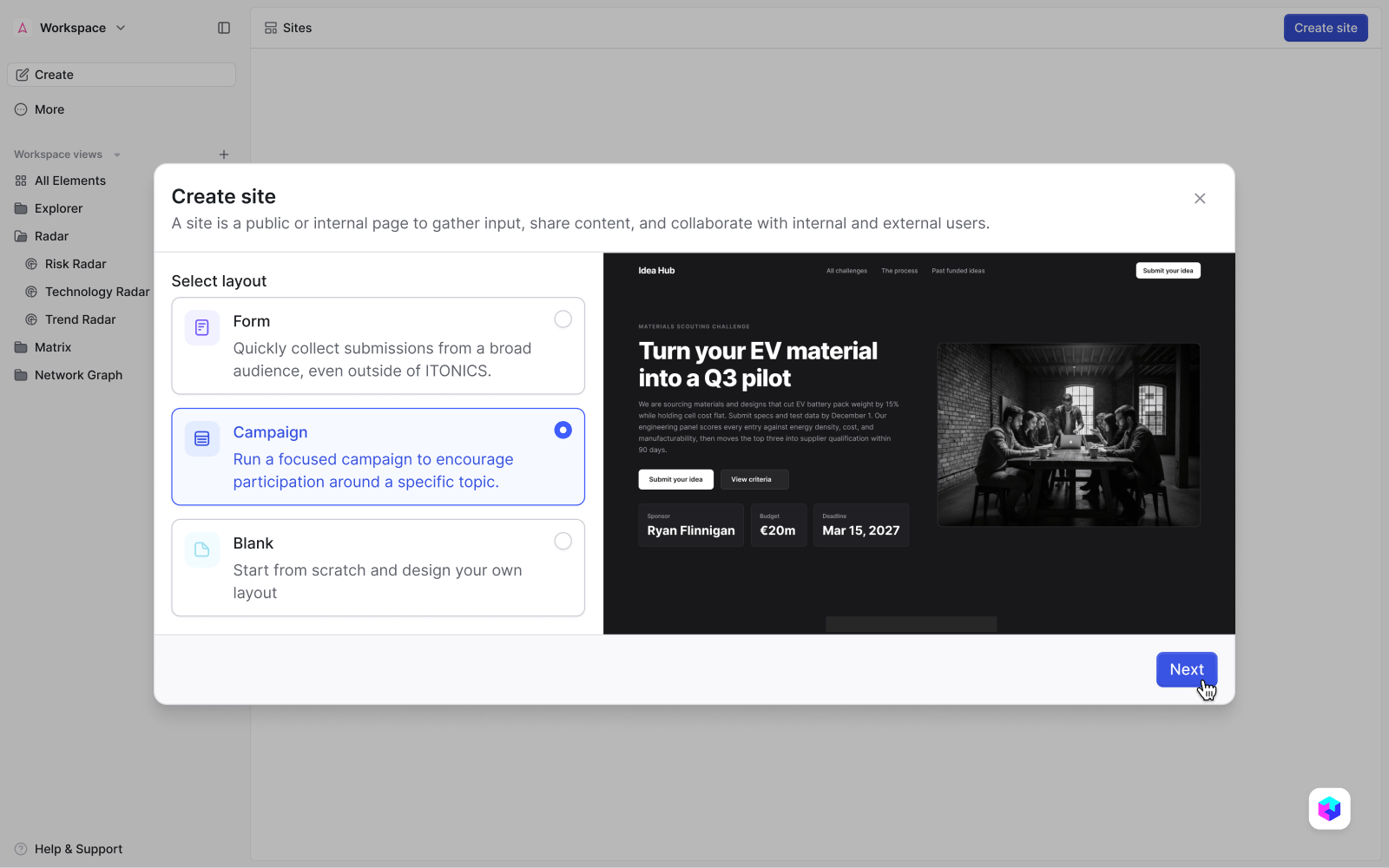 Exhibit 12: Creating a webpage to collect external ideas with ITONICS